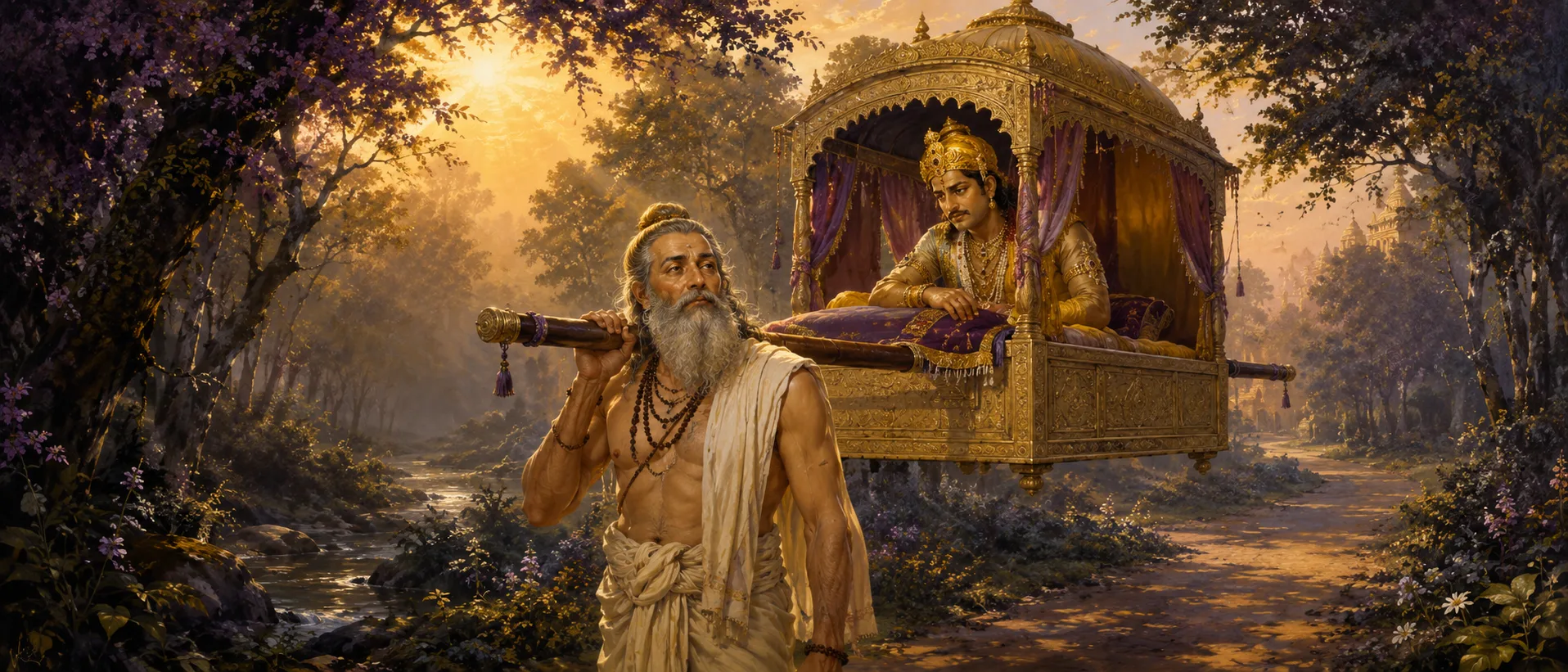
Amsa 2 turns from Amsa 1's cosmogony to cartography: the seven dvipas (island-continents) ringing Mount Meru, with Bharata-varsha — the land named for King Bharata — described in real geographic detail, its rivers and mountains and the varied character of its peoples. Below the earth lie the seven Patalas, home to Shesha the cosmic serpent who bears the world on his hood; below those, the hells and the specific torments matched to specific sins. Above, the seven lokas rise toward Brahmaloka, and the Ganga's descent from Vishnu's foot through Shiva's hair to the earth is told as the cosmic event linking all three worlds. A long astronomical section maps the sun's yearly path, the moon and planets, wound through with teaching that treats the visible sky as itself a form of Vishnu. The Amsa closes with its most memorable narrative: King Bharata's excessive attachment to a orphaned fawn causes his own rebirth as a deer, and then, in a further birth, as Jada Bharata — an enlightened brahmin who feigns idiocy to avoid worldly entanglement, is pressed into carrying King Rahugana's palanquin, and delivers, in his own unhurried way, a teaching on non-attachment that includes the older Ribhu-Nidagha dialogue on seeing all things as one.
Chapters
Why it matters today
Jada Bharata's teaching to Rahugana — delivered by a man carrying a king's palanquin while being mocked for walking unevenly — is one of Sanskrit literature's sharpest illustrations that wisdom and social status need not track together, and the story is frequently cited in Vedanta teaching specifically because its philosopher never once claims the authority his listener assumes he lacks.
This story is also told in
Dhruva's penance and Prithu's reign (Bhagavata Purana, Skandha 4)
Dhruva ch. 8-12, Prithu ch. 15-23.
Jada Bharata (Bhagavata Purana, Skandha 5, ch. 7-13)
Includes the embedded Ribhu-Nidagha dialogue.
Dhruva and Prithu, compressed (Vishnu Purana, Amsa 1)
Dhruva ch. 11-12, Prithu ch. 13 — the same episode sequence, heavily compressed.