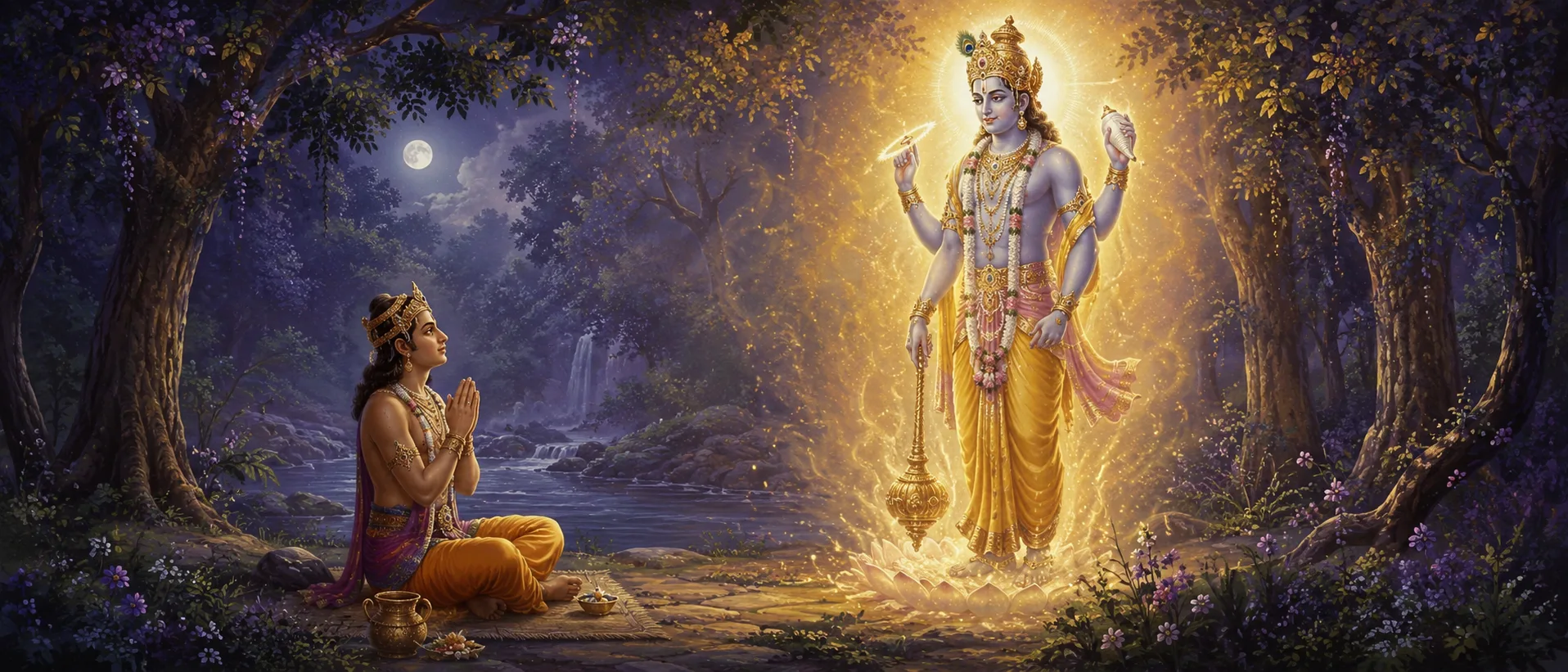
Skandha 4 begins in tragedy: King Daksha's contempt for his son-in-law Shiva erupts at a great sacrifice, and his daughter Sati, unable to bear the insult, gives up her own life in the sacrificial fire — grief that Shiva answers with a fury only Brahma can calm. From this the book turns to Dhruva, a five-year-old prince humiliated by a stepmother who tells him he cannot sit on his father's lap unless he is born of her own womb; the boy's answer is to walk into the forest and win, through relentless penance, a station in the heavens higher than any his father held. His descendant Prithu inherits a ravaged, barren earth and, refusing to accept famine as fate, chases the earth herself — fled in the form of a cow — until she agrees to be 'milked' by every class of being for exactly the sustenance each one needs. The skandha's final movement turns allegorical: Narada tells the Pracetas of King Puranjana, whose nine-gated city, watchful queen, and fatal hunting trip are revealed, piece by piece, to be the body, the intellect, and the senses — a soul's whole entrapment told as if it were simply a story about a king.
Chapters
Why it matters today
Skandha 4 is full of characters who refuse the terms they're handed: Dhruva refuses his stepmother's verdict on his worth, Prithu refuses a starving earth as simply how things are. The Puranjana allegory, read straight, is almost uncomfortably modern — a whole life of pursuit and defense and loss, narrated as if it were an adventure, until the frame breaks and it turns out to have been the story of a body all along.
This story is also told in
Daksha's sacrifice and Sati's death (Shiva Purana, Rudra Samhita)
The most detailed telling, ch. 21-63 of the Sati Khanda.
Daksha's sacrifice retold (Shiva Purana, Vayaviya Samhita)
A shorter retelling within the same Purana, ch. 18 and 22.
Daksha's sacrifice (Skanda Purana, Kedara Khanda, ch. 1-7)
Opens the entire Skanda Purana.
Daksha's sacrifice, Kashi-localized (Skanda Purana, Kashi Khanda, ch. 87-93)
Emphasis shifted to linga-origin etiology tied to specific Varanasi shrines.
Jada Bharata (Bhagavata Purana, Skandha 5, ch. 7-13)
Includes the embedded Ribhu-Nidagha dialogue.
Dhruva and Prithu, compressed (Vishnu Purana, Amsa 1)
Dhruva ch. 11-12, Prithu ch. 13 — the same episode sequence, heavily compressed.
Jada Bharata (Vishnu Purana, Amsa 2, ch. 13, 16)
Also includes the Ribhu-Nidagha dialogue.