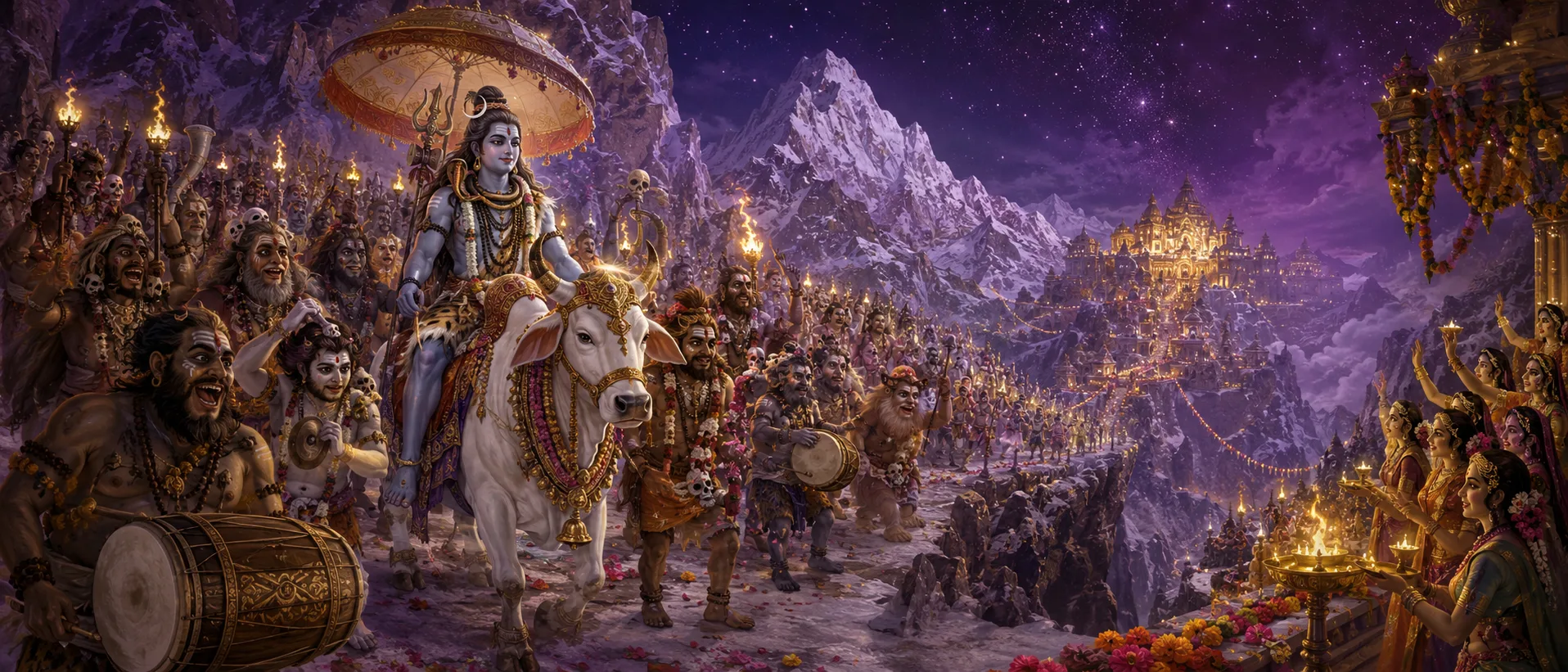
The Rudra Samhita is the narrative heart of the Shiva Purana, following Shiva through two complete marriages, the birth of both his sons, and a long sequence of wars. It opens with cosmology and the story of Gunanidhi's redemption. Sati is born to Daksha, wins Shiva as husband, and the marriage prospers until Daksha's enmity — sharpened by Sati's own uninvited presence at his sacrifice — leads to her self-immolation and Shiva's grief-stricken destruction of the yajna, resolved only when Daksha is restored with a goat's head. Sati is reborn as Parvati, daughter of Himalaya; her long austerities, tested by the seven sages and by Shiva himself in disguise, finally win his acceptance, and their wedding — with its terrifying baraat of ganas, its illusion-play deceiving her parents, and the rite itself — closes the Parvati Khanda. Their son Kartikeya, born to defeat the invincible demon Tarakasura, does exactly that, while his brother Ganesha's own dramatic origin — beheaded and restored with an elephant's head — makes him lord of the ganas and gatekeeper of Shiva's house. The Samhita's final and longest movement is a chain of wars: the burning of Tripura's three cities, Jalandhara's rise and fall (entangled with the origin of Tulasi and the Shaligrama stone), Shankhachuda's death and the origin of the conch shell, and Andhaka's long war and eventual redemption as a gana-lord, alongside further victories over Banasura, Gajasura, and other demons — closing this, the largest Samhita in the entire Shiva Purana.
Chapters
Why it matters today
The Rudra Samhita's recurring pattern — a demon rendered invulnerable through some form of righteous power (a wife's chastity, a boon, an armor) who can only be defeated once that power is deceptively broken — appears at least three times across this single Samhita (Jalandhara/Vrinda, Shankhachuda/Tulasi, and echoes elsewhere), making it one of the clearest places in the Puranic corpus to see a single narrative template deliberately reused and varied across an extended text.
This story is also told in
Daksha's sacrifice (Bhagavata Purana, Skandha 4, ch. 2-7)
Told with emphasis on cosmic grief and Shiva's fury.
Daksha's sacrifice retold (Shiva Purana, Vayaviya Samhita)
A shorter retelling within the same Purana, ch. 18 and 22.
Daksha's sacrifice (Skanda Purana, Kedara Khanda, ch. 1-7)
Opens the entire Skanda Purana.
Daksha's sacrifice, Kashi-localized (Skanda Purana, Kashi Khanda, ch. 87-93)
Emphasis shifted to linga-origin etiology tied to specific Varanasi shrines.
Parvati's birth, wedding, and Kartikeya's birth (Skanda Purana, Kaumarika Khanda)
Ch. 50-68 — the same story arc as its own book's namesake.
Kumara's birth to slay Tarakasura (Padma Purana, Srishti Khanda)
A shorter telling within the Purana's opening cosmogony.
Ganesha's origin, told alongside Kumara's birth (Padma Purana, Srishti Khanda)
A shorter parallel telling.
Tulasi and Shankhachuda (Devi Bhagavatam, Skandha 9, ch. 17-25)
The Devi Bhagavatam's own text notes this same story is also told in the Shiva Purana.
Tulasi and Jalandhara (Padma Purana, Uttara Khanda, ch. 96-105)
The husband here is named Jalandhara rather than Shankhachuda.