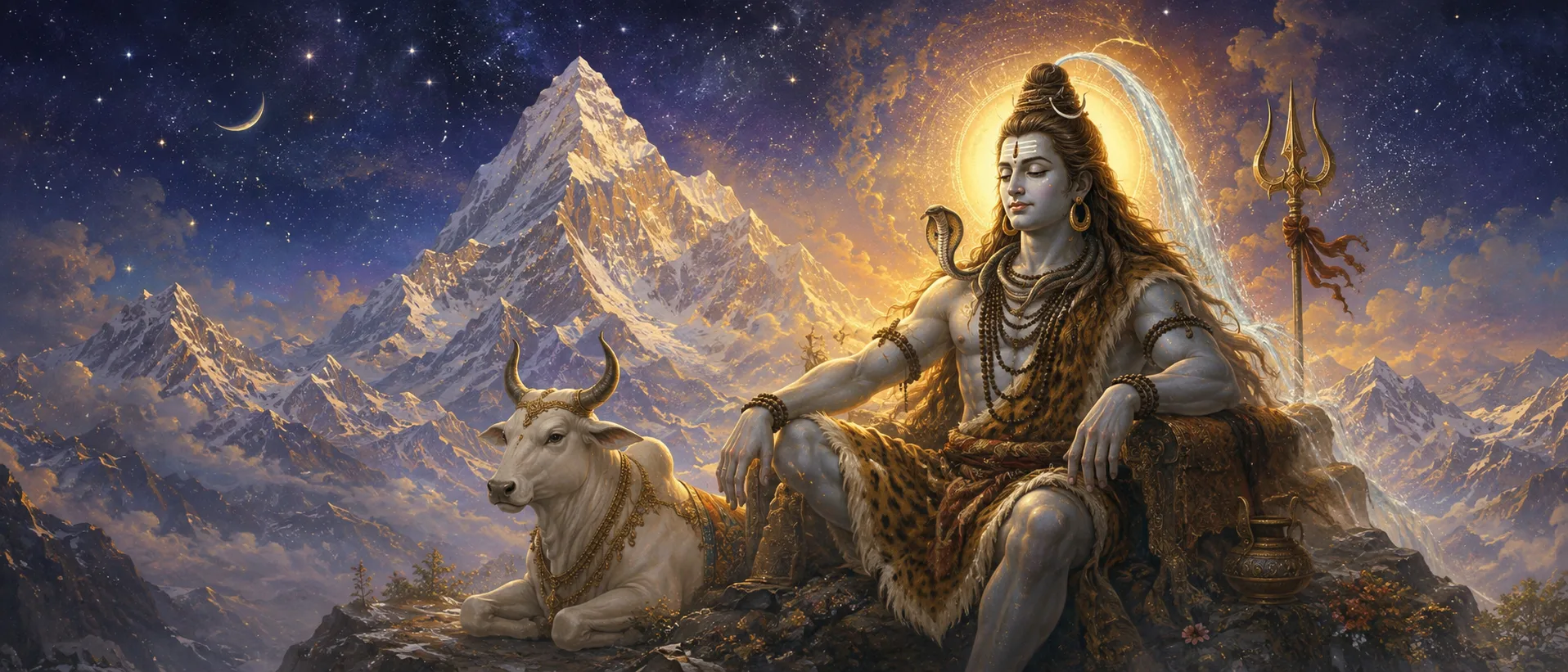
Maheshvara Khanda opens in tragedy and ends in triumph. Its first sub-book, Kedara Khanda, tells of Daksha's contempt for his son-in-law Shiva erupting at a great sacrifice, Sati's self-immolation, and Virabhadra's fury — before turning to devotional teaching on linga-worship, the sages of the Deodar forest and their curse, and the churning of the cosmic ocean that yields the poison Shiva swallows to save creation. The second and longest sub-book, Kaumarika Khanda, tells the full cycle that follows: the demon Taraka's rise to threaten the gods, Sati's rebirth as Parvati, her long austerities and disguised trial by Shiva himself, their wedding, and finally the birth of Kartikeya (Skanda) specifically to lead the gods to victory — ending with Taraka's death and the young war-god's own remorseful founding of expiatory shrines. The khanda's final movement, the Arunachala Mahatmya, tells an entirely separate but equally foundational story: the origin of Arunachaleshvara, Shiva's jyotirlinga of fire at Tiruvannamalai, born from a dispute between Brahma and Vishnu over which of them was truly supreme — a dispute Shiva settles by manifesting as an infinite pillar of flame neither god can find the end of.
Chapters
Why it matters today
The Arunachala Mahatmya's jyotirlinga-of-fire episode remains one of the most vivid and widely-retold theological arguments for Shiva's supremacy in living Shaiva tradition, and Tiruvannamalai's Annamalaiyar Temple, built on the site this khanda describes, remains one of South India's most actively visited Shiva pilgrimage centers today — giving this khanda's closing story a continuous, unbroken devotional life outside the text itself.
This story is also told in
Daksha's sacrifice (Bhagavata Purana, Skandha 4, ch. 2-7)
Told with emphasis on cosmic grief and Shiva's fury.
Daksha's sacrifice and Sati's death (Shiva Purana, Rudra Samhita)
The most detailed telling, ch. 21-63 of the Sati Khanda.
Daksha's sacrifice retold (Shiva Purana, Vayaviya Samhita)
A shorter retelling within the same Purana, ch. 18 and 22.
Daksha's sacrifice, Kashi-localized (Skanda Purana, Kashi Khanda, ch. 87-93)
Emphasis shifted to linga-origin etiology tied to specific Varanasi shrines.
Parvati's penance, the wedding, and Kartikeya's birth (Shiva Purana, Rudra Samhita)
Ch. 69-130 — the Parvati Khanda and Kumara Khanda.
Kumara's birth to slay Tarakasura (Padma Purana, Srishti Khanda)
A shorter telling within the Purana's opening cosmogony.
The churning of the ocean of milk (Bhagavata Purana, Skandha 8, ch. 8-9, 12)
Full narrative including the Mohini episode.
Samudra Manthan, compressed (Vishnu Purana, Amsa 1, ch. 9)
The whole episode in a single chapter.
Vamana and Bali (Bhagavata Purana, Skandha 8, ch. 15, 18-22)
The fullest telling.
Vamana-Trivikrama (Padma Purana, Srishti Khanda, ch. 30)
A shorter telling within the opening cosmogony.