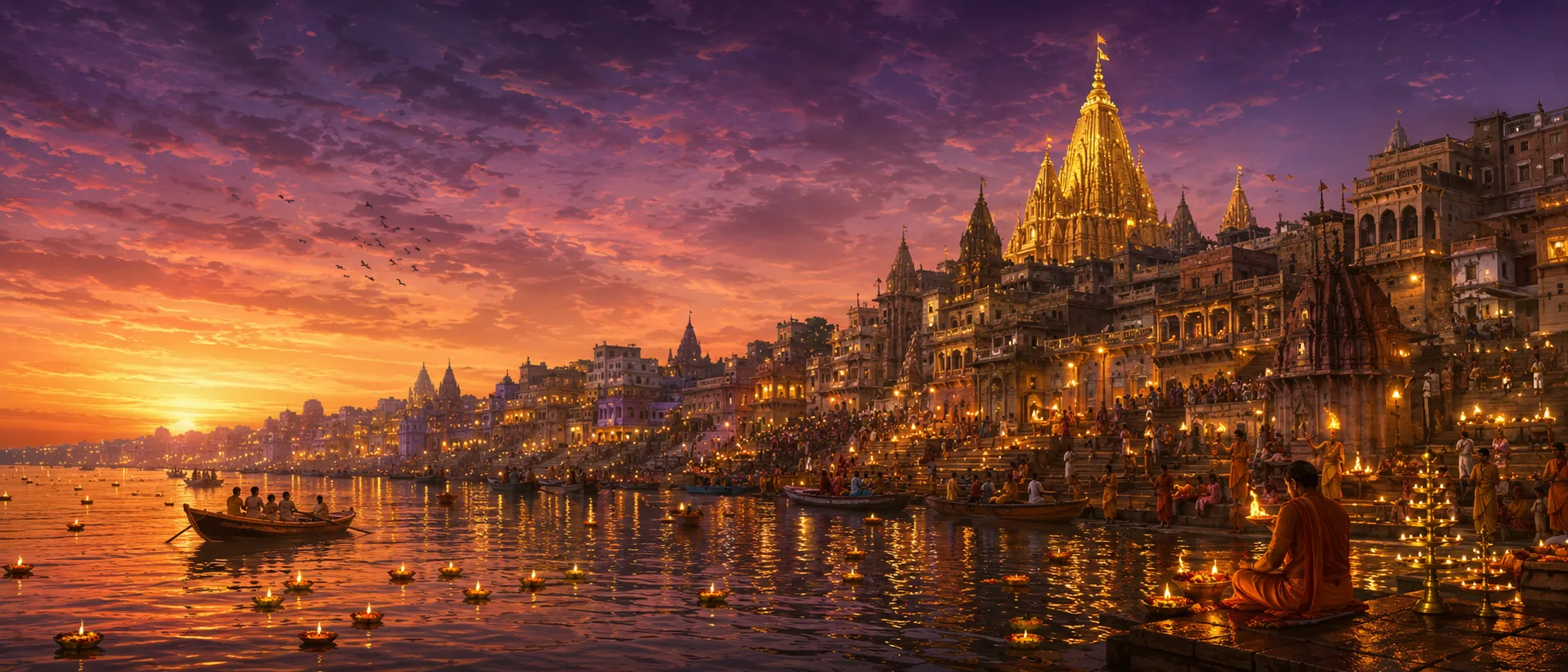
The Kashi Khanda is a complete devotional encyclopedia of Varanasi. Its Purvardha opens with cosmogony and Agastya's own reluctant departure from Kashi to subdue the swelling Vindhya mountain, then widens into cosmological description (the realms of the planets, Yama, the Apsaras, the seven sages), King Divodasa's righteous rule of the city, the founding of its great lingas — Vishveshvara, the sixty-four Yoginis, Lolarka and the other Adityas — and closes with an extended dharmashastra section on rites, marriage, the four ashramas, and Kashi's own sixfold yoga as a path to liberation available nowhere else. Its Uttarardha turns to narrative glory-literature at scale: the thousand names of the Ganga, the manifestations of Bhairava and Dandapani as the city's guardians, the sixty-eight tirthas gathered into Kashi from across India, the guardian goddesses, Durga's victory over the demon Durgama, the fourteen lingas of Omkara, and a long sequence of further linga-origin stories — before closing with its own index chapter, a full accounting of every pilgrimage circuit within the city and the merit of walking each one.
Chapters
Why it matters today
The Kashi Khanda remains one of the most functionally alive texts in this entire project's build — Varanasi's status as Hinduism's most visited pilgrimage city and the continuous ritual life of its ghats, temples, and Ganga-aarti make this khanda's geography and glory-stories a living itinerary rather than a purely literary one, still referenced by pilgrims and priests navigating the city's tirthas today.
This story is also told in
Daksha's sacrifice (Bhagavata Purana, Skandha 4, ch. 2-7)
Told with emphasis on cosmic grief and Shiva's fury.
Daksha's sacrifice and Sati's death (Shiva Purana, Rudra Samhita)
The most detailed telling, ch. 21-63 of the Sati Khanda.
Daksha's sacrifice retold (Shiva Purana, Vayaviya Samhita)
A shorter retelling within the same Purana, ch. 18 and 22.
Daksha's sacrifice (Skanda Purana, Kedara Khanda, ch. 1-7)
Opens the entire Skanda Purana.