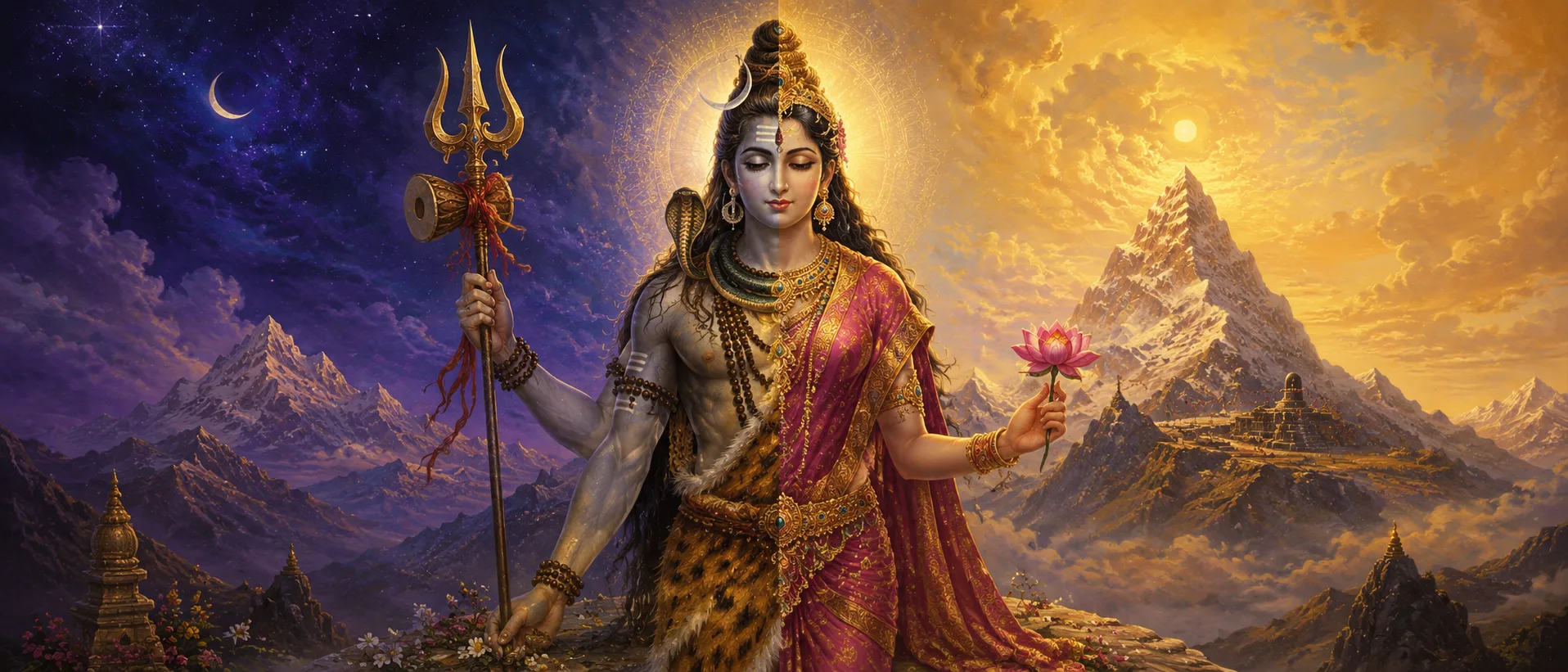
The Vayaviya Samhita closes the Shiva Purana in two movements. Its Purvakhanda opens with cosmology and the manifestation of Rudra from Brahma's anger, moves through Ardhanarishvara theology (Shiva as half-male, half-female, establishing Shakti's inseparability from Shiva), and retells the Daksha-yajna and Sati's death in this Samhita's own version, closing with the birth of Virabhadra and the twenty-eight-fold Vyasa-avatara lineage down to Krishna Dvaipayana himself. Its Uttarakhanda turns entirely to practice: the glory of the five-syllable pancakshara mantra (Namah Shivaya) argued at length across several chapters, the full procedure of mantra-diksha initiation, the complete Shaiva-Siddhanta sequence of purification, consecration, and worship, yogic teaching on liberation, and a description of the sage-pilgrimage to Naimisharanya that frames this whole Purana's narration. In its final chapter, the text turns to speak about itself: what merit accrues to a reader or reciter of the Shiva Purana, closing not only this Samhita but the entire eight-Samhita, twenty-four-thousand-verse work with its own benediction.
Chapters
Why it matters today
The pancakshara mantra chapters at the heart of this Samhita's Uttarakhanda are the textual foundation for one of the most widely chanted Shaiva mantras today — Om Namah Shivaya — and reading the full theological argument for its power here shows how a five-syllable phrase recited casually by millions carries an entire Samhita's worth of scriptural justification behind it.
This story is also told in
Daksha's sacrifice (Bhagavata Purana, Skandha 4, ch. 2-7)
Told with emphasis on cosmic grief and Shiva's fury.
Daksha's sacrifice and Sati's death (Shiva Purana, Rudra Samhita)
The most detailed telling, ch. 21-63 of the Sati Khanda.
Daksha's sacrifice (Skanda Purana, Kedara Khanda, ch. 1-7)
Opens the entire Skanda Purana.
Daksha's sacrifice, Kashi-localized (Skanda Purana, Kashi Khanda, ch. 87-93)
Emphasis shifted to linga-origin etiology tied to specific Varanasi shrines.