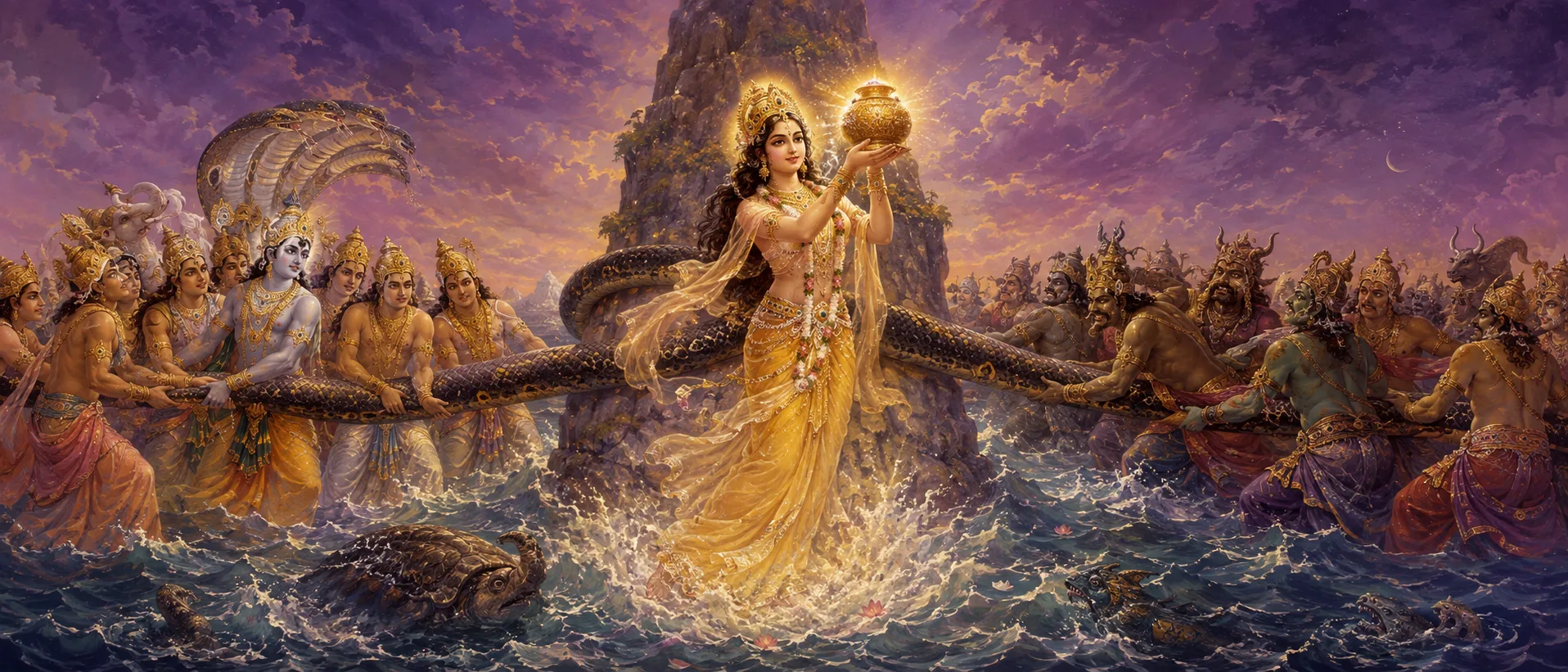
Skandha 8 begins with Gajendra, an elephant-king whose own great strength fails him entirely against a crocodile's grip — and whose surrender, once every other resource is exhausted, is answered instantly, a story the tradition reads as proof that devotion doesn't require strength, only sincerity at the point strength runs out. From there the skandha turns to the churning of the ocean of milk, an alliance of convenience between gods and their oldest enemies, undertaken to win the nectar of immortality neither side can produce alone — an alliance Vishnu himself ensures ends in the gods' favor through Mohini, a form so captivating it distracts even Shiva. The skandha's final chapters belong to Bali, a demon-king whose virtue is genuine enough that Vishnu must approach him not as an enemy but as a beggar, asking for three paces of land and receiving, when Bali keeps his word past the point of ruin, not punishment but honor — sovereignty over a hidden kingdom and the Lord's own gatekeeping in his next life. It closes with Matsya, the fish who tows Manu's boat, and with it the entire future of creation, safely through the flood that ends one cosmic age and begins the next.
Chapters
Why it matters today
Skandha 8's three great stories — Gajendra, the churning, and Vamana — share a structure: strength or cunning gets a party only so far, and what actually resolves each crisis is something closer to grace arriving at the exact point self-sufficiency runs out. Bali's story in particular complicates any easy villain/hero reading — the 'demon' here is the one who keeps his word at personal ruin.
This story is also told in
Samudra Manthan, compressed (Vishnu Purana, Amsa 1, ch. 9)
The whole episode in a single chapter.
Samudra Manthan, Shiva-centered (Skanda Purana, Kedara Khanda, ch. 9)
Emphasis on Shiva swallowing the poison rather than the nectar/Mohini plot.
Vamana-Trivikrama (Padma Purana, Srishti Khanda, ch. 30)
A shorter telling within the opening cosmogony.
Vamana-Trivikrama (Skanda Purana, Kedara Khanda, ch. 18-19)
Told within the Setu tirtha sequence.