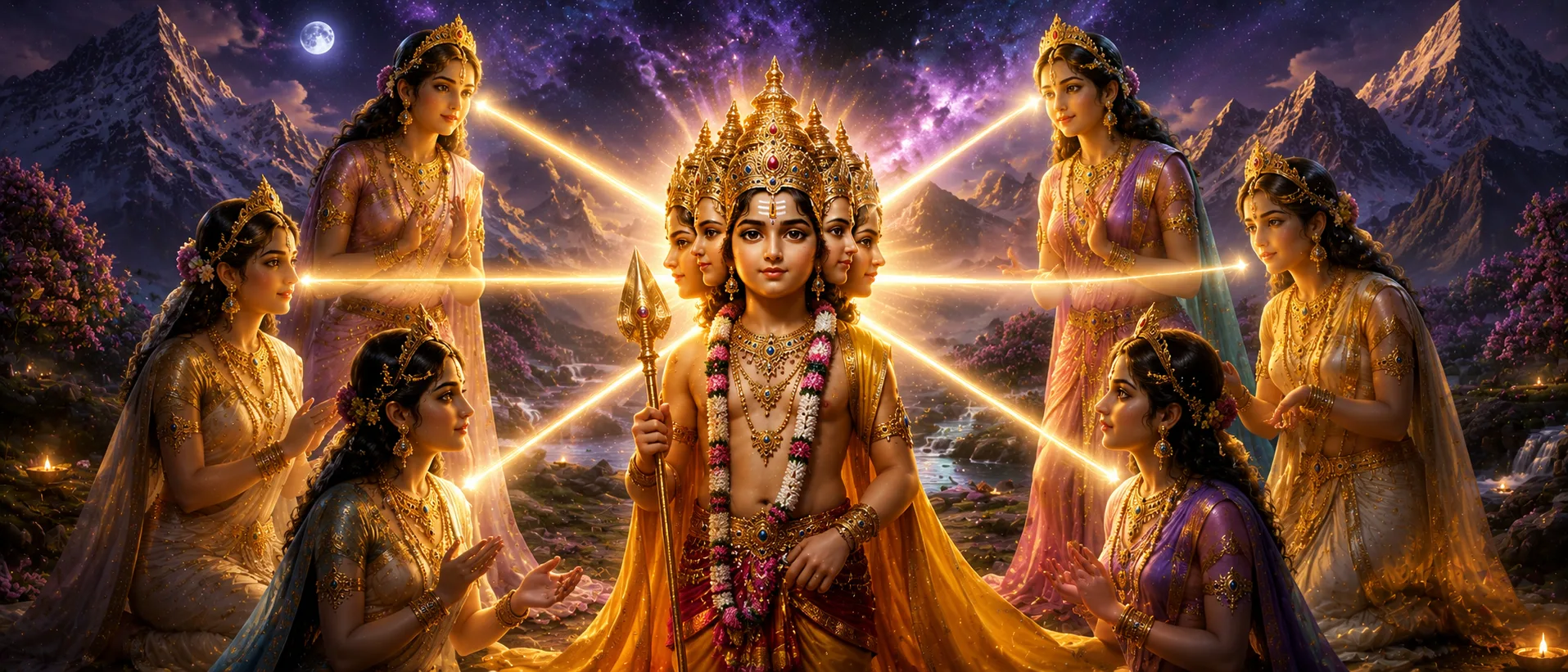
The Srishti Khanda is a compressed cosmos in itself. It opens with cosmogony proper — a Sankhya-inflected account of creation, Varaha's rescue of the drowned earth, and the birth of Rudra — before its first great narrative arc: Gauri's austerities, her marriage to Shiva, and the birth of Kumara specifically to slay the invincible demon Taraka, alongside Ganesha's own dramatic origin. Extensive genealogies follow, tracing the solar dynasty through Rama and the lunar dynasty through to Krishna's own birth, interwoven with the story of how Vishnu, Brahma, and Shiva delude the Danavas away from their own protective dharma. A long middle section gathers foundational teaching: Rudra's penance for slaying a brahmana, the founding of the Pushkara tirtha, the full compendium of the Gayatri mantra, and a sequence of vratas and their fruits. Its final third turns to devotional glory-literature — the power of the Rudraksha bead and of Tulasi, the sanctity of the Ganga, the story of Ahalya's release from her curse, the complete Vamana-Trivikrama story of Vishnu's three strides and Bali's humbling, Rama's journey toward Lanka, and the cosmic Tarakamaya war between gods and demons — before closing with a systematic account of how to worship each of the nine grahas (sun, moon, five visible planets, and the shadow-points Rahu and Ketu), the Purana's own closing gesture for this, its opening book.
Chapters
Why it matters today
This khanda's sheer scale and range — cosmogony, genealogy, devotional narrative, and ritual manual all inside a single book — makes it a useful single-volume introduction to how a major Purana actually functions: not as one genre of text but as a deliberately mixed container built to serve very different reading purposes at once.
This story is also told in
Parvati's penance, the wedding, and Kartikeya's birth (Shiva Purana, Rudra Samhita)
Ch. 69-130 — the Parvati Khanda and Kumara Khanda.
Parvati's birth, wedding, and Kartikeya's birth (Skanda Purana, Kaumarika Khanda)
Ch. 50-68 — the same story arc as its own book's namesake.
Ganesha's beheading and restoration (Shiva Purana, Rudra Samhita, ch. 131-138)
The fullest telling, alongside Kartikeya's own birth story.
Vamana and Bali (Bhagavata Purana, Skandha 8, ch. 15, 18-22)
The fullest telling.
Vamana-Trivikrama (Skanda Purana, Kedara Khanda, ch. 18-19)
Told within the Setu tirtha sequence.