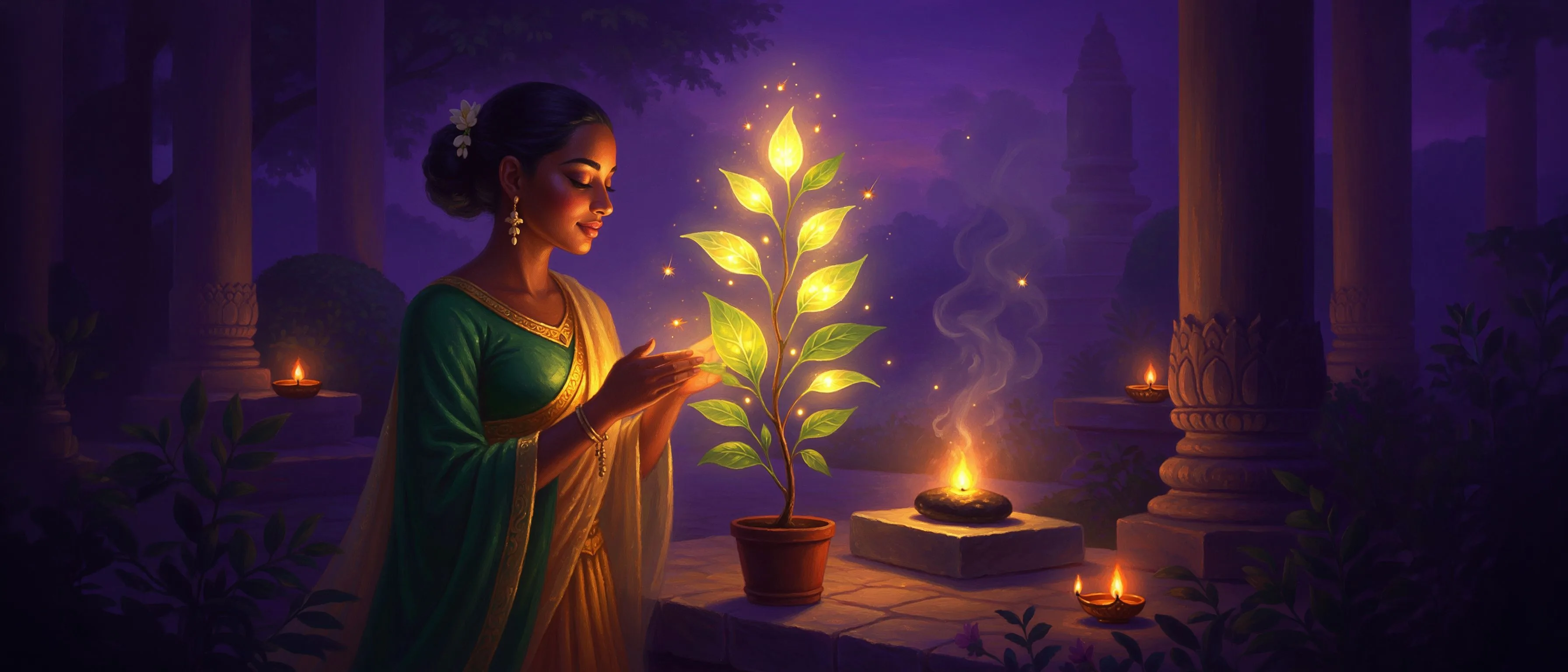
Skandha 9 is the Devi Bhagavatam's longest book, a sustained meditation on the goddesses who stand beside Vishnu and Krishna. It opens with Ganga becoming one of Krishna's wives, then Narada learning of Shakti's manifestation, the birth of Vedavati — a form of Mahalakshmi born into a royal house — and, at considerable length, the story of Tulasi: her birth as Dharmadhvaja's daughter, her marriage to the demon Shankhachuda, the war his invulnerability provokes, and her transformation into both the tulasi plant and, through Vishnu, the Shaligrama stone. The narrative then turns to Lakshmi's own origin and a dhyana-stotra in her praise, before moving through the linked stories of Svaha (Agni's wife), Svadha (offered to the Pitrs), Dakshina, Shashthi (protector of children), the serpent-goddess Manasa, and the wish-fulfilling cow Surabhi. The skandha's single longest sustained narrative closes it: the full Savitri-Satyavan legend, Savitri's philosophical dialogue with Yama as he carries away her husband's soul, Yama's own extended discourse on which specific sins lead to which specific hells, and the eighty-six hell-pits catalogued one by one — resolved by Savitri's persistence winning Satyavan's life back — before the skandha closes with the procedure for worshipping the Goddess's surrounding retinue of attendant deities.
Chapters
Why it matters today
The Savitri-Satyavan legend closing this skandha remains one of the most frequently retold stories in Hindu tradition precisely because Savitri's victory comes not through combat or magic but through sustained philosophical argument — she out-reasons Yama himself — making it a rare mythological narrative where wit and persistence, not force, are what overturn death's judgment.