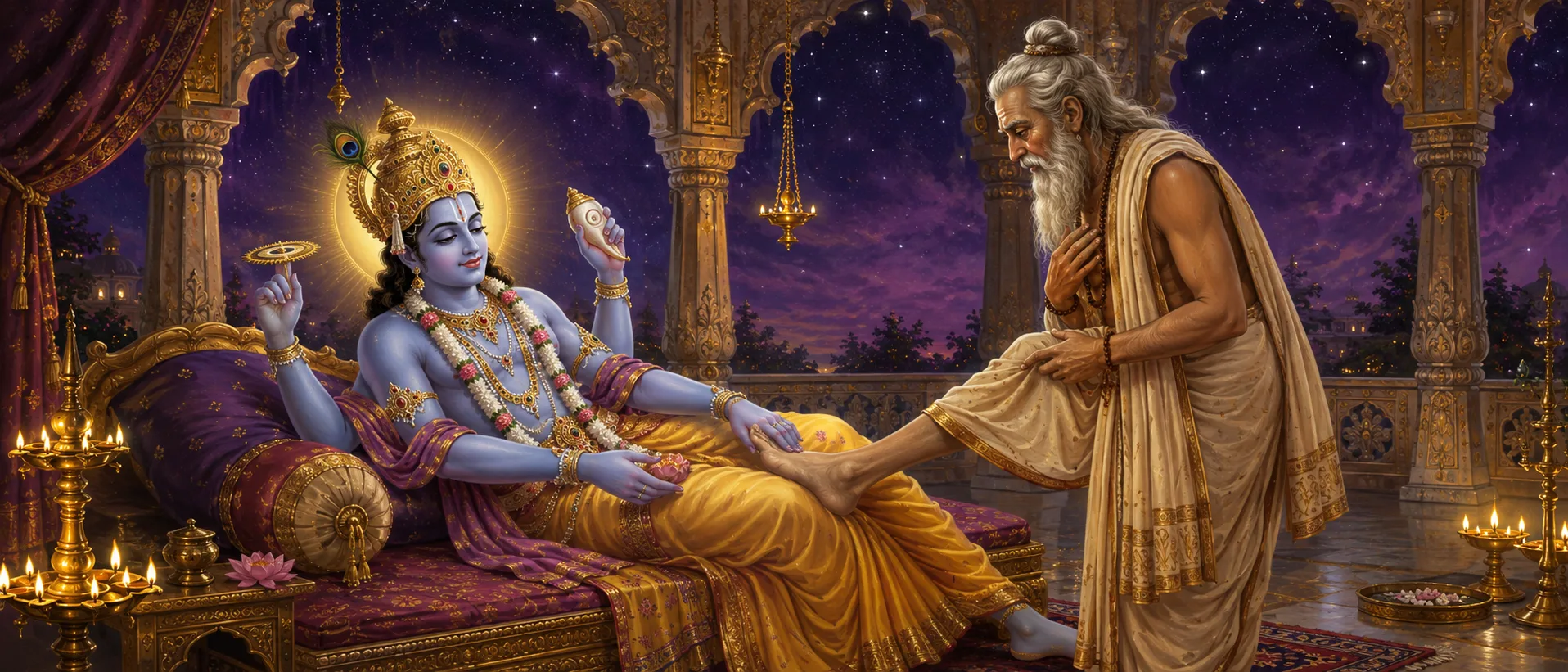
The Uttara Khanda is the Padma Purana's largest book, a sprawling compendium that opens by cataloguing its own many topics before unfolding an immense sequence of Vaishnava devotional narrative and tirtha-glory. Early chapters trace the Nigamabodha tirtha and the sanctity of Dvaraka, then turn to the memorable tale of Mukunda and a humble barber, Chandaka, whose devotion transforms his fate — a story the khanda uses to argue that sincerity outweighs birth or station. A long central sweep gathers tirtha-mahatmyas for Kosala (with its own naming etiology via a sage's curse on the moon-god Budha), Madhuvana, the Himalayan shrine of Badarikashrama, Haridwar, and Pushkara, before arriving at Prayaga-Indraprastha and widening into extensive Krishna-lila narrative, philosophical dialogue, and devotional hymns. The khanda's famous closing movement is the Bhrigu-pariksha: the irascible sage Bhrigu, deputed to determine which of the three great gods is truly supreme, insults Brahma, is cursed by an enraged Shiva, and finally kicks Vishnu in the chest while he sleeps — only for Vishnu to wake and gently massage the sage's foot, asking if he was hurt. The episode settles the question of divine forbearance and closes both the khanda and, with it, the entire Padma Purana's account of dharma proper to devotion.
Chapters
Why it matters today
The Bhrigu-pariksha episode is one of the most widely retold stories in popular Vaishnava tradition, still cited today as the classical scriptural basis for ranking Vishnu's forbearance above Brahma's and Shiva's more reactive temperaments — a story frequently repeated in Vaishnava discourse independent of its specific Puranic source.