Brajeshwari Devi
बज्रेश्वरी देवी
The Shakti Peeth of Nagarkot, where Sati's left breast is said to have fallen, plundered and rebuilt across a thousand years
Kangra, Himachal Pradesh, India
Brajeśvarī Devī Mandir, Kāṅgaṛā (Vajreśvarī / Bajreśvarī)Also known as: Vajreshwari Devi Mandir, Kangra, Bajreshwari Devi Mandir, Kangra, Nagarkot Devi Mandir, Kangra Devi Mandir, Maa Brajeshwari Temple, श्री ब्रजेश्वरी देवी मन्दिर, काँगड़ा, श्री वज्रेश्वरी देवी मन्दिर, नगरकोट देवी मन्दिर
Open
05:00 (summer 05:00; winter 06:00; opens earlier on festival days) – 21:00 (closes 12:00–14:00 for the midday break; reopens 14:00–21:00; extended hours on festival days)
The Sacred Legend · पवित्र कथा
The Brajeshwari Devi temple at Kangra — known across the broader pre-modern Indian tradition as Nagarkot, after the fortified town in which it sits — is one of the canonical 51/52 Shakti Peethas of the Hindu tradition. According to the foundational narrative preserved across the Devi Bhagavata Purana, the Kalika Purana, and the Pithanirnaya, the temple marks the place where Sati's left breast (vama-stana) fell when Vishnu's Sudarshana Chakra dismembered her body to release Shiva's overwhelming grief. The body-part attribution is among the more-settled in the broader Shakti Peeth list; the left-breast association at Nagarkot/Kangra is preserved consistently across the principal Tantric and Puranic sources, and the temple's identity within the Shakti Peeth network is established beyond serious dispute. The temple's significance, however, extends beyond its Shakti Peeth membership in two directions that distinguish it within the broader corpus. First, Brajeshwari Devi is the principal anchor of the Himachal Devi circuit — a regional five-temple devotional unit (Brajeshwari Kangra, Chamunda Dharamshala, Jwalamukhi, Chintpurni, Naina Devi) that pilgrims commonly traverse in a single multi-day yatra. The Himachal Devi circuit is theologically built on multiple canonical Shakti Peethas being clustered within a single hill-range region — a denser concentration than almost anywhere else in the broader pan-Indian Shakti Peeth geography — and Brajeshwari serves as the primary base from which the others are visited. Second, the temple's history is one of the most-thoroughly-documented sequences of medieval looting and reconstruction in the Indian sacred-site corpus. The treasure looted by Mahmud of Ghazni in 1009 CE is preserved in detail in Persian chronicles of the period; the second looting by Firuz Shah Tughlaq in 1360 is similarly documented; and the devastating 1905 Kangra earthquake brought a third major destructive event in the temple's history, requiring decades of reconstruction. The deity at Brajeshwari is venerated in the pindi-form (a rounded sacred stone) rather than the anthropomorphic murti form found at Mansa Devi or Chandi Devi. The pindi configuration is the standard Shakti Peeth iconographic register and connects Brajeshwari to the other pindi-form Shakti Peethas across the network — Vaishno Devi's three pindis being the most-internationally-known parallel. The pindi is elaborately decorated daily with silver-and-gold shringar, coverings, and floral arrangements; the visible form changes through the daily ritual cycle and across the Navaratri and festival cycles. The temple is administered under Himachal Pradesh state religious oversight — broadly within the third administrative-architecture mode of the Devi Marquee corpus (managed trust with state oversight), parallel to the Haridwar Mansa-Chandi pattern. As of 2026, Brajeshwari operates as a steadily-trafficked Himachal pilgrimage destination, with peak attendance during the Sharadiya and Chaitra Navaratri windows and during the broader Himachal Devi-circuit yatra-flow that traverses the five Himachal Devi temples.
Sacred Designationपवित्र पदनाम
Sacred Origin Storyपवित्र उत्पत्ति कथा
Source: The Daksha Yajna and Sati-dismemberment narrative as preserved in the Devi Bhagavata Purana, the Kalika Purana, the Skanda Purana, and the Pithanirnaya (the principal Tantric enumeration of the Shakti Peethas); the broader 51/52-Shakti-Peetha network historiography; Persian chronicle sources (principally Al-Utbi's Tarikh-i-Yamini) for the documented 1009 CE looting by Mahmud of Ghazni; subsequent Mughal, Sikh, and colonial-period records for the temple's medieval and early-modern continuity; Government of India and Government of Himachal Pradesh records for the post-1905 reconstruction phase.
The Brajeshwari narrative unfolds across three deeply-distinct layers, each of which must be taken in sequence to understand the temple's full significance.
The first is the Shakti Peeth foundational narrative — shared with all 51/52 Shakti Peethas across the Indian subcontinent and preserved across the Daksha Yajna cycle of Hindu cosmological literature. Sati, the daughter of Daksha and the wife of Shiva, immolated herself in her father's Yajna-fire when Daksha publicly slighted Shiva. The grieving Shiva, beyond consolation, picked up Sati's body and danced his terrible Tandava across the cosmos, threatening to dissolve the worlds. Vishnu intervened with the Sudarshana Chakra, dismembering Sati's body so that Shiva could no longer hold to her and so that the cosmos could be preserved. The places where the body-parts fell became the Shakti Peethas — the sacred sites where the goddess in her dismembered-yet-preserved presence is venerated. At Nagarkot (Kangra), the left breast (vama-stana) of Sati fell. The body-part attribution is preserved consistently across the Devi Bhagavata Purana, the Kalika Purana, and the Pithanirnaya, making the Nagarkot/Kangra attribution among the more-settled in the broader Shakti Peeth list. The Bhairava paired with this Shakti Peeth as its canonical guardian is Vajra Bhairava — the form of Shiva whose name shares the etymological root with the temple's deity-name Vajreshwari/Brajeshwari (both deriving from vajra, the thunderbolt-diamond).
The second is the medieval looting-and-reconstruction history — among the most-thoroughly-documented in the broader Indian sacred-site corpus. In 1009 CE, Mahmud of Ghazni — the Turkic ruler of the Ghaznavid Empire — extended his campaigns across the Indo-Gangetic plain into the Kangra valley and looted the Brajeshwari temple. The looting is preserved in extensive detail in the Persian chronicle Tarikh-i-Yamini by Al-Utbi, the principal contemporary court chronicler of Mahmud, and in subsequent Persian historical sources. The wealth taken from Nagarkot was extraordinary: gold, silver, jewels, and ritual objects accumulated over centuries of patronage and pilgrim-offering were carried away. Al-Utbi's account of the looting is one of the most-cited primary sources for the wealth of a major pre-Islamic-conquest Indian temple. The temple was substantially destroyed in the 1009 looting and the surrounding Nagarkot fortified town was sacked. Reconstruction followed over the subsequent decades and centuries; the temple was reconsecrated and continued in worship through the medieval period.
In 1360 CE, the temple was looted a second time, by Firuz Shah Tughlaq during his Kangra campaign. The second looting was less devastating than the first but again required reconstruction. The temple continued through the subsequent Mughal period, with varying levels of patronage and hostility from successive Mughal administrations; the temple's resilience across these centuries is itself one of the documented sacred-site continuity narratives in the broader Indian tradition. Maharaja Ranjit Singh of the Sikh Empire — whose territory included the Kangra region in the early nineteenth century — patronised the temple substantially. Various Hindu princely-state and zamindari families across the broader Punjab and Himachal regions contributed to the temple's maintenance and ornamentation through the colonial period.
The third is the 1905 Kangra earthquake — the major destruction of the modern era. On 4 April 1905, the Kangra earthquake of approximately magnitude 7.8 struck the region, killing approximately 20,000 people in the broader Kangra valley and severely damaging the temple. The Brajeshwari temple was substantially destroyed; the principal sanctum survived in damaged form but the surrounding compound, sub-shrines, and ancillary structures collapsed. Reconstruction was undertaken over the subsequent decades; the present visible structure is substantially the post-1905 reconstruction, completed over the early-to-mid twentieth century. The reconstruction preserved the temple's traditional layout and orientation while necessarily replacing the pre-1905 structure that had been destroyed. The pre-earthquake stone foundations are preserved at the lower levels and visible in places; Persian and Sanskrit inscriptions from pre-1905 periods are preserved within the compound as documentary continuity that the reconstructed structure itself cannot provide.
Devotees thus engage with Brajeshwari Devi on multiple registers simultaneously: the Shakti Peeth theological layer (the goddess as the dismembered-yet-preserved presence of Sati's left breast), the medieval-history layer (a thousand-year sequence of looting and reconstruction that has preserved the temple's continuity through repeated destructions), and the early-twentieth-century layer (the post-1905 reconstruction that gives the temple its present visible form). Each layer contributes to the temple's lived identity; the three layers together establish Brajeshwari as one of the most-documented Shakti Peethas in the broader pan-Indian tradition.
Sources cited:
- Devi Bhagavata Purana — Shakta canonical source for the Sati-dismemberment narrative and the body-part attribution at Nagarkot
- Kalika Purana — broader Shakta-Tantric framework within which the Shakti Peetha enumeration is preserved
- Pithanirnaya — the principal Tantric enumeration of the 51/52 Shakti Peethas, source for the left-breast attribution at Nagarkot
- Skanda Purana — Puranic references to Nagarkot as a major Devi shrine
- Tarikh-i-Yamini (Al-Utbi, eleventh century) — Persian chronicle of Mahmud of Ghazni's reign and the primary contemporary documentation of the 1009 looting of Nagarkot
- Tarikh-i-Firuz Shahi and related Tughlaq-period Persian chronicles for the 1360 looting
- Sikh Empire (Maharaja Ranjit Singh) administrative records
- Government of India Geological Survey records on the 4 April 1905 Kangra earthquake
- Government of Himachal Pradesh religious-temple records (post-1948 administration; post-2000 statehood)
Other Traditions · अन्य परंपराएँ
Scholarly Context
The Brajeshwari narrative requires editorial care on four registers. First, the Shakti Peeth body-part attribution: the left-breast attribution at Nagarkot is settled in the canonical Tantric and Puranic sources, and the Eternal Raga treatment follows the canonical consensus without unnecessary qualification. Variant regional enumerations exist but are treated as minor traditions. Second, the Mahmud of Ghazni 1009 looting: the event is historically established and well-documented in contemporary Persian chronicles, and should be reported as factual history. The treatment requires care in two specific respects: (a) the wealth-figures from the Persian chronicles are court-historian approximations rather than precise inventories, and modern scholarship treats them as likely-overstated though still indicating extraordinary wealth; (b) casualty-figures from the campaign are even less precisely documented and should be presented with appropriate scholarly caution. The Eternal Raga approach is to report the looting as factual history while noting the documentary character of the Persian chronicle sources and avoiding either over-precise reporting of contested figures or downplaying of the documented destruction. Third, the 1360 Firuz Shah Tughlaq looting: factually established but less extensively-documented than the 1009 event; reported here as fact with appropriate proportion. Fourth, the 1905 Kangra earthquake: well-documented as a major natural disaster, with the ~7.8 magnitude and ~20,000 broader-regional casualty figures established by Government of India Geological Survey records. The temple's destruction and the post-1905 reconstruction are factually reported. The combined editorial discipline across these registers is to maintain factual reporting of well-documented historical events while preserving appropriate scholarly distance on contested figures and avoiding either sensationalism or downplaying.
Historyइतिहास
The history of Brajeshwari Devi at Nagarkot/Kangra is among the most-thoroughly-documented temple histories in the broader pan-Indian sacred-site corpus — a thousand-year sequence in which the temple has been destroyed, rebuilt, looted again, rebuilt again, devastated by earthquake, and reconstructed once more, while continuing in worship as a Shakti Peeth across the entire span. The documentary continuity owes much to the cross-confessional character of the sources: the Persian Islamic chronicles that record the medieval lootings are at least as important to the temple's historical record as the Sanskrit Puranic sources that establish its theological identity, and the British colonial-period geological survey records that document the 1905 earthquake are critical to understanding the present temple's relationship with its pre-1905 antecedents.
The pre-eleventh-century foundational phase is documented through regional Sanskrit Devi-mahatmya sources rather than through dated historical records. Nagarkot appears in pre-Islamic-conquest Indian literature as a major Devi shrine, with substantial royal patronage from successive Hindu dynasties of the broader Punjab and Himachal regions. The wealth accumulated at the temple during this pre-conquest phase — through royal grants, pilgrim-offerings, and centuries of devotional ornamentation — is what made it a target for Mahmud of Ghazni's 1009 CE campaign.
The Ghaznavid looting of 1009 CE is the temple's first dated historical event. Mahmud of Ghazni — the Turkic ruler of the Ghaznavid Empire whose campaigns across the Indo-Gangetic plain are documented across the late tenth and early eleventh centuries — extended his operations into the Kangra valley and looted the Brajeshwari temple. The looting is preserved in Al-Utbi's Tarikh-i-Yamini and subsequent Persian historical sources. The temple was substantially destroyed and the surrounding Nagarkot fortified town was sacked. Reconstruction followed over the subsequent decades and centuries; the temple was reconsecrated within the broader pattern of north Indian temple-restoration that accompanied the political reconfigurations of the eleventh and twelfth centuries.
The 1360 CE looting by Firuz Shah Tughlaq — the Tughlaq Sultan whose Kangra campaign extended Delhi-Sultanate influence into the Himachal foothills — was the temple's second documented major destruction. Less extensively-documented than the 1009 event but factually established in Tughlaq-period Persian chronicles, the 1360 looting required a second round of reconstruction.
The medieval continuity through the Mughal period (sixteenth through eighteenth centuries) was characterised by varying levels of patronage and hostility from successive Mughal administrations. The temple continued in worship throughout. The Sikh Empire period of the early nineteenth century brought significant patronage from Maharaja Ranjit Singh, whose territory included the Kangra region from approximately 1809 until his death in 1839. The post-Ranjit Singh decade was politically turbulent (the Anglo-Sikh wars culminating in the 1849 British annexation of Punjab); the temple continued through this period under various administrative arrangements.
The nineteenth-century British colonial administration brought the temple within the broader British Indian administrative framework. Various Hindu princely-state and zamindari families across the broader Punjab and Himachal regions continued to contribute to the temple's maintenance and ornamentation through the colonial period; the temple's importance within the regional pilgrimage network was substantial throughout.
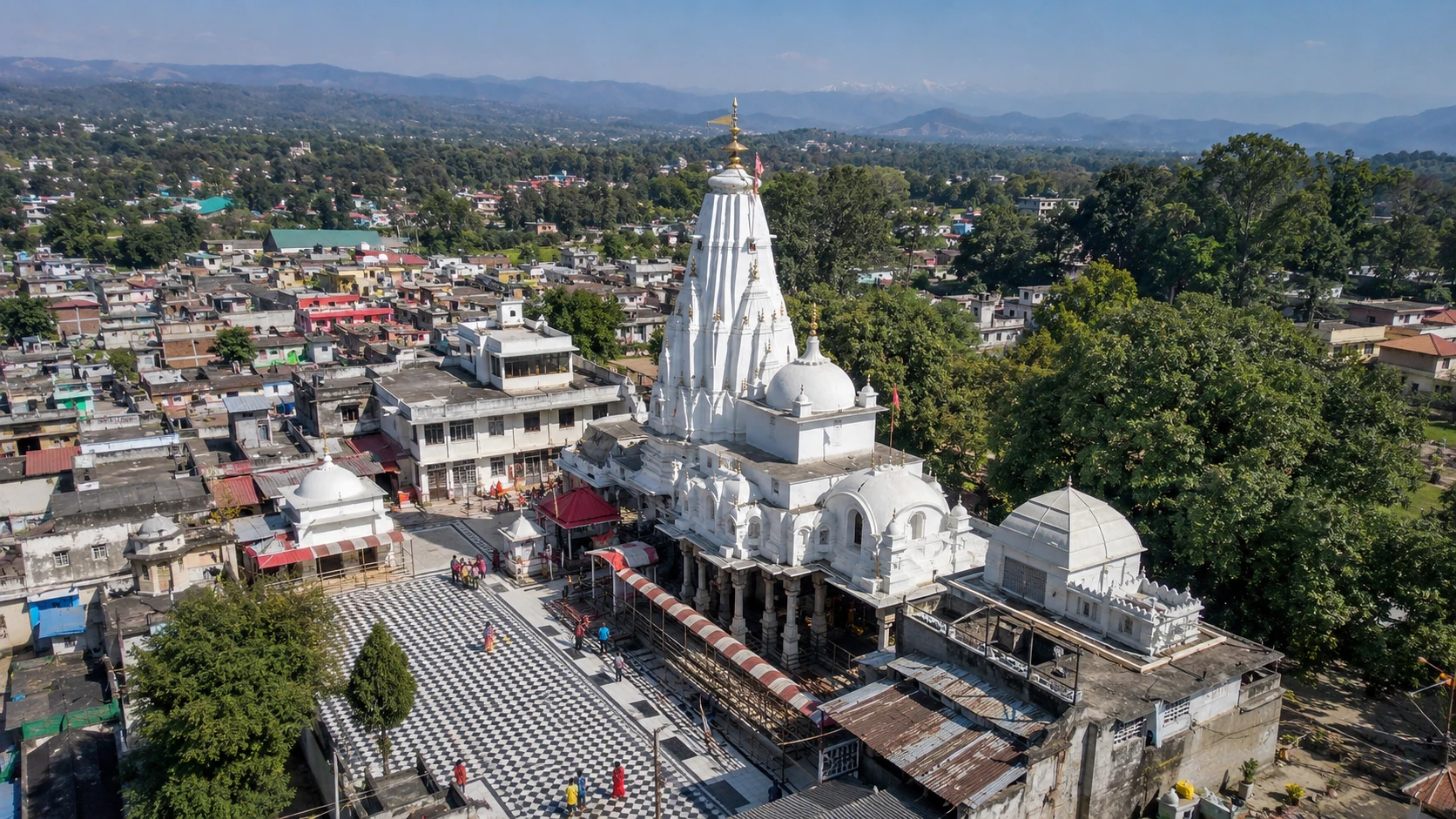
The 4 April 1905 Kangra earthquake — the major destruction of the modern era — was the temple's third great destructive event. The earthquake, of approximately magnitude 7.8 and centred near Kangra, killed approximately 20,000 people in the broader Kangra valley and devastated the temple. The Brajeshwari temple was substantially destroyed; reconstruction was undertaken over the subsequent decades, with the post-1905 work continuing through the British colonial period (until 1947), Indian independence, and the early decades of the Indian Union. The present visible structure was substantially complete by the mid-twentieth century, with subsequent additions through the post-2000 modernization phase.
The post-1947 administrative phase brought the temple within the Indian Union framework, initially under Punjab state administration (Kangra was then part of Punjab). The 1971 creation of Himachal Pradesh as a separate Indian state brought Brajeshwari and the broader Kangra district within the new state; the temple's administration has since operated under Himachal Pradesh state religious oversight. The post-1971 period has seen progressive modernization of visitor logistics — improved approach roads, expanded security and queue-management infrastructure, the introduction of online seva-booking through state-affiliated channels in the post-2010 period, and the integration of Brajeshwari into the broader Himachal Devi-circuit tourism-and-pilgrimage management framework.
As of 2026, Brajeshwari operates as a steadily-trafficked Himachal pilgrimage destination, with Sharadiya Navaratri attendance crossing 100,000 across the festival period and steady year-round flow from Himachal Devi-circuit yatris.
Historical Timelineऐतिहासिक कालक्रम
Nagarkot/Kangra appears in pre-Islamic-conquest Indian literature as a major Devi shrine. Substantial royal patronage from successive Hindu dynasties of the broader Punjab and Himachal regions accumulates wealth at the temple over centuries, including the gold, silver, jewels, and ritual objects that would later be taken by Mahmud of Ghazni.
Mahmud of Ghazni — the Turkic ruler of the Ghaznavid Empire — extends his Indian campaigns into the Kangra valley and loots the Brajeshwari temple at Nagarkot. The looting is preserved in extensive detail in Al-Utbi's Tarikh-i-Yamini, the principal contemporary Persian chronicle of Mahmud's reign. The wealth taken from Nagarkot — gold, silver, jewels, and ritual objects accumulated over centuries — is extraordinary by any historical standard, though modern scholarship treats the Persian chronicle figures as court-historian approximations rather than precise inventories. The temple is substantially destroyed and the surrounding Nagarkot fortified town is sacked.
Reconstruction of the Brajeshwari temple following the Ghaznavid looting; the temple is reconsecrated and continues in worship through the medieval period. The reconstruction is part of the broader north Indian pattern of temple-restoration that accompanies the political reconfigurations of the eleventh and twelfth centuries.
Firuz Shah Tughlaq — the Tughlaq Sultan of Delhi — extends a Kangra campaign that loots the Brajeshwari temple a second time. The looting is documented in Tughlaq-period Persian chronicles. Less extensively-documented than the 1009 event but factually established; a second round of reconstruction follows.
The temple continues through the Mughal period with varying levels of patronage and hostility from successive Mughal administrations. Hindu princely-state and zamindari families of the broader Punjab and Himachal regions contribute to the temple's maintenance and ornamentation through the period.
The Kangra region falls within the Sikh Empire of Maharaja Ranjit Singh. Significant patronage from Ranjit Singh and the broader Sikh-Empire administration supports the temple's maintenance and pilgrimage flow. The temple benefits from the political stability and economic prosperity of the Sikh-Empire period.
The British annexation of Punjab following the Second Anglo-Sikh War brings the Kangra region within the British Indian administrative framework. The temple continues under British administration, with various Hindu princely-state and zamindari families continuing to contribute to its maintenance.
The Kangra earthquake — of approximately magnitude 7.8 and centred near Kangra — strikes the region, killing approximately 20,000 people in the broader Kangra valley and devastating the Brajeshwari temple. The principal sanctum survives in damaged form but the surrounding compound, sub-shrines, and ancillary structures collapse. The 1905 earthquake is the temple's third great destructive event of the documented historical period, following the 1009 and 1360 lootings.
Reconstruction of the Brajeshwari temple following the 1905 earthquake. Work proceeds over decades through the late British colonial period, with the temple's traditional layout and orientation preserved while the destroyed pre-1905 structure is replaced. Pre-earthquake stone foundations are preserved at the lower levels and visible in places; Persian and Sanskrit inscriptions from pre-1905 periods are preserved within the compound.
Indian Independence. The temple continues under the Indian Union, initially within Punjab state (which then included the Kangra region). The post-1905 reconstruction continues through the post-independence early decades.
Himachal Pradesh is created as a separate Indian state from Punjab. Brajeshwari Devi and the broader Kangra district come within the new state's administrative jurisdiction; the temple has since operated under Himachal Pradesh state religious oversight.
Progressive modernization of visitor logistics — improved approach roads, expanded security and queue-management infrastructure, the introduction of online seva-booking through state-affiliated channels, and integration of Brajeshwari into the broader Himachal Devi-circuit tourism-and-pilgrimage management framework.
What You'll Seeदर्शन में
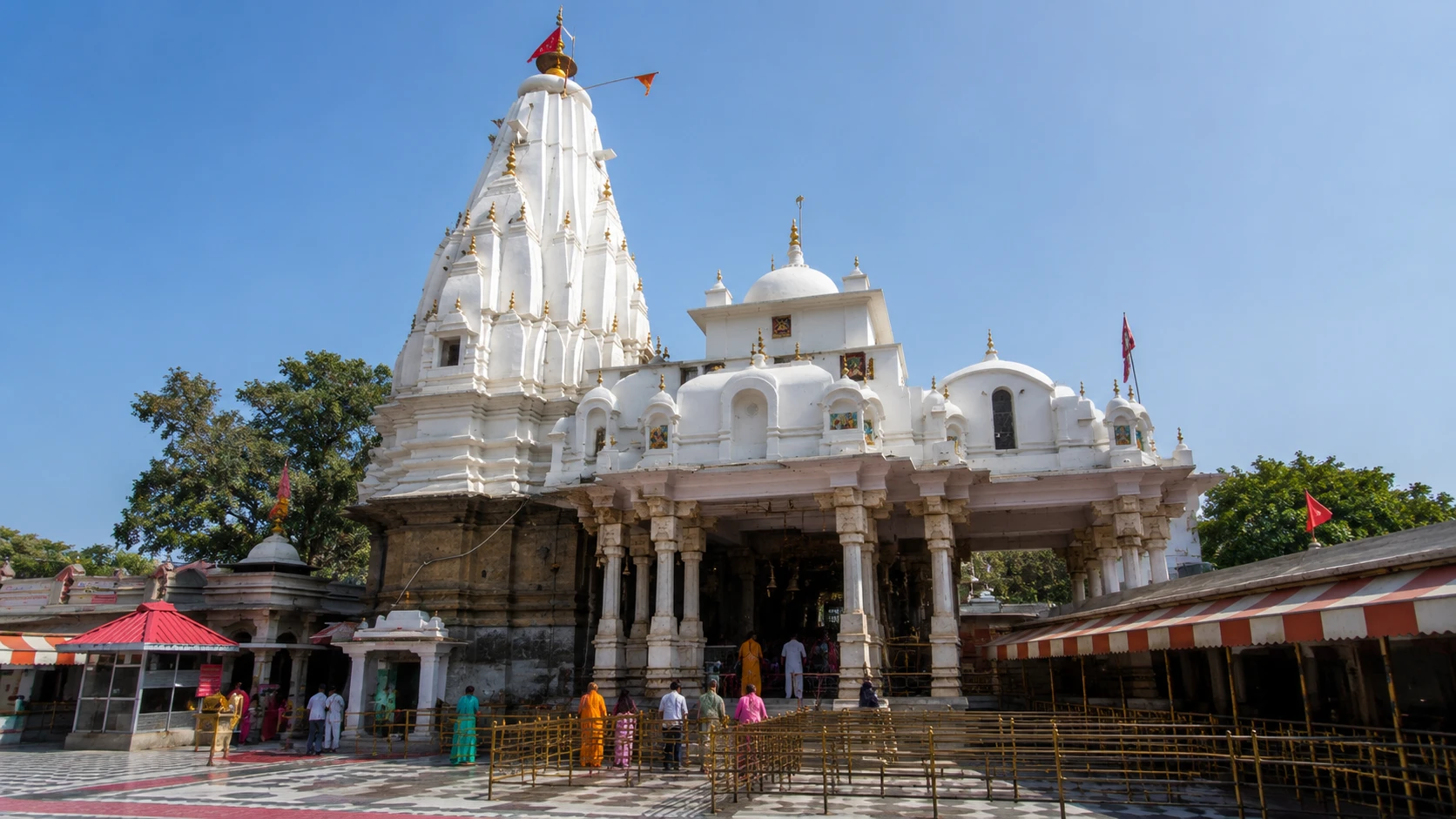
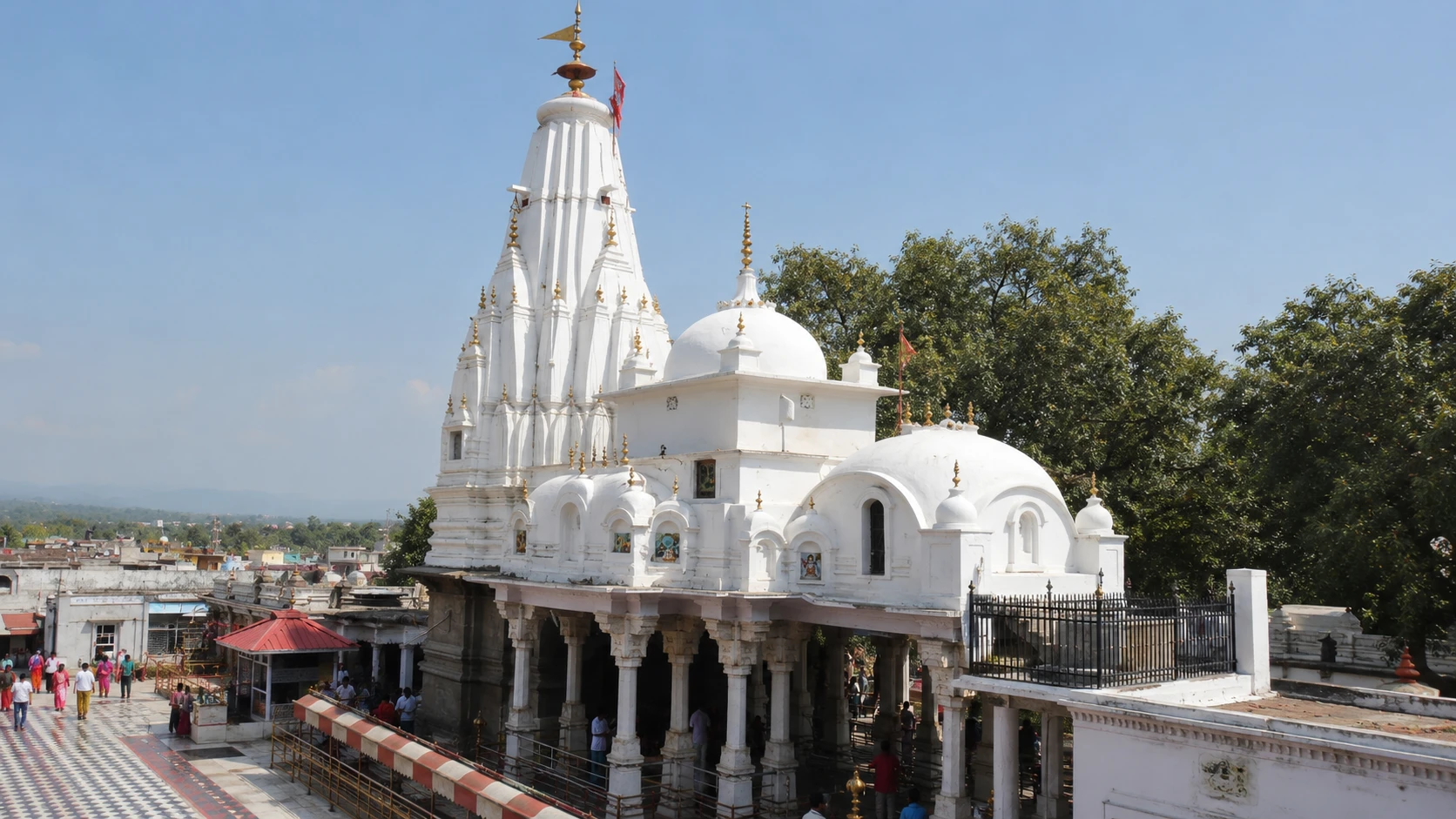
The principal sanctum holds the Brajeshwari Devi pindi — a rounded sacred stone representing the goddess in the canonical Shakti Peeth iconographic register, traditionally identified as the site of Sati's left breast (vama-stana). The pindi configuration places Brajeshwari within the broader pindi-form Shakti Peeth tradition that includes Vaishno Devi (three pindis), Hinglaj (pindi-form), and several other principal Shakti Peethas across the network. The pindi-form is iconographically distinct from the anthropomorphic-murti tradition at Kalighat, Kamakhya, Mahalakshmi Mumbai, Mansa Devi, and Chandi Devi (the latter two being the most-immediate corpus comparisons within the Devi Marquee).
The pindi is elaborately decorated daily with shringar that includes silver-and-gold ornamentation, ritually-changed cloth coverings, and floral arrangements. The visible form of the goddess thus changes through the daily ritual cycle: the morning aarti reveals the pindi in one configuration, the noon-meal-offering reveals her in another, and the evening sandhya-aarti and night shayan-aarti each present distinct shringar configurations. Across the year, the Navaratri shringar-rotation draws on the Navadurga forms (Shailaputri, Brahmacharini, Chandraghanta, Kushmanda, Skandamata, Katyayani, Kaalratri, Mahagauri, Siddhidatri), with the pindi presented in each Navadurga aspect on the corresponding night of the nine-night cycle. The Diwali, Navaratri, and other peak-festival days bring even more elaborate shringar; the daily darshan-experience is thus substantially mediated by the temporally-shifting decoration of the underlying stone form.
The walled compound includes the Bhairava sub-shrine — the canonical guardian of every Shakti Peeth, here venerated as Vajra Bhairava (the form of Shiva paired with this specific Shakti Peeth and the etymological cognate of the temple's deity-name Brajeshwari/Vajreshwari). The Vajra Bhairava sub-shrine receives devotional attention as part of the canonical Shakti Peeth darshan circuit; pilgrims who understand themselves to be completing a Shakti Peeth observance typically take both the principal Devi-darshan and the Bhairava-darshan as theologically necessary halves of a single ritual unit. Additional sub-shrines for Shiva, Ganesha, and other subsidiary deities are part of the broader compound architecture.
The pre-1905 stone foundations are visible at the lower levels of the compound and preserve a documentary continuity that the post-1905 reconstructed superstructure cannot. Persian and Sanskrit inscriptions from various pre-1905 periods are preserved within the compound — including inscriptions from the Mughal period, the Sikh Empire period, and the broader early-modern temple-patronage record — providing a layered epigraphic record of the temple's pre-modern history.
Photography of the Brajeshwari pindi during darshan is restricted. Devotees may photograph the temple's external structure, the courtyard, the Vajra Bhairava sub-shrine, the other sub-shrines, the preserved Persian and Sanskrit inscriptions, and the broader compound architecture; photography is not permitted within the inner sanctum or directly facing the principal pindi. The trust's protocols are enforced by temple-employed darshan staff.
Distinctive Practicesविशिष्ट परंपराएँ
Shakti Peeth canonical darshan with Vajra Bhairava-pairing
वज्र भैरव-युग्म के साथ शक्तिपीठ प्रामाणिक दर्शन
The defining devotional practice at Brajeshwari is the Shakti Peeth canonical darshan — taking the principal Devi-darshan at the Brajeshwari pindi together with the Vajra Bhairava sub-shrine darshan, theologically understood as the two halves of a single canonical Shakti Peeth observance. Devotees following the broader Shakti Peeth pilgrimage tradition often understand themselves to be completing this canonical pair when they visit Brajeshwari, just as they do at Kalighat (with Nakulesha Bhairava), Kamakhya (with Umananda Bhairava), and the other canonical Shakti Peethas across the network. The practice connects Brajeshwari to the broader pan-Indian Shakti Peeth devotional geography rather than only to the regional Himachal-Devi context.
Himachal Devi-circuit multi-day yatra (Brajeshwari → Chamunda → Jwalamukhi → Chintpurni → Naina Devi)
हिमाचल देवी-परिक्रमा बहु-दिवसीय यात्रा (ब्रजेश्वरी → चामुण्डा → ज्वालामुखी → चिन्तपूर्णी → नैना देवी)
The most-distinctive regional devotional practice is the multi-day Himachal Devi-circuit yatra, in which Brajeshwari serves as the primary base from which the four other Himachal Devi temples are visited. The standard sequence — Brajeshwari (Kangra) → Chamunda Devi (~25 km, near Dharamshala) → Jwalamukhi (~30 km from Kangra) → Chintpurni (~75 km) → Naina Devi (~210 km, Bilaspur district) — takes 3–5 days at a comfortable pace. Many pilgrims arrive at Kangra (via the Pathankot-Jogindernagar narrow-gauge railway or Kangra Airport), use Kangra town as their base accommodation, and undertake daily excursions to the other temples. Some pilgrims extend the circuit to include Mansa Devi and Chandi Devi at Haridwar and Vaishno Devi at Katra, creating a longer Punjab-Himachal-Jammu Shakti Peeth-and-Devi-circuit yatra of 10–14 days.
Navaratri Navadurga shringar-rotation
नवरात्रि नवदुर्गा शृंगार-परिवर्तन
Across the nine nights of both Sharadiya and Chaitra Navaratri, the Brajeshwari pindi is presented in shringar-configurations corresponding to the nine Navadurga forms: Shailaputri on the first night, Brahmacharini on the second, Chandraghanta on the third, Kushmanda on the fourth, Skandamata on the fifth, Katyayani on the sixth, Kaalratri on the seventh, Mahagauri on the eighth, and Siddhidatri on the ninth. The rotation is one of the most-elaborate Navaratri shringar-cycles in the broader Devi-temple network and gives daily darshan during Navaratri a distinct character on each of the nine nights. Many devotees plan their Brajeshwari visits to coincide with the specific Navadurga form they wish to invoke for a personal vow or vrat.
Reading of pre-1905 Persian and Sanskrit inscriptions as historical-continuity observance
ऐतिहासिक-निरन्तरता अनुष्ठान के रूप में 1905-पूर्व फ़ारसी और संस्कृत शिलालेखों का पाठ
A distinctive practice at Brajeshwari is the devotional engagement with the pre-1905 Persian and Sanskrit inscriptions preserved within the compound. Pilgrims, particularly those with a historical-and-scholarly interest in the temple's medieval and early-modern continuity, walk the perimeter of the compound to read the inscriptions — which include Mughal-period grants, Sikh-Empire period patronage records, and earlier devotional dedications. The inscriptions are theologically significant as a documentary continuity that the post-1905 reconstruction itself cannot provide; reading them is understood as a form of remembrance of the temple's millennium-long history.
Coconut-and-flowers darshan-offering with Vajra Bhairava prasad
वज्र भैरव प्रसाद के साथ नारियल-व-पुष्प दर्शन-अर्पण
The standard darshan-offering at Brajeshwari includes coconut, red and yellow flowers, kumkum, and incense; the offering is taken into the principal sanctum and presented before the pindi. A distinctive feature is that pilgrims completing the Shakti Peeth canonical observance take a smaller secondary offering — coconut and incense — to the Vajra Bhairava sub-shrine as well, completing the paired offering for the canonical Shakti Peeth darshan. The Vajra Bhairava prasad (small packets distributed at the sub-shrine) is a distinctive Brajeshwari take-home prasad-item.
Connection with the broader Punjab-Himachal-Jammu Devi-pilgrimage network
व्यापक पंजाब-हिमाचल-जम्मू देवी-तीर्थ नेटवर्क के साथ सम्बन्ध
Pilgrims undertaking the broader Punjab-Himachal-Jammu Devi-pilgrimage network — connecting Vaishno Devi in Jammu, the Himachal Devi-circuit five temples, and (in extended circuits) Haridwar's Mansa Devi and Chandi Devi — frequently use Brajeshwari as the central node of the Himachal segment. The broader network is theologically continuous (multiple canonical Shakti Peethas and major regional Devi shrines connected by overnight road and rail travel) and is operationally well-supported by Himachal Pradesh and broader north Indian state tourism infrastructure. The extended yatra typically takes 10–14 days and connects pilgrims to the largest concentration of Devi-shrines accessible in a single multi-day trip in northern India.
Did You Know?क्या आप जानते हैं?
Brajeshwari Devi at Kangra is one of the canonical 51/52 Shakti Peethas, marking the place where Sati's left breast (vama-stana) fell in the Daksha Yajna dismemberment narrative. The body-part attribution is preserved consistently across the Devi Bhagavata Purana, the Kalika Purana, and the Pithanirnaya — the three principal canonical sources — making this among the more-settled attributions in the broader Shakti Peeth list. This is the first canonical Shakti Peeth entry in the Devi Marquee series, distinguishing it from the prior entries (none of which are in the canonical 51/52 list).
The temple was looted by Mahmud of Ghazni in 1009 CE — one of the most-thoroughly-documented medieval temple-looting events in Indian history. The wealth taken from Nagarkot is preserved in extensive detail in the Persian chronicle Tarikh-i-Yamini by Al-Utbi, the principal contemporary court chronicler of Mahmud. The 1009 looting is among the principal primary-source documents for the extraordinary wealth held by a major pre-Islamic-conquest Indian temple. Modern scholarship treats the Persian chronicle figures as court-historian approximations rather than precise inventories, but the documented destruction is established beyond serious dispute.
The temple was looted a second time in 1360 CE by Firuz Shah Tughlaq during his Kangra campaign — less extensively-documented than the 1009 event but factually established in Tughlaq-period Persian chronicles. The combined 1009-and-1360 destruction-and-reconstruction sequence gives Brajeshwari one of the longest-documented sequences of temple resilience in the broader Indian sacred-site corpus.
The 4 April 1905 Kangra earthquake — of approximately magnitude 7.8 and centred near Kangra — was the temple's third great destructive event of the documented historical period. The earthquake killed approximately 20,000 people in the broader Kangra valley and substantially destroyed the temple structure. The present visible structure is largely the post-1905 reconstruction, completed over decades through the early-to-mid twentieth century. The pre-1905 stone foundations remain visible at the lower levels of the compound.
The deity is venerated in the pindi-form — a rounded sacred stone — rather than the anthropomorphic murti form found at Mansa Devi, Chandi Devi, or Mahalakshmi Mumbai. The pindi-form configuration places Brajeshwari iconographically alongside Vaishno Devi (three pindis), Hinglaj (pindi-form), and the other principal pindi-form Shakti Peethas across the network. The pindi is elaborately decorated daily with silver-and-gold shringar; the visible form changes through the ritual cycle.
The Bhairava paired with this Shakti Peeth as its canonical guardian is Vajra Bhairava — the form of Shiva whose name shares the etymological root with the temple's deity-name Vajreshwari/Brajeshwari (both deriving from vajra, the thunderbolt-diamond). The Bhairava-pairing is canonical for every Shakti Peeth across the broader network; the Brajeshwari-Vajra Bhairava pair is among the more-iconographically-coherent because of the shared etymology.
Brajeshwari is the principal anchor of the Himachal Devi circuit — a regional five-temple devotional unit (Brajeshwari Kangra, Chamunda Dharamshala, Jwalamukhi, Chintpurni, Naina Devi) that pilgrims commonly traverse in a single multi-day yatra. The Himachal Devi circuit is unusual within the broader pan-Indian Shakti Peeth geography for its density: multiple canonical Shakti Peethas clustered within a single hill-range region — a denser concentration than almost anywhere else in the network.
The temple preserves Persian and Sanskrit inscriptions from various pre-1905 periods within the compound — including inscriptions from the Mughal period, the Sikh Empire period under Maharaja Ranjit Singh (early nineteenth century), and earlier devotional dedications. These inscriptions are theologically significant as a documentary continuity that the post-1905 reconstructed superstructure itself cannot provide; reading them is a distinctive Brajeshwari devotional practice for pilgrims with a historical-and-scholarly orientation.
The Kangra Valley Railway — the narrow-gauge railway from Pathankot to Jogindernagar that passes through Kangra Mandir station approximately 3 km from the temple — is one of the principal heritage narrow-gauge railways of India. The railway, opened in 1928 (and substantially operational since), gives Brajeshwari one of the most distinctive scenic-railway approaches in the Indian temple network. Many pilgrims combine their Brajeshwari visit with the Kangra Valley Railway journey itself as a heritage-rail experience.
Brajeshwari Devi is administered under Himachal Pradesh state religious oversight — broadly within the third administrative-architecture mode of the Devi Marquee corpus (managed trust with state oversight), parallel to the Haridwar Mansa-Chandi pattern. The corpus now has three Devi temples within this third administrative mode (Mansa Devi, Chandi Devi, Brajeshwari) and contrasts with two private trusts (Mahalakshmi Mumbai, Dakshineswar) and two pure public-statute trusts (Annapurna Varanasi, Saraswati Basar) — a 2:2:3 split across the seven entries.
The Brajeshwari temple sits within the medieval Nagarkot fortified town — the older name by which the broader pre-modern Indian tradition knew the site. The Persian chronicles of the 1009 looting refer to the site as Nagarkot, not Kangra; the shift to the 'Kangra Devi' or 'Brajeshwari Kangra' designation is a more modern usage that emerged through the colonial and post-independence periods. The temple's name across the broader Shakti Peeth liturgical tradition is preserved variously as Brajeshwari, Vajreshwari, and Bajreshwari — all etymologically connected to vajra (thunderbolt/diamond).
Festivalsत्योहार
Sharadiya Navaratri (with Navadurga shringar-rotation)
शारदीय नवरात्रि (नवदुर्गा शृंगार-परिवर्तन के साथ)
The temple's principal annual flagship. As a canonical Shakti Peeth, Brajeshwari's Navaratri observance integrates the Navadurga shringar-rotation — the pindi presented in each of the nine Navadurga forms across the nine nights (Shailaputri, Brahmacharini, Chandraghanta, Kushmanda, Skandamata, Katyayani, Kaalratri, Mahagauri, Siddhidatri). The Saptami, Ashtami, and Navami nights are particularly significant; cumulative attendance across the festival period crosses 100,000 in the Himachal Devi-circuit pilgrim flow that intensifies during the Sharadiya nine nights.
Chaitra Navaratri (Vasanta Navaratri)
चैत्र नवरात्रि (वसन्त नवरात्रि)
The vernal counterpart to Sharadiya Navaratri. The Navadurga shringar-rotation is also performed across the Chaitra nine nights; attendance is substantial though less than during Sharadiya. The Chaitra Navaratri at Brajeshwari benefits from the favourable spring weather in the Kangra valley and from coinciding with the Himachal Devi-circuit yatra-flow that picks up after the winter quiet-season.
Diwali (Deepawali)
दीपावली
Diwali at Brajeshwari is observed with a distinctive Devi-centric character — the goddess as the Lakshmi-aspect of the integrated Devi tradition, rather than as a separate Lakshmi observance. The pindi is presented in particularly elaborate gold-and-silver shringar with diya-illumination throughout the compound. The night-long programme connects to the broader Himachal Devi-temple Diwali observance pattern.
Makar Sankranti (Lohri-Maghi cycle)
मकर संक्रान्ति (लोहड़ी-माघी चक्र)
The Makar Sankranti period — the broader Punjab-Himachal Lohri-Maghi observance window — brings expanded regional pilgrim attendance to Brajeshwari. The observance is part of the regional Himachal winter-festival cycle; the temple sees a substantial flow of pilgrims from the broader Punjab-Himachal region who include Brajeshwari as part of their Lohri-Maghi devotional itinerary.
Holi (with regional Kangra-Pahari observance)
होली (क्षेत्रीय काँगड़ा-पहाड़ी अनुष्ठान के साथ)
Holi at Brajeshwari is observed with the regional Kangra-Pahari character — colours, devotional bhajans in the Pahari tradition, and a compound-wide Holi observance that includes the surrounding Kangra community. The day is moderately attended at the principal sanctum but is significant for the broader temple-community connection that characterises Brajeshwari's social presence in Kangra town.
Hanuman Jayanti
हनुमान जयन्ती
Although Hanuman is not a principal deity at Brajeshwari, the Hanuman sub-shrine within the compound receives expanded attendance on Hanuman Jayanti. The day connects Brajeshwari to the broader Ramayana-devotional landscape and is observed as a sub-shrine-focused day rather than a principal-deity-focused observance.
Mahashivratri
महाशिवरात्रि
Mahashivratri at Brajeshwari is observed with particular emphasis on the Vajra Bhairava sub-shrine — the canonical Shiva-form paired with this Shakti Peeth. The day's all-night observance includes Vajra Bhairava abhishekam and the integration of the Shakti-Shiva theological framework that runs through every canonical Shakti Peeth. The small Shiva sub-shrine within the compound also receives expanded ritual.
Traditional Offeringsपारंपरिक अर्पण
Primary Offerings
Red and yellow flowers (hibiscus, marigold, rose)
लाल और पीले पुष्प (गुड़हल, गेंदा, गुलाब)
Red and yellow flowers are the standard Devi-offering at canonical Shakti Peethas in the north Indian tradition. Hibiscus (jaba), marigold (genda), and rose petals are offered at the pindi during darshan; the flowers are placed alongside the silver-and-gold shringar that decorates the pindi daily. The flowers are typically purchased at small stalls within the Kangra town approach area or from the trust-operated counters at the temple entrance.
Coconut (nariyal)
नारियल
Coconut is brought by devotees and broken in the courtyard area at the entrance to the sanctum precinct. The coconut-offering is theologically associated with the breaking of the ego before the deity and is a standard Shakti Peeth offering across the broader network. A distinctive Brajeshwari pattern: a small secondary coconut is also taken to the Vajra Bhairava sub-shrine as part of the canonical Shakti Peeth paired-darshan observance. The flesh is returned to the devotee as prasad.
Kumkum, sindoor, and turmeric
कुंकुम, सिन्दूर, और हल्दी
The triad of red kumkum, vermilion sindoor, and turmeric is offered at the pindi and applied to its surface during shringar; the triad is also distributed back to devotees as part of the prasad-blessing. Married women receive the sindoor-blessing as a saubhagya-aashirvad. The triad is part of the standard Devi-temple offering vocabulary across north India.
Incense (dhoop) and ghee diya
धूप और घी का दीपक
Incense sticks and ghee lamps are integral to the daily darshan-offering. Devotees light incense at the sanctum entrance and at the platform corners; ghee diyas are placed at the pindi platform as part of the ritual. Akhand-jyot (continuous ghee-lamp) sponsorship is available through the trust's seva-booking system, particularly for Sharadiya and Chaitra Navaratri observances.
Mishri, fruits, and regional Himachal sweets
मिश्री, फल, और क्षेत्रीय हिमाचल मिष्ठान्न
Mishri (rock sugar), seasonal fruits, and regional Himachal sweets (ladoos, patisa, and other Pahari mithai) complete the standard Devi-offering set at Brajeshwari. The fruits are placed at the pindi platform during darshan and returned in part to the devotee as prasad. Regional Himachal sweets — particularly those that travel well — are popular as take-home prasad for pilgrims returning home from the Himachal Devi-circuit yatra.
Unique to This Temple
Vajra Bhairava paired darshan-prasad
वज्र भैरव युग्मित दर्शन-प्रसाद
The distinctive Brajeshwari practice is the paired darshan-prasad — pilgrims completing the canonical Shakti Peeth observance take both the principal Brajeshwari darshan-prasad (Devi prasad) and a separately-distributed Vajra Bhairava sub-shrine prasad (Bhairava prasad). The two prasad-items together constitute the complete Shakti Peeth canonical offering-cycle. The Vajra Bhairava prasad is typically a smaller portion than the principal Devi prasad and is distributed at the sub-shrine itself.
Navaratri Navadurga shringar-specific offering
नवरात्रि नवदुर्गा शृंगार-विशिष्ट अर्पण
Across the nine nights of Sharadiya and Chaitra Navaratri, devotees can sponsor specific Navadurga shringar — booking a particular night's shringar (Shailaputri, Brahmacharini, Chandraghanta, and so on) and contributing the silver-and-gold ornaments, cloth coverings, and floral arrangements that constitute the night's distinct presentation of the pindi. The Navadurga shringar-sponsorship is among the most-elaborate Brajeshwari seva options and is heavily oversubscribed during Sharadiya Navaratri.
Himachal Devi-circuit yatra-completion prasad set
हिमाचल देवी-परिक्रमा यात्रा-पूर्णता प्रसाद सेट
For pilgrims completing the Himachal Devi-circuit (Brajeshwari → Chamunda → Jwalamukhi → Chintpurni → Naina Devi), a yatra-completion prasad set — combining items from the five-temple circuit — is available at the trust counters as a take-home set. The set is operationally distinctive to Brajeshwari as the principal anchor of the circuit; pilgrims completing the yatra typically purchase the set on their final visit to Brajeshwari before returning home.
Devotees may bring offerings from outside the temple grounds or purchase them at the stalls along the Kangra town approach and at the trust-operated counters at the temple entrance. Flowers, kumkum, coconuts, and incense are most commonly purchased at the temple-approach stalls; the trust counters offer the Navaratri shringar-sponsorship, the Himachal Devi-circuit yatra-completion prasad set, and other formal-seva registrations. Coconut-breaking is done at the entrance area; flowers and kumkum are taken into the sanctum. Monetary offerings to the temple go through the trust counters for receipt; for larger sponsorship-amount offerings (Navadurga shringar, Akhand Jyot, Annadan), advance booking through the trust office or its online channels is recommended, particularly during Sharadiya and Chaitra Navaratri.
How to Reachकैसे पहुँचें
Brajeshwari Devi is located within Kangra town, accessible by road from the broader Kangra-Dharamshala region. By rail, Kangra Mandir railway station on the Pathankot-Jogindernagar narrow-gauge Kangra Valley Railway is approximately 3 km from the temple; the Kangra Valley Railway is one of India's principal heritage narrow-gauge lines, with daily services from Pathankot. For broad-gauge connectivity, Pathankot Junction (PTK) is approximately 95 km, with frequent trains from Delhi, Jammu, Amritsar, and Mumbai; transfer to Kangra is by narrow-gauge train (scenic, 4–5 hours) or by road (~2 hours by taxi). By air, Kangra Airport (DHM, also known as Gaggal Airport) is approximately 14 km from the temple, with limited domestic connectivity principally to Delhi. For broader international connectivity, Indira Gandhi International Airport (DEL) at Delhi is approximately 480 km — the practical international gateway, with road transfer (~10 hours by car) or rail transfer (overnight train to Pathankot + connecting transport). By road, Kangra is well-connected to Delhi via the Delhi-Chandigarh-Kangra route (NH 503 / NH 154; ~10 hours by car). Within Kangra town, auto-rickshaws, e-rickshaws, shared tempo travellers, and private cabs operate from the railway station, bus stand, or airport to the temple. Many pilgrims travelling the Himachal Devi circuit base themselves in Kangra town or in nearby Dharamshala (~18 km) and undertake daily excursions to Brajeshwari, Chamunda, Jwalamukhi, Chintpurni, and (for the extended yatra) Naina Devi.
Plan Your Visitयात्रा की योजना
🌤 Best Season
October to March is the most comfortable period to visit — Kangra valley temperatures range from 5–22°C with clear views of the Dhauladhar range rising above the temple to the north; the post-monsoon and winter months bring the most-distinct mountain vistas. Sharadiya Navaratri (September–October) and Chaitra Navaratri (March–April) are the most spiritually charged windows; Sharadiya Navaratri in particular brings the broader Himachal Devi-circuit yatra-flow at its peak. Avoid the heart of the monsoon (July–August) when the Kangra valley sees heavy rainfall, landslide risk on the broader Himachal road network is elevated, and the Kangra Valley Railway may have service interruptions. The April-through-June pre-monsoon period is warmer (highs 28–35°C) but generally pleasant; the temple's elevation gives some relief from the heat of the broader Indo-Gangetic plain. Early-morning windows (06:00–09:00) are the least crowded year-round.
👘 Dress Code
Modest traditional dress is expected. For men, full-length trousers or dhotis with sleeved shirts or kurtas are appropriate; for women, sarees, salwar suits, or long skirts with covered shoulders are appropriate. The cooler Kangra valley climate (particularly October through March) means layered clothing including a warm shawl or sweater is comfortable; mornings can be quite cool. Shorts, sleeveless tops, and very short dresses are not appropriate for sanctum darshan. Pilgrims following the Shakti Peeth tradition often dress in the traditional yatra-attire (saffron or white) that distinguishes the canonical Shakti Peeth pilgrim circuit.
📱 Phones & Photography
Mobile phones must be on silent within the temple precinct. Photography with phones is permitted in the outer courtyard, at the Vajra Bhairava sub-shrine, at the preserved Persian and Sanskrit inscriptions, at the other sub-shrines, and at the broader compound architecture. Photography is not permitted in the inner sanctum during Brajeshwari darshan. Flash photography is discouraged throughout the temple complex. There is no phone-deposit requirement at the temple entrance.
🏨 Accommodation
Kangra town offers a range of accommodation from community-trust dharmashalas and budget guesthouses to mid-range hotels; the broader Dharamshala area (~18 km north) has extensive accommodation across all categories including budget hostels, mid-range hotels, and the higher-end properties in McLeod Ganj and the Dalai Lama's exile-community area. For Himachal Devi-circuit yatris, Kangra town accommodation is generally preferable as it positions pilgrims close to Brajeshwari and within easy day-trip range of Chamunda, Jwalamukhi, and Chintpurni. For Sharadiya Navaratri and Chaitra Navaratri visits, pre-booking 3–6 weeks in advance is strongly recommended; the broader Himachal Devi-circuit yatra-flow fills accommodation across Kangra and Dharamshala during these windows.
Book a Pujaपूजा बुक करें
The Brajeshwari temple operates within Kangra town with the post-1905 reconstructed structure as the visible temple. Devotees should plan their visit around the following: (a) the temple has a midday closure period (typically 12:00–14:00) — plan to either complete darshan in the morning window or arrive after 14:00 reopening; (b) photography is not permitted in the inner sanctum during Brajeshwari darshan or in the inner-shrine moments of the Vajra Bhairava sub-shrine, with trust enforcement; (c) Sharadiya Navaratri (particularly Saptami through Navami), Chaitra Navaratri peak nights, and the broader Himachal Devi-circuit yatra-flow weeks see extreme crowds — pre-plan accordingly with Navadurga shringar-sponsorship advance enquiry and accommodation booking in Kangra or Dharamshala; (d) the monsoon season (July–August) brings landslide risk on the broader Himachal road network and potential service interruptions on the Kangra Valley Railway — plan transport accordingly; (e) the temple does not authorise third-party agents or booking-aggregator services to provide paid darshan-skip services outside the trust's official channels — any such offer should be refused; (f) the pre-1905 inscriptions within the compound are historical artifacts and devotees should not touch them; (g) several fraudulent websites and social-media pages impersonate the Brajeshwari temple administration, particularly during Navaratri periods. Carry photo ID for ticketed-seva attendance.
Managed by: Shri Brajeshwari Devi Trust (managed under Himachal Pradesh state religious oversight)
Mangala Aarti participation (pre-dawn opening of the goddess)
मंगला आरती में भागीदारी (देवी का प्रातः-पूर्व उद्घाटन)
Brajeshwari Abhishekam
ब्रजेश्वरी अभिषेकम
Vajra Bhairava paired darshan-sponsorship
वज्र भैरव युग्मित दर्शन-प्रायोजन
Navadurga shringar-day sponsorship (Navaratri seva)
नवदुर्गा शृंगार-दिवस प्रायोजन (नवरात्रि सेवा)
Akhand Jyot (continuous oil/ghee lamp)
अखण्ड ज्योत (निरन्तर तेल/घी दीप)
Annadan (community meal sponsorship)
अन्नदान (सामुदायिक भोजन प्रायोजन)
Himachal Devi-circuit yatra-coordination seva
हिमाचल देवी-परिक्रमा यात्रा-समन्वय सेवा
Booking information verified: 2026-05-21
Sacred Soundsपवित्र ध्वनि
Devi Mahatmya (Durga Saptashati) — the foundational Shakta text recited at the temple, particularly during Sharadiya and Chaitra Navaratri
stotram
Mahishasura Mardini Stotram (Aigiri Nandini) — the principal Devi-victory hymn
stotram
Brajeshwari Devi Chalisa — the forty-verse devotional invocation in the north Indian Devi Chalisa tradition
stotram
Brajeshwari Ashtottara Shatanamavali — the 108 names of Brajeshwari recited at the temple's daily and festival rituals
stotram
Vajra Bhairava stuti — the protective invocation of the Shakti Peeth's canonical guardian Bhairava form
stotram
Brajeshwari Aarti — the temple's daily morning and evening aarti hymn
aarti
Regional Kangra-Pahari Devi bhajans — folk-devotional songs in the Pahari tradition of the Kangra valley
bhajan
Did You Know? · क्या आप जानते हैं?
The same translation error that turned '33 Koti' into '33 crore' in Hinduism also happened in Buddhism. The Chinese translation of Buddhist texts rendered 'Sapta Koti Buddha' (7 Supreme Buddhas) as '7 Crore Buddhas.' The Tibetan translation got it right: 7 types, not 7 crore. One Sanskrit word, misread across two major world religions, generated two identical misconceptions independently.
Related Contentसंबंधित सामग्री
Related Scriptures
Related Temples
Chamunda Devi (Pahari)
चामुंडा देवी (पहाड़ी)
Dadh / Chamunda Nandikeshwar Dham, Himachal Pradesh
Chhinnamastika (Chintpurni)
छिन्नमस्तिका (चिंतपूर्णी)
Chintpurni, Himachal Pradesh
Naina Devi
नैना देवी
Bilaspur, Himachal Pradesh
Vaishno Devi
वैष्णो देवी
Katra, Jammu and Kashmir
Kalighat
कालीघाट
Kolkata, West Bengal
Kamakhya Temple
कामाख्या मंदिर
Guwahati, Assam
Mansa Devi (Haridwar)
मनसा देवी मंदिर
Haridwar, Uttarakhand
Chandi Devi (Haridwar)
चंडी देवी मंदिर
Haridwar, Uttarakhand
Community Reflections
🕉️
Be the first to share your reflection.