Chandi Devi (Haridwar)
चंडी देवी मंदिर
The warrior-form Devi of Neel Parvat, slayer of Chanda and Munda, whose murti is traditionally attributed to Adi Shankaracharya
Haridwar, Uttarakhand, India
Caṇḍī Devī Mandir, HaridvārAlso known as: Chandi Devi Mandir, Haridwar, Neel Parvat Chandi Devi, Maa Chandi Devi Temple, श्री चण्डी देवी मन्दिर, हरिद्वार, चण्डी देवी मन्दिर, नील पर्वत
Open
06:00 (summer 06:00; winter 06:30; opens earlier on festival days) – 20:00 (closes 12:00–14:00 for the midday break; reopens 14:00–20:00; extended hours on festival days; ropeway operations 08:00–18:00 typical, with extensions during Navaratri and the Char Dham yatra-opening period)
The Sacred Legend · पवित्र कथा
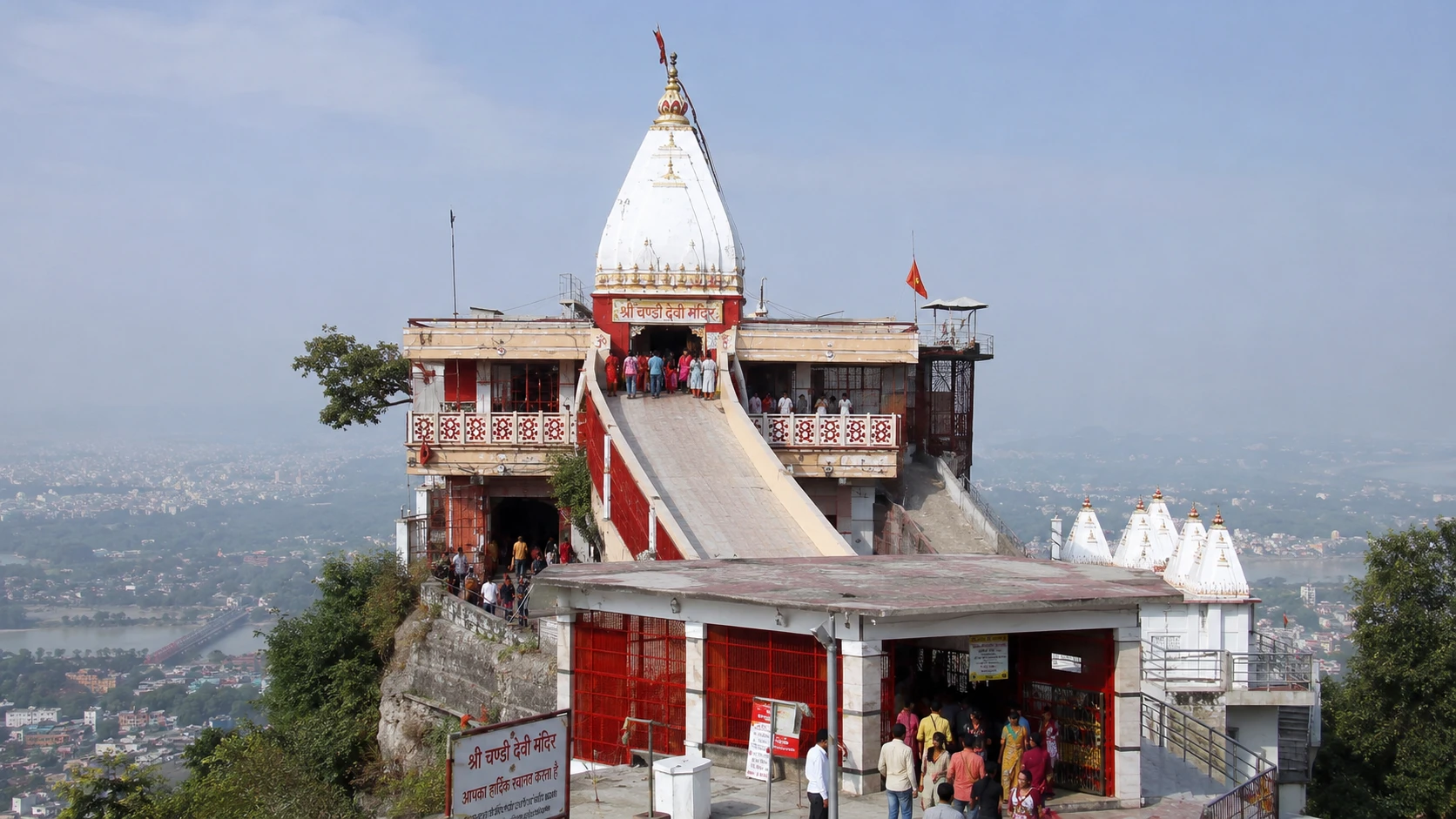
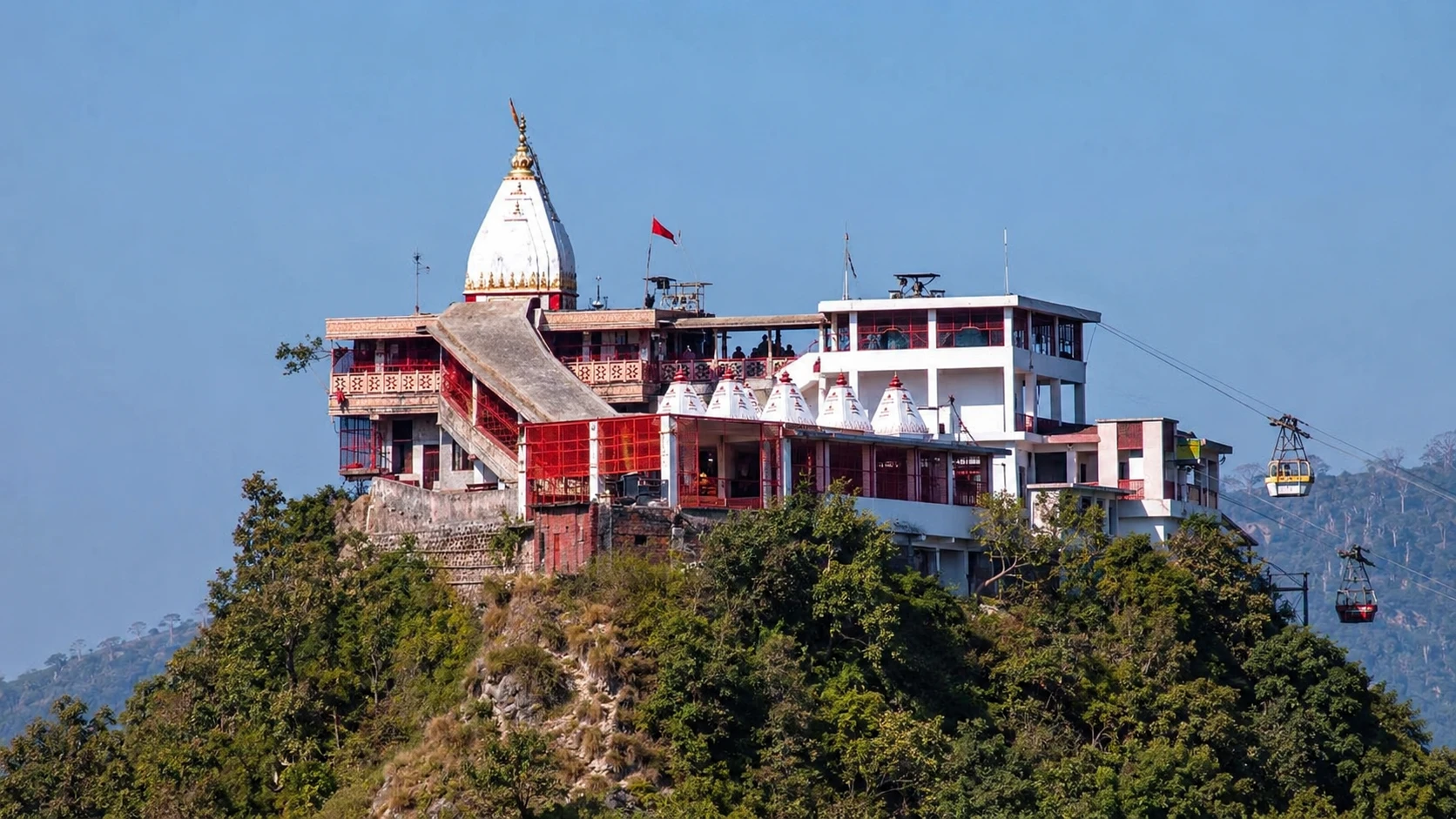
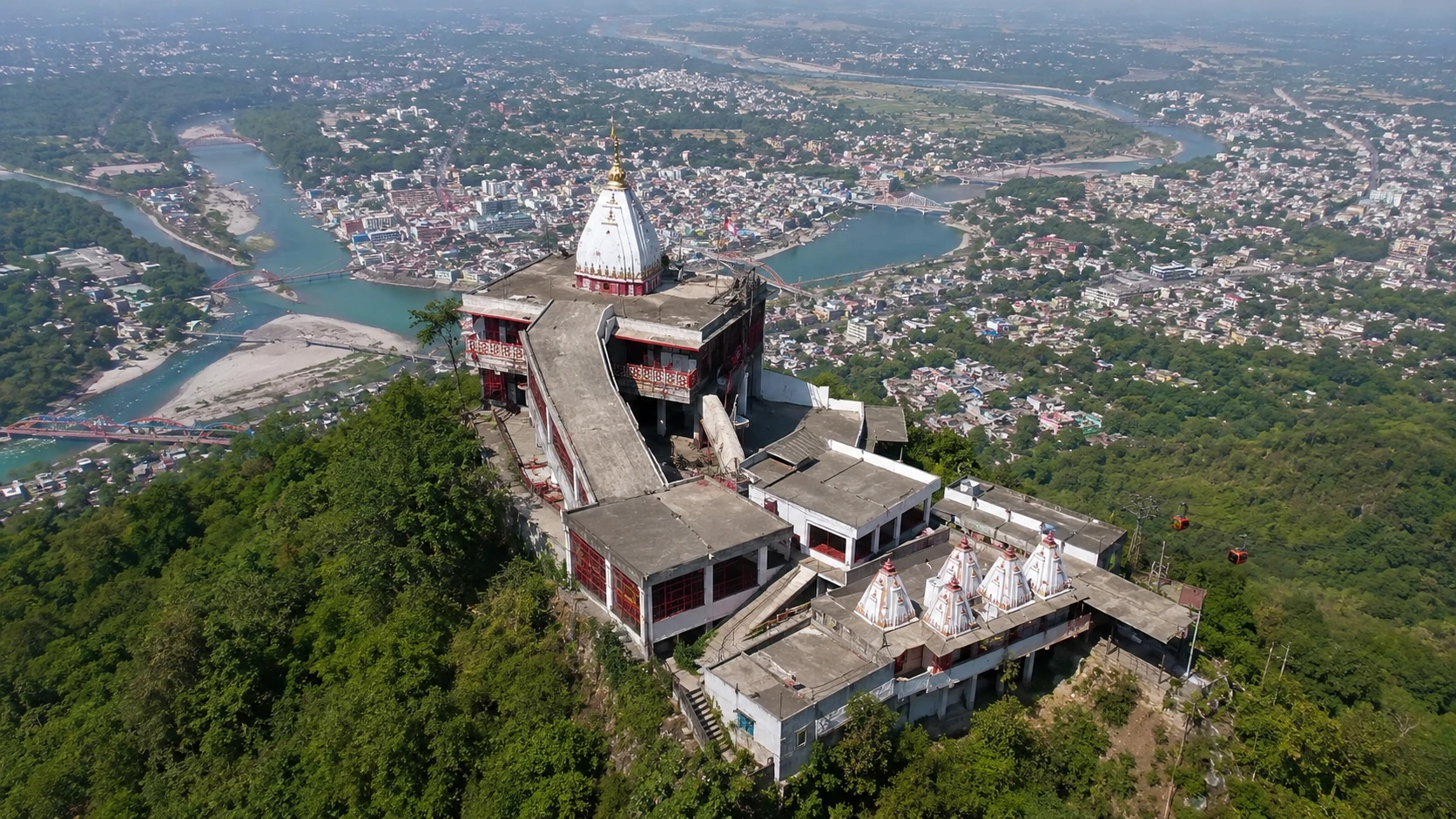
The Chandi Devi temple stands on the summit of Neel Parvat — the eastern of the three Shivalik foothills rising above Haridwar, on the opposite side of the Ganga from Bilwa Parvat where Mansa Devi sits. The two temples form a deliberately paired devotional unit: Mansa Devi to the west, Chandi Devi to the east, the Ganga flowing between them, and Maya Devi within Haridwar town completing the informal Haridwar Devi triad. The principal deity is Chandi Devi — the fierce warrior-form of the Goddess who, in the Devi Mahatmya, slew the asuras Chanda and Munda and from this victory received the epithet Chamunda. The temple's iconographic and devotional register is thus distinct from Mansa Devi's: where Mansa is approached as the wish-fulfilling goddess of the mind, Chandi is approached as the unsubduable warrior-Devi who has already won the cosmic battle and now sits on her hill as the protector who saw it through. The temple's foundational distinction is its attribution to Adi Shankaracharya. According to the long-standing tradition preserved across the Haridwar devotional and broader Advaita-Vedantic historiography, the present principal murti was consecrated by Adi Shankaracharya himself during his eighth-century pilgrimage through northern India — placing Chandi Devi within the rare set of Hindu temples for which a Shankaracharya foundation is traditionally claimed (alongside Sringeri Sharadamba, Kanchi Kamakshi, and a handful of others). The architectural temple structure visible today substantially postdates that early consecration: the temple was built or rebuilt in 1929 by Maharaja Suchat Singh of Kashmir, and the visible structure reflects that early-twentieth-century reconstruction. The 1998 opening of the Chandi Devi Udankhatola (the ropeway, operated by Usha Breco Limited) seventeen years after the Mansa Devi ropeway transformed the temple's accessibility for the broader pilgrim flow. Devotees take Chandi Devi's darshan within the broader Haridwar pilgrimage geography — typically as the second leg of a same-day combined Mansa-Chandi visit, sometimes paired with the Anjana Devi sub-shrine (the small temple to Hanuman's mother that sits within walking distance of Chandi Devi on the same hill) and the Kalu Siddh Baba shrine nearby. Char Dham Yatra-bound pilgrims include Chandi Devi alongside Mansa Devi in their pre-yatra observances, asking the warrior-Devi's protection for the longer Himalayan journey to follow. The combined Haridwar Devi circuit thus operates as a single devotional unit even though the three temples are administered separately and have distinct foundational traditions, deities, and iconographic registers. The temple is administered by the Shri Chandi Devi Mandir Samiti, a managed trust operating under broadly similar governance arrangements as the Shri Mansa Devi Mandir Sanchalini Samiti — both are private-trust-with-state-oversight bodies in the third administrative-architecture mode of the Devi Marquee corpus, distinct from both pure private trusts (Mahalakshmi Mumbai, Dakshineswar) and pure public-statute trusts (Annapurna Varanasi, Saraswati Basar).
Sacred Designationपवित्र पदनाम
Sacred Origin Storyपवित्र उत्पत्ति कथा
Source: Devi Mahatmya (Durga Saptashati), chapters 6–8 (the Chanda-Munda combat sequence) and chapter 7 specifically for the moment from which Chandika receives the Chamunda epithet; Markandeya Purana (within which the Devi Mahatmya is preserved); regional Haridwar mahatmya sources for the temple-foundation tradition; the Adi Shankaracharya pilgrimage-historiography preserved across the Sringeri Sharadamba and broader Shankaracharya-associated-site literature; family-history sources on Maharaja Suchat Singh of Kashmir for the 1929 reconstruction tradition.
The Chandi-narrative is set in the seventh chapter of the Devi Mahatmya, the foundational Shakta text. The asuras Shumbha and Nishumbha, having received the gift of invulnerability, terrorise the three worlds. The gods, dispossessed of their realms, gather on the Himalayas and invoke the Devi. The Devi-as-Kaushiki emerges in radiant form from the body of Parvati; the asuras Shumbha and Nishumbha, struck by her beauty, send their general-asuras Chanda and Munda to capture her by force. As they approach with their armies, the Devi's wrathful form Kali springs from her forehead — black-complexioned, gaunt, armed, the embodiment of the goddess's destroying-aspect. Kali advances on the asura armies, sweeping them aside, and seizes Chanda and Munda themselves. With one stroke she severs the head of each. The Devi, observing Kali's victory, bestows upon her the epithet Chamunda — 'she who has slain Chanda and Munda' — and the name is preserved across the subsequent Shakta tradition as one of the seven Matrikas and as one of the principal Devi-victory-names.
The Chandi Devi temple at Haridwar is theologically positioned within this narrative-framework: the Chandi enshrined at Neel Parvat is the goddess who has already won the cosmic battle, who has slain the demons of obstacle and obstruction, and who now sits on her hill as the protector-from-above. Devotees who approach her do so not to invoke the cosmic battle but to receive its already-completed protection. This devotional register is theologically distinct from the wish-fulfilling Mansa Devi on Bilwa Parvat across the river: where Mansa is approached for the placement of new wishes, Chandi is approached for the protection of journeys already underway and the warding-off of threats not yet faced. The complementarity is deliberate and is one of the reasons the two temples function as a paired devotional unit.
The temple's foundational tradition — distinct from the Devi Mahatmya theological layer — attributes the consecration of the present principal murti to Adi Shankaracharya during his eighth-century pilgrimage through northern India. The Shankaracharya-foundation claim is preserved across the regional Haridwar devotional literature and across the broader Shankaracharya-pilgrimage historiography that connects the four mathas and several principal Devi-shrines. The visible architectural temple structure substantially postdates Shankaracharya: the present temple was built or rebuilt in 1929 by Maharaja Suchat Singh of Kashmir, whose family is preserved in the regional foundational narrative as the modern patrons who restored the temple to its present scale. The visible structure thus reflects the 1929 reconstruction; the principal murti within is the older Shankaracharya-attributed murti preserved through successive reconstructions.
Devotees thus engage with Chandi Devi on multiple registers simultaneously: the Devi Mahatmya theological layer (Chandi as the Chanda-Munda-slaying warrior-Devi), the Shankaracharya-historical layer (the murti within as a vestige of the eighth-century Advaita-Vedantic pilgrimage network), the Suchat Singh-architectural layer (the present temple structure as a 1929 reconstruction by the Kashmir royal family), and the operational-modern layer (the 1998 ropeway, the pre-Char-Dham observance, the combined Mansa-Chandi pilgrimage). Each layer contributes to the temple's lived identity; none of them displaces any other.
Sources cited:
- Devi Mahatmya (Durga Saptashati), chapters 6–8 — the Chanda-Munda combat narrative and the bestowing of the Chamunda epithet
- Markandeya Purana — within which the Devi Mahatmya is preserved
- Adi Shankaracharya pilgrimage historiography (regional Sringeri, Joshimath, and Kanchi Kamakshi traditions)
- Regional Haridwar mahatmya literature (the sthala-purana tradition for the Haridwar Devi circuit)
- Family-history sources on Maharaja Suchat Singh of Kashmir for the 1929 temple reconstruction tradition
- Devi Bhagavata Purana — broader Shakta theological framework
- Saptashati Chandipath liturgical tradition (the standard recitation of the Devi Mahatmya at the temple)
Other Traditions · अन्य परंपराएँ
Scholarly Context
The Chandi Devi narrative requires editorial care on three registers. First, the Adi Shankaracharya attribution: the claim that the present principal murti was consecrated by Shankaracharya during his eighth-century pilgrimage is preserved across multiple regional traditions and is theologically significant, but it is a traditional historiographical claim rather than an archaeologically-settled historical fact. The Eternal Raga treatment is to present the attribution faithfully as it is preserved in the devotional tradition, while noting that the millennium of intermediate history (between Shankaracharya's eighth-century consecration and the 1929 Suchat Singh reconstruction) is documentarily thin and that the present visible temple structure is substantially the 1929 work. Second, the Devi Mahatmya theological layer: the Chanda-Munda combat narrative is presented as the foundational scriptural account from which the goddess's name and protective-aspect identity derive; this is theological-narrative content rather than historical-event content, and is presented as such. Third, the pair-temple-with-Mansa-Devi question: while the Mansa-Chandi pairing is operationally well-established (combined ropeway tickets, combined pilgrimage logic, the Haridwar Devi triad framing), the pairing is a product of geographic-and-devotional convenience rather than of canonical scriptural prescription. The Mansa-Chandi pairing has no formal scriptural source in the way that the Sapt Puri or Dwadasha Jyotirlinga lists have formal scriptural sources; it is a popular-devotional construction that has hardened into operational reality over the past century. The Eternal Raga treatment is to acknowledge the pair-temple framing as devotionally significant while noting its non-canonical character.
Historyइतिहास
The history of Devi-worship on Neel Parvat is, in its earliest phases, traceable through regional Devi-mahatmya literature rather than through archaeological evidence. The pre-eighth-century devotional presence at the site is attested in regional sources without specific dating; what the Chandi Devi narrative tradition identifies as the temple's foundational moment is the consecration of the present principal murti by Adi Shankaracharya during his eighth-century pilgrimage through northern India. This consecration places the temple within the small set of Devi-shrines for which a Shankaracharya foundational attribution is traditionally claimed — alongside Sringeri Sharadamba, Kanchi Kamakshi, and a handful of others — and gives Chandi Devi a historiographical layer that the otherwise similar Mansa Devi (also on a Shivalik foothill above Haridwar) lacks.
The period between the eighth-century Shankaracharya consecration and the 1929 reconstruction is documentarily thin. Regional Haridwar mahatmya literature attests continuous worship at the site through the medieval period; the temple is mentioned in various pilgrim-itinerary sources from the seventeenth century onwards; and the broader Haridwar pilgrimage network — which centred on Har-ki-Pauri and the Ganga ghats but also included the hilltop Devi shrines — operated through the period of Mughal regional control, Maratha campaigns, and the early colonial period. The temple's continuity through this millennium is preserved in the devotional tradition without detailed structural records of the various reconstructions, repairs, and ritual adaptations that must have occurred over so long a span.
The modern phase of the temple's history begins clearly in 1929, when Maharaja Suchat Singh of Kashmir undertook the substantial reconstruction (or, in some accounts, the substantial restoration of a temple that had fallen into significant disrepair) of the present structure. The Kashmir royal family's patronage was part of a broader pattern of late-Princely-State religious patronage in north India during the final decades of British rule, in which various royal families undertook major temple-construction or temple-restoration projects across the Hindu pilgrimage network. The 1929 work established the visible temple structure as it stands today; subsequent twentieth- and twenty-first-century work has expanded courtyard infrastructure, ropeway-arrival facilities, and visitor amenities without significantly altering the 1929 sanctum-and-shikhara core.
The twentieth century saw the temple continue under the Shri Chandi Devi Mandir Samiti, a managed trust. Through Indian independence (1947), the integration of the princely states (1947–1949), Indian statehood reorganisation, and the 2000 creation of Uttarakhand as a separate state, the temple's administrative governance has evolved in parallel with broader Indian temple-administration practices. The relationship with Uttarakhand state oversight took its present form during the post-2000 state-formation period.
The most consequential modern operational change came in 1998 with the opening of the Chandi Devi Udankhatola — the ropeway operated by Usha Breco Limited, the same operator as the older Mansa Devi ropeway across the Ganga. The 1998 opening was seventeen years after the Mansa Devi ropeway and reflected the success of the Mansa Devi precedent in transforming Devi-temple pilgrimage logistics in Haridwar. The ropeway fundamentally changed the temple's accessibility for the broader pilgrim flow: where previously the 3 km stepped pedestrian path had been the only practical route to the hilltop sanctum, the ropeway made the temple accessible in 5–8 minutes for visitors of all ages and physical conditions.
The twenty-first century has brought continuing modernisation focused on visitor logistics. The 2013 Uttarakhand floods (the 'Himalayan tsunami', mid-June 2013) — while they did not directly affect Chandi Devi on the hilltop — disrupted the broader Char Dham Yatra network and brought a temporary contraction in pre-yatra pilgrim flow through Haridwar. The temple recovered within the following yatra season. The 2021 Haridwar Kumbh Mela, held in a curtailed pandemic-affected form, brought reduced but still significant footfall to the Haridwar Devi temples. As of 2026, Chandi Devi operates as a steadily-trafficked Haridwar pilgrimage destination — second to Mansa Devi in daily footfall but with growing recognition particularly among pilgrims following the Shankaracharya-pilgrimage network as a Haridwar node of that broader devotional geography.
Historical Timelineऐतिहासिक कालक्रम
Adi Shankaracharya, according to the long-standing devotional tradition preserved across regional Haridwar sources and broader Shankaracharya-pilgrimage historiography, consecrates the principal murti of Chandi Devi during his eighth-century pilgrimage through northern India. The consecration places the temple within the small set of Hindu shrines for which a Shankaracharya foundational attribution is traditionally claimed.
The temple continues in worship through the medieval Indian period; references to the hilltop Devi shrine appear in regional pilgrimage-itinerary literature from the seventeenth century onwards. The broader Haridwar pilgrimage network operates through Mughal regional control, Maratha campaigns, and the early colonial period.
Maharaja Suchat Singh of Kashmir undertakes the substantial reconstruction (or, in some accounts, the substantial restoration) of the Chandi Devi temple. The 1929 work establishes the visible temple structure as it stands today and is part of a broader pattern of late-Princely-State religious patronage in north India during the final decades of British rule.
Indian Independence. The temple continues under the Shri Chandi Devi Mandir Samiti through the broader transformations of independence and partition.
The Chandi Devi Udankhatola (ropeway) opens, operated by Usha Breco Limited — the same operator as the older Mansa Devi ropeway across the Ganga. The opening occurs seventeen years after the Mansa Devi ropeway and reflects the success of the earlier precedent in transforming Haridwar Devi-temple pilgrimage logistics. The ropeway fundamentally changes the temple's accessibility, making the hilltop sanctum reachable in 5–8 minutes for visitors of all ages and physical conditions.
Uttarakhand is created as a separate Indian state from Uttar Pradesh. Haridwar — and Chandi Devi with it — comes under the new state's administrative jurisdiction; the Shri Chandi Devi Mandir Samiti's relationship with state oversight evolves during the subsequent state-formation period.
The Uttarakhand floods (the 'Himalayan tsunami') strike the Garhwal Himalayas, devastating the Char Dham region and disrupting the broader Char Dham Yatra network. Chandi Devi on the Neel Parvat hilltop is not directly affected by flooding but experiences a temporary contraction in pre-yatra pilgrim flow through Haridwar; recovery follows in the subsequent yatra season.
The Haridwar Kumbh Mela is held in a curtailed pandemic-affected form. Chandi Devi receives reduced but still significant footfall during the curtailed Kumbh; pandemic-era access protocols are operationalised at the ropeway base and hilltop sanctum.
Post-pandemic recovery brings progressive return of Char Dham Yatra and Kumbh-spillover footfall to pre-pandemic levels and beyond. Modernisation of ropeway operations (online booking, expanded operating windows during festival periods) continues. The temple's recognition within the Shankaracharya-pilgrimage network grows particularly among pilgrims following that broader devotional geography.
What You'll Seeदर्शन में
The principal sanctum holds the Chandi Devi murti at the centre of the small temple structure rebuilt in 1929 by Maharaja Suchat Singh of Kashmir. The murti — traditionally attributed to the eighth-century Adi Shankaracharya consecration and preserved through successive reconstructions — depicts the goddess in her canonical Devi-Mahatmya warrior-form. The standard iconographic configuration shows Chandi Devi seated or standing in a victorious posture, multi-armed and bearing weapons: typically a sword (khadga), a trishul (trident), a chakra (discus), and other Devi-armaments in alternating hands, with at least one hand held in varada-mudra (the boon-granting gesture) or abhaya-mudra (the fear-not gesture). She is depicted in the deep red-and-saffron colours of the Devi-warrior register, with a crown, heavy gold ornamentation, and a richly-coloured sari that is changed daily and ritually. Her vahana (mount) — the lion — is depicted at her feet or alongside her, iconographically signifying her sovereignty over the natural-and-cosmic order.
The iconographic registers that distinguish Chandi from Mansa Devi (her pair-temple counterpart across the Ganga) operate on two principal axes. First, the weapons: Mansa Devi's two iconographic configurations (trimukhi and ashta-bhuji) emphasise the multiplicity of the goddess and her wish-granting capacity; Chandi's iconographic configuration emphasises the goddess's protective and victorious capacity through the explicit display of weapons. Second, the posture: Mansa Devi is depicted in a more benevolent and approachable configuration; Chandi is depicted in the alert-warrior posture of a goddess who has just won (or stands ready to win) the cosmic battle. The two configurations together — Mansa on the western hill, Chandi on the eastern hill — present a complementary devotional landscape that captures both the wish-giving and the wish-protecting registers of the Devi-tradition.
The sanctum precinct includes the silver-and-stone railing through which devotees take darshan; the daily-changed floral, silk, and ornament-arrangements at the goddess's feet; perpetual ghee-lamps maintained at the platform corners; and the canopy of garlands renewed at each major aarti. Sub-shrines within the broader hilltop precinct include a small Shiva sub-shrine adjacent to the main sanctum and a Hanuman sub-shrine; the broader hilltop circuit extends to the Anjana Devi sub-shrine (~10–15 minutes walk) and the Kalu Siddh Baba shrine nearby.
Photography of the Chandi Devi sanctum during darshan is restricted. Devotees may photograph the temple's exterior structure, the courtyard, the Shiva sub-shrine, the Hanuman sub-shrine, the Anjana Devi sub-shrine, the Kalu Siddh Baba shrine, the viewing platforms, and the ropeway base and summit stations; photography is not permitted within the inner sanctum or directly facing the Chandi Devi murti. The trust's protocols are enforced by temple-employed darshan staff.
Distinctive Practicesविशिष्ट परंपराएँ
Combined Mansa-Chandi pair-temple pilgrimage with ropeway-circuit ticket
रोपवे-परिक्रमा टिकट के साथ संयुक्त मनसा-चण्डी युग्म-मन्दिर तीर्थ
The most distinctive operational devotional practice at Chandi Devi is the combined pair-temple visit with Mansa Devi on Bilwa Parvat across the Ganga. The two temples are operationally connected through the combined Mansa-Chandi ropeway ticket offered by Usha Breco Limited (the common operator of both ropeways), which represents a modest discount on individual purchases and represents the standard pilgrim itinerary for a single-day Haridwar Devi visit. Pilgrims typically take Mansa Devi darshan in the morning (Bilwa Parvat being more accessible from the Har-ki-Pauri side of the river), cross the Ganga via the Vivekananda Setu road bridge or by ferry, and complete Chandi Devi darshan in the afternoon before returning to Haridwar town for the evening Ganga Aarti at Har-ki-Pauri. The combined-circuit pilgrimage operationalises the complementary devotional pairing — wish-giving Mansa, protective Chandi — as a single devotional unit.
Pre-Char-Dham yatra-protection darshan and Durga Kavach recitation
चार धाम-पूर्व यात्रा-रक्षा दर्शन और दुर्गा कवच पाठ
Char Dham Yatra-bound pilgrims include Chandi Devi as a pre-yatra observance to invoke the warrior-Devi's protection across the Garhwal Himalayan journey to come. The practice is theologically aligned with Chandi's protective-aspect identity in a way that the wish-fulfilling Mansa Devi's pre-yatra observance is not — Chandi is approached specifically for protection-against-threat, which is operationally relevant to the demanding Char Dham route. The Durga Kavach (the protective hymn from the Devi Mahatmya tradition) is commonly recited at the sanctum by pilgrims undertaking the yatra; some pilgrims complete the recitation themselves, others sponsor a temple priest to perform the recitation. The pre-Char-Dham observance peaks during the late-April / early-May yatra-opening window.
Devi Mahatmya recitation on Saptami of Sharadiya Navaratri
शारदीय नवरात्रि की सप्तमी पर देवी माहात्म्य पाठ
The seventh day of Sharadiya Navaratri — the day on which the Devi Mahatmya describes the Chanda-Munda combat — is the temple's symbolic peak-narrative day. The Devi Mahatmya's sixth and seventh chapters (containing the Chanda-Munda combat narrative and the bestowing of the Chamunda epithet) are recited at the sanctum by devotees and priests; many devotional groups organise a continuous Saptashati-path on this day. The practice connects the daily devotional engagement at the temple to the foundational scriptural narrative from which the goddess's identity derives.
Anjana Devi sub-shrine visit (Hanuman's mother)
अंजना देवी उप-स्थल यात्रा (हनुमान की माता)
The Anjana Devi sub-shrine — dedicated to Hanuman's mother and sitting approximately 10–15 minutes walk from the Chandi Devi sanctum along the hilltop path — is included in the standard Chandi Devi pilgrimage circuit. The sub-shrine is theologically distinct from the principal Chandi Devi worship but devotionally linked: pilgrims typically take darshan at Chandi Devi first, then walk the connecting path to Anjana Devi, then return. The combined visit gives the hilltop pilgrimage a richer texture, particularly for devotees with a Hanuman-tradition orientation; the practice is also distinctive because Anjana Devi sub-shrines are relatively rare in the broader Indian Hindu temple-network.
Shankaracharya-network pilgrimage inclusion
शंकराचार्य-नेटवर्क तीर्थ में समावेश
Pilgrims following the broader Shankaracharya-pilgrimage network — visiting Sringeri Sharadamba, Kanchi Kamakshi, the four mathas (Sringeri, Dwaraka, Puri, Jyotirmath), and other Shankaracharya-associated Devi-shrines — frequently include Chandi Devi as the Haridwar node of that broader devotional geography. The practice is distinctive to a particular Advaita-Vedantic-oriented devotional stream rather than to general Haridwar pilgrimage; pilgrims following this stream often arrive at Chandi Devi with a particular sense of completing a Shankaracharya-network observance, and may include the Joshimath (Jyotirmath) connection in their broader yatra plan.
Forest-path pedestrian approach as a contemplative ascent
एक चिन्तनशील चढ़ाई के रूप में वन-पथ पैदल मार्ग
The 3 km stepped pedestrian path from the base to the Chandi Devi hilltop — longer than Mansa Devi's 1.5 km path — passes through the lower edge of the Rajaji National Park forest cover and offers a contemplative ascent for pilgrims who prefer the traditional approach over the ropeway. The path takes 45–75 minutes on foot at a moderate pace; experienced trekkers and yatris of the Char Dham route often use the pedestrian approach as a preparation-walk before the longer Himalayan trek to follow. The path's forest-edge setting and the elevation gain combine to give the approach a meditative quality distinct from the rapid ropeway transit.
Did You Know?क्या आप जानते हैं?
The Chandi Devi temple is traditionally attributed to Adi Shankaracharya's eighth-century pilgrimage consecration of the principal murti — placing it within the small set of Hindu shrines (alongside Sringeri Sharadamba, Kanchi Kamakshi, and a handful of others) for which a Shankaracharya foundational attribution is preserved across regional devotional tradition. This historiographical layer distinguishes Chandi Devi from the otherwise-similar Mansa Devi on Bilwa Parvat across the Ganga.
The temple's principal narrative identity derives from the Devi Mahatmya's Chanda-Munda combat (chapters 6–8), in which the goddess slays the asura generals Chanda and Munda and receives from this victory the epithet Chamunda. The temple's name 'Chandi Devi' preserves the Chandika identity from this narrative; the temple is operationally one of the principal sites at which the Chandi-narrative is liturgically performed, particularly during Sharadiya Navaratri.
The present visible temple structure was substantially rebuilt in 1929 by Maharaja Suchat Singh of Kashmir — part of a broader pattern of late-Princely-State religious patronage in north India during the final decades of British rule, in which various royal families undertook major temple-construction or temple-restoration projects across the Hindu pilgrimage network. The principal murti within is older than the 1929 structure and is the murti traditionally attributed to the eighth-century Shankaracharya consecration, preserved through successive reconstructions.
The Chandi Devi Udankhatola (ropeway) opened in 1998, seventeen years after the Mansa Devi ropeway across the Ganga. Both ropeways are operated by Usha Breco Limited, the same operator, and a combined Mansa-Chandi ropeway ticket is offered at a modest discount on individual ticket prices — operationalising the pair-temple devotional pairing as a single-day combined-circuit pilgrimage.
The Mansa-Chandi pair-temple pairing — Mansa on the western Bilwa Parvat, Chandi on the eastern Neel Parvat, with the Ganga flowing between them — operates as a complementary devotional landscape rather than as a hierarchical or canonical pairing. Mansa is approached as the wish-fulfilling goddess of the mind; Chandi is approached as the protective warrior-form. The pairing has no formal scriptural source in the way that the Sapt Puri or Dwadasha Jyotirlinga lists have formal scriptural sources; it is a popular-devotional construction that has hardened into operational reality over the past century, particularly accelerated by the ropeway openings (1981 Mansa, 1998 Chandi).
The Anjana Devi sub-shrine — dedicated to Hanuman's mother and located approximately 10–15 minutes walk from the Chandi Devi sanctum along the same hilltop path — is one of the relatively rare Anjana Devi shrines in the broader Indian Hindu temple-network. The sub-shrine is included in the standard Chandi Devi pilgrimage circuit and gives the hilltop visit a richer texture for pilgrims with a Hanuman-tradition orientation. The connection to Hanuman through his mother is theologically significant in the broader Ramayana-devotional landscape.
The Kalu Siddh Baba shrine nearby on the same hill is a Siddh-tradition yogi shrine — part of the broader north Indian Siddh and Nath yogi devotional landscape that operates parallel to, and sometimes integrates with, the Devi-temple network. The Kalu Siddh Baba shrine is theologically distinct from the Chandi Devi worship but is treated within the broader hilltop pilgrimage circuit by pilgrims with a Siddh-tradition orientation.
Chandi Devi is administered by the Shri Chandi Devi Mandir Samiti, a managed trust operating under broadly similar governance arrangements as the Shri Mansa Devi Mandir Sanchalini Samiti — both fall within the corpus's third administrative-architecture mode (managed trust with some Uttarakhand state oversight), distinct from both pure private trusts (Mahalakshmi Mumbai, Dakshineswar) and pure public-statute trusts (Annapurna Varanasi, Saraswati Basar). The two-temple parallel-governance arrangement in Haridwar reflects the broader Uttarakhand state pattern of managed-trust oversight for Devi temples that emerged in the post-2000 state-formation period.
Chandi Devi is not in the canonical 51/52 Shakti Peeth list. The temple's significance is established through (a) the Devi Mahatmya Chandi-Mahatmya warrior-Devi tradition, (b) its position as the eastern apex of the Haridwar Devi triad, (c) its Adi Shankaracharya foundational attribution placing it within the eighth-century Advaita-Vedantic pilgrimage network, (d) its role as a Char Dham Yatra pre-pilgrimage observance, and (e) its Kumbh-Mela-host-city placement.
Char Dham Yatra-bound pilgrims include Chandi Devi as a pre-yatra observance to invoke the warrior-Devi's protection across the Garhwal Himalayan journey. The Durga Kavach (the protective hymn from the Devi Mahatmya tradition) is commonly recited at the sanctum by yatra-bound pilgrims; the practice peaks during the late-April / early-May yatra-opening window. The Chandi-protection register is theologically distinct from the wish-fulfilling Mansa Devi pre-yatra observance — Chandi is approached specifically for protection-against-threat, which is operationally relevant to the demanding Char Dham route.
The Haridwar Kumbh Mela — held every twelve years (most recent: 2021, next: 2033) and with an Ardh Kumbh every six years — brings extraordinary spillover footfall to all Haridwar Devi temples including Chandi Devi. During Kumbh and Ardh Kumbh years, cumulative attendance at Chandi Devi can multiply several-fold during the central bathing-snan days. The 2021 Haridwar Kumbh, held in a curtailed pandemic-affected form, brought reduced but still significant footfall to the temple.
Festivalsत्योहार
Sharadiya Navaratri (with Saptami Chanda-Munda observance)
शारदीय नवरात्रि (सप्तमी चण्ड-मुण्ड अनुष्ठान के साथ)
Sharadiya Navaratri is the temple's principal annual flagship — Chandi Devi being one of the Devi forms most directly associated with the Devi Mahatmya's narrative cycle. The seventh-night Saptami observance is theologically distinctive: the day on which the Chanda-Munda combat is described in the foundational scripture is the day on which the temple's narrative-and-name comes into focus. Many devotional groups organise continuous Saptashati-path (recitation of the full Devi Mahatmya) over the nine nights, with the sixth and seventh chapters (containing the Chanda-Munda combat) receiving particular emphasis on Saptami.
Chaitra Navaratri (Vasanta Navaratri)
चैत्र नवरात्रि (वसन्त नवरात्रि)
The vernal counterpart to Sharadiya Navaratri. At Chandi Devi, the Chaitra observance is moderately attended — substantially less than the Sharadiya nine nights — but is theologically significant as the spring-Navaratri Devi-observance. The closing Ramnavami day connects the Devi observance to the Vaishnava Rama-tradition.
Char Dham Yatra opening (pre-yatra Chandi observance)
चार धाम यात्रा प्रारम्भ (यात्रा-पूर्व चण्डी अनुष्ठान)
The Char Dham Yatra-opening week brings substantial pre-yatra pilgrim attendance to Chandi Devi specifically because of the temple's Chandi-protective-aspect identity. The Durga Kavach is widely recited at the sanctum during this window; the yatra-mangal blessing seva (a dedicated pre-yatra protective puja) is offered by the trust. The combined Mansa-Chandi circuit operates at its highest non-Navaratri annual footfall during this window.
Kumbh Mela and Ardh Kumbh Mela
कुम्भ मेला और अर्ध कुम्भ मेला
Haridwar is one of the four Kumbh-Mela cities, and during Kumbh and Ardh Kumbh years Chandi Devi receives extraordinary spillover footfall from the broader Kumbh pilgrim flow. The central bathing-snan days at Har-ki-Pauri see Kumbh pilgrims commonly extending their Haridwar visit to include Mansa Devi and Chandi Devi darshan; cumulative attendance during these days can multiply several-fold over typical festival-day levels. The 2021 Haridwar Kumbh, held in a curtailed pandemic-affected form, brought reduced but still significant footfall.
Hanuman Jayanti (with Anjana Devi sub-shrine emphasis)
हनुमान जयन्ती (अंजना देवी उप-स्थल पर बल के साथ)
Hanuman Jayanti is observed at Chandi Devi with a particular focus on the adjacent Anjana Devi sub-shrine (Hanuman's mother). The day brings expanded attendance from devotees with a Hanuman-tradition orientation, who walk the connecting path from the main Chandi Devi sanctum to the Anjana Devi sub-shrine and offer Hanuman Chalisa and Bajrang Baan recitations at the sub-shrine. The day is moderately attended at the main Chandi Devi sanctum but is the peak day for the Anjana Devi sub-shrine.
Mahashivratri
महाशिवरात्रि
Although primarily a Shaiva observance, the small Shiva sub-shrine within the Chandi Devi hilltop precinct draws expanded attendance on Mahashivratri. The day brings combined Devi-Shiva darshan completion for devotees who emphasise the integrated Shaiva-Shakta worship tradition; pilgrims commonly combine the Chandi-Mansa circuit with a visit to the Daksha Mahadev temple in Kankhal on Mahashivratri.
Devi Mahatmya Saptaha
देवी माहात्म्य सप्ताह
The annual seven-day continuous recitation of the Devi Mahatmya — particularly emphasising the Chanda-Munda combat chapters from which the temple's name and identity derive — is conducted by the temple at the hilltop precinct. The Saptaha draws scholars, Vaidikas, and devotees with a particular Shakta-textual orientation; the seventh-day conclusion typically involves a purnaahuti (closing-fire-offering) and expanded prasad-distribution.
Char Dham Yatra closing (post-yatra Chandi observance)
चार धाम यात्रा समापन (यात्रा-उत्तर चण्डी अनुष्ठान)
Char Dham Yatra-returning pilgrims include Chandi Devi as a post-yatra thanksgiving observance, completing the protective-cycle that began with the pre-yatra Durga Kavach recitation in late April / early May. The post-yatra observance is operationally lighter than the pre-yatra peak but is theologically significant as the closing of the protective-cycle. The temple sees a steady flow of yatra-completion devotees during this window.
Traditional Offeringsपारंपरिक अर्पण
Primary Offerings
Red flowers (hibiscus, marigold, rose)
लाल पुष्प (गुड़हल, गेंदा, गुलाब)
Red flowers are the canonical Devi-offering in the north Indian tradition. Hibiscus (jaba), marigold (genda), and rose petals are offered at the goddess's feet during darshan; the red colour invokes the Shakti-aspect of the goddess and is iconographically continuous with the deep red-and-saffron register of the Chandi-warrior iconography. The flowers are typically purchased at small stalls along the pedestrian-path approach or at the ropeway base-station market.
Kumkum, sindoor, and turmeric
कुंकुम, सिन्दूर, और हल्दी
The triad of red kumkum, vermilion sindoor, and turmeric is offered at the goddess's feet and applied to her forehead. The triad is the standard Devi-temple offering vocabulary across north India and is distributed back to devotees as part of the prasad-blessing; married women receive the sindoor-blessing as a saubhagya-aashirvad.
Coconut (nariyal)
नारियल
Coconut is brought by devotees and broken in the courtyard area at the entrance to the sanctum precinct; the broken-coconut offering is theologically associated with the breaking of the ego before the deity and is a standard north Indian Devi-temple offering. The flesh of the coconut is returned to the devotee as prasad; the broken-and-blessed coconut is sometimes carried home for household puja inclusion or carried on Char Dham yatra as a portable blessing.
Ghee diya (clarified-butter lamp)
घी का दीपक
Lamps of pure ghee are lit at the goddess's feet by devotees, who carry small earthen-or-metal dipikas as part of their offering. The light symbolises both the devotional warmth and the dispelling of ignorance through Mother-grace. Akhand-jyot (continuous ghee-lamp) sponsorship is available through the trust's seva-booking system, particularly for Sharadiya Navaratri Saptami observances.
Mishri, fruits, and seasonal offerings
मिश्री, फल, और मौसमी अर्पण
Mishri (rock sugar), seasonal fruits, and other small offerings complete the standard Devi-offering set at Chandi Devi. Mishri is the principal sweet offering at the sanctum and is distributed back as prasad; fruits are placed at the goddess's feet during darshan and returned to the devotee in part as prasad. The seasonal-availability principle is maintained: pilgrimage-season fruits (apples, oranges, pomegranates in autumn through winter; mangoes and seasonal varieties in summer) are offered as available.
Unique to This Temple
Chandi Path sponsorship (continuous Saptashati recitation seva)
चण्डी पाठ प्रायोजन (निरन्तर सप्तशती पाठ सेवा)
The temple's signature seva is the sponsorship of a Chandi Path — the continuous recitation of the Devi Mahatmya (Durga Saptashati) at the sanctum, with particular emphasis on chapters 6–8 (the Chanda-Munda combat narrative). The full recitation takes 3–4 hours and is conducted by trust priests with the sponsor in attendance. The Chandi Path sponsorship is theologically the most-aligned vow-completion offering for the temple: the goddess's principal scriptural source is recited in her presence, and the sponsor receives the protective-aspect blessing that the recitation invokes. The Chandi Path is particularly popular during Sharadiya Navaratri, the Char Dham yatra-opening window, and as a vow-completion for a successfully-completed Char Dham yatra.
Weapon-symbol offerings (small ritual blades, trishul-replicas)
आयुध-प्रतीक अर्पण (छोटे अनुष्ठानिक ब्लेड, त्रिशूल-प्रतिकृतियाँ)
Devotees may offer small symbolic ritual blades or miniature trishul-replicas at the sanctum as offerings that invoke the goddess's warrior-aspect identity. The practice is distinctive to Chandi Devi within the broader Devi-temple offering landscape and connects directly to the Chanda-Munda combat narrative; the symbol-weapons are blessed at the sanctum and may be carried home for household puja-shrine inclusion. The practice should not be confused with the historical Bengal Shakta blood-sacrifice tradition: the Chandi Devi temple's daily ritual is fully vegetarian and the weapon-symbol offering is purely emblematic.
Char Dham yatra-mangal blessing (pre-yatra protective offering, parallel to Mansa Devi)
चार धाम यात्रा-मंगल आशीर्वाद (यात्रा-पूर्व रक्षा-अर्पण, मनसा देवी के समानांतर)
Like Mansa Devi across the Ganga, Chandi Devi offers a pre-yatra blessing service for Char Dham Yatra-bound pilgrims — a dedicated short puja in which the pilgrim's yatra-mangal is invoked at the Chandi Devi sanctum, with thread-blessing, akshat-application, and a small protective amulet (taveez). The Chandi Devi version of the seva emphasises the warrior-Devi's protection against the threats of the Himalayan route, distinct from the wish-fulfilling emphasis of the Mansa Devi version. Many pilgrims complete both blessings — Mansa Devi for the placement of the yatra-wish, Chandi Devi for the protection of its completion.
Boondi laddu prasad (the temple's signature prasad-sweet)
बूँदी लड्डू प्रसाद (मन्दिर का हस्ताक्षर प्रसाद-मिष्ठान्न)
Boondi laddu — the small-bead besan-and-sugar laddu — is the temple's signature prasad-sweet, distributed at counters near the sanctum exit. The choice is regional-north-Indian and parallel to Mansa Devi's signature prasad; many pilgrims complete the combined Mansa-Chandi pair-temple circuit with laddu-prasad purchases from both temples carried home together. The laddu is sattvika (no onion-garlic) and is sold in small and larger take-home packets.
Devotees may bring offerings from outside the temple grounds or purchase them at the stalls along the pedestrian-path approach and at the ropeway base-station market. Flowers, kumkum, and coconuts are most commonly purchased at the base-station market or the lower stretches of the pedestrian path; the in-temple counters operated by the trust offer the Chandi Path sponsorship, the Char Dham yatra-mangal blessing, and the weapon-symbol offering registration. Coconut-breaking is done at the entrance area; flowers and kumkum are taken into the sanctum. Monetary offerings to the temple go through the trust counters for receipt; for larger sponsorship-amount offerings (Chandi Path, Akhand Jyot, Char Dham yatra-mangal, Navaratri Saptami special-day sponsorship), advance booking through the trust office is recommended, particularly during peak periods.
How to Reachकैसे पहुँचें
Chandi Devi is reached principally by the Chandi Devi Udankhatola (ropeway, operated by Usha Breco Limited since 1998) from the base station on the eastern bank of the Ganga, approximately 4 km from Har-ki-Pauri, or by a 3 km stepped pedestrian path from the base station. The ropeway ride takes 5–8 minutes and covers a horizontal distance with substantial elevation gain to the hilltop sanctum; the pedestrian path takes 45–75 minutes on foot at moderate pace and passes through the lower edge of the Rajaji National Park forest. Ropeway tickets can be booked at the base station or online through Usha Breco's portal; combined Mansa-Chandi ropeway tickets — covering both Bilwa Parvat (Mansa Devi) and Neel Parvat (Chandi Devi) on the same day — are recommended for pilgrims doing the pair-temple circuit. Reaching the Chandi Devi base station: from Har-ki-Pauri (the central Haridwar Ganga ghat), cross the Ganga via the Vivekananda Setu road bridge (~5 km via road) or via ferry (~15-minute river crossing), then proceed to the base station on the eastern bank. Haridwar Junction railway station (HW) is approximately 5 km from the Chandi Devi base station; Jolly Grant Airport (DED) in Dehradun is approximately 35 km; Delhi (IGI Airport, the practical international gateway) is approximately 225 km. Auto-rickshaws, e-rickshaws, shared tempo travellers, and private cabs (Ola, Uber) operate within Haridwar from the railway station, bus stand, or Har-ki-Pauri to the Chandi Devi base station. The combined Mansa-Chandi single-day itinerary is most efficiently executed with a pre-booked private cab or by careful scheduling of the public-transport options across the Ganga.
Plan Your Visitयात्रा की योजना
🌤 Best Season
October to March is the most comfortable period to visit — Haridwar temperatures range from 8–25°C with low humidity and clear views from the Neel Parvat hilltop across the Ganga to Mansa Devi on Bilwa Parvat. Sharadiya Navaratri (September–October) and the Char Dham yatra-opening period (late April / early May) are the most spiritually charged windows; the seventh-day Saptami of Sharadiya Navaratri (the Chanda-Munda observance day) is the temple's symbolic peak. Avoid the heart of the monsoon (mid-July through August) when ropeway operations may be suspended during heavy rain or high wind, and when landslide risk in the surrounding Garhwal foothills disrupts broader regional travel. Avoid late-April through May-onset (peak summer pre-monsoon, 35–40°C) when the pedestrian path becomes uncomfortable in midday hours. The 2013 Uttarakhand floods (the 'Himalayan tsunami', mid-June 2013) — which did not directly affect Chandi Devi on the hilltop — remains a reference for the broader regional flood-risk profile during peak monsoon. Early-morning windows (07:00–10:00) are the least crowded year-round.
👘 Dress Code
Modest traditional dress is expected. For men, full-length trousers or dhotis with sleeved shirts or kurtas are appropriate; for women, sarees, salwar suits, or long skirts with covered shoulders are appropriate. Char Dham-bound pilgrims often visit Chandi Devi in traditional yatra-dress (saffron or white). Comfortable footwear is important for the pedestrian-path approach (rubber-soled shoes are preferable to leather sandals on the stepped path); the ropeway is also more comfortable in modest dress. Shorts, sleeveless tops, and very short dresses are not appropriate for sanctum darshan.
📱 Phones & Photography
Mobile phones must be on silent within the temple precinct. Photography with phones is permitted in the outer courtyard, on the viewing platforms looking out over Haridwar and the Ganga (with Bilwa Parvat and Mansa Devi visible across the river), at the Anjana Devi sub-shrine, at the Kalu Siddh Baba shrine, and at the ropeway base and summit stations. Photography is not permitted in the inner sanctum during Chandi Devi darshan; flash photography is discouraged everywhere. There is no phone-deposit requirement at the temple entrance.
🏨 Accommodation
Haridwar has extensive accommodation across all categories — see the Mansa Devi entry for the broader Haridwar-and-Rishikesh accommodation landscape. For Chandi Devi specifically, pilgrims typically stay in Haridwar town or in the broader Bhupatwala / Jwalapur area rather than in proximity to the Chandi Devi base station (which is more remote from the principal Haridwar hotel concentrations). The combined Mansa-Chandi pair-temple circuit is most easily managed from a Har-ki-Pauri-area base. For Char Dham Yatra-season visits (April through November), pre-booking accommodation 4–8 weeks in advance is strongly recommended; for Sharadiya Navaratri and any Kumbh-Mela year, pre-booking is essential.
Book a Pujaपूजा बुक करें
The Chandi Devi temple operates two access routes (Chandi Devi Udankhatola ropeway via Usha Breco Limited and the 3 km stepped pedestrian path through the lower edge of Rajaji National Park). Devotees should plan their visit around the following: (a) the ropeway operates approximately 08:00–18:00 typical hours, with extended operation during Navaratri and the Char Dham yatra-opening period — book tickets in advance during peak windows; (b) ropeway operations may be suspended during heavy rain or high wind, particularly during the monsoon (mid-July through August); pedestrian-path access remains available year-round but is also affected by monsoon conditions; (c) the temple has a midday closure period (typically 12:00–14:00) — plan to either complete darshan in the morning window or arrive after 14:00 reopening; (d) photography is not permitted in the inner sanctum during Chandi Devi darshan, with trust enforcement; (e) Sharadiya Navaratri Saptami, the Char Dham yatra-opening week, and any Kumbh-Mela year see extreme crowds — pre-plan accordingly with combined Mansa-Chandi ropeway tickets and seva-booking advance enquiry; (f) the temple does not authorise third-party agents or booking-aggregator services to provide paid darshan-skip or ropeway-priority services outside the trust's and Usha Breco's official channels — any such offer should be refused; (g) several fraudulent websites and social-media pages impersonate the temple trust, particularly during Char Dham yatra-opening and Navaratri periods. Carry photo ID for ticketed-seva attendance and ropeway booking.
Managed by: Shri Chandi Devi Mandir Samiti (managed trust with some Uttarakhand state oversight)
Mangala Aarti participation (pre-dawn opening of the goddess)
मंगला आरती में भागीदारी (देवी का प्रातः-पूर्व उद्घाटन)
Chandi Devi Abhishekam
चण्डी देवी अभिषेकम
Chandi Path Archana sponsorship (continuous Saptashati recitation)
चण्डी पाठ अर्चना प्रायोजन (निरन्तर सप्तशती पाठ)
Akhand Jyot (continuous oil/ghee lamp)
अखण्ड ज्योत (निरन्तर तेल/घी दीप)
Annadan (community meal sponsorship)
अन्नदान (सामुदायिक भोजन प्रायोजन)
Char Dham yatra-mangal blessing (pre-yatra protective puja)
चार धाम यात्रा-मंगल आशीर्वाद (यात्रा-पूर्व रक्षा पूजा)
Navaratri Saptami special-day sponsorship
नवरात्रि सप्तमी विशेष-दिवस प्रायोजन
Booking information verified: 2026-05-21
Sacred Soundsपवित्र ध्वनि
Devi Mahatmya (Durga Saptashati) chapters 6–8 — the Chanda-Munda combat narrative from which the temple derives its identity
stotram
Chandi Path (the full Saptashati recitation) — the temple's principal liturgical text
stotram
Durga Kavach — the protective hymn from the Devi Mahatmya tradition; particularly recited by Char Dham pilgrims at Chandi Devi as pre-yatra protection
stotram
Mahishasura Mardini Stotram (Aigiri Nandini) — the principal Devi-victory hymn
stotram
Chandi Devi Chalisa — the forty-verse devotional invocation in the north Indian Devi Chalisa tradition
stotram
Chandi Aarti (Jai Chandi Maa) — the temple's daily morning and evening aarti hymn
aarti
Hanuman Chalisa — recited at the Anjana Devi sub-shrine, particularly on Hanuman Jayanti
stotram
Did You Know? · क्या आप जानते हैं?
The same translation error that turned '33 Koti' into '33 crore' in Hinduism also happened in Buddhism. The Chinese translation of Buddhist texts rendered 'Sapta Koti Buddha' (7 Supreme Buddhas) as '7 Crore Buddhas.' The Tibetan translation got it right: 7 types, not 7 crore. One Sanskrit word, misread across two major world religions, generated two identical misconceptions independently.
Related Contentसंबंधित सामग्री
Related Scriptures
Related Temples
Mansa Devi (Haridwar)
मनसा देवी मंदिर
Haridwar, Uttarakhand
Vaishno Devi
वैष्णो देवी
Katra, Jammu and Kashmir
Chamunda Devi (Pahari)
चामुंडा देवी (पहाड़ी)
Dadh / Chamunda Nandikeshwar Dham, Himachal Pradesh
Brajeshwari Devi
बज्रेश्वरी देवी
Kangra, Himachal Pradesh
Chhinnamastika (Chintpurni)
छिन्नमस्तिका (चिंतपूर्णी)
Chintpurni, Himachal Pradesh
Mahalakshmi Temple (Mumbai)
महालक्ष्मी मंदिर
Mumbai, Maharashtra
Annapurna Mandir (Varanasi)
अन्नपूर्णा मंदिर
Varanasi, Uttar Pradesh
Gnana Saraswati (Basar)
ज्ञान सरस्वती मंदिर
Basar, Telangana
Dakshineswar Kali
दक्षिणेश्वर काली
Kolkata, West Bengal
Community Reflections
🕉️
Be the first to share your reflection.