Chhinnamastika (Chintpurni)
छिन्नमस्तिका (चिंतपूर्णी)
The Shakti Peeth of Sati's forehead in Una district — canonically the Chhinnamastika among the Dasha Mahavidya — venerated as Chinta-Purni, fulfiller of devotees' worries
Chintpurni, Himachal Pradesh, India
Chinnamastikā Devī Mandir (Chintāpūrṇī Dhām), UnāAlso known as: Chinnamastika Devi Mandir, Chinta Purni Devi Mandir, Chinta Purni Dham, Mata Chintpurni, श्री छिन्नमस्तिका देवी मन्दिर, श्री चिन्ता पूर्णी देवी मन्दिर, श्री चिन्ता पूर्णी धाम, माता चिन्तपूर्णी
Open
05:00 (summer 05:00; winter 06:00; opens earlier on festival days) – 22:00 (closes 12:00–14:00 for the midday break; reopens 14:00–22:00; extended hours on festival days)
The Sacred Legend · पवित्र कथा
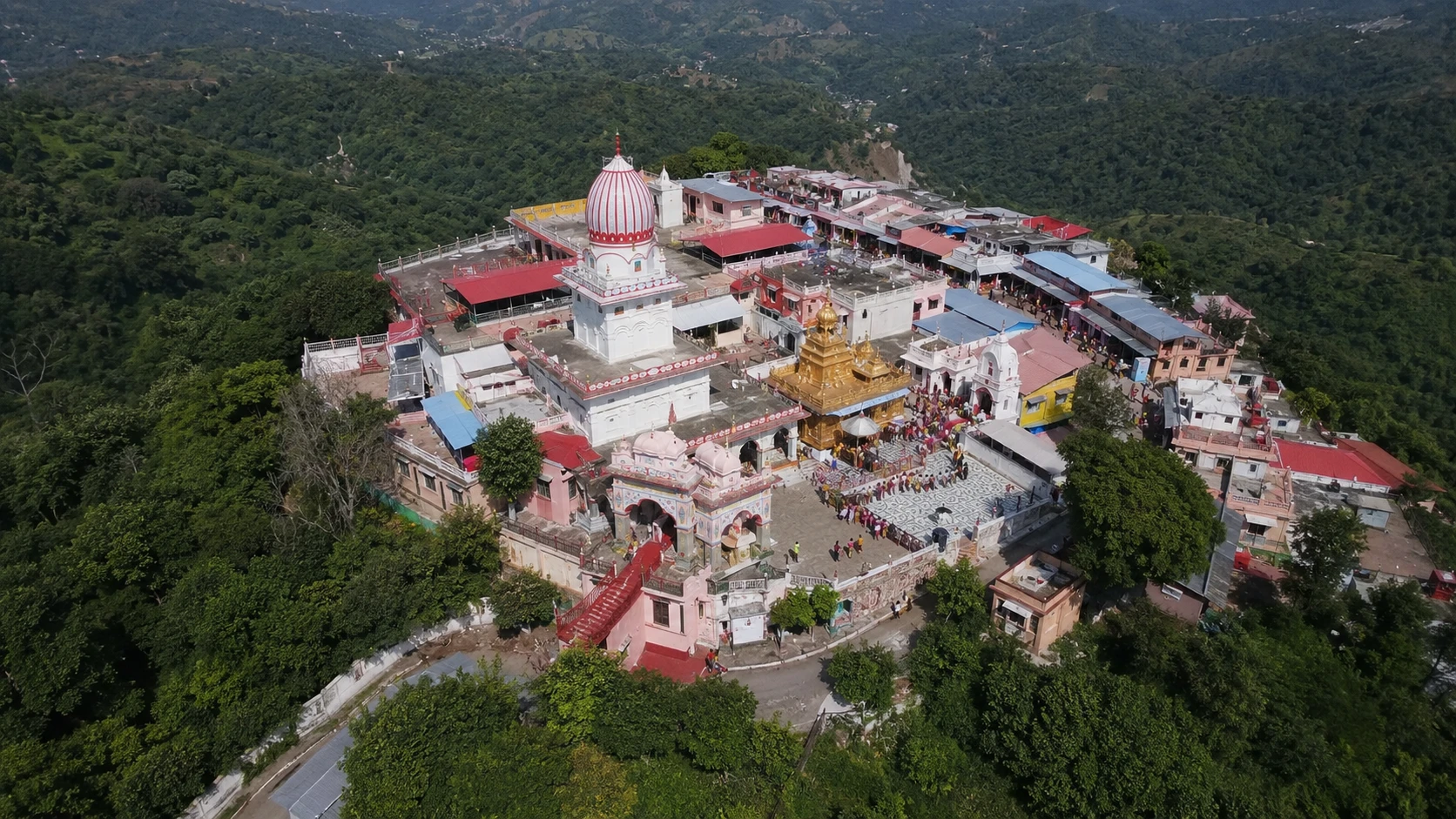
The Chintpurni temple — formally Chinnamastika Devi Mandir — sits in Chintpurni village of Una district, Himachal Pradesh, approximately 75 km south-west of Brajeshwari Devi at Kangra and 100 km south of Chamunda Devi at Dharamshala. It is the third anchor of the Himachal Devi circuit (Brajeshwari → Chamunda → Chintpurni → Jwalamukhi → Naina Devi) and is among the most-venerated Shakta pilgrimage sites of north India. The temple's unusual significance derives from a rare convergence of two canonical Devi-network memberships: Chintpurni is one of the canonical 51/52 Shakti Peethas, marking the place where Sati's forehead (mastaka) fell in the Daksha Yajna dismemberment narrative, AND it is the principal Indian temple-site for Chhinnamastā / Chhinnamastika — the sixth of the Dasha Mahavidya, the ten great Tantric wisdom-goddesses of the Devi tradition. Few Indian Devi-temples hold both canonical-network memberships at this depth; Chintpurni's distinctive theological location at the intersection of the Shakti Peeth and Dasha Mahavidya traditions makes it editorially distinctive within the broader Devi-temple corpus. The Chhinnamastā iconography is among the most theologically arresting in the entire Hindu tradition. The goddess is depicted as standing on a copulating couple, having decapitated herself, holding her own severed head in her left hand while three streams of blood flow from her neck — two streams nourishing her two female attendants Dakini and Varnini, the third stream entering her own severed mouth. The iconography expresses the highest Tantric-Shakta theological insight: the goddess who sustains the cosmos by ceaseless self-sacrifice, who is simultaneously the giver of life, the receiver of life, and the act of giving itself. The iconography is theologically dense and is venerated more often in the broader Mahavidya devotional literature than in standard iconographic display; many Chintpurni pilgrims approach the temple primarily through the more-accessible Chinta-Purni framing (the goddess as fulfiller of devotees' worries) without engaging the full Chhinnamastā iconography. At the temple itself, the goddess is venerated in pindi-form — a rounded sacred stone, consistent with the broader Shakti Peeth iconographic tradition and parallel to Brajeshwari, Vaishno Devi (three pindis), and other pindi-form Shakti Peethas across the network. The pindi-form veneration is theologically significant: it preserves the Shakti Peeth tradition of the dismembered-yet-preserved Devi-presence while allowing the temple's daily devotional engagement to operate through the broader Devi-worship vocabulary rather than through the theologically-demanding Chhinnamastā iconography. The full Chhinnamastā theology remains accessible to pilgrims who engage with the deeper Tantric-Shakta tradition; for the broader devotional flow, the Chinta-Purni framing (literally 'she who fulfils worries') provides the popular devotional access-point. The temple is administered under Himachal Pradesh state religious oversight — broadly within the third administrative-architecture mode of the Devi Marquee corpus (managed trust with state oversight), parallel to Brajeshwari, Chamunda, and the two Haridwar Devi temples (Mansa and Chandi). As of 2026, Chintpurni operates as one of the most-trafficked Himachal pilgrimage destinations, with cumulative attendance during Sharadiya Navaratri crossing 200,000 — among the highest in the broader Himachal Devi-circuit network.
Sacred Designationपवित्र पदनाम
Sacred Origin Storyपवित्र उत्पत्ति कथा
Source: The Daksha Yajna and Sati-dismemberment cycle as preserved in the Devi Bhagavata Purana, the Kalika Purana, and the Pithanirnaya — for the Shakti Peeth foundational layer (Sati's forehead at Chintpurni). The Mahavidya literature, particularly the Mundamala Tantra, the Tantrasara, the Sakta Pramoda, and the broader Dasha Mahavidya devotional tradition — for the Chhinnamastā theology and the canonical Dasha Mahavidya enumeration. Regional Himachal-Punjab devotional and sthala-purana literature for the temple's local foundational tradition, including the Markandeya Rishi founding-narrative and the Chinta-Purni popular-name tradition.
The Chintpurni narrative unfolds across three interlocking theological layers, each of which contributes to the temple's distinctive devotional identity at the intersection of two major Devi-traditions.
The first is the Shakti Peeth foundational narrative — shared with all 51/52 Shakti Peethas across the Indian subcontinent. Sati, the daughter of Daksha and the wife of Shiva, immolated herself in her father's Yajna-fire when Daksha publicly slighted Shiva. The grieving Shiva picked up Sati's body and danced his terrible Tandava across the cosmos; Vishnu intervened with the Sudarshana Chakra, dismembering Sati's body to release Shiva from his overwhelming grief and to preserve the worlds. The places where the body-parts fell became the Shakti Peethas. At Chintpurni, the forehead (mastaka) of Sati fell. The forehead-attribution is preserved consistently across the Devi Bhagavata Purana, the Kalika Purana, the Pithanirnaya, and the broader Tantric Shakti Peeth literature; the Chintpurni attribution is among the more-settled in the broader Shakti Peeth list. The Bhairava paired with this Shakti Peeth as its canonical guardian is preserved in the Tantric enumeration as the specific guardian-Bhairava form for this site.
The second is the Dasha Mahavidya theological layer — the canonical Tantric framework that enumerates the ten great wisdom-goddesses, of whom Chhinnamastā is the sixth. The Dasha Mahavidya (Kali, Tara, Tripura Sundari, Bhuvaneshvari, Bhairavi, Chhinnamastā, Dhumavati, Bagalamukhi, Matangi, Kamala) are theologically presented as ten aspects through which the supreme Devi reveals herself, each Mahavidya embodying a distinct dimension of cosmic wisdom. Chhinnamastā's iconographic narrative — preserved in the Mundamala Tantra, the Tantrasara, and the broader Mahavidya scriptural literature — describes the goddess standing on a copulating couple (representing the cosmic principle of generative-and-dissolving energy), having decapitated herself, holding her own severed head in her left hand while three streams of blood flow from her neck. Two of the streams nourish her two female attendants Dakini and Varnini; the third stream enters her own severed mouth. The iconography is the highest Tantric-Shakta theological statement: the Devi who sustains the cosmos by ceaseless self-sacrifice, who is simultaneously the giver of life, the receiver of life, and the act of giving itself — the dissolution of the subject-object distinction in the unified field of cosmic wisdom. The Chintpurni temple is the principal Indian temple-site for Chhinnamastā veneration; pilgrims with a Mahavidya-tradition orientation approach the temple specifically as the central site of this sixth Mahavidya.
The third is the regional Chinta-Purni narrative — the popular devotional framing through which most pilgrims engage the temple. According to the regional tradition preserved across the Una district and the broader Himachal-Punjab devotional literature, the temple's name 'Chinta-Purni' (literally 'she who fulfils worries') derives from a local foundational episode involving the Markandeya Rishi tradition. Markandeya Rishi, the sage to whom the Devi Mahatmya is traditionally attributed in its Sanskrit transmission, is referenced as the founding sage at the site; the regional tradition holds that worried devotees who approach the goddess with sincere bhakti receive the fulfillment of their concerns (chinta-purti). The Chinta-Purni framing operates as the popular devotional access-point to the temple, mediating the theologically-demanding Chhinnamastā iconography through a more-accessible wish-fulfillment register. Most pilgrims approach the temple primarily through the Chinta-Purni framing; the deeper Chhinnamastā-Mahavidya theology remains accessible to those who engage with the broader Tantric-Shakta tradition.
At the temple itself, the goddess is venerated in pindi-form — a rounded sacred stone, consistent with the broader Shakti Peeth iconographic tradition. The pindi-form veneration is theologically significant in two respects: first, it preserves the Shakti Peeth tradition of the dismembered-yet-preserved Devi-presence at this specific Shakti Peeth site; second, it mediates between the popular Chinta-Purni devotional framing and the theologically-demanding Chhinnamastā iconography in a way that allows both registers to coexist within the daily devotional engagement. The full Chhinnamastā iconographic form exists as supplementary religious imagery within the broader compound and in the regional devotional literature, but is not the primary visible focus of darshan.
Devotees thus engage with Chintpurni on multiple registers simultaneously: the Shakti Peeth theological layer (the goddess as the dismembered-yet-preserved presence of Sati's forehead), the Dasha Mahavidya theological layer (Chhinnamastā as the sixth of the ten great Tantric wisdom-goddesses), the popular Chinta-Purni layer (the goddess as fulfiller of devotees' worries), and the regional Himachal-Punjab pilgrimage-network layer (the third anchor of the Himachal Devi circuit and a major node of the broader Punjab-Himachal-Jammu Devi-pilgrimage corridor). Each layer contributes to the temple's lived identity.
Sources cited:
- Devi Bhagavata Purana — Shakta canonical source for the Sati-dismemberment narrative and the body-part attribution at Chintpurni
- Kalika Purana — broader Shakta-Tantric framework within which the Shakti Peetha enumeration is preserved
- Pithanirnaya — Tantric enumeration of the 51/52 Shakti Peethas, source for the forehead attribution at Chintpurni
- Mundamala Tantra — principal Tantric scripture for Chhinnamastā iconography and theology
- Tantrasara — broader Tantric framework within which the Dasha Mahavidya enumeration is preserved
- Sakta Pramoda — Mahavidya devotional and ritual literature
- Devi Mahatmya (Durga Saptashati) — Markandeya Rishi tradition (founding-sage of the temple)
- Markandeya Purana — within which the Devi Mahatmya is preserved
- Regional Una district devotional and sthala-purana literature for the local foundational tradition
Other Traditions · अन्य परंपराएँ
Scholarly Context
The Chintpurni narrative requires editorial care on four registers. First, the Shakti Peeth body-part attribution: the forehead (mastaka) attribution is settled in the canonical Tantric and Puranic sources, and the Eternal Raga treatment follows the canonical consensus. Second, the Dasha Mahavidya theology: Chhinnamastā as the sixth Mahavidya is established canonical knowledge in the Tantric-Shakta tradition. The Chhinnamastā iconography is theologically demanding and requires respectful editorial treatment — the goddess's self-decapitation and three-stream blood-flow nourishing her two attendants and herself is a precise Tantric symbolic statement of cosmic self-sacrifice, not a sensationalist image. The Eternal Raga treatment presents the iconography accurately and with appropriate theological framing, noting that the temple itself venerates the goddess in pindi-form rather than displaying the full Chhinnamastā iconography. Third, the popular Chinta-Purni framing: this is presented as the regional devotional access-point through which most pilgrims engage the temple, mediating the theologically-demanding Chhinnamastā iconography through the wish-fulfillment register. The Chinta-Purni framing is theologically continuous with the broader Chhinnamastā theology rather than a popular displacement of it — the goddess who sustains the cosmos through self-sacrifice is also the goddess who fulfils the worries of those who approach with bhakti. Fourth, the corpus-internal first-Mahavidya-entry significance: Chintpurni is the corpus's first temple entry within the Dasha Mahavidya tradition, opening a new theological dimension for the broader Eternal Raga Devi-corpus. Future Mahavidya temple entries (potentially at series-extension stage) will draw on the Chintpurni precedent for the editorial protocols of Mahavidya-temple coverage.
Historyइतिहास
The history of Chintpurni at the present Una district site is documented through regional Devi-mahatmya sources, sthala-purana literature, and post-medieval administrative records. The foundational tradition references Markandeya Rishi — the sage to whom the Devi Mahatmya is traditionally attributed in its Sanskrit transmission — as the founding sage who established the original Devi-worship at the site; the Markandeya Rishi samadhi-shrine within the broader compound commemorates this founding-narrative. References to the site as a major Devi shrine appear in pre-Islamic-conquest regional literature, suggesting a substantial pre-eleventh-century presence; the site's relatively remote location in the lower Shivalik foothills appears to have insulated it from the major medieval looting events that affected Brajeshwari at Nagarkot.
The medieval period saw Chintpurni continue under varying levels of regional patronage from the Hindu princely-states and zamindari families of the broader Una and Hoshiarpur regions. The Sikh Empire period of the early nineteenth century brought patronage from Maharaja Ranjit Singh and the broader Sikh-Empire administrative-and-economic framework; the Una region fell within the Sikh Empire from approximately 1809 until the 1849 British annexation of Punjab following the Second Anglo-Sikh War. The temple's continuity through these political reconfigurations is preserved in regional devotional sources and continuous worship-tradition.
The 1849 British annexation brought the Una region within the British Indian administrative framework. Chintpurni continued under British administration, with various Hindu princely-state and zamindari families across the broader Punjab and Hill-states regions contributing to the temple's maintenance and pilgrim infrastructure. The 1905 Kangra earthquake — the major destructive event in the broader Kangra-valley sacred-geography corpus — affected Chintpurni less severely than it affected Brajeshwari and the more-directly-impacted central Kangra valley temples; the Una-district location's greater distance from the epicentre meant only minor structural damage at Chintpurni.
The post-1947 administrative phase brought the temple within the Indian Union framework, initially under Punjab state administration (Una was then part of Punjab) and from 1 November 1966 under Himachal Pradesh administration (when Una and several other Punjab districts were transferred to Himachal Pradesh as part of the Punjab reorganisation). The full Himachal Pradesh statehood from 25 January 1971 brought Chintpurni and the broader Una district within the new state's administrative jurisdiction; the temple has since operated under Himachal Pradesh state religious oversight.
The post-1971 period has seen the most-substantial modernization of the temple's visitor infrastructure: improved approach roads (particularly the upgrading of NH 503), expanded queue-management and security infrastructure during the heavy festival-period crowds, the introduction of online seva-booking through state-affiliated channels, and the integration of Chintpurni into the broader Himachal Devi-circuit tourism-and-pilgrimage management framework. The Amb-Andaura broad-gauge railway line, opened in 2013, brought direct rail connectivity to within 20 km of the temple — a significant upgrade from the prior reliance on the more-distant Una railway station.
The temple's pilgrim flow grew substantially across the post-2000 period as the broader Himachal Pradesh tourism infrastructure expanded and as the Punjab-Himachal-Jammu Devi-pilgrimage corridor (connecting Vaishno Devi, the Himachal Devi-circuit temples, and the broader north Indian Devi-temple network) became more operationally integrated. As of 2026, Chintpurni operates as one of the most-trafficked Himachal Devi-circuit destinations, with cumulative Sharadiya Navaratri attendance crossing 200,000 — placing it alongside Brajeshwari at the very top of the regional Devi-temple pilgrimage flow.
Historical Timelineऐतिहासिक कालक्रम
The Markandeya Rishi tradition identifies the founding-sage of the site; references to a major Devi shrine appear in pre-Islamic-conquest regional literature. The Una district's location in the lower Shivalik foothills places it on the broader pre-modern Indian Hindu sacred-geography network.
Chintpurni continues under varying levels of regional patronage from Hindu princely-states and zamindari families of the broader Una and Hoshiarpur regions. The site's relatively remote location protects it from the major medieval looting events affecting Brajeshwari at Nagarkot (1009 CE, 1360 CE).
The Una region falls within the Sikh Empire of Maharaja Ranjit Singh and the subsequent Sikh-Empire administration. Significant patronage supports the temple's maintenance.
The British annexation of Punjab brings the Una region within the British Indian administrative framework. The temple continues under British administration.
The Kangra earthquake strikes the broader region. Chintpurni's Una-district location at greater distance from the epicentre experiences only minor structural damage; the temple continues without major disruption.
Indian Independence. The temple continues under the Indian Union, initially within Punjab state.
The Punjab reorganisation transfers Una district from Punjab to Himachal Pradesh. Chintpurni comes within Himachal Pradesh administrative jurisdiction (then a Union Territory).
Himachal Pradesh is established as a full Indian state. Chintpurni comes within full Himachal Pradesh state administration.
The Amb-Andaura broad-gauge railway line opens, bringing direct rail connectivity to within 20 km of Chintpurni — a significant upgrade from the prior reliance on the more-distant Una railway station and the road approaches.
Progressive modernization — expanded queue-management and security infrastructure, online seva-booking through state-affiliated channels, NH 503 road upgrades, and integration of Chintpurni into the broader Himachal Devi-circuit tourism-and-pilgrimage management framework.
What You'll Seeदर्शन में
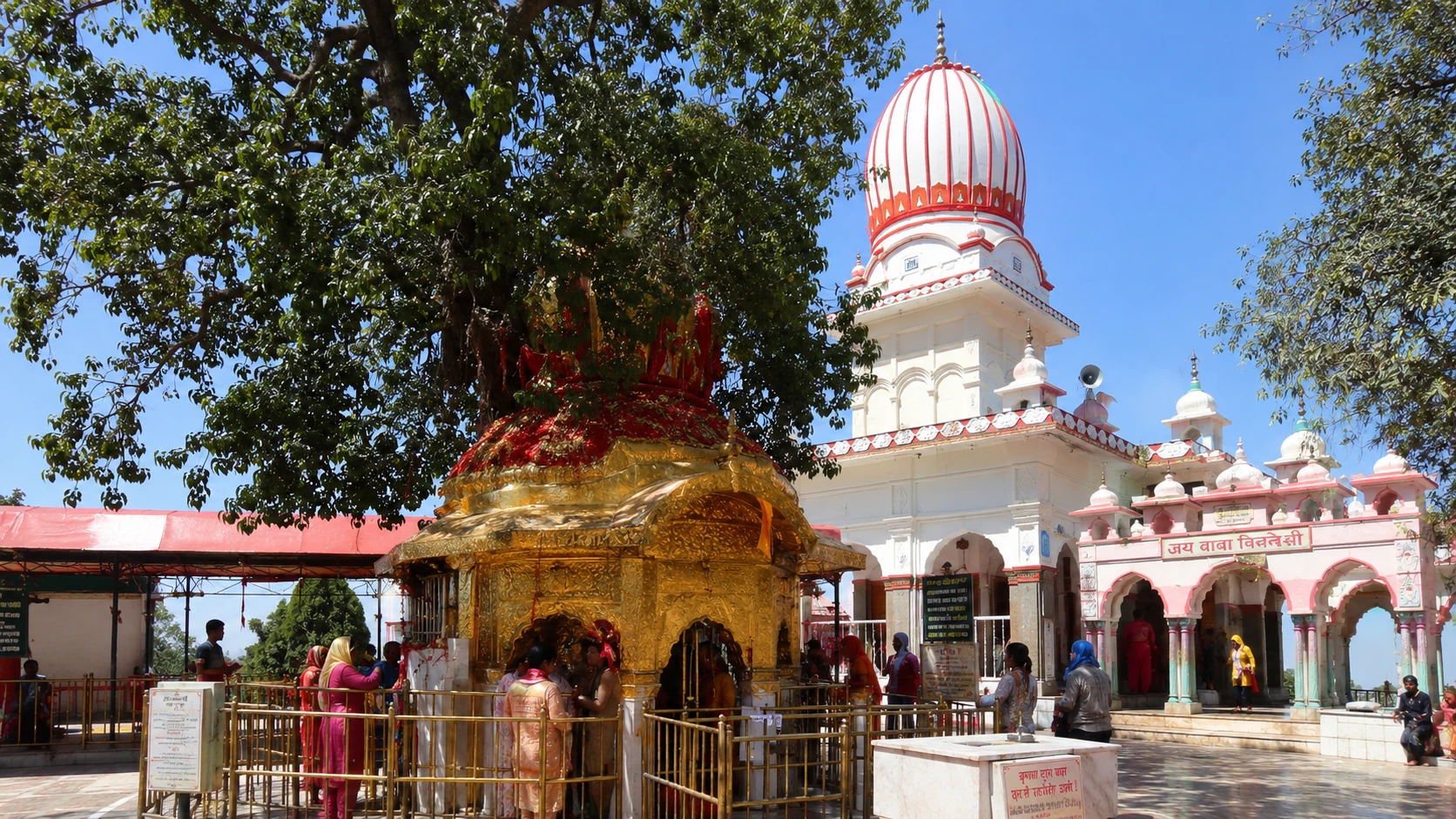
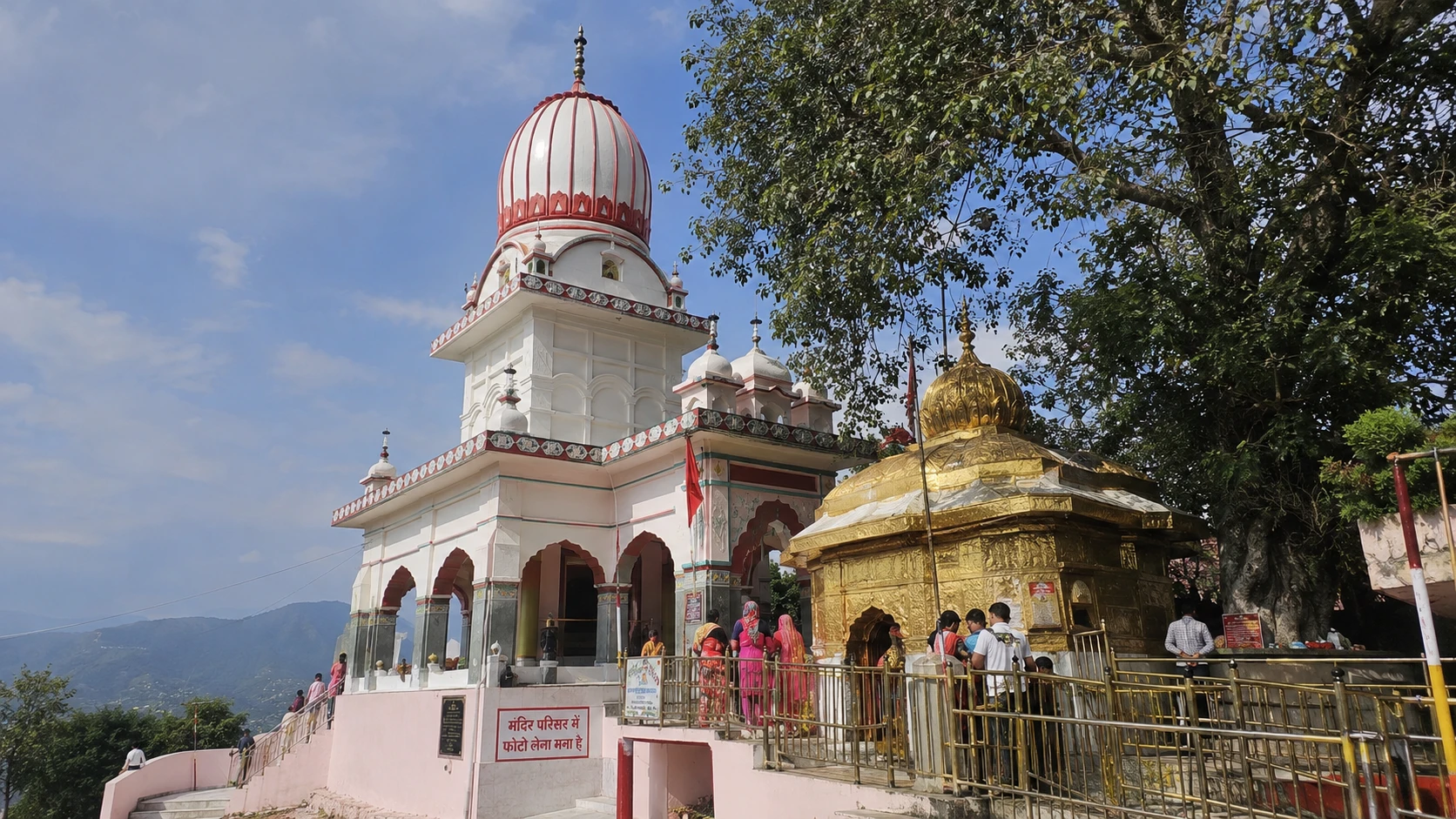
The principal sanctum holds the Chintpurni Devi pindi — a rounded sacred stone in the canonical Shakti Peeth iconographic register. The pindi is elaborately decorated daily with shringar that includes silver-and-gold ornamentation, ritually-changed cloth coverings, and floral arrangements; the visible form changes through the daily ritual cycle. The pindi-form veneration is theologically significant in two respects: first, it preserves the Shakti Peeth iconographic register consistent with the broader pindi-form network (Vaishno Devi, Brajeshwari, Hinglaj, and other principal pindi-form Shakti Peethas); second, it mediates the temple's relationship with the full Chhinnamastā iconography — the goddess holding her severed head, with the three-stream blood-flow nourishing her two attendants Dakini and Varnini and herself — which exists as supplementary religious imagery within the broader compound and in the regional devotional literature but is not the primary visible focus of darshan. The pindi-form thus operates as the day-to-day devotional access-point, with the Chhinnamastā iconography remaining theologically present as the deeper Tantric-Mahavidya substrate.
The walled compound includes the Bhairava sub-shrine — the canonical guardian of every Shakti Peeth, here venerated as the specific Bhairava form paired with the forehead-Shakti-Peeth as its canonical guardian. The Bhairava-pairing tradition operates here in the standard Shakti Peeth canonical mode rather than in the etymologically-cognate mode found at Brajeshwari (Vajra Bhairava ↔ Vajreshwari); the Chintpurni Bhairava-pairing is theological-canonical, like the Nandikeshwar pairing at Chamunda Devi. Adjacent to the principal sanctum is the Markandeya Rishi samadhi-shrine — a small commemorative shrine to the founding-sage of the temple, theologically significant for pilgrims who engage the Markandeya tradition (which connects the Devi Mahatmya itself, attributed to Markandeya, to this specific site).
Additional sub-shrines within the broader compound include a Hanuman sub-shrine and a Ganesha sub-shrine (the latter for ritual-completion purposes that begin Hindu temple visits in many regional traditions). The post-1971 modernization phase has expanded the visitor-amenity infrastructure substantially: covered approach corridors for queue management during peak festival periods, security and screening infrastructure, prasad-distribution counters, and accessible-pathway upgrades.
Photography of the Chintpurni pindi during darshan is restricted. Devotees may photograph the temple's external structure, the Bhairava sub-shrine (outer aspects), the Markandeya Rishi samadhi-shrine, the other sub-shrines, and the broader compound architecture; photography is not permitted within the inner sanctum or directly facing the principal pindi. Some pilgrims who engage with the Chhinnamastā-Mahavidya tradition may also engage with iconographic imagery of the full Chhinnamastā form within the supplementary religious imagery context, but the temple's primary devotional focus is the pindi-form veneration.
Distinctive Practicesविशिष्ट परंपराएँ
Chinta-Purni vow tradition (chinta-purti seva)
चिन्ता-पूर्णी संकल्प परम्परा (चिन्ता-पूर्ति सेवा)
The temple's most-distinctive devotional practice is the Chinta-Purni vow — pilgrims approach the goddess with a specific worry or concern (chinta), make a vow (sankalpa) at the sanctum, and return to the temple after the worry is fulfilled to complete the vow with a prasad-offering and thanksgiving observance. The vow-and-return cycle is deeply embedded in the temple's regional devotional flow; many of the temple's repeat-pilgrims are those returning to complete a Chinta-Purni vow after a successful resolution. The trust offers formal Chinta-Purni seva registrations to record the vow-and-return cycle at the temple's seva counters.
Dasha Mahavidya canonical observance (Chhinnamastā specifically)
दश महाविद्या प्रामाणिक अनुष्ठान (विशेष रूप से छिन्नमस्ता)
Pilgrims with a Mahavidya-tradition orientation approach Chintpurni specifically as the principal Indian temple-site for Chhinnamastā, the sixth of the Dasha Mahavidya. These pilgrims engage with the broader Chhinnamastā theological tradition through Tantric-Shakta liturgical practice — recitation of the Chhinnamastā Stotra, the Chhinnamastā Kavach, and the broader Mahavidya stotra-literature. Some pilgrims following the Dasha Mahavidya pilgrimage-network extend their Chintpurni visit to other Mahavidya temple-sites (Kalighat for Kali, Tarapith for Tara, Kanchipuram for Kamala, and others) as part of a broader multi-temple Mahavidya yatra.
Shakti Peeth canonical paired-darshan with Bhairava
भैरव के साथ शक्तिपीठ प्रामाणिक युग्मित-दर्शन
Devotees following the canonical Shakti Peeth tradition take the principal Chintpurni Devi darshan together with the Bhairava sub-shrine darshan, theologically understood as the two halves of a single canonical Shakti Peeth observance. The paired-darshan tradition operates here in the standard Shakti Peeth canonical mode that the corpus has documented across Brajeshwari (with Vajra Bhairava) and Chamunda Devi (with Nandikeshwar). The practice connects Chintpurni to the broader pan-Indian Shakti Peeth devotional geography.
Markandeya Rishi samadhi observance
मार्कण्डेय ऋषि समाधि अनुष्ठान
Pilgrims engaging the founding-sage tradition include the Markandeya Rishi samadhi-shrine darshan in their Chintpurni visit. The samadhi-shrine connects Chintpurni to the broader Devi Mahatmya transmission tradition (the Saptashati is attributed to Markandeya in its Sanskrit form) and to the Markandeya Purana within which the Devi Mahatmya is preserved. The observance is part of the temple's broader theological positioning within the Devi-tradition's textual heritage.
Sawan Ashtami fair observance
सावन अष्टमी मेला अनुष्ठान
The Sawan Ashtami fair — observed in Shravana month (July–August) — is one of the temple's distinctive regional observances. The fair draws substantial regional attendance from across the Punjab-Himachal pilgrimage corridor and is theologically aligned with the broader Shravana-month Shakti observances of the regional Devi-temple network. The Sawan Ashtami fair is operationally one of the year's peak attendance windows alongside the two Navaratri observances.
Punjab-Himachal-Jammu Devi-pilgrimage corridor connection
पंजाब-हिमाचल-जम्मू देवी-तीर्थ कॉरिडोर सम्बन्ध
Chintpurni operates as a major node within the broader Punjab-Himachal-Jammu Devi-pilgrimage corridor that connects Vaishno Devi (Katra, Jammu), the Himachal Devi-circuit five temples (Brajeshwari, Chamunda, Chintpurni, Jwalamukhi, Naina Devi), Mansa Devi (Panchkula and the broader Punjab Mansa Devi shrines), and Haridwar's Mansa-Chandi pair. Chintpurni's Una district location at the boundary between Himachal Pradesh and the Punjab plains makes it geographically central to this corridor; pilgrims arriving from Punjab via the Amb-Andaura railway or the NH 503 frequently make Chintpurni their first stop in the Himachal Devi-circuit, with the corridor extending northward to Brajeshwari and Chamunda and southward through Haryana to Haridwar.
Did You Know?क्या आप जानते हैं?
Chintpurni holds dual canonical Devi-network memberships: it is one of the 51/52 canonical Shakti Peethas (with Sati's forehead/mastaka attribution) AND the principal Indian temple-site for Chhinnamastā, the sixth of the Dasha Mahavidya (the ten great Tantric wisdom-goddesses). This dual-membership is rare within the broader Devi-temple network and makes Chintpurni the corpus's FIRST entry within the Dasha Mahavidya tradition — opening a new theological dimension for the broader Eternal Raga Devi-corpus.
The Chhinnamastā iconography — the goddess holding her own severed head, with three streams of blood from her neck nourishing her two attendants Dakini and Varnini and herself — is among the most theologically dense in the entire Hindu tradition, expressing the highest Tantric-Shakta statement of cosmic self-sacrifice. The Chintpurni temple venerates the goddess in pindi-form rather than displaying the full Chhinnamastā iconography, allowing the daily devotional engagement to operate through the more-accessible Chinta-Purni framing while preserving the deeper Chhinnamastā theology.
The temple's name 'Chinta-Purni' (literally 'she who fulfils worries') derives from the regional tradition that worried devotees who approach the goddess with sincere bhakti receive the fulfillment of their concerns (chinta-purti). The Chinta-Purni vow tradition is one of the temple's most-distinctive devotional practices — pilgrims make sankalpa at the sanctum, return after the worry is fulfilled, and complete the vow with prasad-offering and thanksgiving observance.
Markandeya Rishi — the sage to whom the Devi Mahatmya (Durga Saptashati) is traditionally attributed in its Sanskrit transmission — is referenced as the founding sage who established the original Devi-worship at the site. The Markandeya Rishi samadhi-shrine within the broader compound commemorates this founding-narrative, connecting Chintpurni theologically to the Devi Mahatmya itself and to the Markandeya Purana within which the Saptashati is preserved.
Chintpurni's relatively remote location in the lower Shivalik foothills of Una district protected the temple from the major medieval looting events that affected Brajeshwari at Nagarkot (1009 CE under Mahmud of Ghazni; 1360 CE under Firuz Shah Tughlaq). The temple's continuous worship-tradition through the medieval period is preserved without major destructive interruptions — distinguishing Chintpurni from the more-thoroughly-documented Brajeshwari history.
The 1905 Kangra earthquake (magnitude ~7.8) had only minor impact on Chintpurni — the Una district's greater distance from the epicentre meant only minor structural damage, in contrast to the substantial destruction at Brajeshwari and the moderate damage at Chamunda Devi. The temple continued without major disruption through the 1905 event and the subsequent recovery phase.
Sharadiya Navaratri cumulative attendance at Chintpurni crosses 200,000 across the festival period — placing it alongside Brajeshwari at the very top of the Himachal Devi-circuit pilgrimage flow. The Sawan Ashtami fair in Shravana month (July–August) is another of the temple's peak-attendance windows.
The 2013 opening of the Amb-Andaura broad-gauge railway brought direct rail connectivity to within 20 km of Chintpurni — a significant upgrade from the prior reliance on the more-distant Una railway station and the road approaches. The railway connectivity has substantially increased pilgrim flow from Punjab, Haryana, and Delhi.
Chintpurni is administered under Himachal Pradesh state religious oversight — within the third administrative-architecture mode of the Devi Marquee corpus (managed trust with state oversight). The corpus now has five Devi temples within this third mode (Mansa Devi Haridwar, Chandi Devi Haridwar, Brajeshwari Devi Kangra, Chamunda Devi Dharamshala, Chintpurni Una), extending the administrative-architecture split to 2:2:5 across the nine entries — the third mode now constitutes the corpus's dominant administrative configuration.
Chintpurni's Una district location at the geographic boundary between Himachal Pradesh and the Punjab plains gives the temple a distinctive cross-regional pilgrimage flow — substantial pilgrim attendance from Punjab and Haryana arrives via the Amb-Andaura railway and the NH 503, alongside the Himachal Devi-circuit yatra-flow from the north (Brajeshwari and Chamunda). This cross-regional pilgrim flow distinguishes Chintpurni operationally within the Himachal Devi-circuit.
Festivalsत्योहार
Sharadiya Navaratri
शारदीय नवरात्रि
The temple's principal annual flagship. Cumulative attendance crosses 200,000 across the festival period — among the highest in the broader Himachal Devi-circuit network. The Navadurga shringar-rotation operates across the nine nights with the pindi presented in each of the nine Navadurga forms. Saptami, Ashtami, and Navami are the peak nights; the broader Himachal Devi-circuit yatra-flow intensifies during the Sharadiya window.
Chaitra Navaratri
चैत्र नवरात्रि
The vernal counterpart to Sharadiya Navaratri. The spring weather in the Una valley is favourable; attendance is substantial. The Navadurga shringar-rotation is performed across the nine nights; the closing Ramnavami brings Vaishnava-tradition observance into the temple calendar.
Sawan Ashtami fair (Shravana Ashtami)
सावन अष्टमी मेला (श्रावण अष्टमी)
The Sawan Ashtami fair is one of the temple's distinctive regional observances, drawing substantial regional attendance from across the Punjab-Himachal pilgrimage corridor. Theologically aligned with the broader Shravana-month Shakti observances of the regional Devi-temple network; operationally one of the year's peak attendance windows alongside the two Navaratris.
Mahashivratri
महाशिवरात्रि
Mahashivratri at Chintpurni is observed with particular emphasis on the Bhairava sub-shrine — the canonical Shaiva-Shakta paired-Shiva form for this Shakti Peeth. The day's all-night observance integrates the broader canonical Shakti Peeth Shaiva-Shakta pairing tradition; attendance is moderate at the principal sanctum but substantial at the Bhairava sub-shrine.
Diwali (with Mahavidya emphasis)
दीपावली (महाविद्या बल के साथ)
Diwali at Chintpurni is observed with a Devi-centric character, with the pindi presented in elaborate Lakshmi-aspect shringar. Pilgrims engaging the Dasha Mahavidya tradition may engage with the Kamala-Mahavidya layer (Kamala being the tenth Mahavidya, theologically continuous with Lakshmi) on this day; the compound is illuminated with diyas through the night.
Hanuman Jayanti
हनुमान जयन्ती
The Hanuman sub-shrine within the temple complex receives expanded attendance on Hanuman Jayanti. The day connects Chintpurni to the broader Ramayana-devotional landscape.
Makar Sankranti / Lohri-Maghi cycle
मकर संक्रान्ति / लोहड़ी-माघी चक्र
The Lohri-Maghi cycle brings expanded regional pilgrim attendance to Chintpurni — particularly from Punjab and Haryana via the Amb-Andaura railway and NH 503. The temple's cross-regional pilgrim flow is at one of its peak windows during this period.
Traditional Offeringsपारंपरिक अर्पण
Primary Offerings
Red and yellow flowers (hibiscus, marigold, rose)
लाल और पीले पुष्प (गुड़हल, गेंदा, गुलाब)
Red and yellow flowers are the standard Devi-offering at canonical Shakti Peethas in the north Indian tradition. Hibiscus (jaba), marigold (genda), and rose petals are offered at the pindi during darshan. Flowers are typically purchased at small stalls along the temple approach.
Kumkum, sindoor, and turmeric
कुंकुम, सिन्दूर, और हल्दी
The triad of red kumkum, vermilion sindoor, and turmeric is offered at the pindi and applied during shringar; the triad is distributed back to devotees as part of the prasad-blessing. Married women receive the sindoor-blessing as a saubhagya-aashirvad.
Coconut (nariyal) — with paired Bhairava offering
नारियल — युग्मित भैरव अर्पण के साथ
Coconut is brought by devotees and broken in the courtyard area. A small secondary coconut is taken to the Bhairava sub-shrine as part of the canonical Shakti Peeth paired-shrine observance. The flesh is returned to the devotee as prasad.
Ghee diya (clarified-butter lamp)
घी का दीपक
Lamps of pure ghee are lit at the pindi by devotees. Akhand-jyot (continuous ghee-lamp) sponsorship is available through the trust's seva system, particularly for Sharadiya Navaratri and Sawan Ashtami observances.
Mishri, fruits, and regional Himachal-Punjab sweets
मिश्री, फल, और क्षेत्रीय हिमाचल-पंजाब मिष्ठान्न
Mishri (rock sugar), seasonal fruits, and regional Himachal-Punjab sweets complete the standard Devi-offering set. Regional sweets — particularly those that travel well — are popular as take-home prasad for the temple's substantial cross-regional pilgrim flow from Punjab and Haryana.
Unique to This Temple
Chinta-Purni vow-completion seva (chinta-purti seva)
चिन्ता-पूर्णी संकल्प-पूर्णता सेवा (चिन्ता-पूर्ति सेवा)
The temple's signature seva is the Chinta-Purni vow-completion seva — pilgrims who made a sankalpa at an earlier visit return to complete the vow after the worry is fulfilled, with a prasad-offering and thanksgiving observance. The seva is operationally distinctive to Chintpurni and is registered at the trust counters; many of the temple's repeat-pilgrim flow consists of vow-completion observances.
Mahavidya-tradition Chhinnamastā Stotra sponsorship
महाविद्या-परम्परा छिन्नमस्ता स्तोत्र प्रायोजन
For pilgrims with a Mahavidya-tradition orientation, Chhinnamastā Stotra and Chhinnamastā Kavach recitation at the sanctum is available as a sponsored seva. The recitation is conducted by trust priests with the sponsor in attendance; this is the temple's principal seva for engaging the deeper Tantric-Mahavidya theological dimension.
Markandeya Rishi samadhi observance package
मार्कण्डेय ऋषि समाधि अनुष्ठान पैकेज
Pilgrims engaging the founding-sage tradition may sponsor a Markandeya Rishi samadhi-shrine observance — Devi Mahatmya recitation at the samadhi-shrine with the sponsor in attendance, connecting the temple's foundational tradition to the broader Devi Mahatmya textual heritage.
Devotees may bring offerings from outside or purchase them at the stalls along the temple approach. Flowers, kumkum, coconuts, and incense are most commonly purchased at the approach stalls; trust-operated counters at the temple entrance offer the Chinta-Purni vow-completion seva, Mahavidya-tradition stotra-sponsorship, Markandeya Rishi samadhi observance, and other formal-seva registrations. Coconut-breaking is done at the entrance area. Monetary offerings to the temple go through the trust counters for receipt; for larger sponsorship-amount offerings (Saptashati-path, Akhand Jyot, Sawan Ashtami special-day sponsorship), advance booking through the trust office is recommended, particularly during Sharadiya Navaratri, Chaitra Navaratri, and Sawan Ashtami.
How to Reachकैसे पहुँचें
Chintpurni is reached principally via NH 503 (the Una-Dharamshala highway) in Una district, Himachal Pradesh. By road, the temple is approximately 3 km from Bharwain on NH 503, 12 km from Amb (the nearest sub-divisional town), 31 km from Una town, 75 km from Brajeshwari Devi at Kangra, 100 km from Chamunda Devi at Dharamshala, and approximately 210 km from Naina Devi (Bilaspur district). By rail, Amb-Andaura railway station (AADR) on the broad-gauge Indian Railways network — opened in 2013 — is approximately 20 km from the temple and provides direct connectivity to Delhi, Amritsar, and other principal north Indian rail nodes; Una Himachal railway station (UHL) is approximately 35 km. By air, Kangra Airport (DHM, Gaggal Airport) is approximately 95 km — limited domestic connectivity, principally to Delhi; Chandigarh International Airport (IXC) at approximately 160 km is the more-developed regional gateway with broader international connections; Indira Gandhi International Airport (DEL), Delhi, at approximately 410 km is the practical international gateway. From Amb-Andaura railway station, auto-rickshaws, shared tempo travellers, and private taxis make the temple connection. Within the broader Himachal Devi-circuit, pilgrims typically combine Chintpurni with Brajeshwari, Chamunda, and Jwalamukhi (and, for extended yatras, Naina Devi at Bilaspur).
Plan Your Visitयात्रा की योजना
🌤 Best Season
October to March is the most comfortable period to visit — Una valley temperatures range from 8–25°C with clear weather. Sharadiya Navaratri (September–October) and Chaitra Navaratri (March–April) are the most spiritually charged windows; Sawan Ashtami (Shravana month, July–August) is the temple's distinctive regional peak. Avoid the heart of the monsoon (mid-July through August) when the broader Himachal road network sees landslide risk, though Chintpurni itself is less monsoon-affected than the higher-elevation Kangra-area Devi temples. The April-through-June pre-monsoon period is warmer (highs 30–38°C) but generally pleasant; the temple's elevation provides modest relief from the heat of the Punjab plains. Early-morning windows (06:00–09:00) are the least crowded year-round.
👘 Dress Code
Modest traditional dress is expected. For men, full-length trousers or dhotis with sleeved shirts or kurtas are appropriate; for women, sarees, salwar suits, or long skirts with covered shoulders are appropriate. The Una valley climate is moderate; layered clothing including a warm shawl is comfortable in the autumn-through-spring months. Shorts, sleeveless tops, and very short dresses are not appropriate for sanctum darshan. Pilgrims following the canonical Shakti Peeth tradition often dress in the traditional yatra-attire (saffron or white).
📱 Phones & Photography
Mobile phones must be on silent within the temple precinct. Photography with phones is permitted in the outer courtyard, at the Bhairava sub-shrine (outer aspects), at the Markandeya Rishi samadhi-shrine, at the other sub-shrines, and in the broader compound. Photography is not permitted in the inner sanctum during Chintpurni darshan. Flash photography is discouraged throughout. There is no phone-deposit requirement at the temple entrance.
🏨 Accommodation
Chintpurni village offers community-trust dharmashalas, budget guesthouses, and modest hotels — primarily catering to the temple's pilgrim flow rather than to broader tourist segments. Una town (~31 km) offers a wider range of accommodation. For the Himachal Devi-circuit yatra, Kangra or Dharamshala (~75 km and ~100 km respectively) offer more-extensive accommodation options and are preferable bases for pilgrims combining Chintpurni with the northern Himachal Devi temples. Punjab-side pilgrims arriving via the Amb-Andaura railway often base themselves in Una or in Hoshiarpur (Punjab) for the broader regional pilgrimage. For Sharadiya Navaratri and Sawan Ashtami, pre-booking accommodation 3–6 weeks in advance is strongly recommended; the broader Himachal Devi-circuit yatra-flow fills accommodation across the region rapidly during these peak windows.
Book a Pujaपूजा बुक करें
The Chintpurni temple operates as a high-traffic Devi-pilgrimage site at the boundary of Himachal Pradesh and the Punjab plains. Devotees should plan their visit around the following: (a) the temple has a midday closure period (typically 12:00–14:00) — plan to either complete darshan in the morning window or arrive after 14:00 reopening; (b) photography is not permitted in the inner sanctum during Chintpurni darshan, with trust enforcement; (c) Sharadiya Navaratri (particularly Saptami through Navami), Chaitra Navaratri peak nights, and Sawan Ashtami (Shravana month, July–August) see extreme crowds with cumulative attendance crossing 200,000 — pre-plan accordingly with seva-sponsorship advance enquiry and accommodation booking; (d) the monsoon season (July–August) brings landslide risk on the broader Himachal road network — plan transport accordingly, particularly for the Sawan Ashtami crossover with monsoon; (e) the hillside topography means stepped access — visitors with mobility limitations should arrive earlier in the day and request assistance from trust attendants; (f) the temple does not authorise third-party agents or booking-aggregator services to provide paid darshan-skip services outside the trust's official channels; (g) the cross-regional pilgrim flow from Punjab and Haryana via the Amb-Andaura railway brings substantial taxi-fraud and overcharging risks at the railway station — pre-book transport or use Himachal Pradesh Tourism-affiliated services; (h) several fraudulent websites and social-media pages impersonate the Chintpurni temple administration, particularly during Navaratri and Sawan Ashtami periods. Carry photo ID for ticketed-seva attendance.
Managed by: Shri Chintpurni Devi Trust (managed under Himachal Pradesh state religious oversight)
Mangala Aarti participation (pre-dawn opening of the goddess)
मंगला आरती में भागीदारी (देवी का प्रातः-पूर्व उद्घाटन)
Chintpurni Abhishekam
चिन्तपूर्णी अभिषेकम
Bhairava paired darshan-sponsorship (canonical Shakti Peeth paired observance)
भैरव युग्मित दर्शन-प्रायोजन (प्रामाणिक शक्तिपीठ युग्मित अनुष्ठान)
Chinta-Purni vow-completion seva (chinta-purti seva)
चिन्ता-पूर्णी संकल्प-पूर्णता सेवा (चिन्ता-पूर्ति सेवा)
Saptashati-path sponsorship (Devi Mahatmya recitation)
सप्तशती-पाठ प्रायोजन (देवी माहात्म्य पाठ)
Akhand Jyot (continuous oil/ghee lamp)
अखण्ड ज्योत (निरन्तर तेल/घी दीप)
Annadan (community meal sponsorship)
अन्नदान (सामुदायिक भोजन प्रायोजन)
Sawan Ashtami special-day sponsorship
सावन अष्टमी विशेष-दिवस प्रायोजन
Navaratri Saptami special-day sponsorship
नवरात्रि सप्तमी विशेष-दिवस प्रायोजन
Booking information verified: 2026-05-21
Sacred Soundsपवित्र ध्वनि
Devi Mahatmya (Durga Saptashati) — the foundational Shakta text recited at the temple during Sharadiya and Chaitra Navaratri; theologically central given the Markandeya Rishi founding-tradition at Chintpurni
stotram
Chhinnamastā Stotra — the principal Tantric stotra for the sixth Mahavidya, recited by Mahavidya-tradition pilgrims at the temple
stotram
Chhinnamastā Kavach — the protective hymn of the sixth Mahavidya in the Tantric tradition
stotram
Dasha Mahavidya stotra collection — devotional invocations to the ten great Tantric wisdom-goddesses
stotram
Chintpurni Devi Chalisa — the forty-verse devotional invocation in the north Indian Devi Chalisa tradition
stotram
Chintpurni Aarti — the temple's daily morning and evening aarti hymn
aarti
Regional Punjabi-Pahari Devi bhajans — folk-devotional songs in the Punjab-Himachal Pahari tradition reflecting the temple's cross-regional pilgrim flow
bhajan
Did You Know? · क्या आप जानते हैं?
The same translation error that turned '33 Koti' into '33 crore' in Hinduism also happened in Buddhism. The Chinese translation of Buddhist texts rendered 'Sapta Koti Buddha' (7 Supreme Buddhas) as '7 Crore Buddhas.' The Tibetan translation got it right: 7 types, not 7 crore. One Sanskrit word, misread across two major world religions, generated two identical misconceptions independently.
Related Contentसंबंधित सामग्री
Related Scriptures
Related Temples
Brajeshwari Devi
बज्रेश्वरी देवी
Kangra, Himachal Pradesh
Chamunda Devi (Pahari)
चामुंडा देवी (पहाड़ी)
Dadh / Chamunda Nandikeshwar Dham, Himachal Pradesh
Naina Devi
नैना देवी
Bilaspur, Himachal Pradesh
Vaishno Devi
वैष्णो देवी
Katra, Jammu and Kashmir
Kalighat
कालीघाट
Kolkata, West Bengal
Kamakhya Temple
कामाख्या मंदिर
Guwahati, Assam
Mansa Devi (Haridwar)
मनसा देवी मंदिर
Haridwar, Uttarakhand
Chandi Devi (Haridwar)
चंडी देवी मंदिर
Haridwar, Uttarakhand
Community Reflections
🕉️
Be the first to share your reflection.