Matangeshwar Mandir (Khajuraho)
मातंगेश्वर मंदिर
The only living temple at Khajuraho — where Shiva's massive ancient lingam receives uninterrupted worship since 900 CE
Khajuraho, Madhya Pradesh, India
MāṭaṅgeśvaraAlso known as: Matangeshwar Mahadev, Matangeshwara Temple, Bal Shiv Temple Khajuraho, Matangi Peeth Khajuraho
Era
c. 900–925 CE (early Chandela period)
Architecture
Chandela Nagara (early, relatively plain compared to later Khajuraho temples)
Open
06:00 – 21:00
Aarti
06:00 · 12:00 · 19:00
Special
Mahashivratri — the temple's major annual festival; the Western Group light-and-sound show runs nearby nightly
The Sacred Legend · पवित्र कथा
Among the famous temples of Khajuraho — celebrated across the world for their extraordinary erotic sculptures — one temple is fundamentally different from all the others. It is not a preserved monument. It is not separated from devotees by barriers. The Matangeshwar temple is a living temple: puja has continued here without interruption since the Chandela kings built it around 900 CE, making it the only active place of worship among Khajuraho's celebrated temple groups. Inside, rising from its base like a natural column of the earth itself, stands one of the largest ancient Shiva lingams in India — smooth, massive, approximately 8.5 feet in visible height, its surface streaked with the ochre and cream of the stone from which it was shaped more than eleven centuries ago. Devotees come to this lingam not to study it but to circumambulate it, touch it, anoint it, and be changed by an encounter with something far older and more permanent than the famous carved walls outside. The temple is named Matangeshwar — Lord of the Matanga domain — connecting Shiva to the Matanga sage tradition from which the ninth Mahavidya, Matangi, emerges.
Sacred Designationपवित्र पदनाम
Sacred Origin Storyपवित्र उत्पत्ति कथा
Source: Shaiva / Chandela royal tradition; Matanga sage lineage in Shakta Tantra
The name Matangeshwar — Maṭaṅgeśvara — means Lord Matangesha: Shiva as the presiding deity of the Matanga domain. The Matanga tradition in Hindu sacred literature has two interrelated strands. In the first, Matanga is a great sage who, despite his birth in a family considered of low or outcast (chandala) status, attains the highest spiritual realisation through devotion to Shiva. In this tradition, Matangeshwar is Shiva as the god who receives the devotion of the excluded and the marginalised, who accepts worship beyond the boundaries of caste purity and Brahminical convention. This is a profound theological statement embedded in the temple's name: the Shiva worshipped here is specifically the Shiva who can be approached from the margins of society. The second strand connects the Matanga tradition directly to the ninth Mahavidya, Matangi — Ucchishtha Chandalini, the Outcaste One — who embodies precisely this principle: that divine wisdom (vak, speech, arts) arises not from pristine ritual purity but from the ucchishtha (leftover, partially-consumed) spaces that the purity system excludes. Matangeshwar's Shiva and Matangi are two faces of the same teaching. At Khajuraho, the tradition of the temple is specifically Shaiva — the object of worship is the great lingam — but the Matanga name plants the temple firmly in the Shakta-Shaiva boundary space where the ninth Mahavidya tradition lives. In local Khajuraho tradition, the lingam at Matangeshwar is sometimes called Bal Shiv (the young or child form of Shiva) and is said to grow slowly — a grain's breadth with each passing year — a motif of living, organic divinity rather than fixed stone.
Sources cited:
- Archaeological Survey of India, 'Khajuraho' (site documentation and temple descriptions)
- Devangana Desai, 'Khajuraho' (1996), Oxford University Press — comprehensive scholarly treatment of the Khajuraho temple complex
- David Kinsley, 'Tantric Visions of the Divine Feminine: The Ten Mahavidyas' (1997), University of California Press — Chapter 10 (Matangi)
- Shakta Pramoda (Matangi puja vidhi)
- Skanda Purana — Matanga sage narratives
Other Traditions · अन्य परंपराएँ
Mahavidya categorisation: Matangeshwar as Matangi's male counterpart (local and regional Shakta tradition)
In the regional Shakta tradition of the Bundelkhand area, the Matangeshwar temple at Khajuraho is understood not merely as a Shiva temple named after the Matanga sage but as a site where Shiva himself is venerated in his capacity as Matangi's divine partner — the male principle (Matangeshwar) that corresponds to the female Mahavidya (Matangi). In this reading, the great lingam represents not just the aniconic Shiva but specifically the Matanga-Shiva principle that grounds Matangi's tradition. This tradition is less documented in formal texts than in local practitioner knowledge and in the institutional classification of the temple as a Mahavidya site.
Scholarly Context
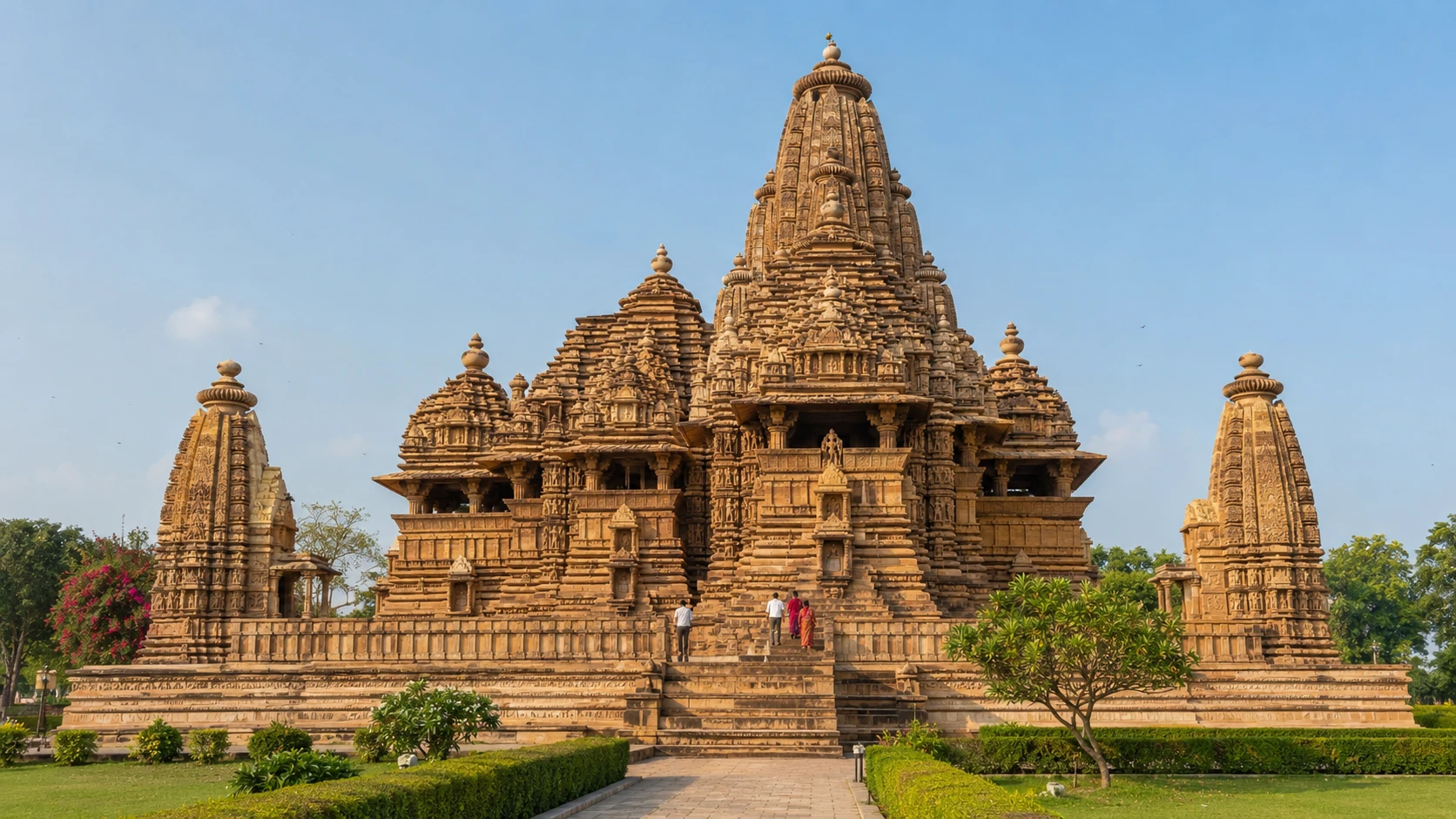
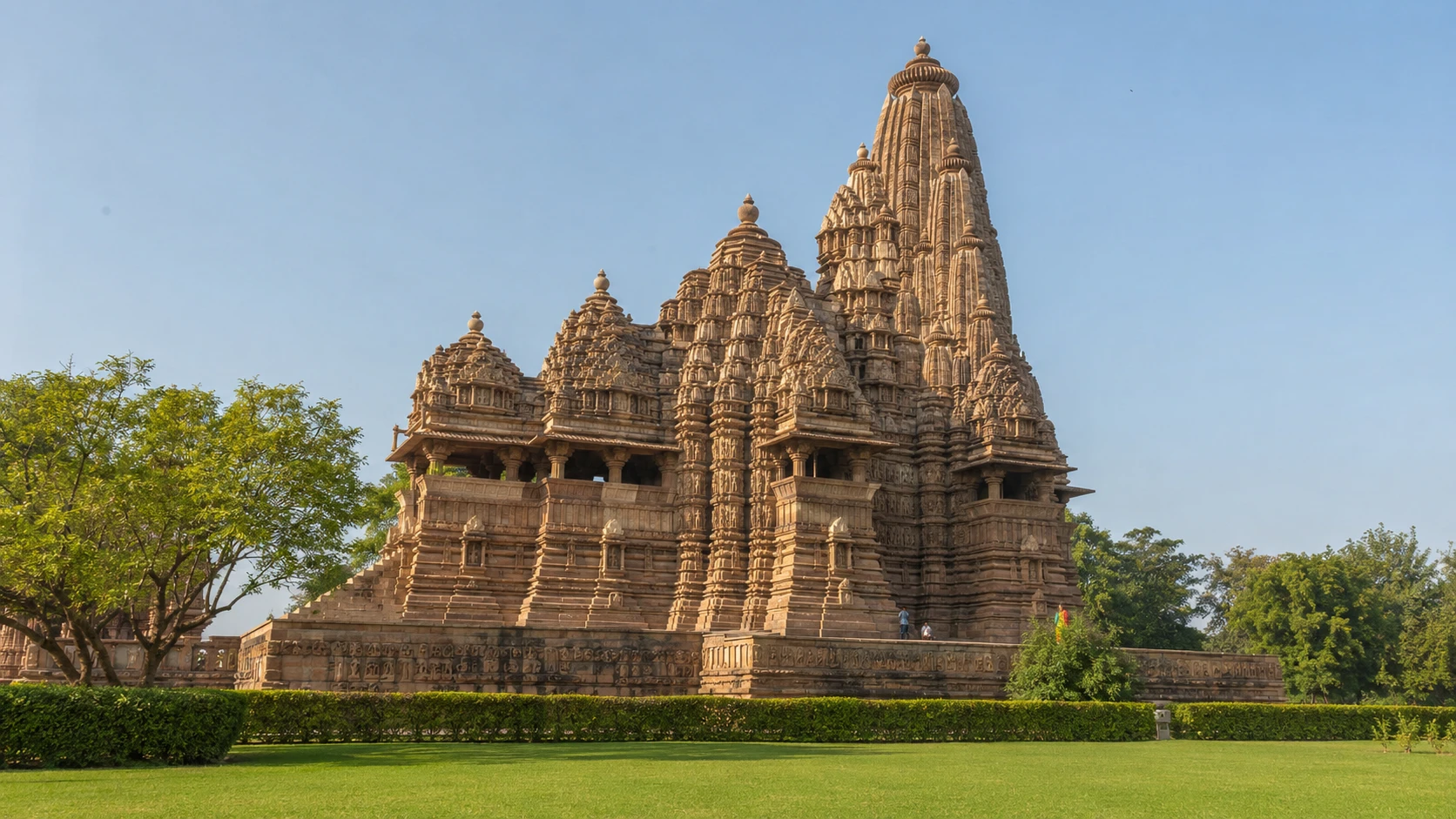
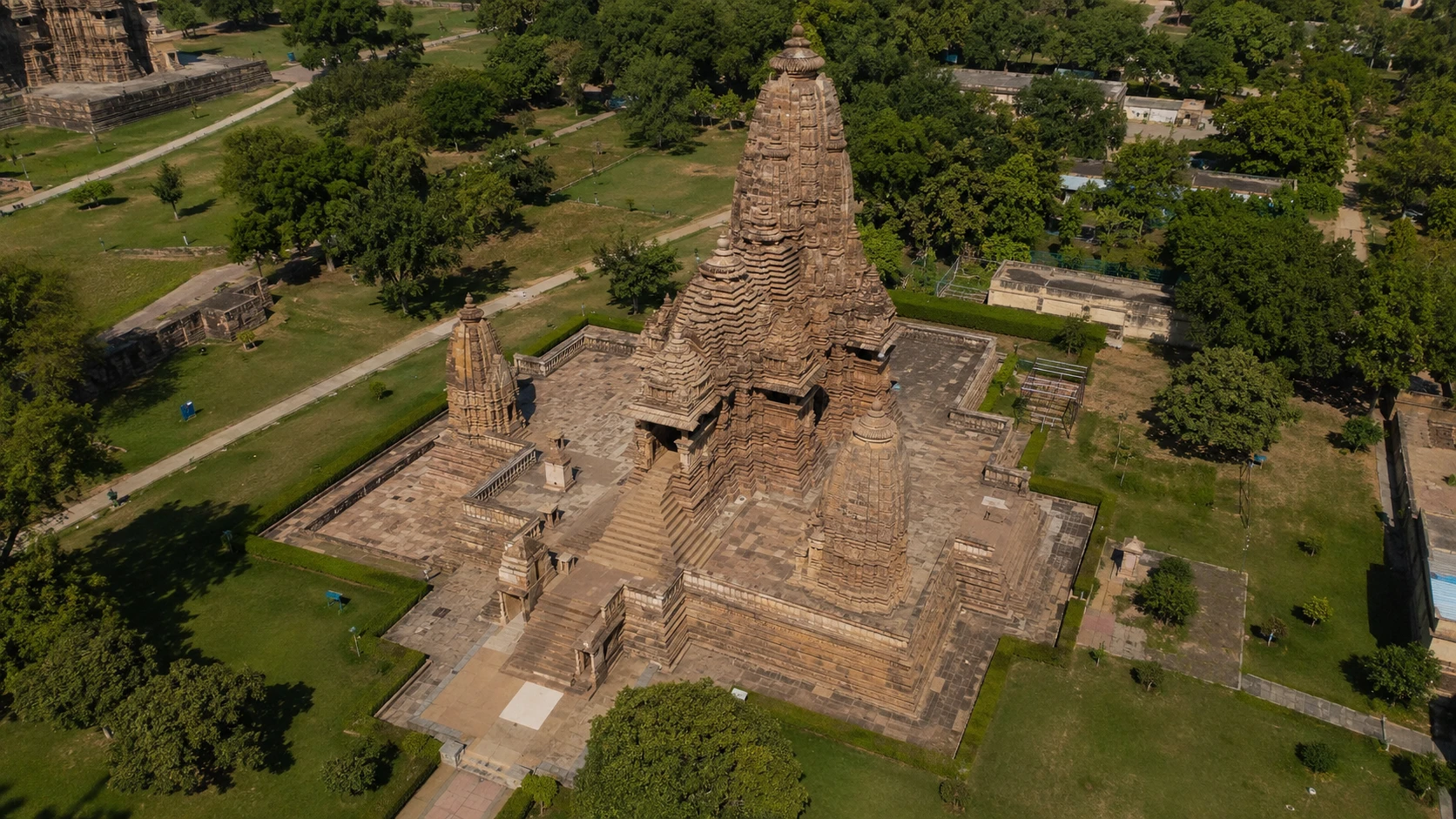
Devangana Desai's 'Khajuraho' (1996) provides the authoritative scholarly treatment of the temple complex. She dates the Matangeshwar temple to approximately 900–925 CE, placing it among the earliest surviving Chandela-period structures. The temple is architecturally simpler than the elaborately carved temples for which Khajuraho is famous — it lacks the dense sculptural programme of temples like Kandariya Mahadeva or Lakshmana — and its value is its living status and its extraordinary lingam rather than its decorative iconography. The lingam's height above the floor is approximately 2.5 metres; with the portion embedded below the platform, the total height may be significantly greater. This places it among the largest in-situ worshipped ancient lingams in India. Kinsley (1997, Chapter 10) describes Matangi as the most complex of the Mahavidyas in terms of her ritual tradition — the ucchishtha (leftover food) offering that is central to her puja violates standard ritual purity norms and functions as a deliberate transgression within the Tantric path. This transgressive principle connects directly to the Matangeshwar name's embrace of the outcast sage and the marginal. The ASI has designated the Western Group of temples at Khajuraho as a UNESCO World Heritage Site (1986); the Matangeshwar temple, being a living worship site, is managed separately from the protected ASI monuments.
Historyइतिहास
The Chandela dynasty — whose origins the clan itself traced to a Rajput-moon god lineage — built their most spectacular architectural legacy at Khajuraho between approximately the 9th and 12th centuries. The complex originally comprised approximately 85 temples; roughly 20 survive today. The temples were built as expressions of the Chandela rulers' power, piety, and theological worldview — the erotic sculptures for which the site is most famous in modern times are understood by scholars as representations of the kama (desire) that, properly understood, is a step toward moksha (liberation), not its opposite. The Matangeshwar temple, built around 900–925 CE under the early Chandela period, is among the oldest surviving structures in the complex. It stands just outside the Western Group — separated from the group of ASI-protected temples by the boundary of the protected zone. This location proved consequential: while the other temples became government-protected monuments in which active worship was eventually restricted, Matangeshwar continued as a living place of worship with an active priestly community. The temple's Shaiva character was never interrupted. When Khajuraho was 'rediscovered' by T.S. Burt of the Bengal Engineers in 1838 — the complex had become largely overgrown and was known primarily to local communities — the Matangeshwar temple was among the living sites that had maintained continuous tradition. The UNESCO World Heritage designation of the Western Group in 1986 brought international attention to Khajuraho, and with it, greatly increased pilgrimage and tourist traffic. The Matangeshwar temple benefits from its proximity to the famous group — visitors to the World Heritage temples typically visit Matangeshwar as the only place where active puja can be witnessed. The Mahashivratri celebration at Matangeshwar is now one of the major annual events in Madhya Pradesh, drawing pilgrims from across the region.
Historical Timelineऐतिहासिक कालक्रम
Matangeshwar temple constructed during the early Chandela period at Khajuraho. The temple is among the earliest surviving structures in the complex and establishes the site as an active Shaiva worship centre. The great lingam is installed, and continuous puja begins. The Chandela king associated with this construction period is generally identified as Harsha (c. 900–925 CE), though some scholars associate the earliest Khajuraho temples with Yashovarman (c. 925–950 CE).
The attribution to Harsha versus Yashovarman is debated in the scholarly literature. Desai's dating of c. 900–925 CE is the standard reference. The lingam is widely considered to be original to the temple's construction rather than a later installation.
The height of Chandela architectural activity at Khajuraho. The great temples of the Western Group — Kandariya Mahadeva, Lakshmana, Vishvanatha — are built during this period, creating the cluster of elaborately carved temples that Khajuraho is now famous for. Matangeshwar stands at the edge of this complex, its simpler form contrasting with the increasingly elaborate temples nearby.
T.S. Burt of the Bengal Engineers encounters the Khajuraho complex, largely overgrown, and documents it in what is often cited as the 'rediscovery' of the site by colonial-era scholarship. He notes the erotic sculptures with shock; the temples' significance as a major monument complex begins to enter the colonial administrative record. Matangeshwar's continuous living tradition means it has never been 'lost' to local communities.
The Western Group of temples at Khajuraho is designated a UNESCO World Heritage Site. The increased international and domestic tourism that follows significantly elevates the visibility of the Matangeshwar temple as the only living temple in the group. Pilgrimage and tourist visits both grow substantially. The ASI management of the protected monuments and the independent management of Matangeshwar create the dual character that defines the site today.
What You'll Seeदर्शन में
The primary sacred object at Matangeshwar is not a murti but a lingam — and this lingam is extraordinary by any measure. Standing approximately 2.5 metres (roughly 8.5 feet) above the floor of the inner sanctum, it is one of the largest ancient worshipped Shiva lingams in India. The lingam is smooth, not carved; its surface is streaked with natural variations in the stone — ochre, cream, and brown tones that run in flowing lines from base to crown. The overall impression is of something that grew from the earth rather than something placed upon it: massive, organic, older than memory. The lingam is set in a yoni (the circular base platform representing the divine feminine principle). The sanctum is relatively small in proportion to the lingam — the stone column fills the space in a way that the elaborately carved temples nearby, with their many deities and subsidiary niches, do not. Here there is essentially one thing: the lingam. Worshippers bring flowers, water (abhishekam), milk, bilva leaves, and kumkum to the lingam and circumambulate it. The scale of the lingam means that a devotee standing before it is physically aware of being smaller than what they have come to worship — an experience not easily replicated through any sculptural representation. Photography is not permitted inside the inner sanctum.
Distinctive Practicesविशिष्ट परंपराएँ
Living temple darshan amid World Heritage monuments
विश्व धरोहर स्मारकों के बीच जीवित मंदिर दर्शन
Daily; during every visit to Khajuraho
The singular experience at Matangeshwar is the contrast with the neighbouring ASI-protected temples. A visitor moves from the extraordinary erotic sculptures of the Western Group — academically framed, photographically documented, viewed through glass and at marked distances — into the Matangeshwar compound, where the rules change: shoes off, puja ongoing, priests conducting abhishekam, devotees pressing close to the lingam. The scent of incense and flowers replaces the outdoor air. The scholarly distance collapses. The ancient and the present merge in the space of the inner sanctum in a way that the preservation zone surrounding the carved temples simply does not permit.
The living character of Matangeshwar is itself the spiritual teaching: the divine is not preserved under glass but present and available. The scale of the lingam — larger than the devotee, older than the dynasty that built its house — inverts the ordinary human experience of being the observer who makes meaning. Here the lingam is not observed but encountered. The circumambulation (pradakshina) of such a large object requires physical movement through space — the body, not just the mind, completes the act of worship.
Abhishekam of the great lingam
महालिंग का अभिषेक
Daily at each aarti; elaborate panchamrit abhishekam on Mahashivratri and Shravan Mondays
The ritual bathing (abhishekam) of the Matangeshwar lingam is the central daily practice. Given the lingam's great height, the abhishekam is conducted from a raised platform. Water, milk, curd, honey, ghee, and sugar (panchamrit) are poured over the full height of the lingam in a continuous stream while prayers are chanted. The liquid runs down the stone surface and is collected in channels leading to the yoni base — the sacred runoff, considered consecrated liquid (charnamrit), is distributed to devotees. The act of bathing a 2.5-metre column of stone with liquids is physically unlike the abhishekam of smaller lingams; the scale transforms the ritual into something that feels less like a ceremony and more like an event of nature.
Did You Know?क्या आप जानते हैं?
The Matangeshwar lingam, at approximately 2.5 metres in visible height above the sanctum floor, is considered one of the largest in-situ worshipped ancient Shiva lingams in India. Unlike museum pieces or protected monuments, this lingam continues to receive daily abhishekam — it is physically touched, bathed, and adorned by priests every day, a continuity of physical contact with the sacred object that has run uninterrupted for over eleven centuries.
Devangana Desai, 'Khajuraho' (1996); ASI, 'Khajuraho' site documentation
Matangeshwar is the only temple among the Khajuraho group that was not taken under ASI protection as a monument — a consequence of the fact that it has never ceased to function as an active place of worship. Under Indian heritage law, a living religious site under active communal use follows a different administrative and legal framework from an archaeological monument. This legal distinction is what has preserved Matangeshwar's living character while the temples 100 metres away became showcases of art history.
Ancient Monuments and Archaeological Sites and Remains Act (AMASR), Government of India; Desai, 'Khajuraho' (1996)
In local tradition at Khajuraho, the Matangeshwar lingam is said to grow slowly — by the size of a sesame seed each year. This belief in an organically growing lingam is not unique to Matangeshwar (similar beliefs exist at several important lingam temples across India) and belongs to the theological category of swayambhu (self-manifested) or jyoti (light-form) lingams — divine forms that emerged from the earth rather than being installed by human hands. The belief positions the lingam as a living divine presence rather than a crafted object.
Local Khajuraho temple tradition; comparative: Diana Eck, 'India: A Sacred Geography' (2012) — swayambhu lingam traditions
The ninth Mahavidya, Matangi, is associated with ucchishtha — leftover or partially-consumed food — as her specific offering medium. Unlike all other goddess traditions in which fresh, pure offerings are required, Matangi accepts and even prefers offerings that have been touched, tasted, or partially eaten. This deliberate transgression of purity norms is the ritual enactment of her principle: that the divine is present in what the purity system excludes. The connection between Matangeshwar (Lord of the Matanga domain) and Matangi (the Mahavidya of the Matanga principle) is thus not merely nominal — both embody the same theology of the excluded made sacred.
Kinsley, 'Tantric Visions of the Divine Feminine' (1997), Chapter 10; Shakta Pramoda
Visitor Accessप्रवेश जानकारी
Matangeshwar is a living temple open to all devotees. Footwear must be removed at the entrance. Photography is not permitted inside the inner sanctum. The temple is located just outside the boundary fence of the Western Group of ASI-protected temples; it is accessible without paying the ASI monument entry fee. The experience of the Matangeshwar lingam is distinct from the ASI monument circuit and worthy of a dedicated visit rather than merely a stop between carved temples.
Matangeshwar is located at the edge of the main Western Group temple complex in Khajuraho village and is easily accessible on foot from the main temple road. It is not inside the ASI fee-zone. For Mahashivratri, advance planning is essential — the festival draws large crowds and accommodation books out across Khajuraho. The Khajuraho Tourism Development Authority and Madhya Pradesh Tourism have information about the Mahashivratri event.
Festivalsत्योहार
Mahashivratri
महाशिवरात्रि
Feb–Mar (Phalgun, Krishna Chaturdashi)
Mahashivratri is the supreme festival at Matangeshwar and one of the most important annual events in Khajuraho. For several days around the festival, the temple receives very large crowds from across Madhya Pradesh and Bundelkhand. The night of Mahashivratri itself — traditionally observed with all-night vigil, continuous abhishekam, and recitation — is marked at Matangeshwar with extended aarti, special puja, and a carnival-like fair in the surrounding area. The combination of Shivratri at the ancient lingam and Khajuraho's atmospheric setting makes this one of the more distinctive festival experiences in central India.
Shravan Somvar (Mondays of Shravan)
श्रावण सोमवार
Jul–Aug (Shravan month, Mondays)
The four or five Mondays of the Shravan month are the most auspicious Shaiva observances outside Mahashivratri. At Matangeshwar, Shravan Mondays bring a sustained surge of pilgrims who come specifically to perform abhishekam on the great lingam with Ganga water, milk, and bilva leaves. The devotional tradition of walking to the Khajuraho temple on the Shravan Mondays is observed by pilgrims from the surrounding region.
Khajuraho Dance Festival
खजुराहो नृत्य महोत्सव
Feb (7 days)
The annual Khajuraho Dance Festival, organised by Madhya Pradesh Kala Parishad, brings classical Indian dance performances to the open-air stage in front of the Western Group temples. While the festival is a cultural rather than strictly religious event, it takes place in the same precinct as Matangeshwar and the temple serves as the sacred anchor for the week-long celebration. The festival's focus on classical arts — Bharatanatyam, Kathak, Odissi — resonates with the Matangi tradition's deep association with music, dance, and the expressive arts.
Traditional Offeringsपारंपरिक अर्पण
Primary Offerings
Bel Patra (Bilva leaves)
बेल पत्र
बिल्व पत्र
The bilva leaf is the supreme offering to Shiva and the defining offering at any Shiva lingam. The three leaflets of the bilva represent the three eyes of Shiva, the trident he wields, and the cosmic functions of creation, preservation, and dissolution. At Matangeshwar, where the lingam is of such great scale, bilva leaves are brought in quantity and placed at the base of the lingam — their fragrance fills the sanctum. The Shiva Purana states that even a single bilva leaf offered with devotion surpasses elaborate rituals.
Water and milk for abhishekam
अभिषेक के लिए जल और दूध
जल, क्षीर
Water and milk are the primary abhishekam substances at Matangeshwar, where the scale of the lingam makes the ritual bathing a substantial act. Ganga water is considered ideal; where unavailable, any clean water serves. Milk is offered as an act of nurturing — the devotee nourishes the divine just as the divine nourishes the devotee. The liquid poured over the Matangeshwar lingam flows down its full 2.5-metre height, the streams running along the natural stone striations as if the lingam itself is directing the flow.
Vibhuti (Sacred ash)
विभूति
विभूति
Sacred ash is applied to the lingam and to the devotee's forehead at Matangeshwar as at all Shaiva shrines. Vibhuti represents the fundamental truth that all material existence returns to ash — the constant reminder of impermanence that is also Shiva's teaching. Three horizontal lines drawn with vibhuti across the forehead symbolise the three realms Shiva governs. At Matangeshwar, where the lingam has endured for over a thousand years while entire dynasties and civilisations have come and gone, the vibhuti teaching of impermanence is particularly resonant.
Dhatura flowers
धतूरा के फूल
धत्तूर
Dhatura — the trumpet-shaped, mildly toxic flowering plant — is sacred to Shiva and offered at Matangeshwar as at all major Shiva lingam shrines. The plant is said to have emerged from Shiva's body when he consumed the halahala poison during the churning of the cosmic ocean; the flower represents Shiva's capacity to transform and transmute what is dangerous into something offered back to him in worship. The offering of dhatura to the Matangeshwar lingam, the oldest worshipped object in the Khajuraho complex, has a particular quality of deep continuity.
Raw rice and kumkum
कच्चा चावल और कुमकुम
अक्षत, कुङ्कुम
Unbroken raw rice (akshata) and vermilion (kumkum) are standard offerings at Shaiva lingam shrines across India. Akshata — literally 'unbroken' — represents wholeness and the unconditional quality of the offering: the grain that has not yet been processed, touched only by the devotee's intention. Kumkum marks the auspiciousness of the encounter. Both are placed at the base of the Matangeshwar lingam, where they join bilva leaves, flowers, and the residue of previous abhishekams.
Unique to This Temple
Panchamrit abhishekam of the great lingam
महालिंग का पंचामृत अभिषेक
The panchamrit abhishekam — bathing the lingam with the five sacred substances (milk, curd, honey, ghee, and sugar) — is offered at all major Shiva temples. At Matangeshwar, the scale of the lingam transforms this ritual: the five liquids are poured down the full 2.5-metre column in a continuous stream, flowing in rivulets along the stone's natural striations. The resulting sacred runoff — charnamrit — collects in the yoni and is gathered and distributed to devotees. This charnamrit is particularly prized at Matangeshwar because it has bathed not just a small lingam but one of India's largest ancient living ones.
Puja items — bilva leaves, flowers, milk, water, dhatura, vibhuti, kumkum — are available from vendors at the temple entrance and in the surrounding market. Priests at Matangeshwar will conduct personal puja and abhishekam on behalf of devotees; approach temple staff for arrangements. The panchamrit abhishekam of the great lingam is a particularly recommended personal offering. During Mahashivratri, special overnight puja arrangements are managed by the temple committee.
How to Reachकैसे पहुँचें
Khajuraho is one of the better-connected heritage sites in central India, with its own airport and railway station. By air: Khajuraho Airport (HJR) receives regular flights from Delhi (approximately 1 hour) and connects to Varanasi and Agra on some schedules; check current Indigo, Air India, or SpiceJet schedules as services vary seasonally. The airport is approximately 5 km from the temple area — taxis and auto-rickshaws are available. By rail: Khajuraho Railway Station (approximately 6 km) connects to major cities via Satna (approximately 117 km, on the main Mumbai-Allahabad line) with connecting trains. Direct trains are available from Delhi (approximately 10–11 hours on the Khajuraho Express/Bundelkhand Express), Varanasi, and Agra. By road: Khajuraho is approximately 175 km from Jhansi, 395 km from Bhopal, and 265 km from Varanasi. The road from Jhansi (NH-75/SH-10) is well-maintained. State buses and private taxis connect Khajuraho to Jhansi, Satna, Chhatarpur, and major cities. Within Khajuraho village, the Matangeshwar temple is a short walk or cycle-rickshaw ride from most accommodation.
Plan Your Visitयात्रा की योजना
🌤 Best Season
October to March is ideal — cool, dry, and clear. Avoid the monsoon (July–September) if the temple itself is the primary objective, though Khajuraho remains accessible year-round. February is when the Khajuraho Dance Festival occurs, offering a combination of the living temple and classical dance in the same atmospheric complex. Mahashivratri in February–March brings the largest crowds.
👘 Dress Code
Modest attire for the temple — no shorts or sleeveless tops. Footwear removed at the entrance. The surrounding ASI monument complex does not have a strict dress code for tourists, creating an interesting transition as visitors move between the cultural tourist space and the active religious space of Matangeshwar.
📱 Phones & Photography
Mobile phones and cameras permitted in the outer areas of the temple and across the Khajuraho village. Photography prohibited inside the Matangeshwar inner sanctum. The ASI monument complex has its own photography policies for the protected temples.
🏨 Accommodation
Khajuraho has accommodation at all price points, from budget guesthouses to mid-range heritage hotels and the excellent Madhya Pradesh Tourism (MPT) properties. The Raja Café area and the main village road have a concentration of accommodation. For Mahashivratri and the Dance Festival, book well in advance — accommodation fills up quickly across the village and surrounding areas.
Book a Pujaपूजा बुक करें
Booking links and phone numbers are verified periodically but may change without notice. No verified online booking portal has been confirmed for Matangeshwar's puja services; approach the resident priests directly at the temple. The ASI monument complex (Western Group) has a separate entry fee; Matangeshwar is outside this fee zone and is freely accessible.
Managed by: Temple management committee, Matangeshwar Mandir, Khajuraho
Personal Abhishekam (panchamrit / jal)
व्यक्तिगत अभिषेक
Mahashivratri special puja
महाशिवरात्रि विशेष पूजा
Booking information verified: 2026-05-23
Sacred Soundsपवित्र ध्वनि
108 Japa Practice
Om Namah Shivaya — Panchakshari Mantra
Chant 108 times in the spirit of this temple
Did You Know? · क्या आप जानते हैं?
The same translation error that turned '33 Koti' into '33 crore' in Hinduism also happened in Buddhism. The Chinese translation of Buddhist texts rendered 'Sapta Koti Buddha' (7 Supreme Buddhas) as '7 Crore Buddhas.' The Tibetan translation got it right: 7 types, not 7 crore. One Sanskrit word, misread across two major world religions, generated two identical misconceptions independently.
Related Contentसंबंधित सामग्री
Related Scriptures
Related Temples
Bhuvaneshwari Mata (Gauhati)
भुवनेश्वरी माता
Gauhati, Assam
Bhairavi Mata Temple
भैरवी माता मंदिर
Tezpur, Assam
Chinnamasta Mandir (Rajrappa)
छिन्नमस्ता मंदिर
Rajrappa, Jharkhand
Dhumavati Mandir (Varanasi)
धूमावती मंदिर
Varanasi, Uttar Pradesh
Bagalamukhi Mandir (Datia)
बगलामुखी मंदिर
Datia, Madhya Pradesh
Kamala Devi (Bishnupur)
कमला देवी मंदिर
Bishnupur, West Bengal
Shodashi Tripurasundari (Kanchipuram)
षोडशी त्रिपुरसुंदरी
Kanchipuram, Tamil Nadu
Community Reflections
🕉️
Be the first to share your reflection.