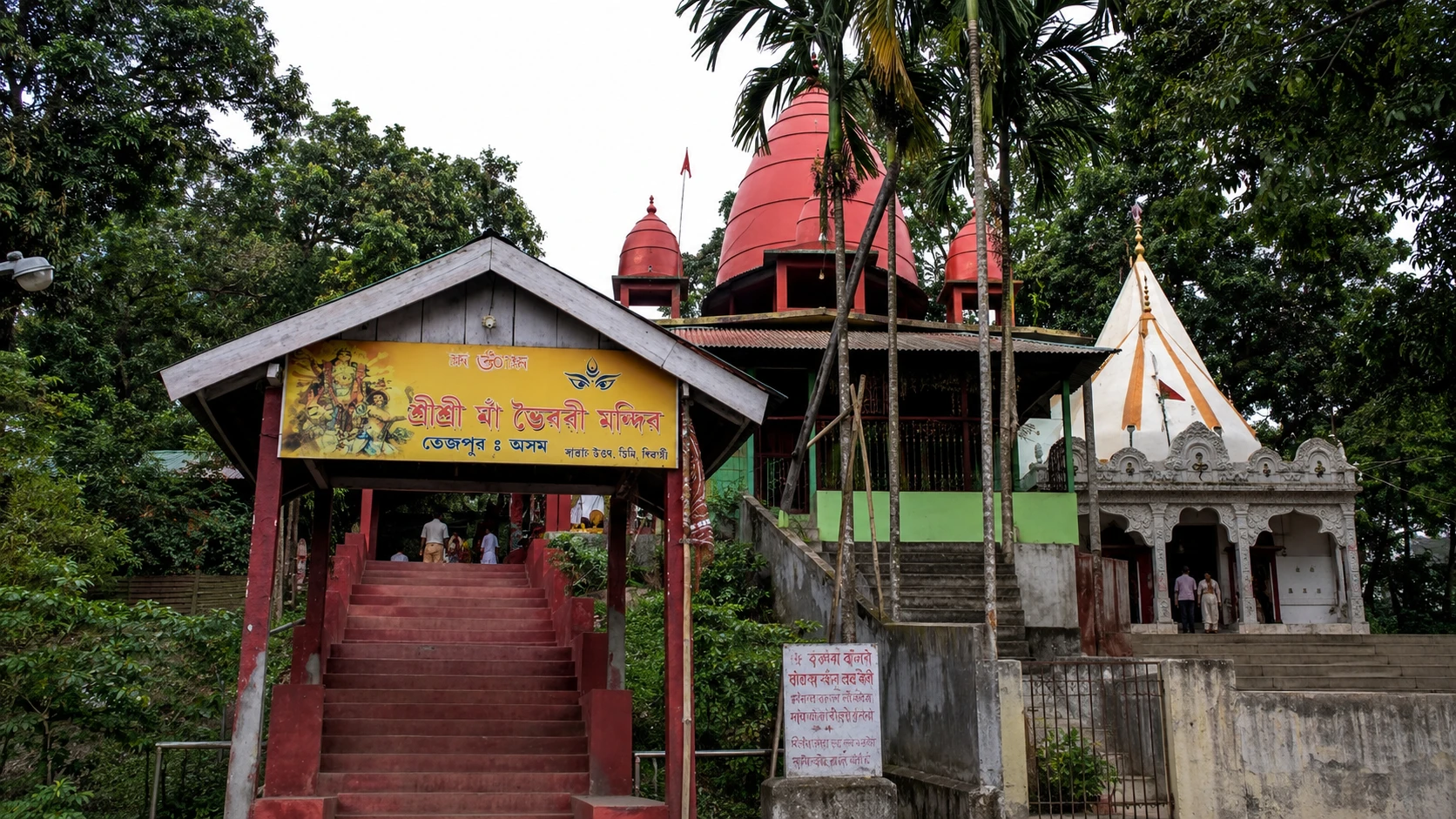
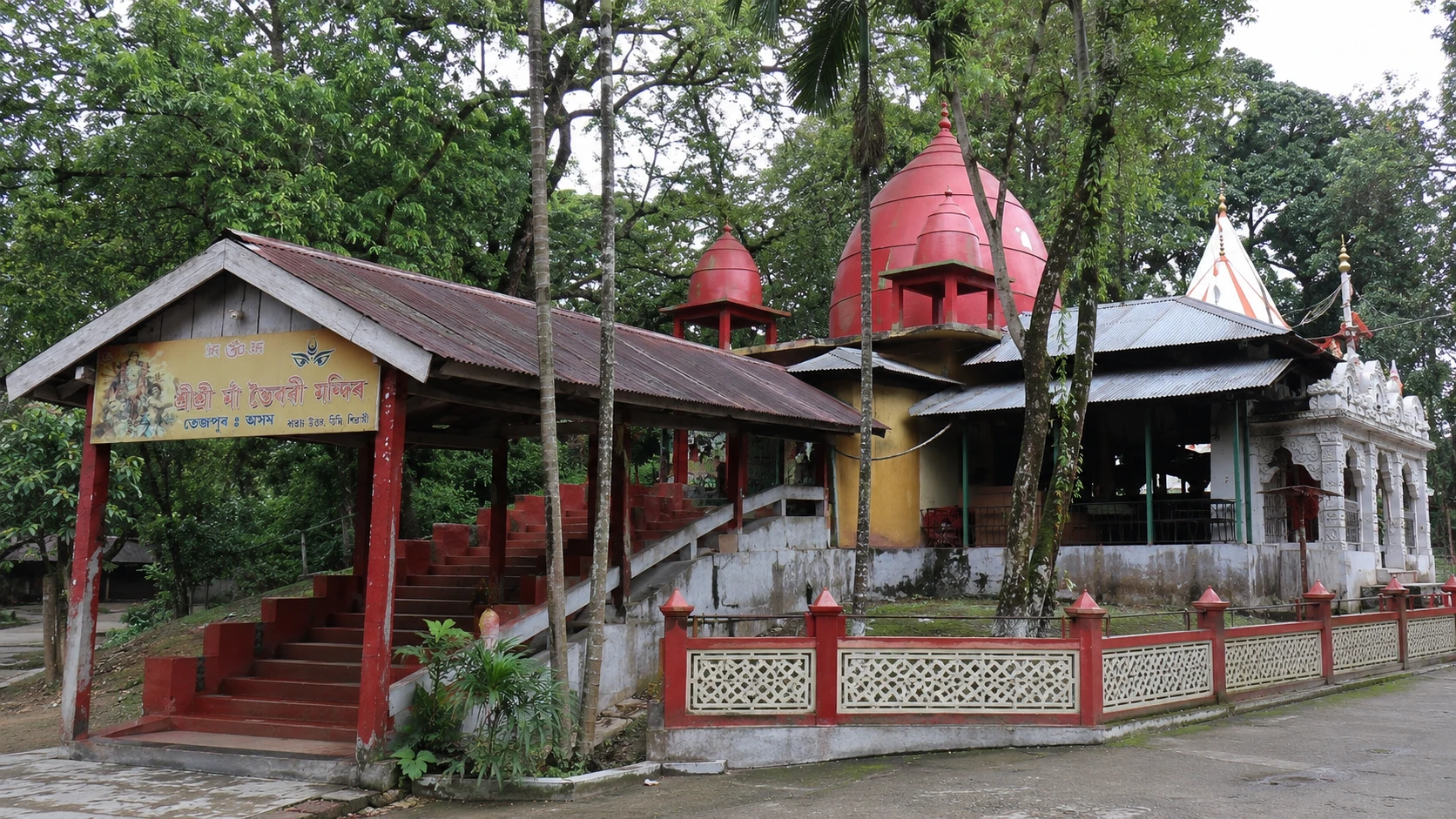
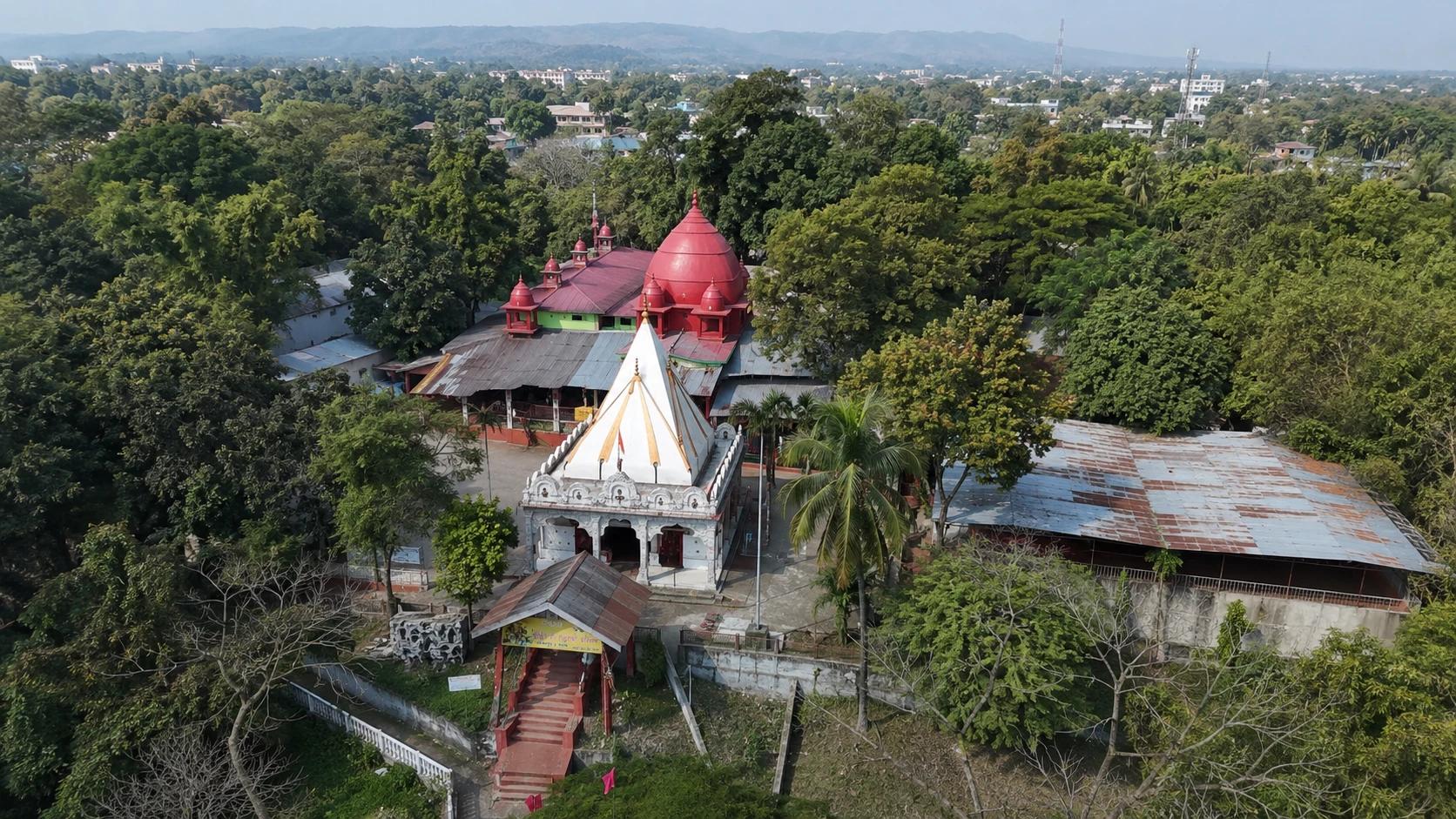
Bhairavi Mata Temple
भैरवी माता मंदिर
Fifth Mahavidya — the goddess of dissolution who burns the cosmos to make room for the new
Tezpur, Assam, India
BhairavīAlso known as: Tripura Bhairavi, Bhairavi Mata, Bhairavi Devi, Chaitanya Bhairavi, Nitya Bhairavi
Era
Ancient tradition; current structure details unverified
Architecture
Assamese vernacular Shakta temple style
Open
06:00 – 20:00
Aarti
06:00 · 12:00 · 18:00
The Sacred Legend · पवित्र कथा
Bhairavi is the goddess who stands at the end of the universe and does not flinch. She is the fifth Mahavidya — the one whose crimson form glows with the heat of dissolution, whose garland of severed heads represents the consumed worlds, and whose worship teaches the devotee that fear, confronted fully, becomes liberation. At her Tezpur shrine in Assam, she is housed in a city whose very name means City of Blood — Tezpur, the ancient Sonitpur of the Puranas, where demon-king Banasura's battles drenched the earth. In this charged landscape of ancient Shakta practice, Bhairavi is not merely a fierce goddess to be propitiated. She is the teaching: that the fire which destroys the false self is the same fire that reveals the indestructible one beneath.
Sacred Designationपवित्र पदनाम
Sacred Origin Storyपवित्र उत्पत्ति कथा
Source: Shakta Tantra / Dasha Mahavidya tradition; Rudrayamala Tantra lineage
The Rudrayamala Tantra and the Tantrasara describe Bhairavi as the fifth Mahavidya — the goddess who embodies the dissolution (laya) of cosmic existence. She arises from the same primordial event as all Mahavidyas: the moment when Adi Shakti generates her ten wisdom-forms to halt Shiva's interference. But where Bhuvaneshwari is the field of the universe, Bhairavi is the fire that periodically consumes it. Her name is the feminine of Bhairava — the terrifying aspect of Shiva — yet she is understood as superior to Bhairava, the power that even the terrifying one cannot contain. Her complexion is red as the rising sun or the colour of fire at dissolution; some texts describe her as brilliant as a thousand suns. Her three eyes blaze. She wears a garland of severed heads (mundamala) — in the deeper Tantric reading, these heads are the fifty-one letters of the Sanskrit alphabet, consumed back into their source, signifying that even the power of speech and mantra ultimately dissolves into her. In her four arms she holds a book (pustaka) and a rosary (akshamala) in her upper hands — signs that she is also a goddess of knowledge and japa — while her lower hands make the abhaya and varada mudras, offering fearlessness and boons. This combination is theologically striking: the most terrifying goddess also holds a book. The teaching is that dissolution is not ignorance — it is the ultimate knowledge, the wisdom of impermanence. At Tezpur, an ancient city whose very name Sonitpur (City of Blood) connects it to the Purana narrative of Banasura's battles, Bhairavi is understood to preside over the transformative power latent in destruction.
Sources cited:
- Rudrayamala Tantra (Shakta Tantric text; Bhairavi puja vidhi and iconography)
- Tantrasara, Krishnananda Agamavagisha (16th–17th century, Bengal Tantric tradition)
- Shakta Pramoda (composite Shakta ritual compendium)
- David Kinsley, 'Tantric Visions of the Divine Feminine: The Ten Mahavidyas' (1997), University of California Press — Chapter 6
- Devi Bhagavata Purana, Skanda 7
Other Traditions · अन्य परंपराएँ
Multiple Bhairavi forms across Tantric texts
Several distinct forms of Bhairavi are enumerated across different Tantric texts — Tripura Bhairavi, Chaitanya Bhairavi, Siddha Bhairavi, Bhuvanesha Bhairavi, Sammohana Bhairavi, and others. Each form carries slightly different iconography, bija mantras, and ritual contexts. The Tripura Bhairavi form (identified with the three cities or three worlds) is the most widely worshipped and is the primary form described in this entry. The Nitya tradition of the Sri Vidya system identifies Bhairavi as one of the sixteen Nitya (eternal) shaktis.
Scholarly Context
David Kinsley (1997) notes that Bhairavi is among the most philosophically rich of the Mahavidyas precisely because her iconography combines the terrifying (mundamala, blood, fire) with the wisdom-bearing (pustaka, akshamala). This combination collapses the apparent opposition between destruction and knowledge — both are faces of the same dissolution of the constructed self. The number assigned to Bhairavi varies across texts: she is fifth in the most commonly cited orderings (Kinsley follows this), though some texts place her sixth (swapping positions with Chhinnamasta). The Tezpur location connects Bhairavi to one of the most ancient Shakta-charged cities in Assam. Tezpur (ancient Sonitpur) appears in the Bhagavata Purana (10.62–63) as the kingdom of Banasura, a devotee of Shiva, where Krishna's battle with Banasura is set. The city's association with blood, battle, and divine combat makes it a fitting seat for Bhairavi's energies in the regional tradition.
Historyइतिहास
Tezpur — derived from the Sanskrit Sonitpur, meaning City of Blood — is one of the most ancient cities in Assam and one of the most mythologically charged sites in the Puranic geography of the northeast. The Bhagavata Purana (Skanda 10, chapters 62–63) locates the kingdom of the demon-king Banasura at Sonitpur; it is the site of the celebrated battle between Krishna (allied with Shiva's ganas) and Banasura, a narrative that permeates the regional sacred imagination. The name Tezpur itself (teja = blood/radiance, pur = city) is held in local tradition to derive from this battleground, where the earth was said to run with blood — blood that carries both the stain of war and the sanctifying power of divine combat. Within this mythologically dense landscape, Bhairavi's presence is understood as entirely congruent: she is the goddess of dissolution, blood, and transformation; she presides over precisely the kind of cosmic combat that the Banasura legend represents. The Shakta tradition in Tezpur and the Sonitpur district has roots in the same ancient stratum that gave Kamakhya in Guwahati its pre-eminence in the regional religious imagination. Assam's Kamarupa region functioned historically as one of the primary crucibles of Tantric practice in the subcontinent, and Tezpur's sacred geography participates in that heritage. The current temple structure's history has not been independently verified for this entry and should be confirmed with local temple authorities.
Historical Timelineऐतिहासिक कालक्रम
The Bhagavata Purana establishes Sonitpur (modern Tezpur) as the site of Banasura's kingdom and Krishna's great battle with the demon-king. This narrative sacralises the city in the regional imagination and provides the mythological foundation for its identity as a site of divine combat and transformation — the theological terrain on which Bhairavi's presence in the city is understood.
The Bhagavata Purana narrative is mythological rather than strictly historical. The Puranic identification of Sonitpur with Banasura's kingdom, while not independently verifiable as a historical event, has been the formative factor in the city's sacred geography for centuries and is treated as foundational in the regional tradition.
The Kalika Purana, composed in the Kamarupa region, establishes the comprehensive theological framework for Assam as the supreme Shakta land. The text's authority legitimises Shakta worship across the region, including the veneration of Bhairavi as part of the Mahavidya circuit of which Tezpur is a node.
The great earthquake of 12 June 1897 (estimated magnitude 8.1) caused widespread structural damage across Assam. Tezpur and the Sonitpur district were within the affected zone, and temple structures throughout the region required repair or reconstruction in subsequent decades.
The current Bhairavi Mata temple structure in Tezpur is the product of 20th-century construction or renovation. Specific construction dates, founding patrons, and the managing trust or committee for this shrine have not been independently verified for this entry and should be confirmed with local temple authorities before publishing.
Operational and structural history for this specific shrine requires on-ground verification with local temple management. This event entry should be updated with sourced information before final publication.
What You'll Seeदर्शन में
Bhairavi's form, as described in the Tantrasara and Rudrayamala Tantra, is simultaneously terrifying and wisdom-bearing. Her complexion is a deep, brilliant crimson — the colour of fire and of dissolution. She has three eyes, the third blazing with knowledge. Her crown is adorned with a crescent moon, and across her chest and body she wears a garland of severed heads (mundamala) — in the esoteric reading, the fifty-one heads correspond to the fifty-one letters of the Sanskrit alphabet, signifying the dissolution of all language and mantra back into their primordial source. Her breasts are typically described as smeared with blood — a mark of the raw, unsanitised power of dissolution. In her upper two hands she holds a book (pustaka), signifying that she is the goddess of wisdom even in her terrifying form, and a rosary (akshamala), signifying mantra and sadhana practice. Her lower two hands make the abhaya mudra (fearlessness) and the varada mudra (boon-giving) — the combination of terror and benevolence that defines the Mahavidya tradition at its most honest. She is typically depicted seated on a lotus or a corpse. The corpse beneath her is Shiva in his inert, unactivated form — the masculine principle that only comes to life through her energy. Photography is not permitted inside the inner sanctum.
Distinctive Practicesविशिष्ट परंपराएँ
Hsraim Japa and Dissolution Meditation
ह्स्रैं जप और लय-ध्यान
Daily practice; intensified during Navratri and Kali Puja
Initiated practitioners at Bhairavi shrines across the Assam–Bengal Shakta tradition practise japa of the bija mantra Hsraim along with a particular form of meditation on dissolution — consciously tracing all perceived phenomena (thoughts, sensations, the sense of self) back to the goddess's consuming fire. The practice is not about inducing fear but about learning to experience the dissolution of self-constructed mental formations as liberating rather than threatening.
The Tantrasara teaches that Bhairavi's gift is not protection from fear but liberation through it. The practitioner who sits with Bhairavi's energy learns to watch the small dissolutions — the death of a thought, the passing of a mood, the ending of a moment — as rehearsals for the great dissolution. In the Tantric framework, the ego that resists dissolution is the source of suffering; Bhairavi's worship dissolves the resistance rather than the ego itself, resulting in equanimity before change.
Did You Know?क्या आप जानते हैं?
The garland of severed heads (mundamala) worn by Bhairavi is given a precise esoteric meaning in the Tantric tradition: the fifty-one heads correspond to the fifty-one letters of the Sanskrit alphabet. In this reading, the goddess is not displaying trophies of conquest but demonstrating that even the letters — the basic building blocks of all speech, scripture, and mantra — are ultimately dissolved back into her. She is thus not opposed to knowledge; she is its final destination.
David Kinsley, 'Tantric Visions of the Divine Feminine' (1997), Chapter 6; Tantrasara (Krishnananda Agamavagisha)
Tezpur's ancient name Sonitpur — City of Blood — comes from the Bhagavata Purana narrative in which the city was the site of the epic battle between Krishna and the demon-king Banasura, a devotee of Shiva. The city's streets were said to run with blood during this cosmic confrontation. This mythological etymology makes Tezpur one of the few Indian cities whose sacred geography is defined by a specific Puranic battle narrative.
Bhagavata Purana, Skanda 10, Chapters 62–63; P.C. Choudhury, 'The History of Civilisation of the People of Assam' (1966)
Bhairavi is theologically unusual among the Mahavidyas in that she holds a book (pustaka) in one hand — an attribute typically associated with Saraswati, the goddess of learning. This combination of fearsome dissolution (mundamala, blood) and wisdom (book, rosary) is the Tantric tradition's way of stating that the highest knowledge is not attained by accumulation but by the burning away of ignorance, fear, and the false self. The wisdom and the destruction are not opposites; they are the same act.
Kinsley, 'Tantric Visions of the Divine Feminine' (1997), Chapter 6; Rudrayamala Tantra
The name Bhairavi is the feminine grammatical form of Bhairava — the terrifying aspect of Shiva. Yet in the Shakta Tantric tradition, Bhairavi is understood as superior to Bhairava, not his consort or subordinate but his activating power. The name embodies a central Shakta philosophical position: the feminine principle (Shakti) is the energy without which the masculine principle (Shiva) remains inert. Bhairavi is what makes even the terrifying possible.
Kinsley, 'Tantric Visions of the Divine Feminine' (1997); Tantrasara
Visitor Accessप्रवेश जानकारी
The Bhairavi Mata temple in Tezpur is open to devotees of all backgrounds. Standard Shakta temple decorum applies: modest or traditional attire, footwear removed at the entrance, and photography prohibited inside the inner sanctum. Devotees are advised to verify current timings with local temple management before travel.
Contact local temple management in Tezpur directly for current visiting hours and puja arrangements. Tezpur is also home to several other important sacred sites including the Mahabhairav Temple and the Da Parbatia archaeological site, which may be combined in a pilgrimage visit.
Festivalsत्योहार
Navratri (Chaitra and Ashwin)
नवरात्रि (चैत्र और आश्विन)
Mar–Apr (Chaitra) and Sep–Oct (Ashwin)
Both Navratri cycles are observed at the Bhairavi shrine, with extended puja schedules and heightened devotional activity. As the fifth Mahavidya, Bhairavi receives special attention on the fifth day (Panchami) of each Navratri. The autumn Navratri (Ashwin) is particularly significant, leading into the major festival season of Durga Puja and Kali Puja.
Kali Puja
काली पूजा
Oct–Nov (Kartik Amavasya)
Kali Puja — celebrated on the new moon night of Kartik — is one of the most significant festivals for all Mahavidya shrines, and particularly for fierce-form Shakta temples. At Bhairavi's shrine, the night of Kali Puja sees intensified tantric puja practices. Bhairavi and Kali are theologically closely related — both personify dissolution and transformation — making Kali Puja a natural festival for the Bhairavi tradition.
Durga Puja
दुर्गा पूजा
Sep–Oct (Ashwin, 10 days)
Durga Puja is the primary community festival across Assam and Bengal and is celebrated with great fervour in Tezpur. Bhairavi's shrine participates in the broader festival season, with special puja schedules during the ten days. Tezpur's large community celebrations during Durga Puja extend across many neighbourhood pandals and temple sites.
Traditional Offeringsपारंपरिक अर्पण
Primary Offerings
Red hibiscus (Jaba flower)
जवा पुष्प (लाल हिबिस्कस)
जपापुष्प
The red hibiscus is the defining floral offering for fierce Shakta goddesses across the Assam–Bengal tradition. For Bhairavi, whose complexion is the colour of fire and dissolution, the deep crimson of the jaba flower is a direct visual echo of her essence. The offering acknowledges her as the consuming, vivifying energy that the colour red embodies in the Tantric tradition.
Red cloth (Lal vastra)
लाल वस्त्र
रक्तवस्त्र
Red cloth is the traditional offering to Bhairavi as to all fierce-form Shakta Mahavidyas. The red colour in the Tantric tradition represents the rajoguna — the quality of activity, passion, and transformation — which governs Bhairavi's domain of dissolution. Offering red cloth to Bhairavi is an act of surrendering one's own rajasic energy to the goddess, asking her to transform it rather than resist it.
Kumkum (vermilion)
कुमकुम
कुङ्कुम
Kumkum is placed at the feet of Bhairavi and applied to the devotee's forehead. In the context of Bhairavi's worship, the act of applying the goddess's own vermilion to the forehead carries a specific Tantric meaning — the ajna chakra (third eye) is being marked with the colour of dissolution, inviting the practitioner's perception to align with the goddess's own way of seeing: all forms as temporary, all constructions as dissolving back into the source.
Coconut
नारियल
नारिकेल
The coconut offered before Bhairavi carries the Shakta meaning of ego-dissolution: the hard shell represents the constructed self's resistance to change; breaking it open before the goddess of dissolution is an act of conscious surrender. The whiteness and sweetness of the inner coconut represents the undamaged essential self that remains when the hardened surface is removed — the devotee offering Bhairavi their own shell, willingly.
Sesame seeds (Til)
तिल
तिल
Sesame seeds (til) are traditionally offered to fierce or dissolution-associated deities in the Shakta and Shaiva traditions. In rituals associated with ancestors, death, and cosmic dissolution, sesame is the primary grain offering — it carries the energy of transition rather than sustenance. Offering til to Bhairavi connects the devotee to the tradition of accepting dissolution as natural, necessary, and ultimately liberating.
Offering items including flowers, red cloth, kumkum, coconuts, and sesame are available from vendors near the temple. Devotees may bring offerings from outside. The specific prasad distribution and any restrictions on offering types should be confirmed with local temple management.
How to Reachकैसे पहुँचें
Tezpur is accessible by air, road, and (partially) by rail. By air: Salonibari Airport (IATA: TEZ) is approximately 8 km from the city centre and receives regular flights from Guwahati and Kolkata; check current schedule as services are subject to change. By road: Tezpur is well connected by NH-15 (formerly NH-37) and is approximately 175 km from Guwahati (4–5 hours by road). State buses run regularly from Guwahati's ISBT (Interstate Bus Terminal). Private taxis and shared sumos (the standard Assam highland vehicle) are available from Guwahati. By rail: Tezpur does not have a mainline railway station on the Northeast Frontier Railway mainline; the nearest stations are Rangapara North (35 km) and Dekargaon. From these stations, taxis or shared vehicles serve Tezpur. For pilgrims combining the visit with Guwahati (Kamakhya and the Mahavidya circuit), the most practical approach is to base in Guwahati and take a day-trip or overnight trip to Tezpur by road. Within Tezpur, auto-rickshaws and taxis provide local transport.
Plan Your Visitयात्रा की योजना
🌤 Best Season
October to April offers the best visiting conditions in Tezpur — post-monsoon cool, pleasant temperatures, and minimal rainfall. The Brahmaputra valley is lush and scenic in this period. Monsoon (June–September) brings heavy rain and some disruption to road transport; plan travel flexibility if visiting in this season.
👘 Dress Code
Modest or traditional attire is expected. Sarees, salwar kameez, or dhoti-kurta are appropriate. Western-style shorts and sleeveless tops are generally not suitable for Shakta temple entry. Footwear is removed at the temple entrance.
📱 Phones & Photography
Mobile phones are generally permitted in outer temple areas. Photography is not allowed inside the inner sanctum. Follow posted instructions and guidance from temple staff.
🏨 Accommodation
Tezpur has a range of accommodation options from budget guesthouses to mid-range hotels. Assam Tourism Development Corporation (ATDC) operates guest houses in the town. Tezpur is also known as a base for wildlife tourism (Nameri National Park is nearby), so mid-range tourist accommodation is available. Most pilgrims combining Tezpur with Guwahati find it practical to do a day-trip from Guwahati.
Sacred Soundsपवित्र ध्वनि
Did You Know? · क्या आप जानते हैं?
The same translation error that turned '33 Koti' into '33 crore' in Hinduism also happened in Buddhism. The Chinese translation of Buddhist texts rendered 'Sapta Koti Buddha' (7 Supreme Buddhas) as '7 Crore Buddhas.' The Tibetan translation got it right: 7 types, not 7 crore. One Sanskrit word, misread across two major world religions, generated two identical misconceptions independently.
Related Contentसंबंधित सामग्री
Related Scriptures
Related Temples
Bhuvaneshwari Mata (Gauhati)
भुवनेश्वरी माता
Gauhati, Assam
Kamakhya Temple
कामाख्या मंदिर
Guwahati, Assam
Chinnamasta Mandir (Rajrappa)
छिन्नमस्ता मंदिर
Rajrappa, Jharkhand
Dhumavati Mandir (Varanasi)
धूमावती मंदिर
Varanasi, Uttar Pradesh
Bagalamukhi Mandir (Datia)
बगलामुखी मंदिर
Datia, Madhya Pradesh
Matangeshwar Mandir (Khajuraho)
मातंगेश्वर मंदिर
Khajuraho, Madhya Pradesh
Kamala Devi (Bishnupur)
कमला देवी मंदिर
Bishnupur, West Bengal
Shodashi Tripurasundari (Kanchipuram)
षोडशी त्रिपुरसुंदरी
Kanchipuram, Tamil Nadu
Community Reflections
🕉️
Be the first to share your reflection.