Shodashi Tripurasundari (Kanchipuram)
षोडशी त्रिपुरसुंदरी
Third Mahavidya — the most beautiful in the three worlds, whose body is the Sri Chakra
Kanchipuram, Tamil Nadu, India
TripurasundarīAlso known as: Shodashi, Lalita Tripurasundari, Lalita Devi, Rajarajeshwari, Srividya Devi, Kamakshi (in the Kanchipuram Sri Vidya identification), Kamalatmika, Shodashakshari
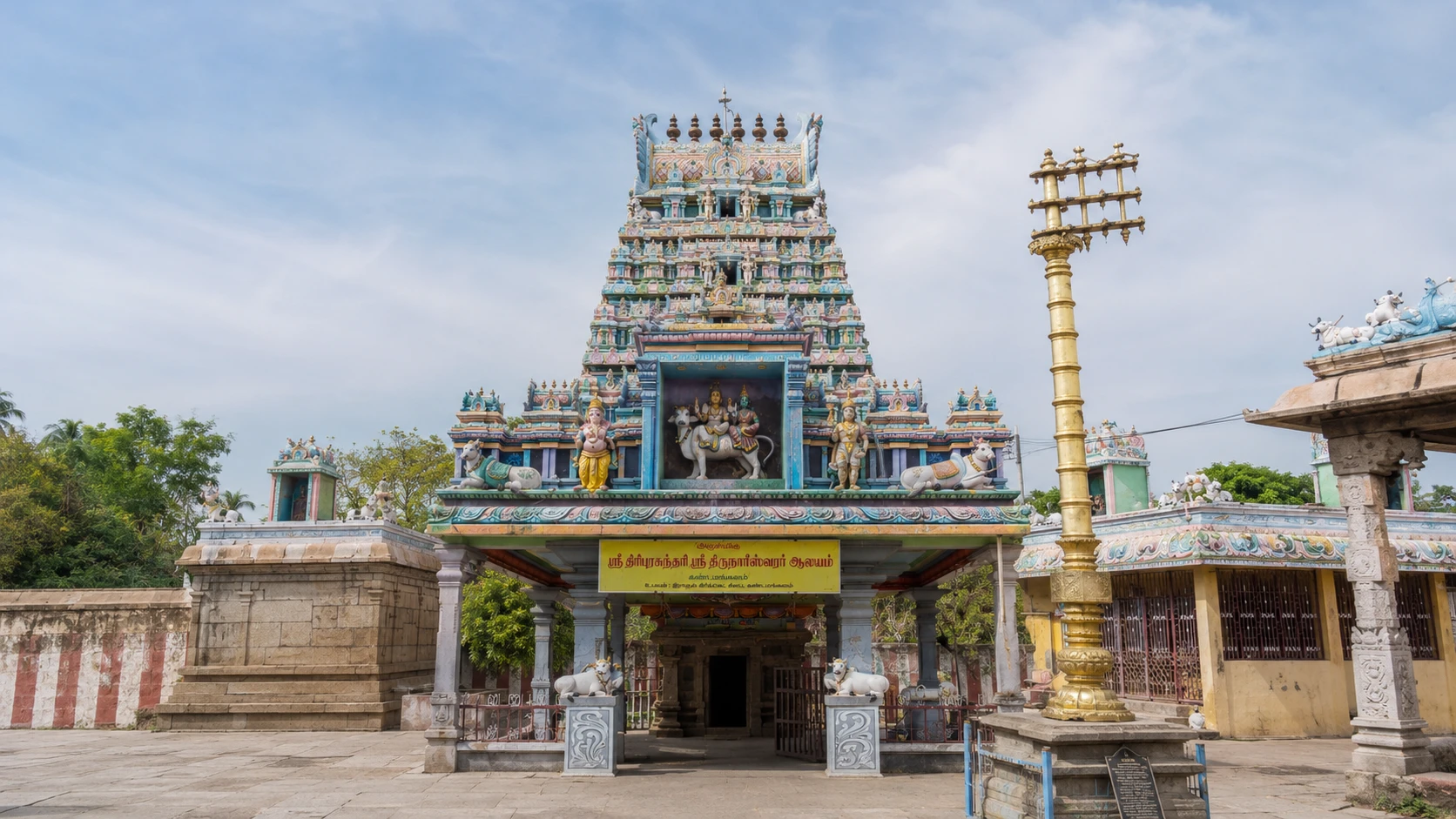
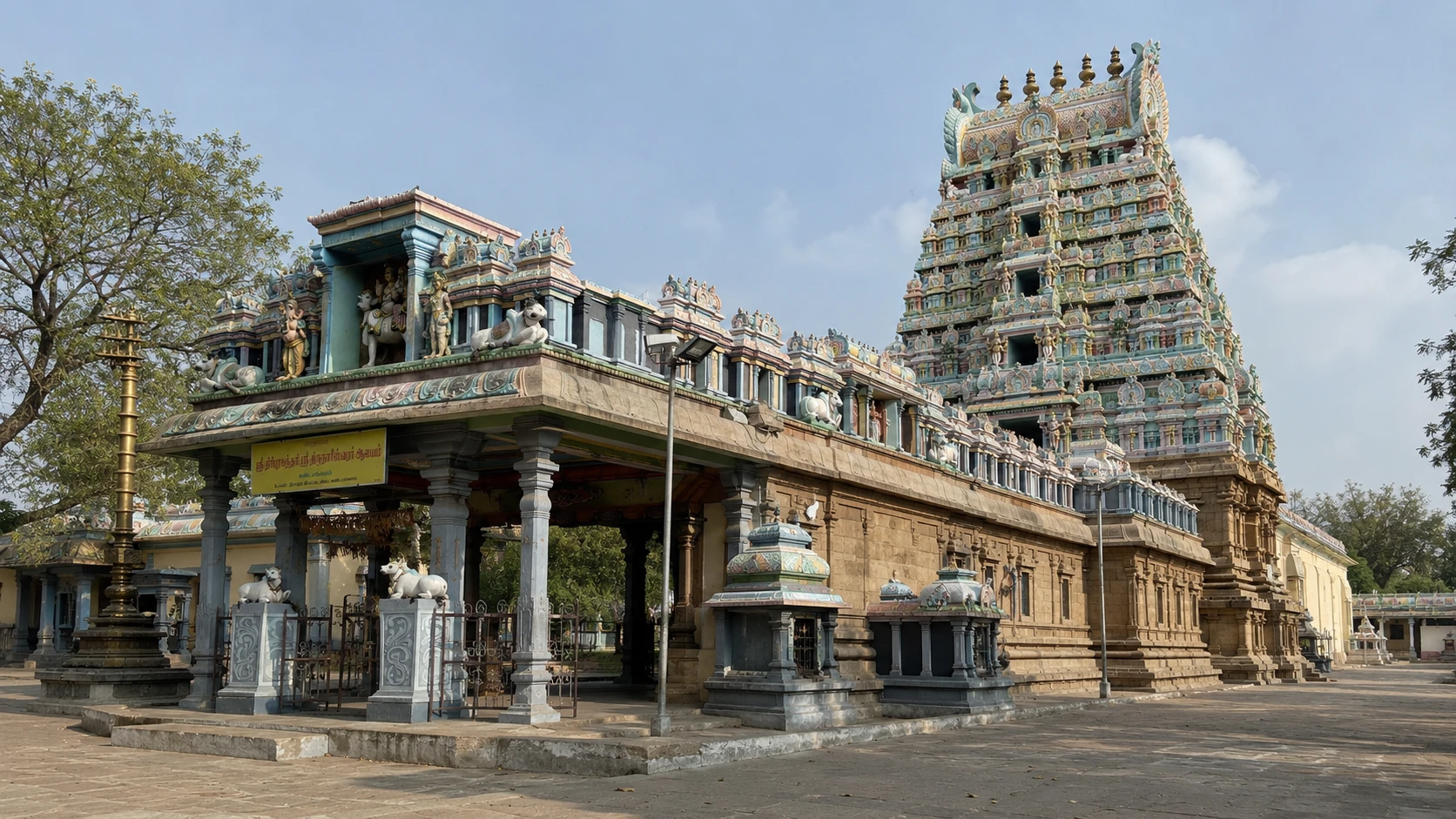
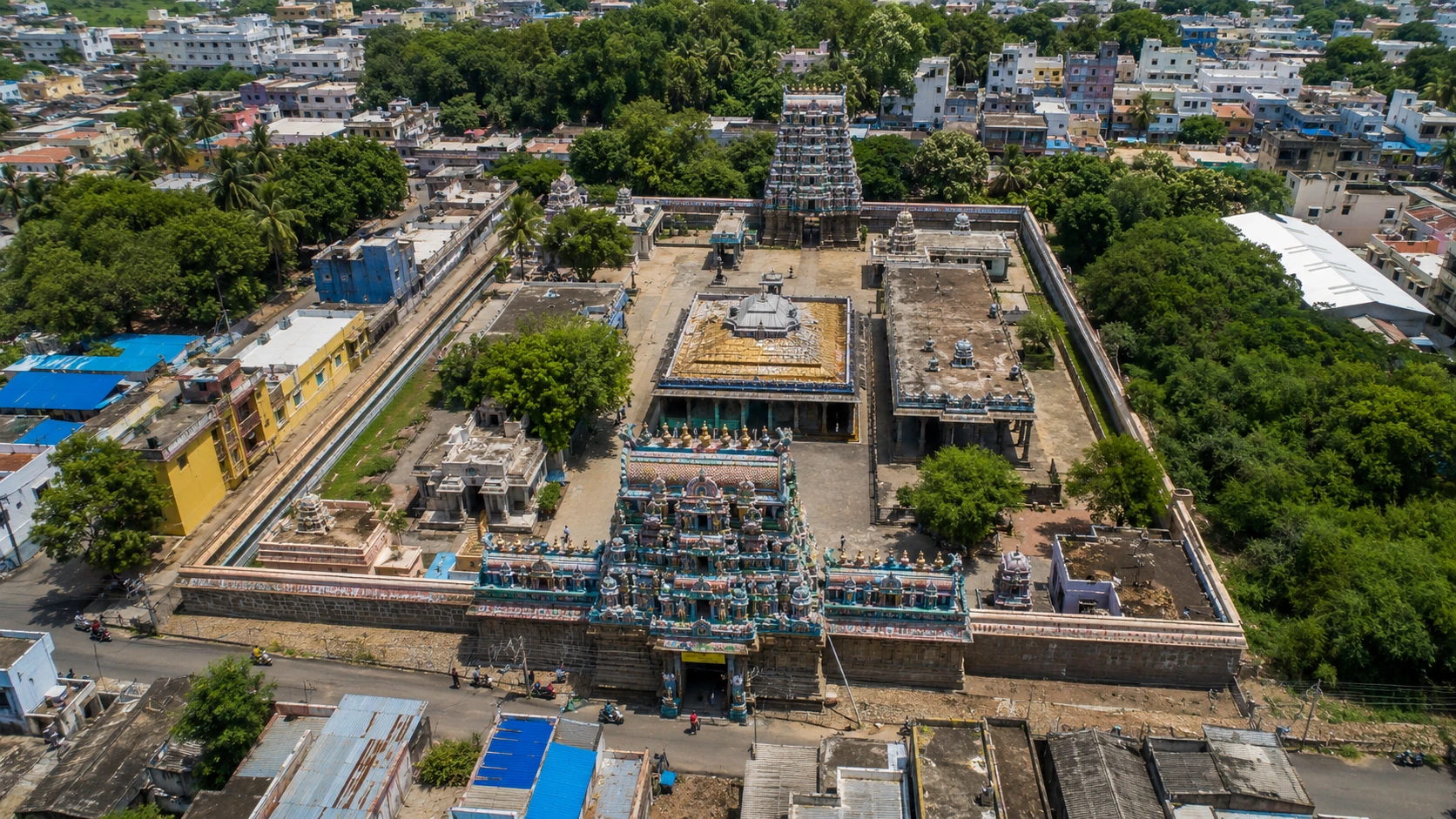
Era
Ancient site tradition; Sri Vidya presence at Kanchipuram attested from at least the 8th century CE
Architecture
Dravidian (South Indian; Pallava and Vijayanagara influences in the broader temple complex)
Open
06:00 – 20:00
Aarti
06:00 · 12:00 · 18:00
Special
Navratri; Lalita Panchami (fifth day of Navratri) is specially significant for Tripurasundari
The Sacred Legend · पवित्र कथा
Shodashi Tripurasundari is the Mahavidya who is beautiful — not with the surface beauty of ornament but with the beauty that arrives when consciousness opens completely and the world reveals its nature as luminous, graceful, and full. She is the third of the ten wisdom goddesses: sixteen years old (shodasha = sixteen), the goddess of the fullness of all sixteen phases of the moon, blazing like a thousand suns, seated on a throne whose four legs are Brahma, Vishnu, Rudra, and Sadashiva — the four functions of the universe serving as her furniture. She presides over the Sri Vidya, the most philosophically complete system of goddess-centred practice in the Hindu world, whose geometric sacred map, the Sri Chakra, is considered her own body rendered in abstract form. At Kanchipuram — the city of a thousand temples, one of the seven sacred Shakti seats of South India, home to the Kanchi Kamakoti Peetha and the living Sri Vidya lineage — Tripurasundari is present in her most gracious and sovereign form. The tradition at Kanchi identifies her with Kamakshi — the goddess of beautiful eyes — and traces its unbroken lineage back to Adi Shankaracharya, who is said to have installed the Sri Chakra at the Kamakshi temple and composed the Soundaryalahari, the most celebrated Sanskrit poem on the divine feminine's beauty, here in Kanchipuram.
Sacred Designationपवित्र पदनाम
Sacred Origin Storyपवित्र उत्पत्ति कथा
Source: Shakta Tantra / Sri Vidya tradition; Lalita Mahatmya (Brahmanda Purana) and Soundaryalahari lineage
The Lalitopakhyana in the Brahmanda Purana narrates the origin of Tripurasundari in an act of cosmic creation that is also cosmic restoration. The demon Bhandasura — created from the ashes of Kama (the god of desire) after Shiva burned him — had conquered the three worlds and expelled the gods from heaven, building his fortress-city Shonita Pura. The gods, led by Indra, performed a great yajna (fire sacrifice) at the instruction of the sage Durvasa. From the fire, blazing with the combined power of all the gods, arose the goddess Lalita Tripurasundari — the most beautiful being in all of creation, sixteen years old in eternal youth, red as the rising sun and red lotus combined, seated on a throne whose four legs were the four gods. Her retinue of sixteen Nitya shaktis (eternal powers) accompanied her, and she conducted the great battle against Bhandasura, defeating him with her sugarcane bow and flower arrows — weapons of desire and beauty used as instruments of destruction, a profound theological paradox that is the tradition's way of saying that beauty itself is the highest power, that the gracious is also the fierce, that Kama (desire/love) destroyed by Shiva becomes the raw material of the goddess. The Soundaryalahari of Adi Shankaracharya — the hundred-verse hymn to the goddess's beauty — is understood in the tradition as composed by Shankaracharya at Kanchipuram, where he installed the Sri Chakra at the Kamakshi temple. In the Sri Vidya theological framework, Tripurasundari is identified with Kamakshi — 'She of Beautiful Eyes' — whose eternal gaze animates and sustains creation. Kamakshi's Sanskrit name is analyzed: kama (desire/beauty) + akshi (eyes) — she whose eyes are the very form of beauty's generative power. The Sri Chakra — the ninefold interlocking triangle yantra — is simultaneously the geometric body of the goddess, the map of the universe's structure, and the primary object of Sri Vidya meditation and puja.
Sources cited:
- Brahmanda Purana, Lalitopakhyana / Lalita Mahatmya (primary narrative source for Tripurasundari)
- Soundaryalahari, attributed to Adi Shankaracharya (8th–9th century CE)
- Lalita Sahasranama (from Brahmanda Purana; thousand names of Lalita Tripurasundari)
- Tantrasara, Krishnananda Agamavagisha (Sri Vidya section)
- David Kinsley, 'Tantric Visions of the Divine Feminine: The Ten Mahavidyas' (1997), University of California Press — Chapter 4
- Douglas Renfrew Brooks, 'The Secret of the Three Cities: An Introduction to Hindu Sakta Tantrism' (1990), University of Chicago Press
Other Traditions · अन्य परंपराएँ
Kamakshi-Tripurasundari identification in the South Indian Sri Vidya tradition
In the South Indian Sri Vidya tradition centered on Kanchipuram, Tripurasundari is identified with Kamakshi — the goddess of beautiful eyes — who is the presiding deity of the Kamakshi Amman temple, one of the most important Shakti Peethas in South India. In this tradition, Kamakshi did tapas (austerities) at Kanchi to obtain Shiva as her consort; the Shiva worshipped here is Ekambareswarar (Lord of the Mango Tree). The Kamakshi tradition holds that Adi Shankaracharya, perceiving that the goddess's form at Kanchi was fierce (ugra), installed the Sri Chakra before her, transforming her energy from fierce to gracious (saumya). The Sri Chakra installation at the Kamakshi temple is the founding narrative of the Kanchi Kamakoti Peetha's authority and is the root of the Sri Vidya transmission lineage at Kanchipuram. This account is not in contradiction with the Lalitopakhyana but represents the regional crystallisation of the Tripurasundari tradition in South Indian Shaiva-Shakta practice.
Scholarly Context
Douglas Brooks's 'The Secret of the Three Cities' (1990) is the authoritative scholarly treatment of the Sri Vidya tradition in English. He establishes the Tripurasundari tradition as the most philosophically elaborate of all Shakta systems — combining Tantric practice, Vedantic philosophy, and devotional poetry in a single integrated framework. Kinsley (1997, Chapter 4) places Tripurasundari third in the Mahavidya sequence and notes her relative accessibility compared to the fiercer Mahavidyas: her beauty, grace, and auspiciousness make her the most widely worshipped of the ten in devotional practice. The Sri Chakra's mathematical properties — nine interlocking triangles generating 43 sub-triangles within lotus circles and a square outer boundary — have been studied by both traditional scholars (Bhaskararaya's 18th-century commentary on the Lalita Sahasranama is definitive) and modern mathematicians (the figure's geometric properties are extraordinary). The Kanchi Kamakoti Peetha (founded in its current institutional form by tradition from Adi Shankaracharya) is one of the most influential living Sri Vidya institutions in India. The Kanchipuram Shodashi/Tripurasundari shrine in the Eternal Raga corpus represents the Mahavidya dimension of this tradition. The specific shrine details — founding history, current management, and exact location — require on-ground verification with local Sri Vidya practitioners before final publication.
Historyइतिहास
Kanchipuram — ancient Kanchi or Kanchipura — is one of the seven sacred cities (Sapta Puri) of Hinduism and one of the oldest continuously inhabited cities in South Asia, with a history extending back to at least the 3rd century BCE. The city has served as the capital of the Pallava dynasty (3rd–9th centuries CE), whose rulers built some of the most important early Dravidian temple structures in South India, including the Kailasanathar temple. Under the Pallavas, Kanchipuram became a major centre of Shaiva, Vaishnava, and Shakta religious life, as well as Buddhist and Jain traditions. The city's Shakti identity is anchored by the Kamakshi Amman temple, one of the 51 Shakti Peethas and one of the three primary seats of Kamakshi worship. The Sri Vidya tradition at Kanchipuram — centered on the worship of Tripurasundari in her Kamakshi manifestation — claims an institutional continuity traceable to Adi Shankaracharya (c. 788–820 CE, by one chronology), who is said to have established the Kanchi Kamakoti Peetha here and installed the Sri Chakra at the Kamakshi temple. While the historicity of specific details of Shankaracharya's institutional founding is debated by scholars, the Sri Vidya tradition at Kanchi is unquestionably of great antiquity and has produced influential texts (Soundaryalahari), prominent acharyas, and a continuous line of initiates (dikshitas) who have preserved and transmitted the Panchadashakshari and Sri Chakra puja over many centuries. The Vijayanagara empire (14th–17th centuries) was a major patron of Kanchipuram's temples, undertaking significant construction and renovation at the Kamakshi and Ekambareswarar temples. The current structure of the Kamakshi complex reflects this Vijayanagara-period intervention. The Kanchi Kamakoti Peetha, in its modern institutional form, has been led by a succession of Shankaracharyas including the highly revered Chandrasekarendra Saraswati (1894–1994), known as 'the Mahaswami' or 'the Saint of Kanchi', who made the Peetha and Kanchipuram's Sri Vidya tradition internationally known.
Historical Timelineऐतिहासिक कालक्रम
Kanchipuram established as a major urban and religious centre, mentioned in early Sangam literature as Kachi or Kanchi. The city's sacred geography — as a site of both Shaiva and Shakti worship — is established in this period. The Kamakshi tradition's roots are understood in local tradition to predate the Pallava period.
The Sangam period dates are approximate. The earliest references to Kanchi as a major sacred and urban centre are from approximately the 1st–3rd centuries CE; the city's pre-Pallava religious history is attested in literature but less archaeologically documented than the Pallava period.
The Pallava dynasty rules Kanchipuram and undertakes major temple construction. The Kailasanathar temple (c. 685–705 CE, one of the oldest surviving stone temples in South India) is built. The Pallava period establishes Kanchipuram as the preeminent centre of early Dravidian temple architecture and religious patronage. The Kamakshi temple's ancient structure participates in this broader Pallava religious programme.
Adi Shankaracharya visits Kanchipuram, installs the Sri Chakra at the Kamakshi temple, and transforms the goddess from her fierce (ugra) form to her gracious (saumya) form. He is said to have composed the Soundaryalahari here and established the Kanchi Kamakoti Peetha as an institutional seat of Advaita Vedanta and Sri Vidya. This is the foundational narrative of the Sri Vidya transmission lineage at Kanchipuram.
The historical dating of Adi Shankaracharya is debated, with traditional dates of 788–820 CE and alternative scholarly proposals ranging from 509–477 BCE to the 8th century CE. The institutional history of the Kanchi Kamakoti Peetha as a continuous line from Shankaracharya is a traditional claim; modern scholars note the difficulty of establishing unbroken institutional continuity over such a long period. The core facts — that Sri Vidya has been practiced at Kanchipuram for at least a millennium and that the Kamakoshi Peetha is an important Sri Vidya institution — are not in dispute.
The Vijayanagara empire becomes the dominant patron of Kanchipuram's temples. Major construction and renovation of the Kamakshi Amman temple complex occurs during this period, creating the gopuram and mandapa structures that largely define the current appearance of the Kamakshi complex. The Vijayanagara rulers were both Vaishnava and ardent patrons of Shakta worship.
The tenure of Chandrasekarendra Saraswati — the 68th Shankaracharya of the Kanchi Kamakoti Peetha, known as 'the Mahaswami' or 'the Saint of Kanchi' — brings the Peetha and Kanchipuram's Sri Vidya tradition to international prominence. His scholarship, accessibility, and hundred-year lifespan make him one of the most revered spiritual figures of 20th-century India. Under his guidance, the Peetha's Sri Chakra puja tradition and the broader Sri Vidya teaching are preserved and transmitted to new generations.
What You'll Seeदर्शन में
Tripurasundari's form is the most elaborately beautiful in the Mahavidya series. The Lalita Sahasranama describes her complexion as red as the rising sun, red lotus, and red coral simultaneously — a warmth that is simultaneously solar and aquatic, fiery and luminous. She is Shodashi — sixteen years old in eternal youth, the fullness of all sixteen phases of the moon compressed into a single, perpetually young form. She is seated on a throne (paryanka) whose four legs are the four great gods: Brahma (the creator), Vishnu (the sustainer), Rudra (the transformer), and Sadashiva (the eternal Shiva) — the entire masculine principle of divinity supporting a single feminine form. In her four arms she carries: the pasha (noose — representing the bonds she can either tighten or release), the ankusha (elephant goad — the instrument of discipline), the sugarcane bow (ikshukodanda — desire/beauty as her weapon, made from sugarcane because desire is sweet), and flower arrows (pushpabana — the five sense-pleasures as her arrows). She is richly ornamented and crowned. Her three eyes are open; her gaze is the look of absolute benevolent sovereignty. In the Sri Vidya tradition, the Sri Chakra — the geometric yantra of nine interlocking triangles — is simultaneously her abstract form, her cosmological map, and the primary object of her worship. The innermost point of the Sri Chakra (the bindu) is where Tripurasundari herself resides. Photography practices inside the inner sanctum should be confirmed with temple management.
Distinctive Practicesविशिष्ट परंपराएँ
Sri Chakra Puja
श्री चक्र पूजा
Daily in Sri Vidya tradition; elaborate ritual on Navratri, Lalita Panchami, and Fridays
The Sri Chakra puja is the most elaborate and complete ritual in the Shakta Tantric tradition. The yantra — nine interlocking triangles enclosed in lotus circles within a square outer boundary — is worshipped by moving inward from the outermost square to the central bindu point, invoking a specific group of goddesses (shaktis) at each of the nine levels. The ritual requires specific training in the sequence of invocations, offerings, and mantras appropriate to each level. In its full form it takes several hours and covers every aspect of the goddess's nature from gross manifestation (outer square) to pure awareness (central point). At the Kanchipuram Sri Vidya institutions, the Sri Chakra puja has been maintained as a living practice with initiated practitioners.
The Sri Chakra's structure is understood as a complete map of consciousness: the outermost layers represent the grossest aspects of phenomenal experience, while each inner tier represents a progressively more subtle level, culminating at the central bindu which is pure undifferentiated awareness — the goddess herself in her most essential form. Worshipping the Sri Chakra from outside to inside is understood as the devotee's movement from identification with phenomenal experience to recognition of pure consciousness. The yantra is thus simultaneously a cosmological diagram, a map of the body's subtle energy centres, and a guide to meditation.
Soundaryalahari recitation
सौंदर्यलहरी पाठ
Daily at Sri Vidya institutions; particularly on Fridays and Navratri
The Soundaryalahari — 'The Wave of Beauty' — attributed to Adi Shankaracharya is the defining devotional text of the Tripurasundari tradition and is recited daily at Sri Vidya institutions associated with the Kanchi lineage. The hundred verses describe the goddess's beauty from head to toe in a poetic progression that is simultaneously an aesthetic rapture and a systematic meditation guide: each verse focuses on a specific aspect of the divine form, and in the Sri Vidya reading, each description corresponds to a specific chakra, mantra, or yantra. The Soundaryalahari's association with Kanchipuram — where it is traditionally said to have been composed — makes its recitation here a practice of returning the text to its source.
Did You Know?क्या आप जानते हैं?
The Sri Chakra — the primary yantra of Tripurasundari — is among the most mathematically remarkable geometric figures in any religious tradition. Its nine interlocking triangles (four pointing up, five pointing down) generate exactly 43 smaller triangles within their intersections, contained within lotus circles of eight and sixteen petals, surrounded by a square outer boundary with four gates. The central point (bindu), from which all triangles expand, is the geometric equivalent of a singularity — a point of infinite density from which the entire complex structure unfolds. Traditional commentators describe it as a fractal of consciousness; modern mathematicians have noted its properties with admiration.
Bhaskararaya, 'Saubhagyabhaskara' (18th century commentary on Lalita Sahasranama); Douglas Brooks, 'The Secret of the Three Cities' (1990); various mathematical studies of the Sri Yantra geometry
The Soundaryalahari attributed to Shankaracharya is considered the greatest poem in the Sanskrit literary tradition on the theme of the divine feminine. Its opening verse — 'If Shiva is united with Shakti, he is able to act; if otherwise, he cannot even move' — is one of the most quoted lines in all of Shakta philosophy, encapsulating the tradition's central claim that consciousness (Shiva) without the energy of the feminine (Shakti) is inert, like a corpse. The verse positions Shakti as the activating principle of the universe, not a secondary goddess but the prime mover. The Soundaryalahari's Kanchipuram association gives the city a claim to being the site where this foundational statement of Shakta philosophy was first articulated in its most perfect poetic form.
Soundaryalahari, v. 1 (attributed to Adi Shankaracharya); Brooks, 'The Secret of the Three Cities' (1990)
Kanchipuram is one of the very few cities in India that is simultaneously sacred to three of the four major traditions of Hinduism: Shaiva (Ekambareswarar temple, Kailasanathar), Vaishnava (Varadharaja Perumal temple, one of the 108 Divya Desams), and Shakta (Kamakshi Amman temple, one of the 51 Shakti Peethas). The Saiva-Shakta-Vaishnava triple presence in a single city is rare and gives Kanchipuram a theological comprehensiveness unusual even among India's sacred cities.
Diana Eck, 'India: A Sacred Geography' (2012), Tamil Nadu chapter; T.V. Mahalingam, 'Kanchipuram in Early South Indian History' (1969)
The Panchadashakshari — the fifteen-syllable mantra that is the primary mantra of Tripurasundari in the Sri Vidya tradition — is among the most closely guarded of all Hindu Tantric mantras. It is considered initiation-restricted: its correct transmission requires personal diksha (initiation) from a qualified guru in an unbroken lineage. The Kanchipuram Sri Vidya lineage (through the Kanchi Kamakoti Peetha and associated acharyas) is one of the most respected sources of this initiation in South India. The mantra is not published here in keeping with this tradition's own standards of transmission.
Douglas Brooks, 'The Secret of the Three Cities' (1990), Chapter 4; Kanchi Kamakoti Peetha institutional tradition
Visitor Accessप्रवेश जानकारी
The Shodashi Tripurasundari shrine at Kanchipuram is open to devotees. For the broader Kamakshi Amman temple complex — the primary locus of Sri Vidya worship at Kanchipuram — access is generally open to all, though the inner sanctum may have specific protocols. The Kanchi Kamakoti Peetha, which houses the Sri Chakra and conducts Sri Vidya pujas, may have specific access protocols for non-initiates wishing to witness the Sri Chakra puja; visitors should inquire with the Peetha directly. Standard temple decorum applies throughout: modest attire, footwear removed, mobile phone use restricted inside.
For darshan at the Kamakshi Amman temple (the primary Sri Vidya site at Kanchipuram): the temple's official website and the Kanchi Kamakoti Peetha's official site (kamakoti.org) are the best sources for current timings, special puja schedules, and any visiting protocols. For the specific Shodashi/Tripurasundari shrine: confirm exact location and access with local temple authorities or Sri Vidya practitioners in Kanchipuram before travel.
Festivalsत्योहार
Navratri and Lalita Panchami
नवरात्रि और ललिता पंचमी
Sep–Oct (Ashwin, 9 days)
Navratri at Kanchipuram, and specifically at the Kamakshi Amman temple and associated Sri Vidya institutions, is one of the most significant in South India. The fifth day of Navratri — Lalita Panchami — is especially sacred to Tripurasundari/Lalita, and receives special Sri Chakra puja, Sahasranama parayana (recitation of the Lalita Sahasranama), and elaborate Soundaryalahari recitation. The ninth night (Maha Navami) and tenth day (Vijaya Dashami) conclude the festival with the iconic Kolu display — South India's distinctive Navratri tradition of displaying arranged figurines.
Aadi Pooram (Adi festival of Kamakshi)
आदि पूरम
Jul–Aug (Tamil Aadi month, Pooram star)
Aadi Pooram is the primary annual festival of the Kamakshi Amman temple, celebrated in the Tamil month of Aadi (July–August) when the star Pooram (Purva Phalguni) is ascendant. It marks the occasion when Kamakshi/Tripurasundari is believed to be at her most auspicious and accessible. The temple sees its highest annual attendance during this festival, with elaborate processions, decorated palanquin processions (ther/chariot), and special abhishekam. In the Sri Vidya tradition this is the goddess's most gracious manifestation of the year.
Friday special puja (Sukravar Abhishekam)
शुक्रवार विशेष पूजा
Weekly
Friday — the day of Shukra (Venus), associated with beauty, grace, and abundance — is the weekly sacred day across all Shakti temples in South India. At the Kanchipuram Sri Vidya shrines, Friday is marked by extended abhishekam, recitation of the Lalita Sahasranama, and Sri Chakra puja. The association of Friday with Tripurasundari is particularly resonant: Venus governs the aesthetics — beauty, music, poetry, elegance — that are this goddess's domain.
Traditional Offeringsपारंपरिक अर्पण
Primary Offerings
Red lotus (Lal Kamal)
लाल कमल
रक्त पद्म
The red lotus is the most theologically precise offering to Tripurasundari. The Lalita Sahasranama describes her complexion as the colour of red lotus (rakta varna) and the Soundaryalahari describes her lotus-throne. The red lotus embodies three qualities simultaneously: the beauty of the flower (saundarya — her primary quality), the rooting in water (association with Kamala/abundance), and the colour of passion and consciousness (red — the colour of Shakti's active energy). Offering a red lotus to Tripurasundari is placing the purest embodiment of her own nature before her.
Red hibiscus (Jaba / Chembaratti)
लाल जवापुष्प
जपापुष्प
The red hibiscus — jaba in Sanskrit, chembaratti in Tamil — is the standard floral offering at South Indian Shakti temples including the Kamakshi complex at Kanchipuram. For Tripurasundari, whose complexion is crimson and whose nature is beauty made divine, the deep red of the hibiscus directly mirrors her essence. The Devi Bhagavata recommends hibiscus as specially pleasing to the goddess in her active (rajasic) Tantric forms.
Kumkum and turmeric (Tilak)
कुमकुम और हल्दी
कुङ्कुम, हरिद्रा
Kumkum (vermilion) and turmeric are the standard dual offering at South Indian goddess temples and are placed at the feet of Tripurasundari at Kanchipuram. Kumkum represents activated Shakti energy and the third eye; turmeric represents purification, auspiciousness, and the golden colour that is also associated with the Sri Vidya tradition. The combination of deep red (kumkum) and golden yellow (haldi) mirrors the duality of Tripurasundari's own nature: fiery and gracious, active and auspicious.
Sugarcane (Ikshu)
गन्ना
इक्षु
Sugarcane is offered to Tripurasundari because it is literally her weapon: her bow (ikshukodanda) is made of sugarcane, and her arrows are flowers. Offering sugarcane to the goddess is an act of placing her own instrument before her — sweetness as a weapon, desire as a tool of liberation, beauty as a force of cosmic correction. The offering connects the devotee to the teaching that what the world calls pleasurable and what the Mahavidya calls liberation are not opposites but the same energy at different levels of understanding.
Panchamrit abhishekam (Five sacred substances)
पंचामृत अभिषेक
पञ्चामृत
The panchamrit abhishekam — bathing the deity with milk, curd, honey, ghee, and sugar — is performed at Tripurasundari's shrine as at most Shakta goddess shrines. For the Sri Vidya tradition, the five substances correspond to the five elements and the five senses: their offering represents the complete sensory world placed at the goddess's feet, acknowledging that all sensory experience — taste, beauty, sweetness — is ultimately a form of her grace. The abhishekam's liquid residue (charnamrit) is considered particularly precious at a Tripurasundari shrine.
Unique to This Temple
Sri Chakra Archana (yantra worship with Lalita Sahasranama)
श्री चक्र अर्चना
The Sri Chakra Archana — the ritual of offering flowers or kumkum at each of the 43 triangles and intersection points of the Sri Chakra while reciting the Lalita Sahasranama — is the temple-specific puja form particular to Sri Vidya institutions. Each of the thousand names is offered with a specific flower or offering material at a specific point in the yantra's geometry. The complete archana, performed by initiated priests, is one of the most elaborate and beautiful of all Hindu ritual forms. Devotees wishing to commission a Sri Chakra Archana should contact the Kanchi Kamakoti Peetha or associated Sri Vidya institutions directly.
Offering items — red lotus, hibiscus, kumkum, sugarcane, flowers — are available from vendors outside the Kamakshi Amman temple and in the surrounding market. For the Sri Chakra Archana and other elaborate Sri Vidya rituals, contact the Kanchi Kamakoti Peetha (kamakoti.org) or the Kamakshi Amman temple trust directly. The Lalita Sahasranama, the Soundaryalahari, and other Sri Vidya texts are available in print at the Peetha's publications division, which is a valuable resource for devotees wishing to deepen their engagement with the tradition.
How to Reachकैसे पहुँचें
Kanchipuram is one of the most accessible of South India's major temple towns. By road: the city is approximately 75 km from Chennai on NH-48 (Chennai–Bengaluru highway) via Sriperumbudur; taxis from Chennai take approximately 1.5–2 hours. Government and private buses run frequently from Chennai's Koyambedu bus terminus and from Bengaluru (approximately 250 km, 4–5 hours). By rail: Kanchipuram has its own railway station on the Chennai–Arakkonam line; suburban trains from Chennai Central and Chennai Egmore take approximately 1.5–2 hours. Multiple direct trains operate daily. From Chennai airport, a taxi directly to Kanchipuram is approximately 1.5–2 hours depending on traffic. Within Kanchipuram, the major temples are distributed across the city; auto-rickshaws are the standard mode of transport for the temple circuit. Most visitors do Kanchipuram as a day trip from Chennai, but the city has sufficient accommodation for overnight stays, particularly useful during Navratri or major festival periods.
Plan Your Visitयात्रा की योजना
🌤 Best Season
October to March is ideal — pleasant temperatures and the major festival season (Navratri in October, and the cool months that follow). Avoid peak summer (April–June), which is extremely hot in the Tamil Nadu interior. The Aadi Pooram festival in July–August is significant despite the heat. Kanchipuram's silk weaving industry makes it worth combining a temple visit with a visit to the silk weavers' cooperatives — the famous Kanchipuram silk sarees are one of India's great textile traditions.
👘 Dress Code
Traditional or modest attire is required at all Kanchipuram temples. For the Kamakshi Amman temple specifically: traditional South Indian dress — sarees for women, dhoti-veshti for men — is strongly preferred and culturally appropriate. Western clothing (jeans, shorts, sleeveless) is generally not permitted inside the temple. Cotton dress appropriate to South India's heat is practical. Footwear is removed at the temple entrance.
📱 Phones & Photography
Mobile phones permitted in the outer areas of temple complexes. Photography practices inside the inner sanctums vary by temple; the Kamakshi Amman inner sanctum generally does not permit photography. Follow posted instructions and guidance from temple staff.
🏨 Accommodation
Kanchipuram has a range of accommodation from basic guesthouses to mid-range hotels, including Tamil Nadu Tourism Development Corporation (TTDC) properties. Most pilgrims from Chennai and Bengaluru visit as a day trip. Staying overnight allows early morning darshan (the most auspicious time at Kamakshi) and the experience of the city's quieter religious atmosphere before the tourist rush begins.
Book a Pujaपूजा बुक करें
Booking links and phone numbers are verified periodically but may change without notice. The kamakoti.org website is the official Kanchi Kamakoti Peetha portal; verify that any URL you use for puja booking belongs to this domain before making payment. The specific seva pricing and booking details for this shrine have not been independently verified for this entry. Beware of third-party sites claiming to offer Kamakshi or Kanchi puja bookings.
Managed by: Kamakshi Amman Devasthanam Trust, Kanchipuram; Kanchi Kamakoti Peetha
Abhishekam (special ritual bathing)
अभिषेक
Sri Chakra Archana
श्री चक्र अर्चना
Lalita Sahasranama Parayana
ललिता सहस्रनाम पाठ
Booking information verified: 2026-05-23
Sacred Soundsपवित्र ध्वनि
Did You Know? · क्या आप जानते हैं?
The same translation error that turned '33 Koti' into '33 crore' in Hinduism also happened in Buddhism. The Chinese translation of Buddhist texts rendered 'Sapta Koti Buddha' (7 Supreme Buddhas) as '7 Crore Buddhas.' The Tibetan translation got it right: 7 types, not 7 crore. One Sanskrit word, misread across two major world religions, generated two identical misconceptions independently.
Related Contentसंबंधित सामग्री
Related Scriptures
Related Temples
Kamakhya Temple
कामाख्या मंदिर
Guwahati, Assam
Bhuvaneshwari Mata (Gauhati)
भुवनेश्वरी माता
Gauhati, Assam
Bhairavi Mata Temple
भैरवी माता मंदिर
Tezpur, Assam
Chinnamasta Mandir (Rajrappa)
छिन्नमस्ता मंदिर
Rajrappa, Jharkhand
Dhumavati Mandir (Varanasi)
धूमावती मंदिर
Varanasi, Uttar Pradesh
Bagalamukhi Mandir (Datia)
बगलामुखी मंदिर
Datia, Madhya Pradesh
Matangeshwar Mandir (Khajuraho)
मातंगेश्वर मंदिर
Khajuraho, Madhya Pradesh
Kamala Devi (Bishnupur)
कमला देवी मंदिर
Bishnupur, West Bengal
Community Reflections
🕉️
Be the first to share your reflection.