Chinnamasta Mandir (Rajrappa)
छिन्नमस्ता मंदिर
Sixth Mahavidya — the self-decapitated goddess who feeds the world with her own blood
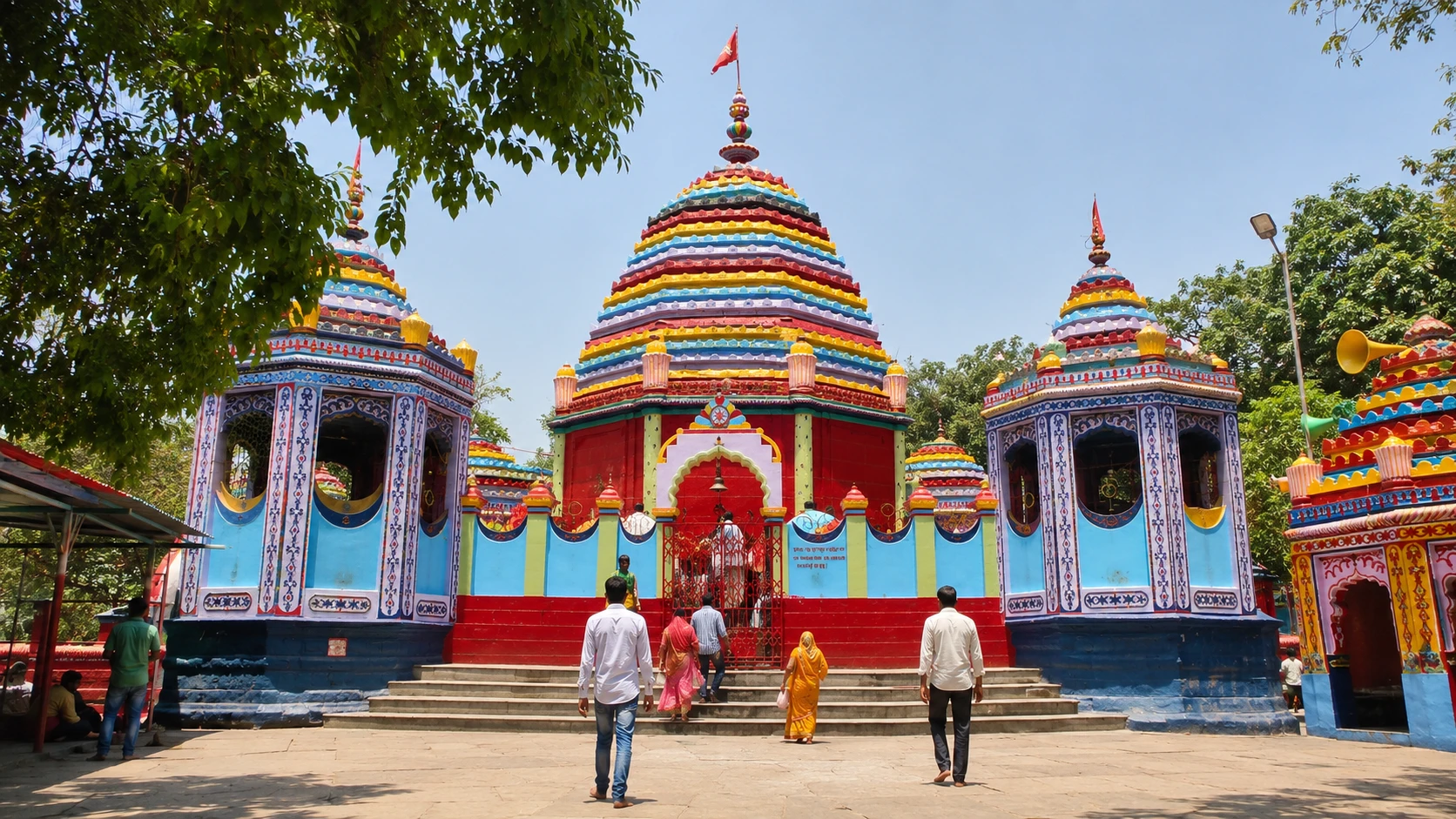
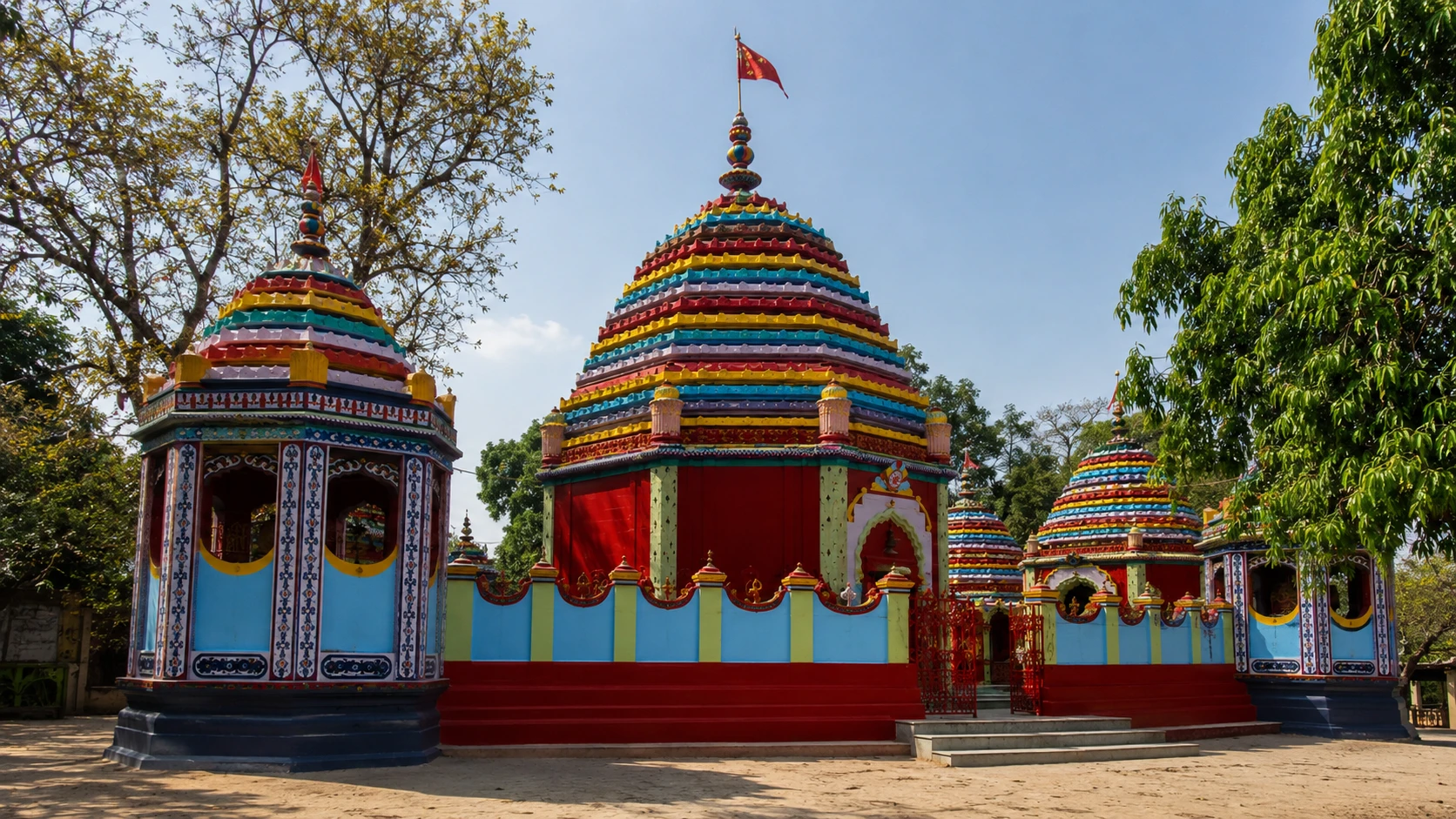
Rajrappa, Jharkhand, India
ChinnamastāAlso known as: Chhinnamasta, Prachanda Chandika, Vajravairochani, Rajrappa Devi, Chinnamastika
Era
Ancient tradition; current structure predominantly 20th century
Architecture
Nagara (modest regional variant)
Open
05:00 – 20:00
Aarti
05:30 · 12:00 · 18:30
Special
Tuesdays and Fridays — peak darshan days; Navratri sees extremely large gatherings
The Sacred Legend · पवित्र कथा
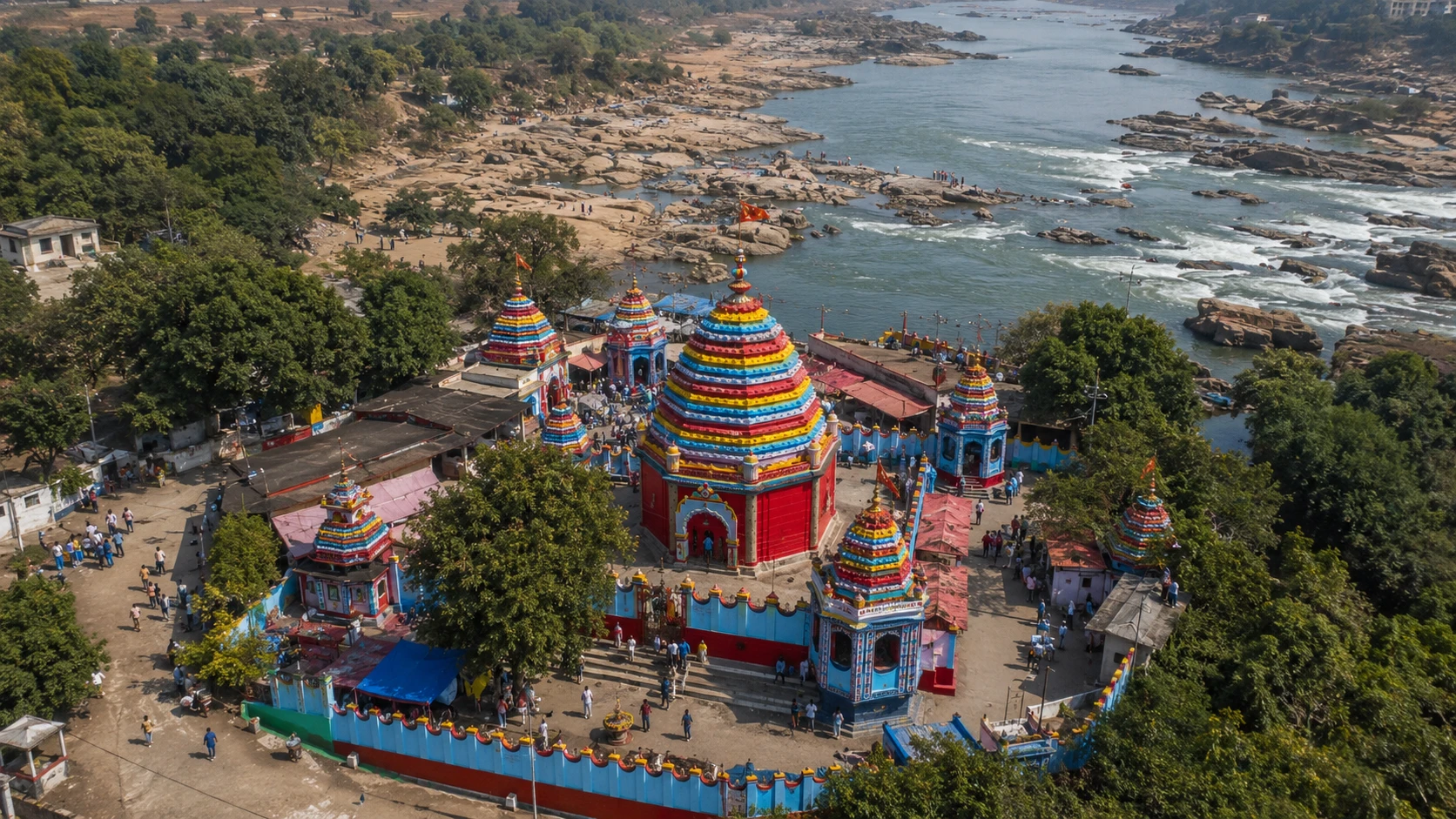
At the confluence of the Bhairavi and Damodar rivers in Jharkhand's Chota Nagpur Plateau, Chinnamasta stands in her most complete and startling form: she has severed her own head with her own sword, and holds it in her outstretched hand. Three streams of blood arc from the severed neck — one flows into her own open mouth, sustaining even her decapitated form; two flow into the mouths of her two attendants who stand beside her, fed and satisfied. She stands on a copulating couple, entirely above the domain of desire. The Rajrappa temple is where this most philosophically extreme of the Mahavidyas is worshipped not as an abstraction but as a living, present, blood-red reality — the goddess who solved hunger by offering herself, who dissolved the boundary between the one who gives and the one who is given, and who teaches that the calculating, self-preserving mind is precisely the thing that must go for true nourishment to flow.
Sacred Designationपवित्र पदनाम
Sacred Origin Storyपवित्र उत्पत्ति कथा
Source: Shakta Tantra / Dasha Mahavidya tradition; Chinnamasta Tantra lineage
The primary mythological account, narrated in the Shakta Pramoda and referenced in the Chinnamasta Tantra, begins on the banks of the Mandakini river. Parvati had come to bathe with her two attendants, Dakini and Varnini. After bathing, the attendants became consumed by hunger and began to importune the goddess, crying out for food. Parvati promised to provide for them, but as they walked on, the hunger of the attendants grew more urgent and their complaints more desperate. At last, moved entirely by compassion rather than reason or strategy, Parvati drew her sword and severed her own head. Three streams of blood leapt from the severed neck: the central stream flowed into the mouth of her own severed head, which she held aloft; the two lateral streams flowed directly into the open mouths of Dakini and Varnini, satisfying their hunger completely. The attendants were fed; the goddess herself was nourished; and the act of self-sacrifice dissolved the boundary between giver and given, between the one who suffers and the one who acts. In the Tantric reading, Chinnamasta's self-decapitation is the supreme act of liberation: she cuts off the discriminating, ego-maintaining head — the organ of calculation, self-preservation, and separation — and what remains is pure consciousness expressed as blood, freely flowing, nourishing all. She stands on a copulating couple, typically identified as Kama (the god of desire) and Rati (his consort, pleasure-itself), indicating that her act transcends even the creative drive of desire. She is above the force of attraction that generates the universe; she is the consciousness that witnesses without being captured. Her nudity (digambara — clad in the directions) signals that she is beyond all clothing, all social construction, all conditioned identity.
Sources cited:
- Shakta Pramoda (composite Shakta ritual compendium; Chinnamasta puja vidhi)
- Chinnamasta Tantra (text specific to Chinnamasta tradition)
- Tantrasara, Krishnananda Agamavagisha (16th–17th century)
- David Kinsley, 'Tantric Visions of the Divine Feminine: The Ten Mahavidyas' (1997), University of California Press — Chapter 7
- Devi Bhagavata Purana, Skanda 7
Other Traditions · अन्य परंपराएँ
Vajrayogini identification (Vajrayana Buddhism)
In the Vajrayana Buddhist tradition, a goddess strikingly similar to Chinnamasta — known as Vajrayogini or Chinnamunda Vajrayogini — appears in the Cakrasamvara Tantra and related texts. She is depicted in near-identical iconography: self-decapitated, holding her severed head, standing on a copulating couple, with three streams of blood. Scholars including Kinsley and Elizabeth English have documented the close parallels between the Hindu Chinnamasta and the Buddhist Vajrayogini, and have debated which tradition the iconography originated in. Both traditions are understood by their practitioners as independent revelations expressing the same fundamental truth. The Eternal Raga presentation follows the Hindu Shakta tradition as the primary account, noting the Buddhist parallel as a significant case of independent convergence.
Scholarly Context
Kinsley (1997, Chapter 7) identifies Chinnamasta as the most philosophically radical of the ten Mahavidyas. Her iconography condenses several themes: the dissolution of the self-preserving mind, the identification of blood (rakta) with consciousness rather than merely with body, the transcendence of desire (standing above Kama and Rati), and the paradox of the goddess nourishing herself from her own body — a circuit of energy that needs no external source. The name Vajravairochani (she who blazes like the vajra/thunderbolt) connects her to the energy of lightning — instantaneous, consuming, and clarifying. The Rajrappa site's location at a river confluence is itself theologically significant: confluences (sangam) in Hinduism represent points of intensified sacred energy, where distinct flows merge and their individual identities dissolve — an apt geography for the goddess of dissolution. Some regional traditions include Rajrappa in extended lists of Shakti Peethas, identifying it as the site where a fragment of Sati's body fell; this claim is not substantiated in the canonical Pitha Nirnaya or the most authoritative 51/52-Peetha enumeration texts and should be treated as a regional devotional tradition rather than a canonical designation.
Historyइतिहास
The Chinnamasta temple at Rajrappa stands at the confluence of the Bhairavi River (also locally called the Bhera) and the Damodar River — a sacred geography that has been a pilgrimage site for centuries in the Chota Nagpur Plateau tradition. The confluence itself is called Rajrappa Dham in regional devotional usage, and the meeting of two rivers, one named for a Mahavidya (Bhairavi) and one carrying the name of a Vaishnava divine epithet (Damodara, a name of Krishna meaning 'rope-bellied one'), creates an unusual devotional resonance — Shakta and Vaishnava sacred geography converging at the same point. The Chota Nagpur Plateau region has deep Shakta roots in both Brahminical Tantric and indigenous Adivasi traditions. The tribal communities of Jharkhand — Santali, Ho, Munda, and others — have their own traditions of goddess worship that predate and parallel the Brahminical Mahavidya tradition. At Rajrappa, these streams have merged over centuries into a distinctive regional Shakta culture. The Nagvanshi dynasty, which historically ruled much of the Chota Nagpur region, was a major patron of temple construction and worship in the plateau. The current temple complex reflects primarily 20th-century construction and renovation, though the site's tradition of sacred status is considerably older. The establishment of Jharkhand as a separate state in November 2000 (carved from Bihar) resulted in the temple coming under the management of Jharkhand's state religious institutions. The site sees several million visitors annually, making it one of the highest-footfall pilgrimage sites in eastern India. Infrastructure development — road improvements, river-bank management, and facilities for pilgrims — has been an ongoing project of the state government and local administration.
Historical Timelineऐतिहासिक कालक्रम
Composition of Shakta Tantric texts including the Chinnamasta Tantra establishes the theological framework for Chinnamasta worship across the Bengal–Jharkhand Shakta sphere. The Chota Nagpur Plateau's Shakta tradition becomes integrated into the larger pan-regional Mahavidya system during this period, with the Rajrappa confluence gaining recognition as a site of special Shakti.
Precise dating of the Chinnamasta Tantra is uncertain; 10th–12th century is a scholarly estimate based on stylistic and doctrinal analysis. The text's composition in the Bengal–Assam Tantric milieu is generally accepted.
The Nagvanshi dynasty, ruling the Chota Nagpur region, is associated with patronage of temple construction and goddess worship across the plateau. The Rajrappa site's elevated status as a major pilgrimage point in the regional Shakta tradition develops during this period of dynastic patronage of sacred sites.
Documentation of Nagvanshi patronage specifically for the Rajrappa site is limited. Attribution is based on the general pattern of the dynasty's sacred site patronage across Chota Nagpur and should be verified with local archival sources.
The development of the Damodar Valley Corporation (established 1948) and associated industrial and infrastructure growth in the Jharkhand–Bengal coal belt brings improved road access to the Rajrappa area, making large-scale mass pilgrimage increasingly feasible. Pilgrim footfall grows substantially across the second half of the 20th century.
Formation of Jharkhand as a separate state (15 November 2000, carved from Bihar) results in the Rajrappa temple passing under Jharkhand state management. The new state government invests in infrastructure development at the site — road improvements, pilgrim facilities, and river embankment works — as part of religious tourism promotion.
What You'll Seeदर्शन में
Chinnamasta's form is among the most arresting in all of Hindu sacred art, and demands to be read carefully rather than recoiled from. She stands naked (digambara — clad only in the directions, signifying the complete absence of social conditioning or constructed identity). Her complexion is described in the Chinnamasta Tantra as brilliant red — the colour of fire and of sunrise. In her right hand she holds her own severed head by the hair, the mouth open to receive one of the three streams of blood arcing from her own neck. In her left hand she holds a sword (khadga) or scimitar — the instrument of her own self-liberation. Around her neck she wears a garland of skulls (mundamala). She stands on the prostrate forms of a copulating couple — most commonly identified as Kama (the god of desire, shown lying on his back) and Rati (pleasure, shown mounted above him). Her two attendants Dakini (on her right) and Varnini (on her left) stand flanking her, each catching a stream of blood in their open mouths. The three streams of blood represent, in the Tantric reading: the three channels of kundalini energy (ida, pingala, and sushumna); the nourishment of gross, subtle, and causal bodies; and the dissolution of the perceived division between self and other. Her name Vajravairochani — one who blazes like the vajra (thunderbolt) — appears in the formal mantra texts. Photography is not permitted inside the inner sanctum.
Distinctive Practicesविशिष्ट परंपराएँ
Sacred river bath at the confluence before darshan
दर्शन से पूर्व संगम पर पवित्र स्नान
Before every visit; at dawn on festival days
The established pilgrimage practice at Rajrappa begins at the river — devotees descend the stone ghats and bathe at the point where the Bhairavi River meets the Damodar River before proceeding to darshan. The confluence itself is considered sacred and the bath is understood as physical and ritual purification before entering the goddess's presence. The cold, swift river water at the confluence and the sound of the two currents merging creates a sensory experience that is itself understood as a preparation for Chinnamasta's teaching.
The confluence (sangam) in Hindu sacred geography is a point of intensified presence — where two distinct flows lose their separateness and become something new. Bathing at this particular sangam, between a river named Bhairavi and one carrying the name of a Vaishnava epithet, creates a symbolic entry into the space where distinct categories dissolve. This dissolution-before-dissolution prepares the devotee for Chinnamasta's central teaching: that the individual boundary dissolves, and what remains nourishes all.
Tuesday and Friday darshan
मंगलवार और शुक्रवार का दर्शन
Every Tuesday and Friday
Tuesdays and Fridays are the weekly high-point at Rajrappa, as at most goddess temples in north and east India. On these two days the temple receives far larger numbers of devotees than other days of the week. Special puja offerings and extended aarti schedules mark these days. Devotees who cannot visit during festivals often plan their visits to coincide with Tuesdays or Fridays.
Tuesday is associated with Mars (Mangal) — a planet of energy, action, and the colour red — and is considered auspicious for worship of fierce or active Shakti forms. Friday (Shukravar) is dedicated to Lakshmi and Shakti broadly in the north Indian tradition. Both days carry the energy of the divine feminine's most active expressions, making them natural high-points for Chinnamasta's worship.
Did You Know?क्या आप जानते हैं?
Chinnamasta is one of only a handful of deities in any religious tradition worldwide who is depicted actively nourishing others with her own blood — not sacrificing herself as a narrative event but standing in an eternal present-tense act of self-offering. The theological implication is radical: the goddess is not depleted by self-sacrifice; she is sustained by it. The circuit of giving and receiving closes within herself, and overflows to nourish others. This is understood in Tantric philosophy as an image of the consciousness that nourishes all existence from its own inexhaustible nature.
David Kinsley, 'Tantric Visions of the Divine Feminine' (1997), Chapter 7; Elizabeth English, 'Vajrayogini' (2002)
The two rivers meeting at Rajrappa carry a remarkable theological pairing: the Bhairavi River is named for the fifth Mahavidya (Bhairavi), and the Damodar River carries the name Damodara — one of the 1,000 names of Vishnu/Krishna, meaning 'one whose belly is bound with rope' (a reference to the childhood story of Krishna being tied to a mortar). The confluence thus brings together Shakta and Vaishnava sacred naming, which may partly explain Rajrappa's draw across devotional traditions.
Monier-Williams Sanskrit Dictionary (Damodara entry); Bhagavata Purana (Damodara lila narrative); local Rajrappa pilgrimage tradition
The Buddhist goddess Vajrayogini — worshipped in Tibetan, Nepalese, and East Asian Vajrayana traditions — is depicted in iconography nearly identical to Chinnamasta: self-decapitated, drinking her own blood, flanked by attendants, standing on a copulating couple. Scholars debate which tradition originated the iconography; both claim independent revelation. The parallel suggests that the image of a self-offering, self-nourishing goddess transcending desire represents a deep religious insight that arose — or was recognised — independently across two of Asia's most sophisticated contemplative traditions.
Kinsley, 'Tantric Visions of the Divine Feminine' (1997); Elizabeth English, 'Vajrayogini' (2002), Wisdom Publications
The Adivasi (indigenous) communities of the Chota Nagpur region — particularly the Santali, Munda, and Ho peoples — have their own traditions of powerful goddess worship that predate and run parallel to the Brahminical Mahavidya tradition at Rajrappa. The convergence of these two streams of goddess veneration at the same confluence has created a distinctive regional Shakta culture where Tantric Brahminical practice and tribal spiritual tradition share a sacred geography, each enriching without erasing the other.
S.C. Roy, 'The Mundas and Their Country' (1912); Verrier Elwin, 'The Religion of an Indian Tribe' (1955)
Visitor Accessप्रवेश जानकारी
The Chinnamasta temple at Rajrappa is open to devotees of all backgrounds. Standard temple decorum applies: modest attire, footwear removed at the entrance. Photography is not permitted inside the inner sanctum. The temple sees extremely large crowds on Tuesdays, Fridays, and during both Navratri periods — plan accordingly and expect queue times. The river confluence area involves stone steps (ghats) that can be slippery; exercise caution especially with elderly pilgrims or young children.
Contact the Jharkhand State Shrine Management Board (JSSMB) or the temple management committee at Rajrappa directly for current visiting timings, puja schedules, and any seasonal restrictions. The Jharkhand Tourism Department website provides general information about the site.
Festivalsत्योहार
Navratri (Chaitra and Ashwin)
नवरात्रि (चैत्र और आश्विन)
Mar–Apr (Chaitra) and Sep–Oct (Ashwin)
Both Navratri cycles bring enormous pilgrim gatherings to Rajrappa — among the highest in Jharkhand. The autumn Navratri (Ashwin) is particularly major: the nine nights of goddess worship, combined with the sacred river confluence, create a pilgrimage experience of unusual intensity. Lakhs of devotees come from across Jharkhand, Bihar, West Bengal, and Odisha during Navratri. Special aartis are performed at dawn and dusk, and the riverside ghats are lit with diyas through the night.
Kali Puja
काली पूजा
Oct–Nov (Kartik Amavasya)
Kali Puja on the new moon night of Kartik is a significant occasion at Rajrappa, as it is at all fierce-form Mahavidya shrines. The darkness of the new moon night, the sound of the river, and the heightened Tantric atmosphere of the night puja create a distinctive Kali Puja experience. Chinnamasta and Kali share the theological space of dissolution and fearlessness, making this festival deeply resonant at the shrine.
Shravan Somvar (Mondays of Shravan)
श्रावण सोमवार
Jul–Aug (Shravan month, Mondays)
While Shravan Mondays are primarily associated with Shiva worship across India, in the Jharkhand region the entire Shravan month sees intensified pilgrimage to major sacred sites. Rajrappa's location near the Damodar river — considered sacred in its own right — makes the Shravan season a time of heightened activity at the temple complex.
Traditional Offeringsपारंपरिक अर्पण
Primary Offerings
Red hibiscus (Jaba flower)
जवा पुष्प (लाल हिबिस्कस)
जपापुष्प
The red hibiscus is the defining floral offering for Chinnamasta, as for most fierce-form Shakta goddesses. The flower's deep crimson colour mirrors the goddess's complexion and the blood that is central to her iconography. In the Tantric offering tradition, presenting a red flower to Chinnamasta is an act of recognising the beauty and the vitality — not the horror — in the act of dissolution that she embodies.
Red cloth (Lal vastra)
लाल वस्त्र
रक्तवस्त्र
Red cloth is the traditional offering to Chinnamasta and the fierce Mahavidya forms. For Chinnamasta specifically, the act of draping red cloth over the deity carries additional meaning — clothing the one who is digambara (clad only in the directions) in the colour of her own blood is a paradox of devotion: the devotee offers what the goddess has already transcended, acknowledging her completeness while expressing care.
Kumkum and sindur
कुमकुम और सिंदूर
कुङ्कुम
Kumkum and sindur are placed at the feet of Chinnamasta. In the context of this shrine, the offering of red vermilion carries a particularly direct resonance — the blood-red substance is offered to the goddess of blood, acknowledging the sacrificial principle at the core of her teaching: that what is most essentially alive is what is freely given away.
Coconut
नारियल
नारिकेल
The coconut is the standard offering across Hindu goddess temples, and at Chinnamasta's shrine it carries the familiar Shakta meaning of ego-dissolution. Breaking a coconut before the goddess who voluntarily dissolved her own boundary between self and other is an act of aspiration: the devotee symbolically breaks the shell of the constructed self, offering it to the one who dissolved hers completely.
Sesame seeds (Til)
तिल
तिल
Sesame is the offering associated with transition, ancestors, and dissolution in the broader Hindu tradition. At Chinnamasta's shrine, offering til connects the devotee to the tradition of accepting impermanence without grief — the same psychological ground from which Chinnamasta's gesture of self-offering arises. Sesame is offered during homa (fire rites) at the temple on auspicious days.
Unique to This Temple
River water from the confluence (Rajrappa Sangam Jal)
राजरप्पा संगम जल
Water collected from the exact confluence point of the Bhairavi and Damodar rivers — where the two distinct streams dissolve into each other — carries unique ritual significance at Rajrappa. Pilgrims collect this sangam jal for use in home puja and for offering to the goddess. The water from the confluence is considered charged with the energy of the meeting point — theologically resonant with Chinnamasta's teaching of the dissolution of separateness.
Offering items are available from vendors along the approach road and near the temple entrance. The sangam itself is accessible for river bathing and water collection. The Jharkhand temple management maintains official counters for prasad. Devotees planning to participate in special puja during Navratri or festival periods should arrive early — queues can be very long, and special darshan arrangements are managed by temple staff.
How to Reachकैसे पहुँचें
Rajrappa is located in Ramgarh district of Jharkhand, approximately 80 km from Ranchi, 48 km from Bokaro Steel City, and 28 km from Ramgarh. By road this is the most practical access method: taxis and shared vehicles from Ranchi (NH-23/NH-33) take approximately 2–2.5 hours; from Bokaro, approximately 1.5 hours. By rail: the nearest mainline stations are Ramgarh Cantonment (approximately 28 km, on the Ranchi–Dhanbad line) and Bokaro Steel City (approximately 48 km, well-connected to Kolkata, Ranchi, and Delhi). From these stations, taxis and shared vehicles are available for the onward journey. By air: Birsa Munda Airport in Ranchi (IXR) is the nearest airport, approximately 80 km away, receiving flights from Delhi, Kolkata, Mumbai, and Patna. State road transport and private taxis connect Ranchi to Rajrappa. Within Rajrappa itself, the temple and the river confluence are walkable from the main access road; parking facilities exist for private vehicles. During Navratri and major festival periods, road congestion near the site is significant — allow extra travel time and consider arriving at off-peak hours.
Plan Your Visitयात्रा की योजना
🌤 Best Season
October to February offers the most comfortable visiting conditions — cool weather, clear skies, and manageable crowds outside festival peaks. Monsoon (June–September) sees heavy rainfall in the Chota Nagpur Plateau and the rivers run high, which adds to the drama of the confluence but requires caution on the ghats. If visiting during either Navratri, plan for very large crowds and book accommodation well in advance.
👘 Dress Code
Modest attire is expected. Traditional dress — sarees, salwar kameez, or dhoti-kurta — is appropriate and recommended. Footwear is removed at the temple entrance. Given the river confluence and the ghats, footwear that is easy to remove and re-wear is practical.
📱 Phones & Photography
Mobile phones are generally permitted in the outer temple areas. Photography is not allowed inside the inner sanctum. Follow posted instructions and guidance from temple management.
🏨 Accommodation
Accommodation options in Rajrappa itself are limited — primarily basic guesthouses and dharamshalas. Most pilgrims base themselves in Ramgarh (28 km) or Bokaro (48 km), which have a wider range of hotels, and travel to Rajrappa for the day. Ranchi (80 km) has full mid-range and upscale hotel options. During major festival periods, all accommodation in the region books out quickly; advance reservation is essential.
Book a Pujaपूजा बुक करें
Booking links and phone numbers are verified periodically but may change without notice. Always confirm the destination URL belongs to the official temple trust before payment. Puja booking details for this temple — including the official portal URL and pricing — have not been independently verified and must be confirmed with the Jharkhand State Shrine Management Board or the Rajrappa temple committee directly.
Managed by: Jharkhand State Shrine Management Board (JSSMB) / Temple Management Committee, Rajrappa
Vishesh Puja (Special Puja)
विशेष पूजा
Navratri Special Darshan
नवरात्रि विशेष दर्शन
Booking information verified: 2026-05-23
Sacred Soundsपवित्र ध्वनि
108 Japa Practice
Om Aim Hreem Shreem — Chinnamasta
Chant 108 times in the spirit of this temple
Did You Know? · क्या आप जानते हैं?
The same translation error that turned '33 Koti' into '33 crore' in Hinduism also happened in Buddhism. The Chinese translation of Buddhist texts rendered 'Sapta Koti Buddha' (7 Supreme Buddhas) as '7 Crore Buddhas.' The Tibetan translation got it right: 7 types, not 7 crore. One Sanskrit word, misread across two major world religions, generated two identical misconceptions independently.
Related Contentसंबंधित सामग्री
Related Scriptures
Related Temples
Bhuvaneshwari Mata (Gauhati)
भुवनेश्वरी माता
Gauhati, Assam
Bhairavi Mata Temple
भैरवी माता मंदिर
Tezpur, Assam
Kamakhya Temple
कामाख्या मंदिर
Guwahati, Assam
Dhumavati Mandir (Varanasi)
धूमावती मंदिर
Varanasi, Uttar Pradesh
Bagalamukhi Mandir (Datia)
बगलामुखी मंदिर
Datia, Madhya Pradesh
Matangeshwar Mandir (Khajuraho)
मातंगेश्वर मंदिर
Khajuraho, Madhya Pradesh
Kamala Devi (Bishnupur)
कमला देवी मंदिर
Bishnupur, West Bengal
Shodashi Tripurasundari (Kanchipuram)
षोडशी त्रिपुरसुंदरी
Kanchipuram, Tamil Nadu
Community Reflections
🕉️
Be the first to share your reflection.