Kamala Devi (Bishnupur)
कमला देवी मंदिर
Tenth Mahavidya — where the path through darkness arrives at the golden goddess of abundance
Bishnupur, West Bengal, India
KamalāAlso known as: Kamala Mata, Kamala Devi Bishnupur, Sri Lakshmi Mahavidya, Tantric Lakshmi, Kamalatmika
Era
Temple tradition rooted in the Malla dynasty period; current structure details require on-ground verification
Architecture
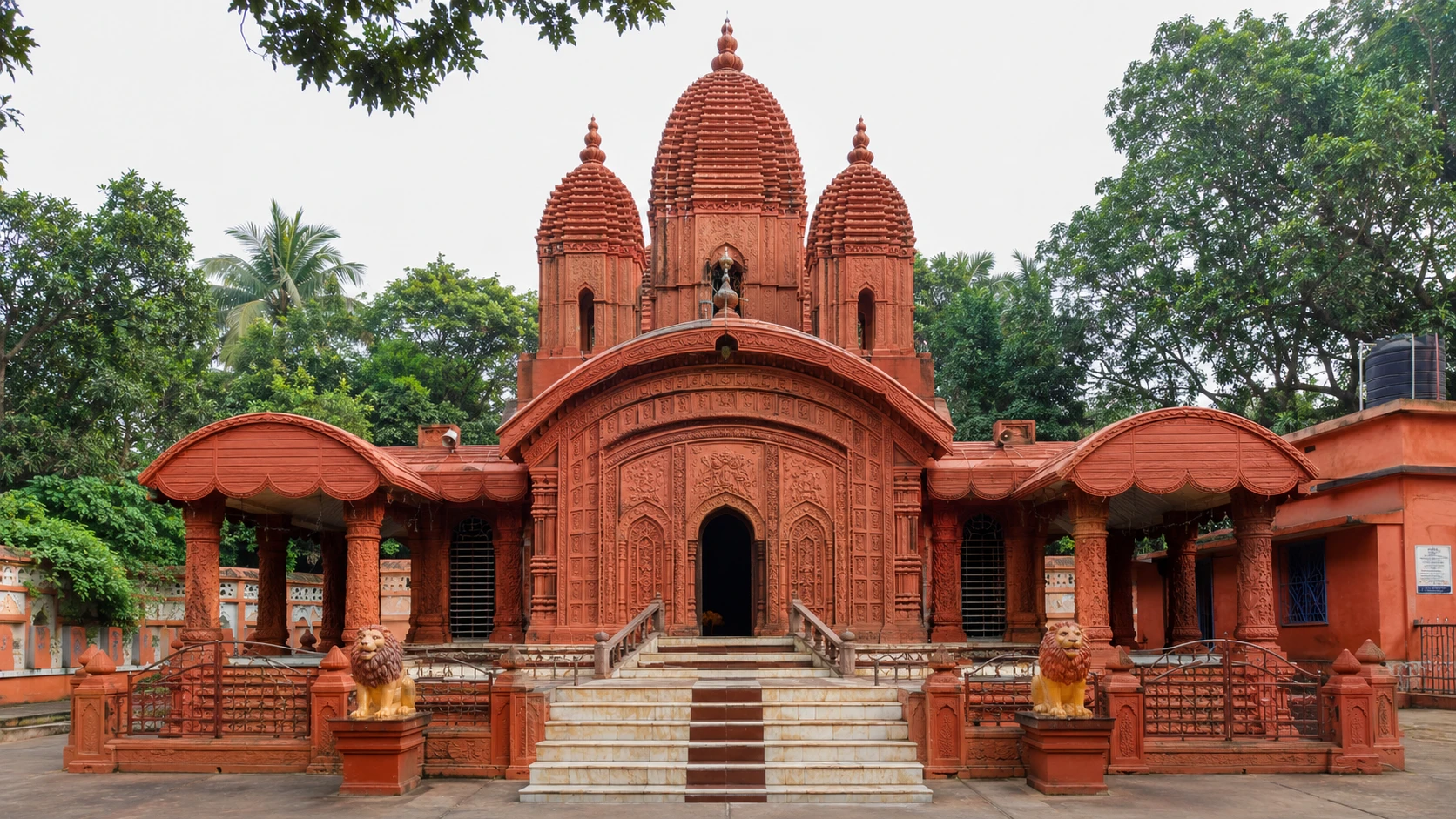
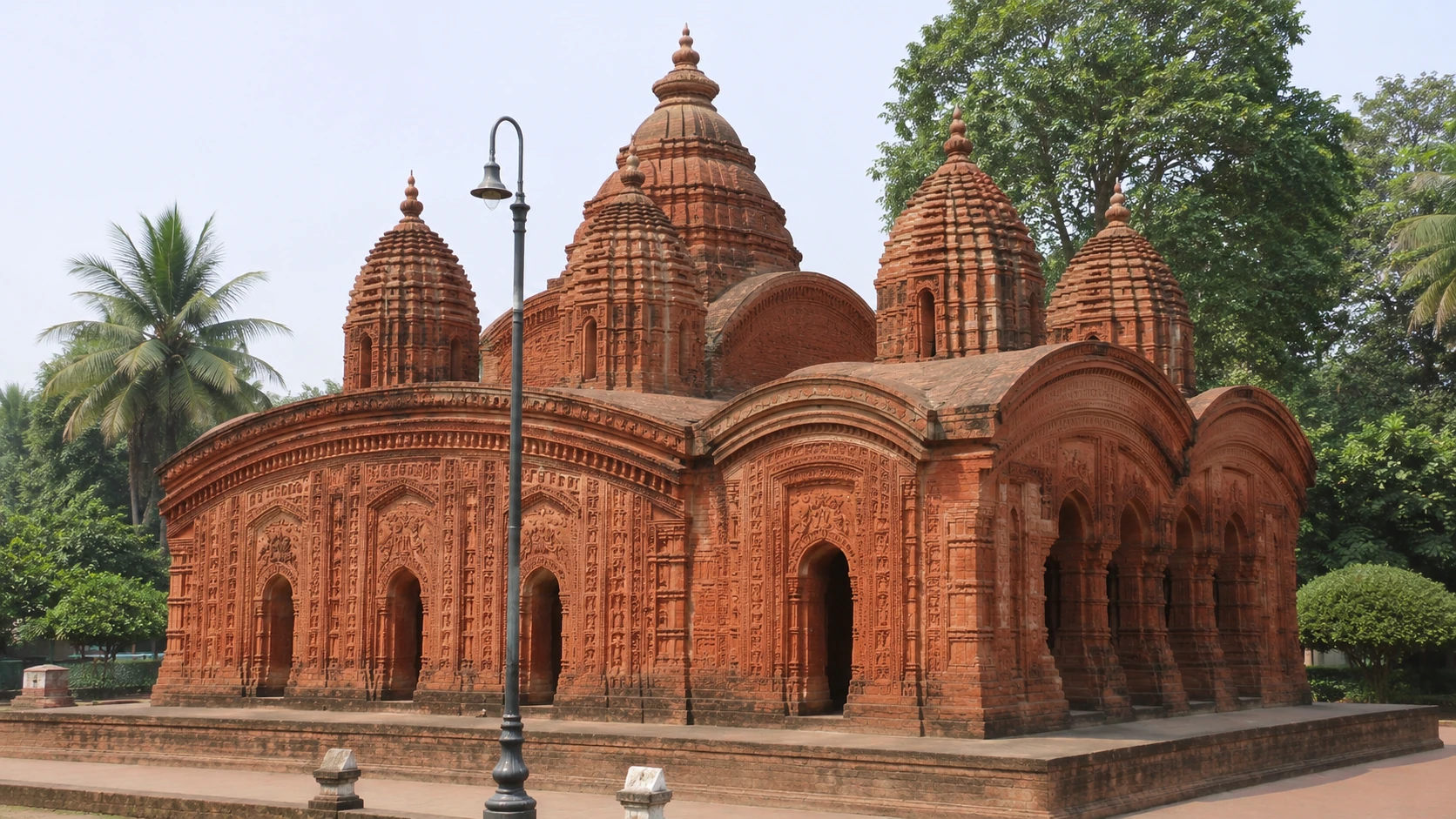
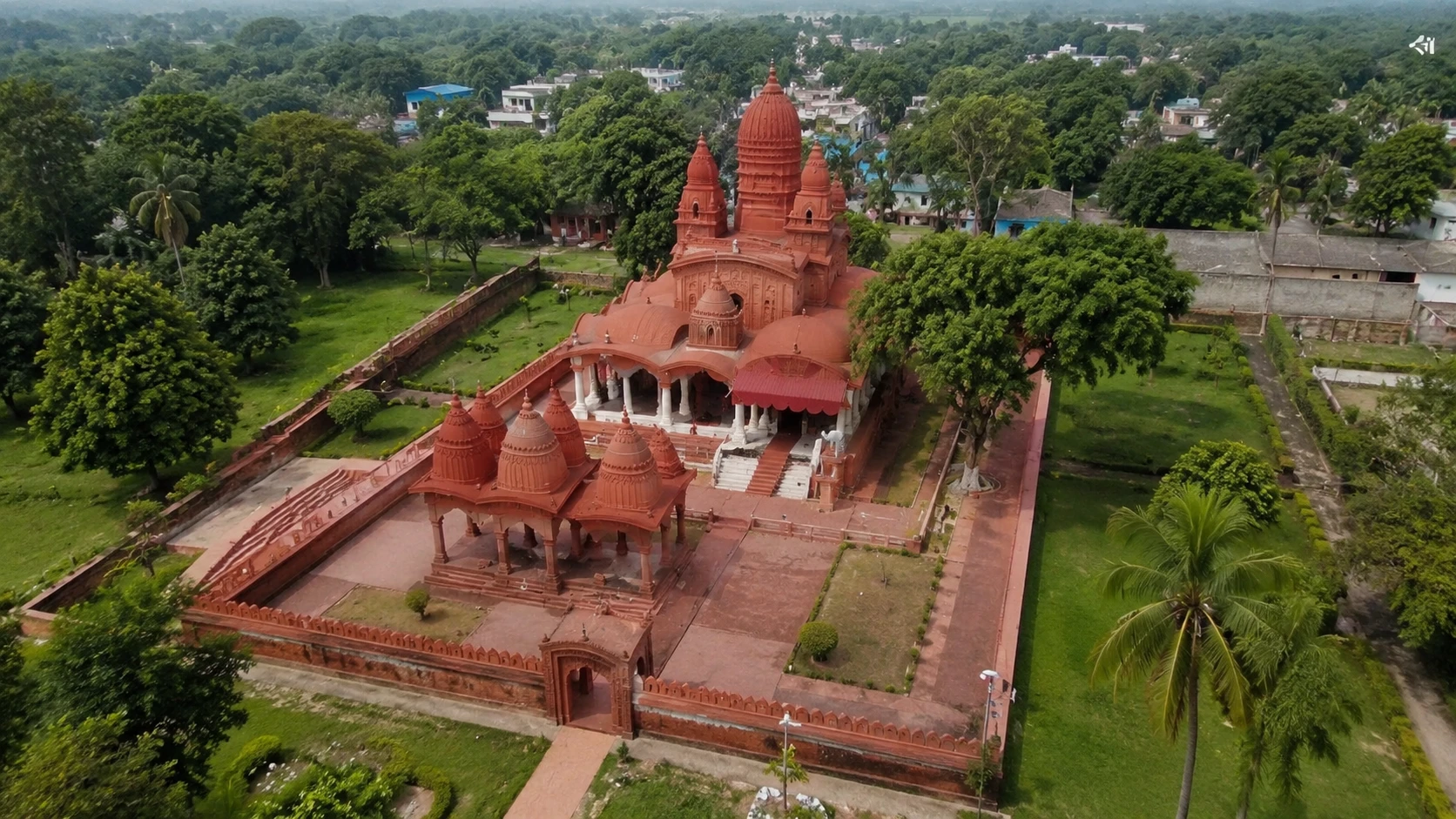
Bengali terracotta vernacular (Bishnupur regional style)
Open
06:00 – 20:00
Aarti
06:00 · 12:00 · 18:00
Special
Kojagari Lakshmi Puja (full moon of Ashwin) — the principal annual festival; Diwali also significant
The Sacred Legend · पवित्र कथा
Kamala is the last of the ten Mahavidyas, and her position at the end of the series is the series' deepest teaching. The sequence began with Kali — consuming darkness, the void that devours time — and moved through the terrifying, the transgressive, the inauspicious, the smoky, the self-decapitated, and the paralyzing. And it arrives here: at Kamala, the lotus goddess, golden-complexioned and serene, seated on a full-blown lotus, bathed by two elephants who pour abundance over her from their raised trunks. This is not a return to the conventional after a difficult journey. It is the revelation that the conventional, properly understood, was always the deepest teaching: that Lakshmi — prosperity, beauty, the daily blessings of life — is not the consolation at the end of the Mahavidya path but its culmination. At Bishnupur, the extraordinary terracotta temple town of West Bengal where the Malla kings built Krishna's cities in baked clay and where classical music found one of its great homes, Kamala is worshipped as the tenth wisdom: the recognition that abundance, received with the full consciousness the Mahavidya path has cultivated, is itself divine.
Sacred Designationपवित्र पदनाम
Sacred Origin Storyपवित्र उत्पत्ति कथा
Source: Shakta Tantra / Dasha Mahavidya tradition; Sri Vidya lineage
The Devi Bhagavata Purana and the Shakta Pramoda identify Kamala as Lakshmi herself — the goddess of prosperity, beauty, abundance, and fortune — placed last in the Mahavidya sequence as the completion of the entire arc. Her mythology draws on the vast reservoir of Lakshmi's own narratives: she was born from the churning of the cosmic ocean (samudra manthan), rising from the milk-white waters on a full-blown lotus, holding lotuses in her hands, surrounded by elephants who bathed her with sacred waters. This Gaja-Lakshmi form — the lotus goddess attended by elephants — is the iconography she carries as a Mahavidya. The specific theological context the Mahavidya tradition adds is what distinguishes Kamala from ordinary Lakshmi worship: in the Mahavidya sequence, Kamala is understood not as the goddess of worldly fortune but as the consciousness that recognises abundance itself as a form of the divine feminine's fullness. Where Dhumavati embodies scarcity as the ground state, Kamala embodies abundance as its completion — both are aspects of the same primordial Shakti. The Mahashri Suktam of the Rigveda (10.125) identifies the goddess with abundance, beauty, and the vital sap (rasa) that runs through all living things; the Shri Suktam — the primary Vedic hymn to Lakshmi — is among the earliest Sanskrit praise-poetry of the divine feminine. In the Sri Vidya tradition, Kamala is associated with the Shreem bija (the seed-sound of abundance and grace), which is considered one of the most auspicious of all bija mantras. Her identification in the Mahavidya context as a wisdom goddess (vidya) rather than merely a prosperity goddess is the tradition's statement that abundance, received with clarity and without attachment, is itself a spiritual state — not a distraction from liberation but a face of it.
Sources cited:
- Devi Bhagavata Purana, Skanda 7 (Kamala as tenth Mahavidya)
- Shakta Pramoda (Kamala / Kamalatmika puja vidhi)
- Shri Suktam (Rigveda; primary Vedic hymn to Lakshmi/Kamala)
- David Kinsley, 'Tantric Visions of the Divine Feminine: The Ten Mahavidyas' (1997), University of California Press — Chapter 11
- Mahashri Suktam, Rigveda 10.125
Other Traditions · अन्य परंपराएँ
Vaishnava reading: Kamala as Vishnu's eternal consort, present in Bishnupur (City of Vishnu)
In the Vaishnava tradition that is primary to Bishnupur's religious identity — the Malla kings were devotees of Krishna-Vishnu and built the famous Radha-Krishna temples — Kamala (Lakshmi) is understood not as an independent Shakta Mahavidya but as the eternal consort of Vishnu, inseparable from him, the Shakti without whom his divine activity is impossible. The name Bishnupur itself (Bishnu = Vishnu, pur = city) makes this connection manifest: the city of Vishnu naturally houses his inseparable Shakti-consort Kamala. The Vaishnava reading does not contradict the Mahavidya reading; both understand Kamala as the highest form of the divine feminine's gracious power. The two readings converge in her iconography: she is the lotus goddess who brings abundance, whose grace is the foundation of all creation's sustaining vitality.
Scholarly Context
Kinsley (1997, Chapter 11) offers an extended discussion of the paradox of Kamala's place in the Mahavidya series. She is the goddess least associated with transgression, least fierce, least inauspicious — and she is placed last, as the culmination. Kinsley reads this as the tradition's statement that the conventional goddess, properly understood through the lens of the Mahavidya wisdom path, is as much a liberating force as the most transgressive figure. The series moves from complete loss of the ordinary (Kali) to complete fulfilment of it (Kamala); the path between them is the Mahavidya curriculum. The Bishnupur location is significant in cultural-historical terms: Bishnupur was the seat of the Malla kingdom (Mallabhum) and the site of an extraordinary flowering of Bengali terracotta temple art, producing temples of great refinement in the 17th–early 18th centuries. The Malla rulers, while primarily Vaishnava, presided over a cultural environment in which Shakta traditions were also well-established — as in most of Bengal's religious history, the traditions were not mutually exclusive but complementary. The specific Kamala Devi temple in Bishnupur should be verified on-ground for its founding history, institutional management, and relationship to the broader Bishnupur temple complex.
Historyइतिहास
Bishnupur — ancient Mallabhum, seat of the Malla dynasty — occupies a unique place in Bengali cultural history. The Malla kings, who according to traditional sources ruled the region from the 7th century CE, created one of the most distinctive artistic traditions in India: the terracotta temple. Between approximately 1600 and 1760, a succession of Malla rulers — including Raghunath Singh II (r. 1626–1656), Vir Singh (r. 1656–1682), and Gopal Singh (r. 1730–1745) — built dozens of temples in a distinctive style that used locally available brick and terracotta (rather than the stone unavailable on the Bengal plateau) and covered their surfaces with elaborate narrative panels depicting scenes from the epics and Puranas, hunting, music, and daily life. These terracotta temples, the most celebrated of which are the Jorbangla, Rasmancha, Shyamrai, and Madan Mohan temples, were primarily Vaishnava shrines — the Malla rulers were dedicated Krishna devotees. Yet the Bishnupur cultural landscape also incorporated Shakta traditions, as was characteristic of Bengal's religious history more broadly. Bishnupur gave its name to the Bishnupur Gharana — one of the classical styles of Hindustani music, rooted in the temple music tradition of the Malla court. In this musical and devotional context, Kamala's presence as the Mahavidya associated with the arts and with graceful abundance is entirely consonant. The Malla dynasty was weakened by Maratha raids in the mid-18th century and eventually incorporated into the British East India Company's territories; however, the cultural and religious traditions of Bishnupur were preserved and continue to the present. The specific history of the Kamala Devi temple within Bishnupur has not been independently documented for this entry and requires on-ground verification with local temple authorities.
Historical Timelineऐतिहासिक कालक्रम
Traditional founding of the Malla kingdom at Bishnupur (Mallabhum) by the Malla dynasty. The dynasty establishes Bishnupur as its capital and begins a centuries-long programme of religious, cultural, and architectural patronage. The Shakta tradition, alongside the primary Vaishnava tradition, is part of the region's religious landscape from the earliest period.
The traditional founding date of the Malla dynasty is disputed; some scholarly sources place the well-documented period from the 10th–11th centuries CE rather than the 7th century. The 7th-century founding is the dynasty's own traditional claim.
The great period of Malla terracotta temple construction at Bishnupur. Successive Malla rulers build the temples for which Bishnupur is now famous — Rasmancha, Jorbangla, Shyamrai, Madan Mohan, Radha Shyam, and others. These primarily Vaishnava temples establish Bishnupur's identity as an extraordinary centre of devotional art and architecture. The Bishnupur Gharana of classical music also reaches its apex during this period.
Maratha raids (Bargis) devastate the Bankura and Bishnupur region. The Malla kingdom is significantly weakened and eventually cannot sustain its patronage of temple construction and cultural institutions at the earlier scale. The raid period marks the end of the great Malla building programme. However, the existing temples and the cultural traditions — music, worship, crafts — survive and are maintained.
Bishnupur's terracotta temples continue under active heritage management by the Archaeological Survey of India. The town's religious life — including Vaishnava Krishna worship, Shakta goddess traditions, and the Bishnupur music tradition — remains vital. The specific Kamala Devi temple's current institutional status and management have not been verified for this entry.
The current institutional status of the Kamala Devi temple at Bishnupur — its founding history, managing trust, and relationship to the ASI-managed temple complex — has not been independently verified for this entry. On-ground research is required before final publication.
What You'll Seeदर्शन में
Kamala's iconography is the most immediately recognisable in the Mahavidya series because it is identical to the classic Gaja-Lakshmi form known across all of Hindu sacred art. She is golden-complexioned, radiant as the rising sun. She is seated on a full-blown lotus — a flower that grows from mud but opens immaculate to the light, the symbol of beauty arising from the ordinary. Flanking her on both sides are two elephants (gaja) who raise their trunks and pour consecrated water over her from golden vessels — this bathing by elephants (gajabhisheka) represents the abundance and auspiciousness that constantly flows towards her. In her two upper hands she holds open lotus blossoms; with her lower right hand she makes the varada mudra (gesture of granting) and with the lower left the abhaya mudra (gesture of fearlessness). She is dressed in rich garments and adorned with the full complement of royal jewellery. Her expression is composed, benevolent, and deeply serene — the face of fulfilment rather than of striving. As the tenth and final Mahavidya, she carries the wisdom that the Mahavidya journey has been preparing the devotee for all along: to receive the gifts of the world with open hands and clear eyes, seeing them as expressions of the divine feminine's abundance rather than as distractions from it. Photography practices inside the inner sanctum should be confirmed with temple management; as a Lakshmi temple, photography restrictions may vary from the strict prohibitions at fierce-form Shakta shrines.
Distinctive Practicesविशिष्ट परंपराएँ
Lotus offering (Kamala Puja with fresh lotus)
कमल-पूजा (ताज़े कमल के फूलों के साथ)
Daily; in larger quantity on Fridays and festival days
The offering of fresh lotus flowers is the defining practice at Kamala's shrine. The lotus — kamala — is not merely the goddess's symbol but her name and her nature: she is the divine that grows from the ordinary (the lotus from the mud) and opens into full light. Devotees bring fresh lotus blooms, place them at the base of the murti, and sometimes offer lotus buds to be opened before the goddess, symbolising the opening of the devotee's own consciousness from its contracted, mud-bound state into full awareness. Where fresh lotus is unavailable, lotus seeds or lotus leaves serve as substitutes.
The lotus's paradox is Kamala's teaching: it grows from the most turbid, impure water but produces a flower that sits above the water, untouched by it, in perfect bloom. The Bhagavata Purana uses this image repeatedly for the liberated being — one who is in the world but not stained by it. Offering lotus to Kamala is to offer the goddess a reflection of her own nature and to ask for the same quality in oneself: to receive the world's abundance fully while remaining as unstained by it as the flower above the mud.
Kojagari Lakshmi Puja vigil
कोजागरी लक्ष्मी पूजा जागरण
Annual; full moon night of Ashwin (September–October)
Kojagari Lakshmi Puja — the full moon night of Ashwin — is the primary annual festival of Lakshmi across Bengal and East India, and at Kamala's Bishnupur shrine it is the year's most significant event. The name 'Kojagari' derives from the Sanskrit 'ko jagarti' — 'who is awake?' — from the belief that on this full moon night Lakshmi herself goes from house to house (or temple to temple) asking who is awake to receive her blessing. Devotees keep a night-long vigil, lamps are lit, special rice-based offerings are prepared, and elaborate puja continues through the night. The Bishnupur cultural context adds depth to this observance: in a town whose artistic tradition is rooted in the music and worship of the Malla courts, the Kojagari vigil has particular resonance.
Did You Know?क्या आप जानते हैं?
In the Mahavidya theological system, Kamala's position as the tenth and final goddess creates what scholars call the 'full-circle' paradox: the series begins with Kali, who represents the absolute stripping away of all that seems auspicious, and ends with Kamala/Lakshmi, who represents the fullness of auspiciousness itself. This structure suggests that the Mahavidya path is not a progressive rejection of the ordinary world in favour of liberation but a deepening encounter with reality at every level — from the darkest to the most luminous — until the devotee can hold both without clinging to either.
David Kinsley, 'Tantric Visions of the Divine Feminine: The Ten Mahavidyas' (1997), Chapter 11 and Conclusion
Bishnupur gave its name to one of the most distinguished schools of Hindustani classical music: the Bishnupur Gharana. Founded in the Malla royal court and rooted in the devotional (dhrupad) tradition, the gharana's music was composed for the temple rituals of the Bishnupur shrines. It is one of the few examples in Indian cultural history of a classical music tradition that grew directly from temple worship rather than from court entertainment — every raga and composition was designed to be performed in the presence of the deity. Kamala, as the Mahavidya associated with arts, music, and the expressive graces of civilisation, finds a natural home in the town that produced this tradition.
Joep Bor et al., 'The Raga Guide' (1999), Nimbus Records/Rotterdam Conservatory of Music — Bishnupur Gharana entry; Bishnupur Gharana academic documentation
Bishnupur's terracotta temples, built by the Malla kings between approximately 1600 and 1760, are unique in Indian temple architecture for their use of locally-made terracotta brick rather than stone (unavailable on the Bengal plateau). The temples are covered in detailed narrative panels depicting scenes from the Ramayana, Mahabharata, Bhagavata Purana, as well as hunting scenes, musicians, military processions, and daily life — a visual encyclopaedia of the 17th-century Bengali world baked into fired clay. The temples are on the UNESCO Tentative World Heritage List.
David McCutchion, 'Late Mediaeval Temples of Bengal' (1972); UNESCO Tentative World Heritage List, Bishnupur
The Shri Suktam — the oldest Vedic hymn specifically dedicated to Lakshmi/Kamala, appended to the Rigveda — is one of the most widely recited texts in Hindu daily worship. It describes the goddess as shining like gold (hiranyavarna), dwelling in lotuses, attended by elephants, connected with wealth, fertility, and the vital force that animates the world. The Shri Suktam's identification of Kamala with the world's generative abundance makes her not just a goddess of individual fortune but the personification of creation's inherent tendency toward fullness. This cosmological reading is what elevates her from prosperity goddess to Mahavidya.
Shri Suktam (Rigveda, Khilani section); Monier-Williams, Sanskrit Dictionary; Kinsley, 'Tantric Visions' (1997)
Visitor Accessप्रवेश जानकारी
The Kamala Devi temple at Bishnupur is open to devotees of all backgrounds. Standard temple decorum applies — modest attire, footwear removed at the entrance. As a Lakshmi temple, it is less likely to have the strict photography prohibitions of fiercer-form Shakta shrines, but practices should be confirmed with temple management. The surrounding terracotta temples of Bishnupur are managed by the ASI and require a separate entry fee.
Contact local temple management for current visiting timings and puja arrangements. Bishnupur is best visited as a full day from Kolkata, combining the Kamala Devi shrine with the famous terracotta temples (ASI-managed) and the Bishnupur music tradition. A local guide familiar with both the heritage temples and the Shakta shrines is recommended for a first visit.
Festivalsत्योहार
Kojagari Lakshmi Puja
कोजागरी लक्ष्मी पूजा
Sep–Oct (Ashwin Purnima)
Kojagari Lakshmi Puja on the full moon night of Ashwin is the year's primary festival at the Kamala shrine and one of the most important religious events in Bengal. The all-night vigil, the question 'ko jagarti' (who is awake?), and the traditional offerings of rice, lotus flowers, and sweets make this festival a direct enactment of the mythology of Lakshmi's visiting — the goddess is expected to actually arrive, and the faithful must be awake to welcome her.
Diwali (Lakshmi Puja on Amavasya)
दीपावली (अमावस्या लक्ष्मी पूजा)
Oct–Nov (Kartik Amavasya)
On the new moon night of Kartik — Diwali in north India — Bengal celebrates Kali Puja as the primary festival, but Lakshmi Puja is also observed. At the Bishnupur Kamala shrine, the Diwali night brings special puja for Lakshmi in her Kamala-Mahavidya form. Lamps and diyas illuminate the temple and surrounding areas, the golden light resonating with the goddess's own golden complexion.
Navratri (Ashwin)
नवरात्रि (आश्विन)
Sep–Oct (Ashwin, 9 days)
The autumn Navratri (Ashwin) is observed at the Kamala shrine as at all Shakta temples. As the tenth Mahavidya, Kamala receives special puja on the tenth day — Vijaya Dashami (Dussehra) — which is also the day associated with the goddess's ultimate victory. In Bengal, Navratri merges seamlessly into the Durga Puja season, and the Kamala shrine participates in this broader autumnal festival energy.
Traditional Offeringsपारंपरिक अर्पण
Primary Offerings
Lotus flowers (Kamal phool)
कमल के फूल
कमल पुष्प
The lotus is not merely Kamala's primary offering — it is her name, her vehicle, her nature. She is Kamala because she is the lotus principle: the divine beauty that arises immaculate from the mud of ordinary existence. Offering fresh lotus flowers to Kamala is the most internally consistent act of worship at her shrine — the devotee offers the goddess herself, her own symbol, as a mirror held up to her nature. When the lotus is placed before the murti, the loop of recognition closes: the lotus that represents the goddess, offered by the devotee who is also the goddess's creation, received by the goddess who is the lotus.
White lotus (Shwet Kamal)
श्वेत कमल
श्वेत पद्म
The white lotus — purer and rarer than the common pink variety — is considered the most auspicious offering to Kamala. The Shri Suktam specifically mentions white objects (hiranya-varna, white radiance) in connection with Lakshmi. White in the Lakshmi tradition is the colour of purity, of the lunar brightness that accompanies her, of the white elephants of Indra that attend her. Where available, white lotus is offered on festival days and for special puja.
Yellow and golden marigold
पीले और सोनहले गेंदे के फूल
Yellow and golden marigold flowers are the standard floral offering where fresh lotus is unavailable, and they are always used in garlands and decorations alongside the lotus. The colour gold resonates directly with Kamala's golden complexion and with the prosperity she embodies. Marigold garlands hung at the entrance of temples and homes during Lakshmi puja are among the most recognisable visual markers of the goddess's festival presence.
Sweet rice (Kheer / Payasam)
खीर
पायस
Sweet rice — kheer — is the primary food offering to Lakshmi and is prepared in households across Bengal for Kojagari Lakshmi Puja and Diwali. Rice is the staple crop of Bengal, and its preparation as sweet kheer — a labour-intensive, auspicious transformation of the basic grain — is an act of presenting abundance at its most refined: the ordinary made extraordinary through effort and care. The Shri Suktam associates the goddess with the fertility of grain, and kheer is the ritual embodiment of that fertility transformed into nourishment.
Gold-coloured sweets (Sandesh, Mishti)
सोनहले मिठाई (संदेश, मिष्टि)
Bengali sweets — particularly sandesh (made from paneer and sugar, sometimes coloured gold with saffron) and other mishti — are characteristic offerings at Kamala's shrine in Bishnupur. Bengal's extraordinary sweet-making tradition is itself a form of the abundance that Kamala represents: the transformation of milk (the sacred white substance) into elaborate, crafted sweetness. Offering sandesh to the goddess of abundance is an act of returning the world's gifts back to their source.
Unique to This Temple
Alpona (ritual floor art) at Kojagari
कोजागरी पर आलपना
Alpona — the intricate ritual floor designs drawn in rice paste (ata) — are created at the entrance to the Kamala shrine and in the worship space during Kojagari Lakshmi Puja. The alpona designs typically feature lotus flowers, Lakshmi's footsteps (the goddess arriving to bless the household), grain, fish, and other abundance symbols. This is a distinctively Bengali Shakta practice of transforming the space itself into an offering — the floor becomes an artistic petition to Kamala to enter and bless. Bishnupur's artistic tradition (terracotta, music, craft) gives the alpona at the Kamala shrine additional cultural resonance.
Lotus flowers, marigolds, kheer ingredients, and sweets are available from vendors in Bishnupur market. During Kojagari Lakshmi Puja, the town's markets are full of specific offerings — white lotus, alpona materials, oil lamps, and festive sweets. The Bishnupur Gharana music tradition means that festival observances here are often accompanied by live classical music, particularly in the courtly-devotional dhrupad style.
How to Reachकैसे पहुँचें
Bishnupur is accessible by rail and road from Kolkata. By rail: Bishnupur Railway Station is on the Howrah–Bankura–Asansol line; direct trains from Howrah (Kolkata) take approximately 3–4 hours. The Bishnupur Express is the primary dedicated service; multiple daily trains serve the route. By road: Bishnupur is approximately 145 km from Kolkata on NH-60 and State Highway via Durgapur or via Bankura; the road journey takes approximately 3–4 hours by car or bus. State buses (SBSTC) and private buses connect Kolkata's Esplanade terminus and Dhaka Road bus stand to Bishnupur. Within Bishnupur, the temples and the Kamala Devi shrine are distributed across the town; cycle-rickshaws, auto-rickshaws, and hired bicycles are the standard modes of local transport. The terracotta temple complex and the Kamala shrine are best explored on a full day — arriving by morning train and returning by evening is feasible from Kolkata.
Plan Your Visitयात्रा की योजना
🌤 Best Season
October to March is ideal — cool, dry weather and the major festival season (Kojagari in October, Diwali in November, Navratri in October). October is particularly rich: Durga Puja transforms all of Bengal, and the Kojagari Lakshmi Puja follows immediately after. Avoid the monsoon (June–September) if possible; Bishnupur's terracotta temples are spectacular in the dry season when their surfaces are clean and the light favourable.
👘 Dress Code
Modest attire is expected. Given the Vaishnava cultural atmosphere of Bishnupur, white or light-coloured clothing is traditional. Footwear is removed at the temple entrance. For the Kojagari vigil, traditional Bengali attire — saree or dhoti-kurta — is customary.
📱 Phones & Photography
Mobile phones generally permitted in outer areas. Photography practices should be confirmed at the Kamala shrine specifically, as policies vary between Shakta temples. The ASI-managed terracotta temples have their own photography policies.
🏨 Accommodation
Bishnupur has a range of accommodation from basic guesthouses to heritage hotels and West Bengal Tourism (WBT) properties. For visitors focused on the temples, the WBT Tourist Lodge is well-located near the main temple area. Most visitors from Kolkata do Bishnupur as a day trip, but overnight stays are worthwhile for those visiting during festivals or wishing to hear Bishnupur Gharana music in its home context.
Sacred Soundsपवित्र ध्वनि
108 Japa Practice
Om Shreem Maha Lakshmyai Namah
Chant 108 times in the spirit of this temple
Did You Know? · क्या आप जानते हैं?
The same translation error that turned '33 Koti' into '33 crore' in Hinduism also happened in Buddhism. The Chinese translation of Buddhist texts rendered 'Sapta Koti Buddha' (7 Supreme Buddhas) as '7 Crore Buddhas.' The Tibetan translation got it right: 7 types, not 7 crore. One Sanskrit word, misread across two major world religions, generated two identical misconceptions independently.
Related Contentसंबंधित सामग्री
Related Scriptures
Related Temples
Bhuvaneshwari Mata (Gauhati)
भुवनेश्वरी माता
Gauhati, Assam
Bhairavi Mata Temple
भैरवी माता मंदिर
Tezpur, Assam
Chinnamasta Mandir (Rajrappa)
छिन्नमस्ता मंदिर
Rajrappa, Jharkhand
Dhumavati Mandir (Varanasi)
धूमावती मंदिर
Varanasi, Uttar Pradesh
Bagalamukhi Mandir (Datia)
बगलामुखी मंदिर
Datia, Madhya Pradesh
Matangeshwar Mandir (Khajuraho)
मातंगेश्वर मंदिर
Khajuraho, Madhya Pradesh
Shodashi Tripurasundari (Kanchipuram)
षोडशी त्रिपुरसुंदरी
Kanchipuram, Tamil Nadu
Community Reflections
🕉️
Be the first to share your reflection.