Gita Govinda -- Jayadeva's Song of Radha and Krishna
गीत गोविन्द -- जयदेव का राधा-कृष्ण गीत
Every night at the Jagannath temple in Puri, before the deity is put to rest, songs from a twelfth-century Sanskrit poem are offered to him. They have been sung there for centuries, and they are love songs. The poem is the Gita Govinda, "the song of Govinda", by the poet Jayadeva, and it is about the separation and reunion of Radha and Krishna on a spring night by the Yamuna.
Little about Jayadeva is certain. Tradition places him in the twelfth century and links him to the court of King Lakshmana Sena of Bengal; Bengal and Odisha both claim his birthplace, at Kenduli. Tradition also names his wife, Padmavati, a dancer, and later legend says that she danced as he sang the poem. Whatever his exact story, the poem itself became one of the most influential works ever written in India.
The story is simple. Krishna, playing with the cowherd women in the spring, seems to have forgotten Radha. Hurt and jealous, she withdraws. Krishna, remorseful, searches for her; her friend carries messages between them; Radha passes through anger, longing and pride; at last Krishna comes to her and asks forgiveness, and they are reunited in a forest bower.
What makes the poem new is its form. Jayadeva built it in twelve cantos (sargas), and set at their heart twenty-four songs called ashtapadis -- songs of eight couplets each, with a refrain -- framed by verses in classical Sanskrit metres. Each song names the raga and tala in which it is to be sung. It is a poem meant to be performed, not only read: a drama in songs.
The Gita Govinda at a Glance
| Feature | Detail |
|---|---|
| Author | Jayadeva, twelfth century (traditionally linked to the court of Lakshmana Sena of Bengal) |
| Structure | Twelve cantos (sargas) with twenty-four ashtapadi songs |
| Language | Sanskrit, in a musical, rhymed style close to the vernacular songs of the time |
| Subject | The estrangement and reunion of Radha and Krishna on a spring night |
| Liturgical use | Sung daily before Jagannath at Puri; part of the repertoire of Odissi dance |
| Opening hymn | The Dashavatara stotra, "pralaya payodhi jale", praising the ten avatars |
The first song of the poem is not about Radha at all. It is a hymn to Vishnu's ten avatars, each verse ending with the refrain "jaya jagadisha hare" -- "victory to Hari, lord of the world" -- beginning with the fish who saved the Vedas in the waters of the dissolution. Jayadeva's list counts Balarama as the eighth avatar and the Buddha as the ninth, praising him for his compassion and his rejection of animal sacrifice. The hymn is sung on its own all over India, and its refrain passed into many later devotional songs.
That opening tells the reader how to take what follows. The Krishna who longs for Radha is the same Lord who takes the ten forms to protect the world. For the tradition, the love of Radha and Krishna is the love between the soul and God -- madhura bhakti, devotion in the mood of lovers -- and its passion is the point, not a distraction from it.
A well-loved legend says that Jayadeva, writing the scene in which Krishna begs Radha to place her foot on his head, could not bring himself to write such a thing of God, and went to bathe. When he returned, the line had been written in his own hand -- by Krishna himself, who had come in Jayadeva's form while he was away.
The Gita Govinda's influence is hard to overstate. It made Radha central to Krishna devotion in a way earlier texts had not, and the great Bhakti poets of the following centuries -- Vidyapati, Chandidas, and the Vaishnavas of Bengal around Chaitanya, who loved to hear it sung -- wrote in its shadow. It shaped Odissi dance, whose dancers still perform its ashtapadis, and the classical music of both north and south; ashtapadis are sung in Kerala temples in a style called sopanam. Two hymns attributed to Jayadeva are even included in the Guru Granth Sahib of the Sikhs.
For a reader today, the best way into the poem is to hear it -- an ashtapadi sung in its raga, or danced -- and then to read it slowly, as Jayadeva meant it: as a love story that is also a prayer.
Meet Jagannath, for whom it is sung
The deity of Puri, before whom the Gita Govinda has been sung every night for centuries.
Eternal Raga · शाश्वत राग
Institutional voice — scholarly articles on Sanatan Dharma
Deepen Your Understanding
अपनी समझ और गहरी करें
deities avatars
Radha -- Krishna's Eternal Beloved and the Supreme Devotee Who Became Greater Than God
She is not mentioned by name in the Bhagavata Purana. She has no temple at the centre of Vrindavan. She did not marry Krishna. And yet -- in the devotional traditions of North India, in the poetry of Jayadeva, in the philosophy of Chaitanya, and in the hearts of millions who chant 'Radhe Radhe' -- she is considered superior to Krishna himself. That is the paradox and the power of Radha.
deities avatars
Jagannath -- Lord of the Universe, the Deity Without Hands and the World's Oldest Chariot Festival
He has no fingers, no feet, no sculpted facial features -- just enormous circular eyes on a flat wooden face. He is the most 'unfinished' deity in Hinduism, and he is worshipped by more people than almost any other form of Vishnu. The Jagannath temple in Puri is one of the four Char Dham, his Rath Yatra is the origin of the English word 'juggernaut,' and his theology breaks every rule of Hindu worship including caste -- at Jagannath's table, everyone eats together.
scriptural exegesis
The Rasa Lila -- What Krishna's Dance with the Gopis Means
On an autumn full-moon night, Krishna's flute called the women of Vraja into the forest, and he danced with all of them at once. The five chapters of the Bhagavata that tell the story, why the text itself raises the obvious objection, and how the tradition answers it.
deities avatars
Dashavatara -- Why Vishnu Comes Back Ten Times
Fish, tortoise, boar, half-lion, dwarf, axe-warrior, prince, cowherd, enlightened teacher, future horseman. The ten avatars of Vishnu are not random folklore. Read them in sequence and you get something startling -- a narrative that mirrors evolutionary biology, tracks the rise and fall of political systems, and argues that God does not sit above history but enters it, gets dirty, and does the work. The Dashavatara is Hinduism's answer to the question every civilisation asks: why does the world keep breaking, and who fixes it?
deities avatars
Krishna Leela -- Why God Chose to Play
He stole butter, broke pots, lied to his mother's face, danced with married women under the full moon, and lifted an entire mountain on his little finger. The Bhagavata Purana's Tenth Skandha -- the most popular 4,000 verses in all of Hindu literature -- is not a biography. It is a theological argument that the Supreme Being's highest expression is not creation, destruction, or cosmic governance. It is play. Krishna Leela is the radical idea that God's truest nature is joy.
scriptural exegesis
Shyama Sangeet -- The Bengali Poets Who Argued With Kali Instead of Fearing Her
This site's Kali Puja article mentions Ramprasad Sen in passing, as the poet who helped reshape how Bengal sees Kali. This article covers the actual poetic tradition he founded: Shyama Sangeet, three centuries of Bengali songs that address the fiercest goddess in the pantheon not with awe but with the complaining, bargaining intimacy of a child talking back to its mother.
A well-loved legend says that Jayadeva, writing the scene in which Krishna begs Radha to place her foot on his head, could not bring himself to write such a thing of God, and went to bathe. When he returned, the line had…
More in Scriptural Exegesis
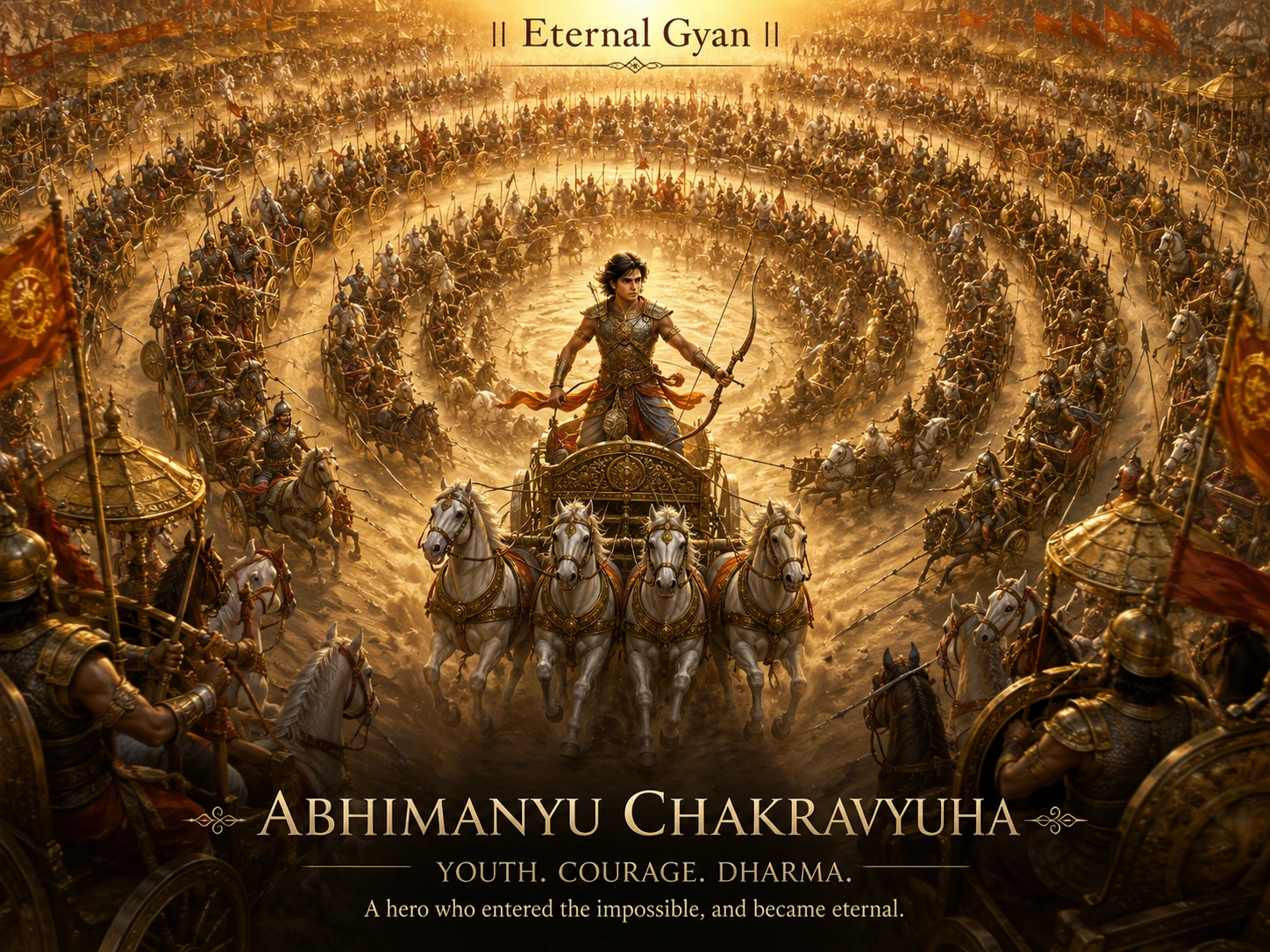
Abhimanyu and the Chakravyuha -- The Boy Who Knew How to Enter but Not How to Leave
14 min read
Adbhuta Ramayana -- The Ramayana Where Sita Becomes Kali
9 min read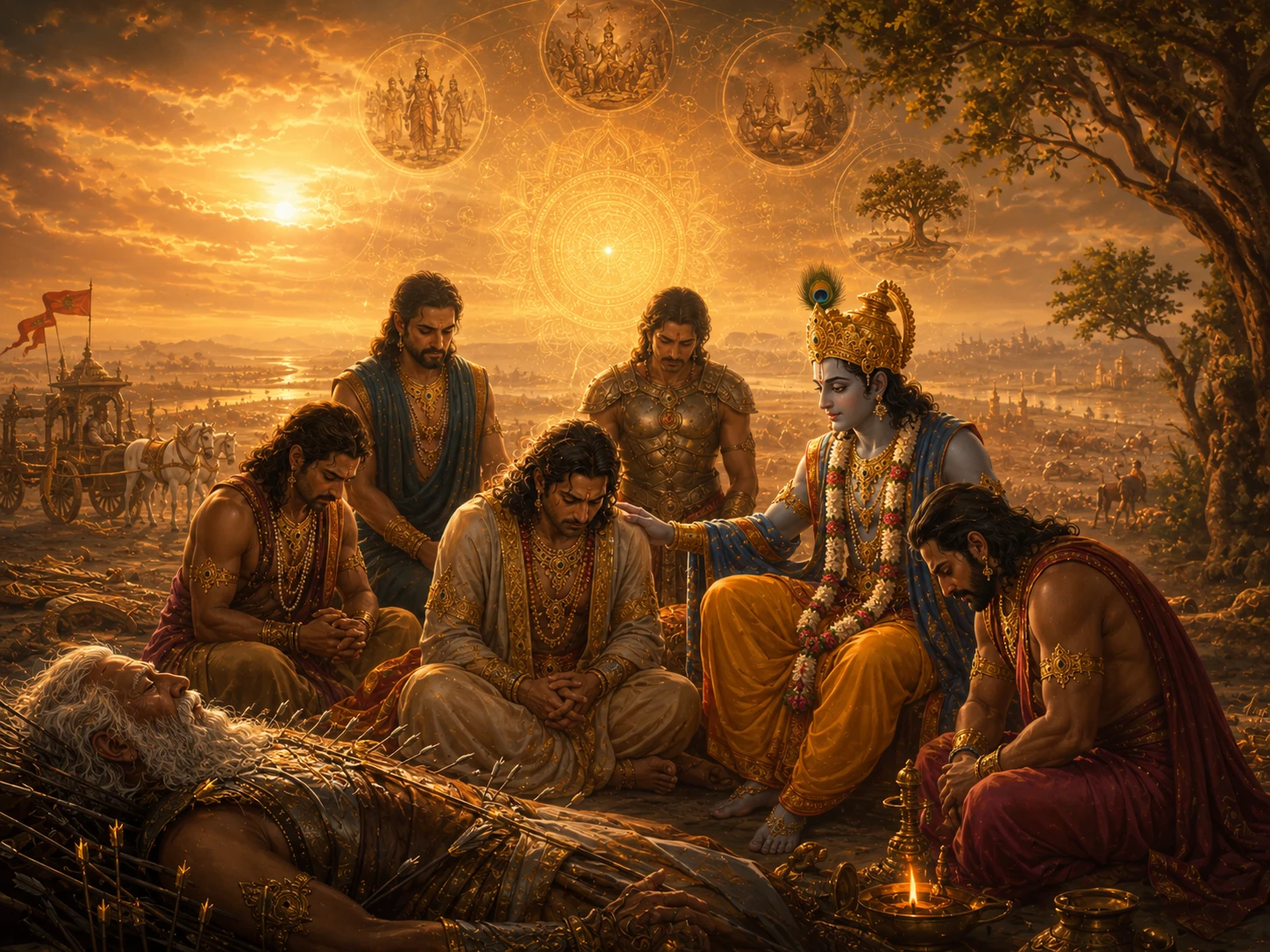
After Kurukshetra -- What Happened Next
14 min readThe same translation error that turned '33 Koti' into '33 crore' in Hinduism also happened in Buddhism. The Chinese translation of Buddhist texts rendered 'Sapta Koti Buddha' (7 Supreme Buddhas) as '7 Crore Buddhas.' The…
Deities AvatarsCommunity Reflections
🕉️
Be the first to share your reflection.