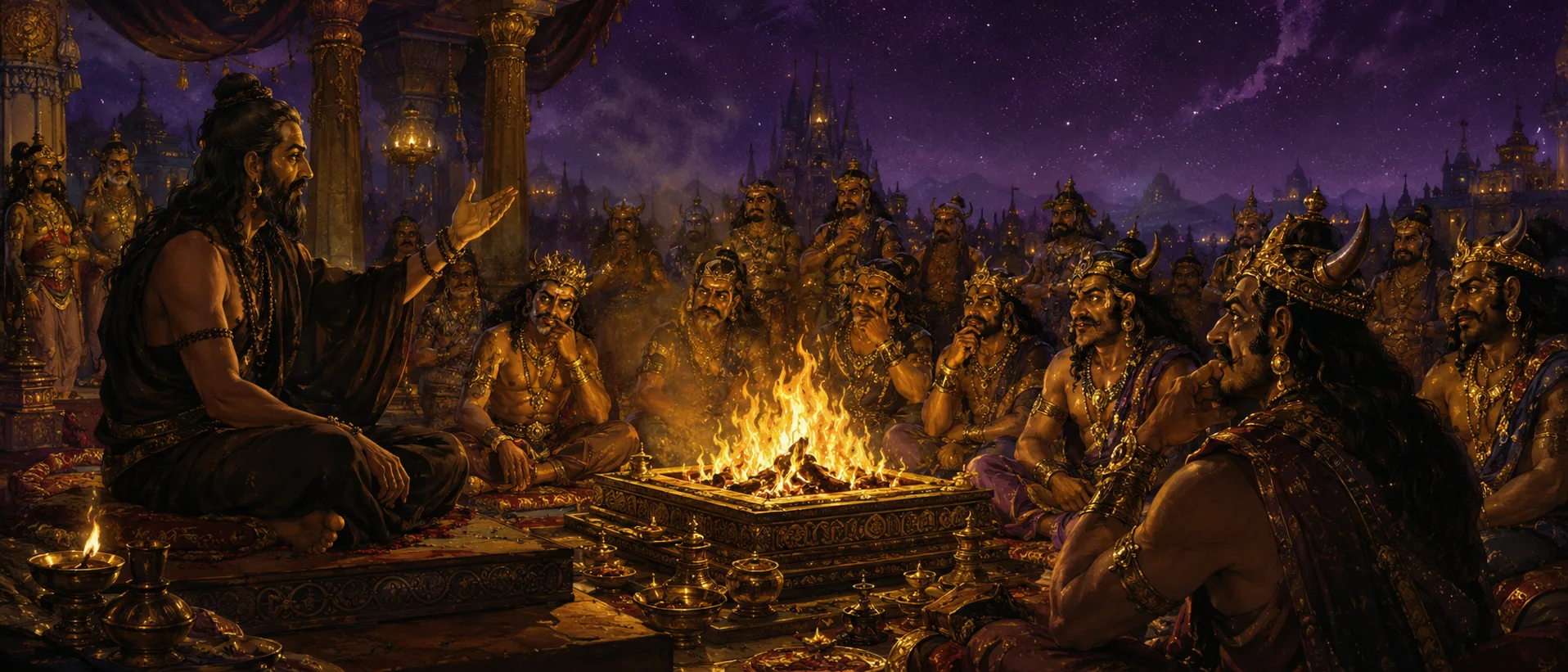
The third Amsa is the Vishnu Purana's book of dharma. It opens with the fourteen Manvantaras named in sequence, each with its Manu, gods, and sages, before turning to a striking recurring claim: in every age, Vyasa divides the single primordial Veda into four for the sake of human capacity, and, in the current age, further compiles the eighteen Puranas — the text pauses here to classify all eighteen by name and general theme, effectively cataloguing its own genre. From this the Amsa moves to practical dharma: the origin of the four varnas from the cosmic being, the duties proper to each varna and each of the four life-stages (ashramas), a detailed description of the householder's correct daily religious conduct, and an extended treatment of shraddha — the rites owed to ancestors, their proper timing, and their spiritual necessity. The Amsa's closing narrative shifts registers entirely: Vishnu, to protect the gods from the Daityas' Vedic merit-earned invincibility, sends an illusory mendicant (Mayamoha) to talk the Daityas out of their own dharma, stripping their protection and enabling their eventual defeat — followed by the gentler story of King Shatadhanu and his devoted queen Shaivya, whose mutual fidelity carries across several successive rebirths.
Chapters
Why it matters today
The Mayamoha episode is a rare Puranic instance of dharma itself being treated as a double-edged tool rather than an unambiguous good — the Daityas' downfall comes not from immorality but from being talked out of a genuine religious discipline, a narrative move that has drawn philosophical attention for complicating any simple equation of ritual correctness with spiritual safety.