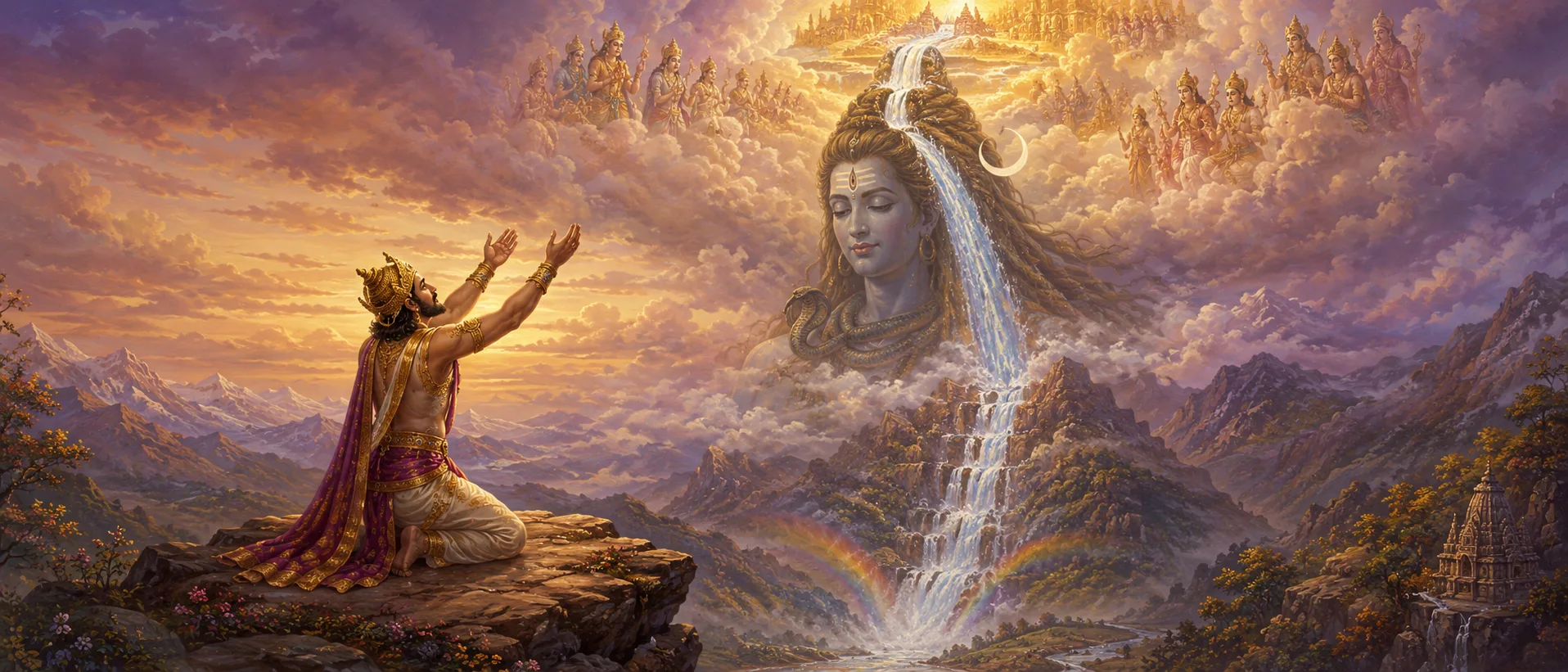
Amsa 4 is the Vishnu Purana's genealogical spine, tracing both great royal lines from their divine origin down to the era the text itself was composed in. The solar dynasty descends from Ikshvaku through Sagara (whose sixty thousand sons are reduced to ash and later redeemed through Bhagiratha's bringing of the Ganga to earth), through Rama, and onward to the kings destined to rule in the degraded Kali Yuga still to come. The lunar dynasty descends from Pururavas and the sage-king Yayati, whose five sons — Yadu, Turvasu, Druhyu, Anu, and Puru — found the lines that eventually produce the Kuru and Yadava clans of the Mahabharata era: the Syamantaka jewel dispute, the birth of Krishna's own ancestors, Shishupala's story, and the crowded genealogy running through Devapi, Shantanu, and Bhishma to Parikshit and beyond. In its final movement the text turns prophetic, naming the future dynasties down through history's decline, foretelling the Kalki avatara who will end Kali Yuga, and closing with the Prithvi Gita — the earth's own teaching, delivered to a line of kings, that no one, however powerful, escapes death, and that wisdom lies in holding even one's dearest attachments loosely.
Chapters
Why it matters today
The Prithvi Gita closing this Amsa is a compact, often-overlooked companion to the more famous Bhagavad Gita — both are teachings on non-attachment delivered at a moment of crisis, but where Krishna speaks to one warrior on a battlefield, the earth here speaks to an entire succession of kings, generalizing the same insight across the whole of political power rather than a single life.