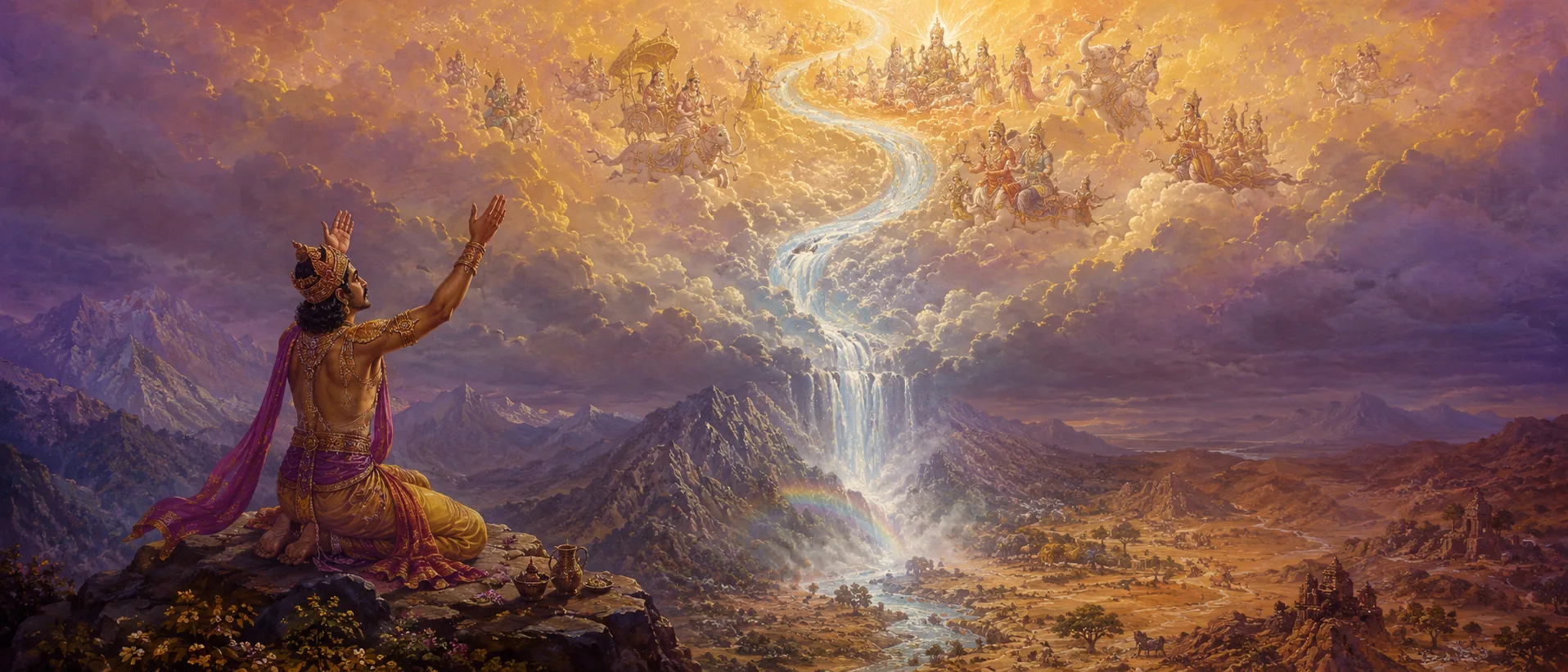
Skandha 9 is the Bhagavatam's genealogical spine, tracing two royal lines from their divine origins down to the generation the Purana itself is being told to. The solar dynasty carries the story of King Ambarisha, whose Ekadashi vow becomes the occasion for a lesson in the difference between ritual and devotion, and of Bhagiratha, whose austerities bring the river Ganga down from heaven to liberate his ancestors' ashes — before arriving, generations later, at Rama, whose entire life is retold here compactly as dynastic history rather than epic, birth to return to the spiritual world, before the line continues past him into the age this Purana itself belongs to. The lunar dynasty carries King Yayati, cursed with premature old age for his infidelity and restored to youth only when his youngest son agrees to bear the curse in his place — a bargain the skandha treats less as tragedy than as a study in what a father's mistake actually costs a child who loves him anyway. From Yayati's line comes Yadu, and from Yadu, generation after generation, the family into which Krishna himself will soon be born — the skandha's closing verses turning, at last, toward the story every other book has been building toward.
Chapters
Why it matters today
Skandha 9's genealogies can read as dry until Yayati's story lands in the middle of them — a father's punishment transferred, by consent, onto a child, and the whole dynasty afterward descending from the son who agreed to carry it. Every subsequent name in the list is, in that light, a descendant of someone else's forgiveness.
This story is also told in
The complete Valmiki Ramayana
The full epic, all seven kandas — the source text these Purana retellings compress.
The Story of Rama (Devi Bhagavatam, Skandha 3)
Adds a Navaratri-vow devotional frame absent from Valmiki, ch. 28-30.
Shiva's telling of the Ramacharita (Padma Purana, Patala Khanda)
The whole khanda is framed as Shiva narrating Rama's story to Parvati, plus a second embedded retelling (Jambavan's Purakalpiya account) told to Rama himself.
A brief Ramayana summary (Garuda Purana, ch. 143)
A short summary within the Purvakhanda's dynastic-history section.
Ganga's descent (Ramayana, Bala Kanda, ch. 35-44)
Told to Rama on the way to Mithila — likely the earliest telling.
Sagara's sons and Bhagiratha (Vishnu Purana, Amsa 4, ch. 3-4)
Part of the same genealogical spine as the Bhagavata's telling.