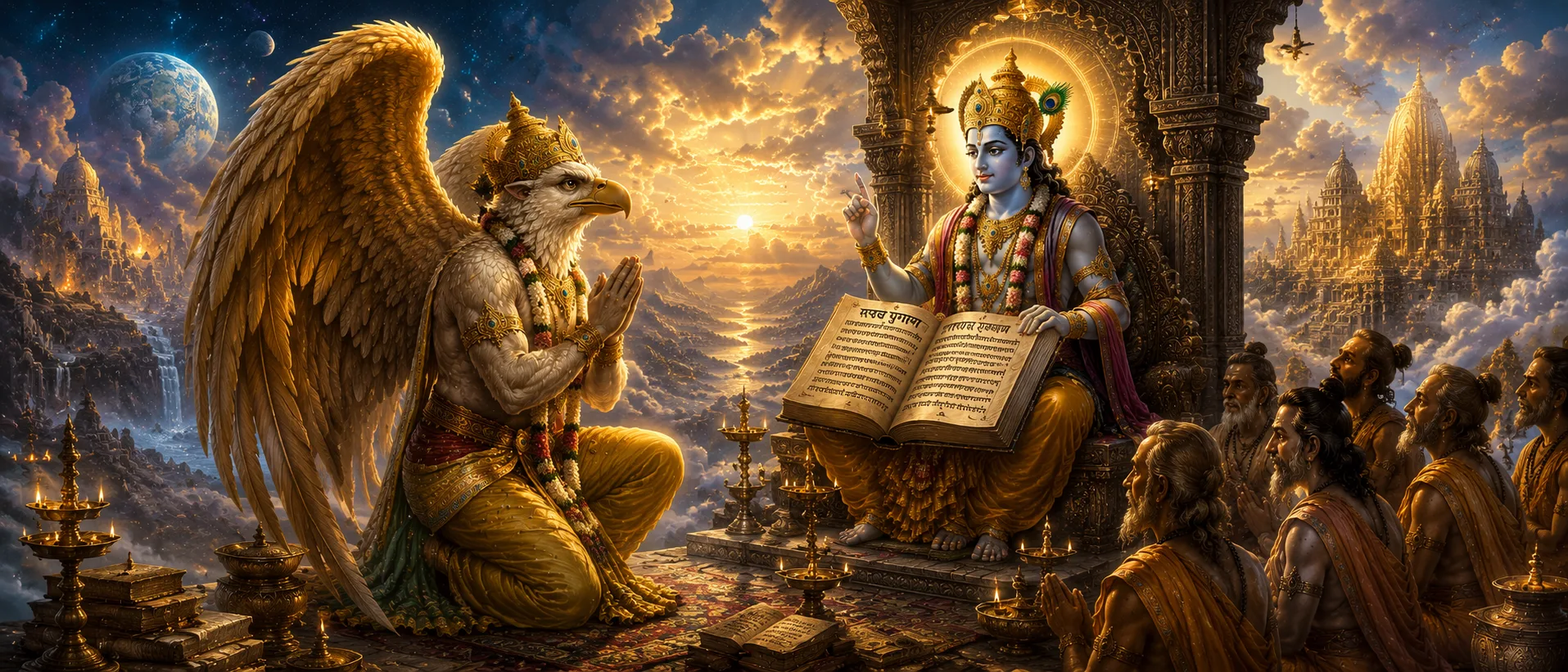
The Purvakhanda opens as Vishnu's direct teaching to Garuda and immediately establishes its encyclopedic character: cosmology and the thousand names of Vishnu, an extended survey of sacred fords with special attention to Gaya, and then a sequence of highly practical material — how to judge a diamond, ruby, or pearl; how to lay out a temple according to Vastu; the full procedure for consecrating a deity's image. A long dharma-shastra block, closely following Yajnavalkya, works through the stages of life, the samskaras, marriage law, shraddha, and the doctrine of karma-vipaka — which specific acts yield which specific results. The text then widens its scope further: a complete cosmography of the seven island-continents and the geography of Bharatavarsha, a full treatment of astrology and physiognomy, and the classical Nitisara — practical ethics and statecraft attributed to Brihaspati and Shaunaka, dense with independently famous Sanskrit maxims on kingship, trust, and equanimity. Dynastic genealogies follow, with the Purana pausing to summarize the Ramayana, the Harivamsha, and the Mahabharata in turn. Monthly vratas are described in detail, and the khanda's closing movement is given over almost entirely to Ayurveda: a sustained, chapter-by-chapter medical treatise diagnosing and treating fever, consumption, heart disease, diabetes, and dozens of other named conditions, closing the largest single book of this Purana.
Chapters
Why it matters today
The embedded Ayurveda treatise closing this khanda is one of the more substantial pieces of classical medical literature preserved inside any Purana, and its inclusion alongside cosmology, ethics, and ritual reflects a worldview in which bodily health, right conduct, and cosmic order were treated as continuous concerns rather than separate domains of knowledge.
This story is also told in
The complete Valmiki Ramayana
The full epic, all seven kandas — the source text these Purana retellings compress.
Rama's dynastic history (Bhagavata Purana, Skandha 9)
Rama's life compressed into the solar-dynasty genealogy, ch. 10-11.
The Story of Rama (Devi Bhagavatam, Skandha 3)
Adds a Navaratri-vow devotional frame absent from Valmiki, ch. 28-30.
Shiva's telling of the Ramacharita (Padma Purana, Patala Khanda)
The whole khanda is framed as Shiva narrating Rama's story to Parvati, plus a second embedded retelling (Jambavan's Purakalpiya account) told to Rama himself.