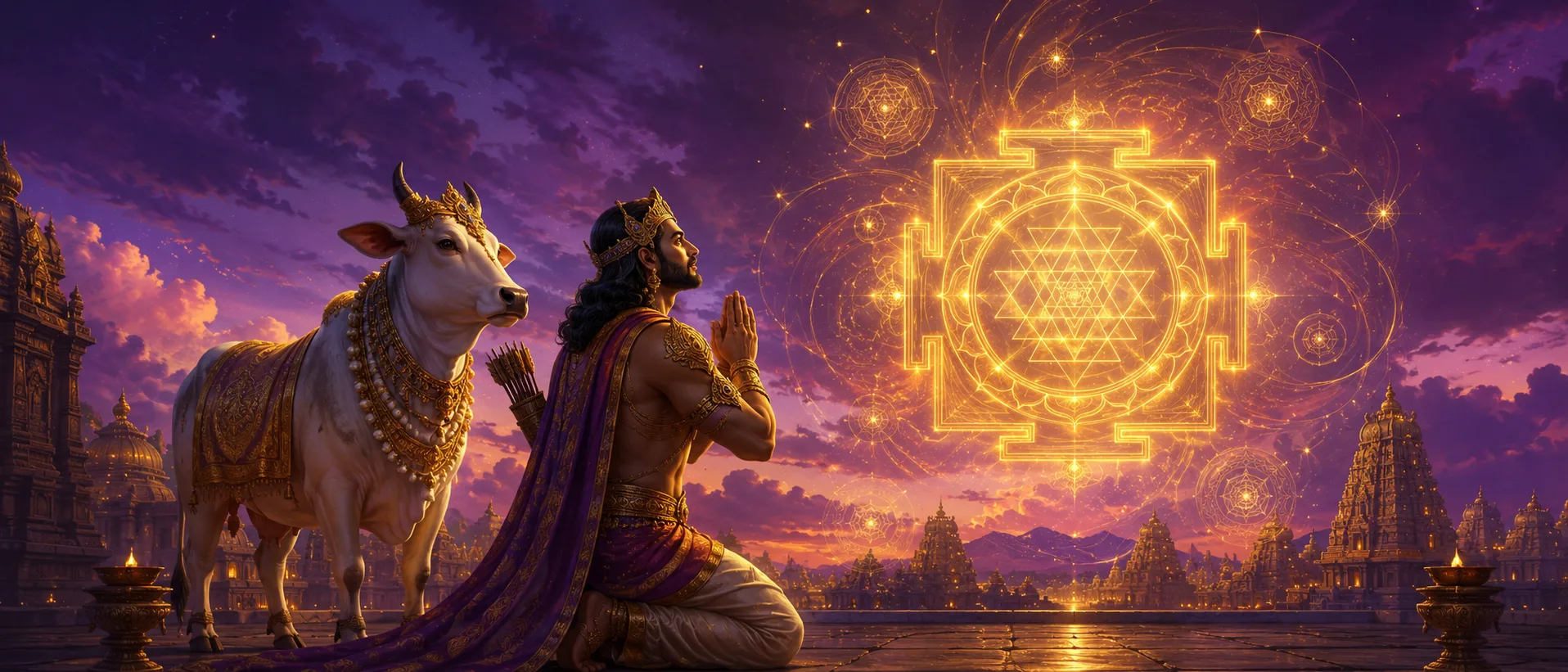
Skandha 3 opens as a theological treatise — Bhuvaneshvari's nature described at length, the Goddess's own direct teaching to Brahma establishing the three gunas as her instrument — before settling into narrative proper: King Satyavrata's story across two chapters, the elaborate rite of sacrifice to Mother Amba, and the conflict between Yudhajit and Bharadvaja that leads, through Sudarshana's chance encounter with sage Vishvamitra's wish-fulfilling cow Nandini, to the discovery of the kama-bija seed-mantra and the founding of formal Durga worship in the cities of Kosala and Kashi. A romantic thread follows — Sudarshana and Shashikala's love, her svayamvara, and the deaths of her father and uncle at the Goddess's hands when they oppose the match — before the skandha turns fully practical: a detailed Navaratri and Kumari-puja ritual manual, including the devotional story of Sushila. In its final movement the text compresses the entire Ramayana into a handful of chapters, arriving at the moment sage Narada teaches Rama the Navaratri vow itself, and the Goddess grants her boon just before the war against Ravana begins — closing the skandha at the very threshold of that war.
Chapters
Why it matters today
This skandha's placement of the Navaratri vow directly inside the Ramayana narrative — Rama himself learning and performing it from Narada before facing Ravana — is the textual root of Navaratri's continuing association with Rama's victory in many regional traditions, distinct from (and supplementing) its more widely known connection to the Devi Mahatmya's own battle narrative.
This story is also told in
The complete Valmiki Ramayana
The full epic, all seven kandas — the source text these Purana retellings compress.
Rama's dynastic history (Bhagavata Purana, Skandha 9)
Rama's life compressed into the solar-dynasty genealogy, ch. 10-11.
Shiva's telling of the Ramacharita (Padma Purana, Patala Khanda)
The whole khanda is framed as Shiva narrating Rama's story to Parvati, plus a second embedded retelling (Jambavan's Purakalpiya account) told to Rama himself.
A brief Ramayana summary (Garuda Purana, ch. 143)
A short summary within the Purvakhanda's dynastic-history section.