Alopi Devi (Madhaveshwari)
अलोपी देवी (माधवेश्वरी)
The Disappeared Devī of Prayāgrāj, corpus-first aniconic Pīṭha worshipped as an empty wooden palanquin at the Triveṇī Sangam confluence, Bhairava-paired with Veṇī Mādhava
Prayagraj, Uttar Pradesh, India
Alopī Devī / MādhaveśvarīAlso known as: Alopi Mata, Alopi Shankari, Mādhaveśvarī Devī, Mādhaveśvarī, Prayāga Mādhaveśvarī, Alop Devi, Alopi Bagh Devi, The Disappeared Devī
Era
Pre-canonical sacred geography of the Triveṇī Sangam confluence (continuous Hindu worship attestation from the Vedic period; the Sangam itself is one of the canonical foundational Hindu sacred sites with attestation in the Rigveda, the Mahābhārata, the Rāmāyaṇa, and the Purāṇa corpus); canonical Pīṭha attestation by 8th, 12th c.; the Alopi Bagh precinct's documented temple structure substantially modern (19th, 20th c.) over older foundation phases; the aniconic cradle (jhulā/khaṭvāṅga) has been preserved through continuous worship across the temple's historical phases
Architecture
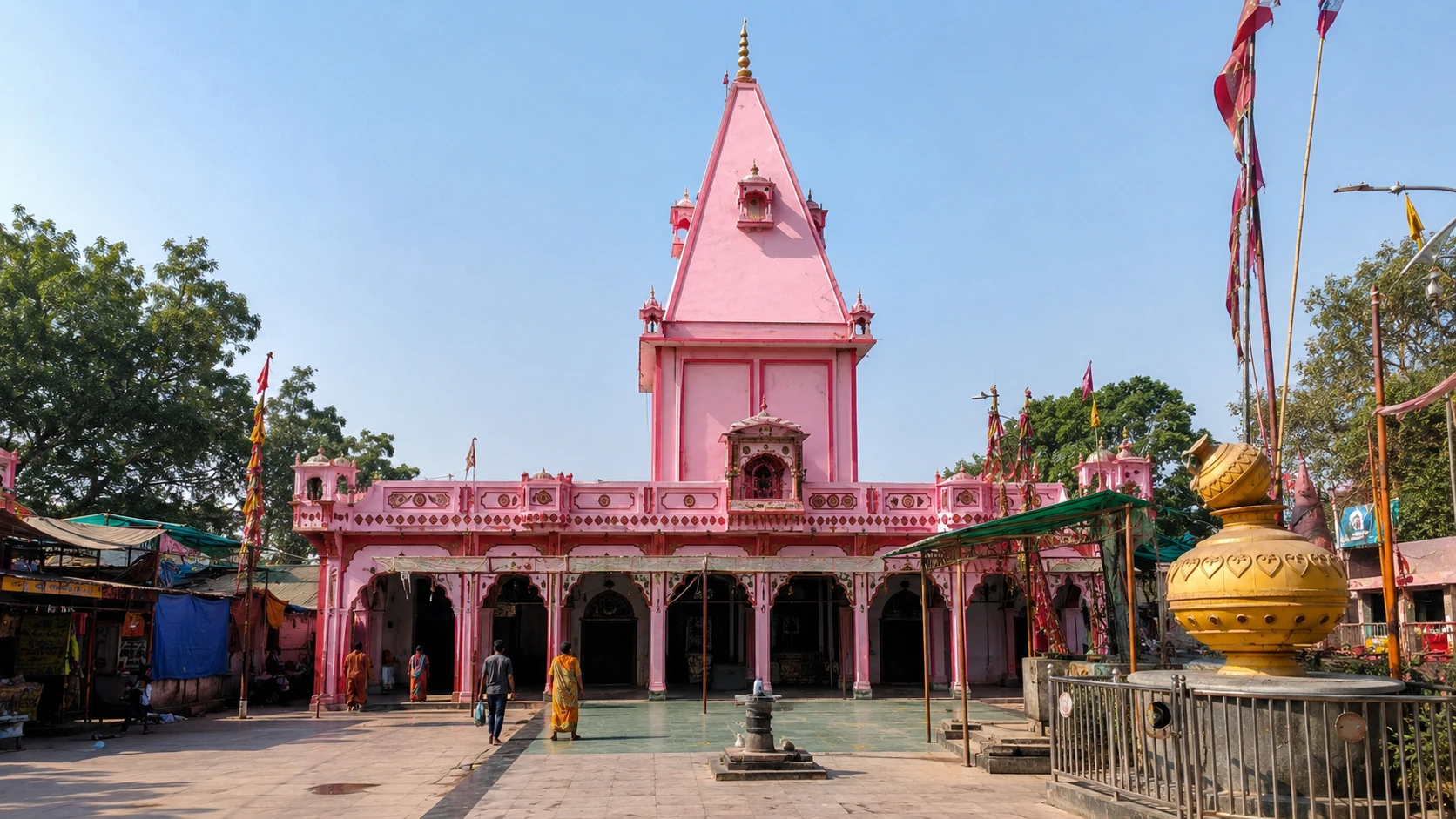
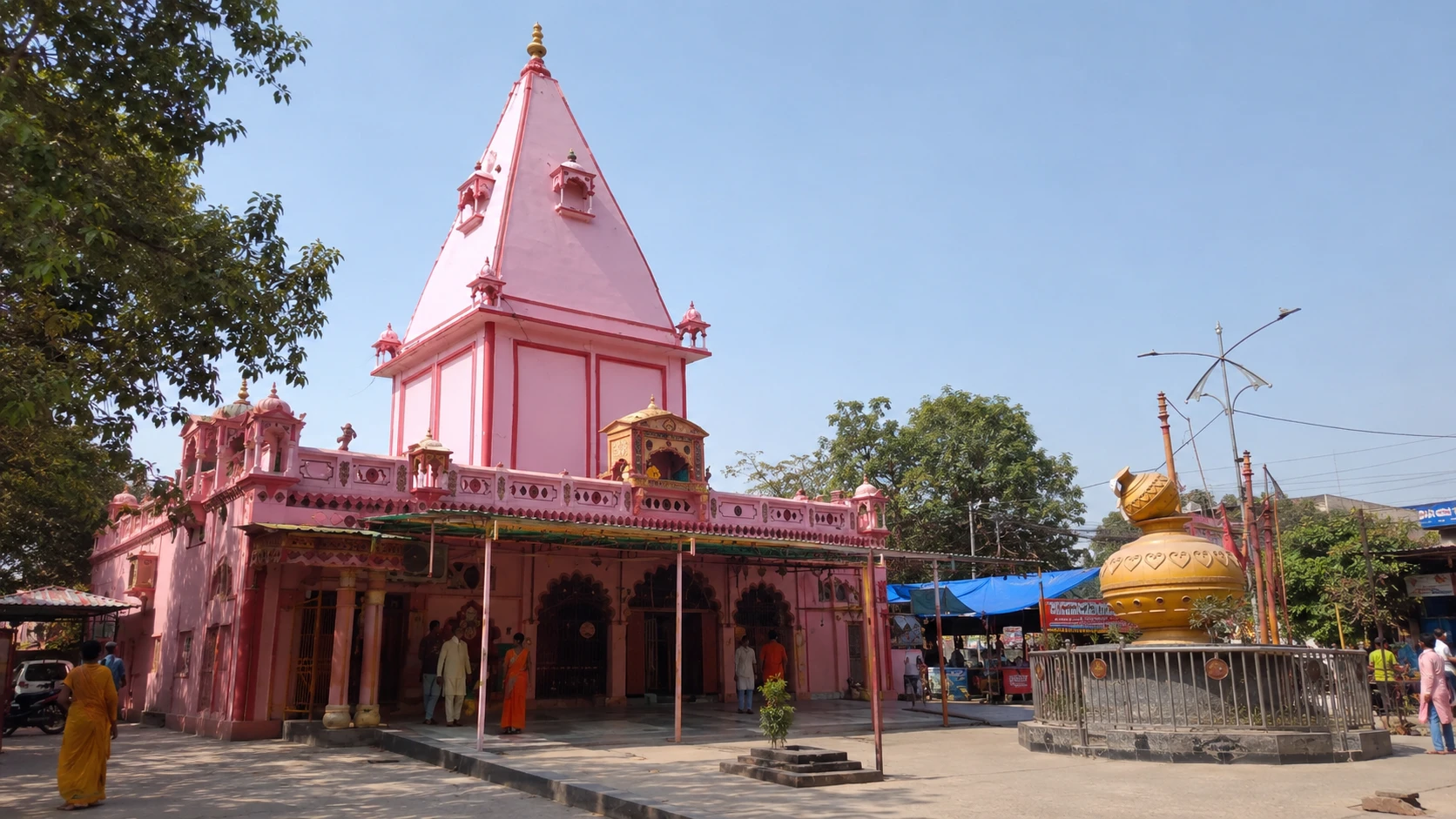
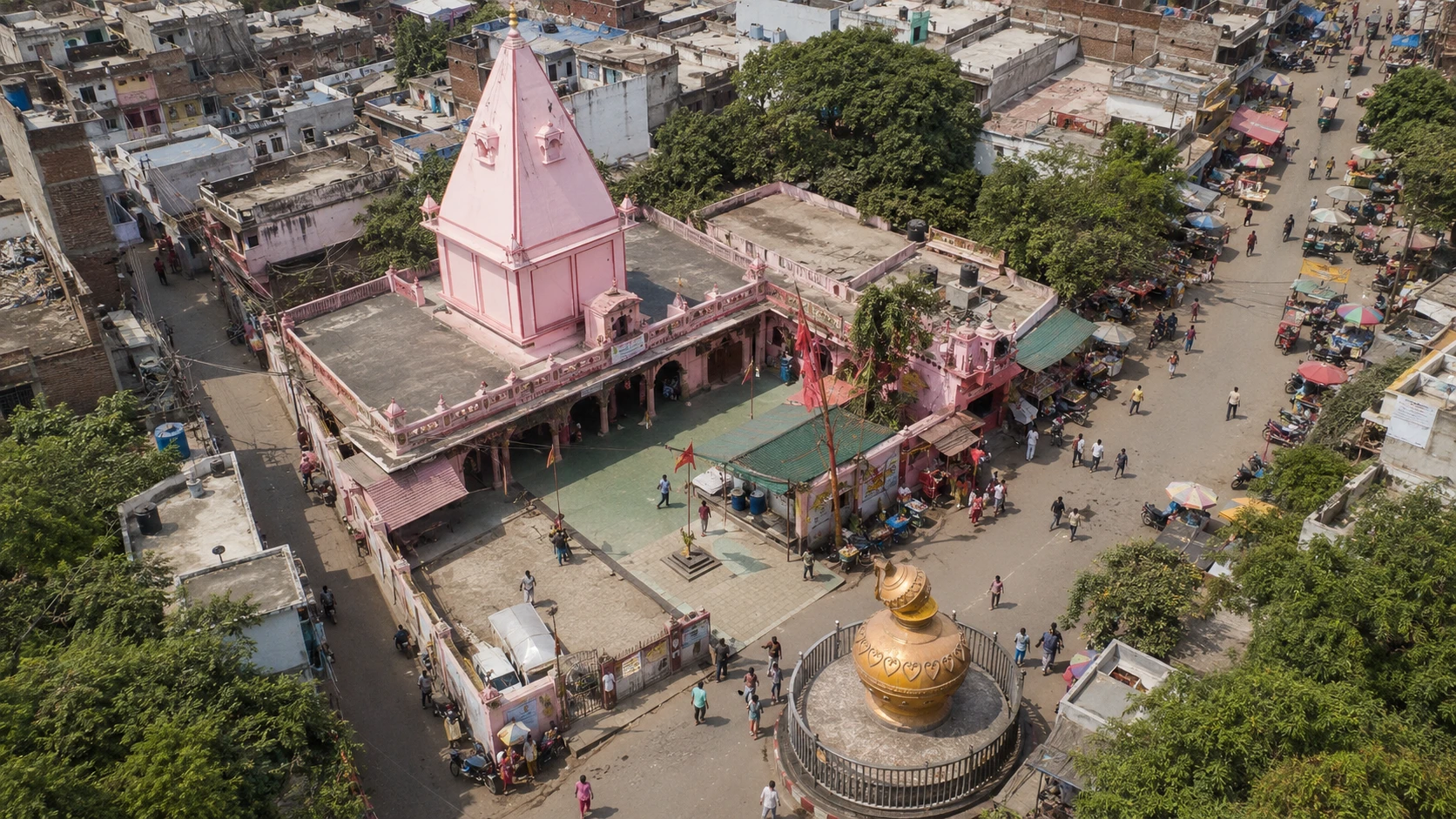
Modest temple structure in the regional north Indian temple-construction style with 19th, 20th c. modernization layers over older foundation elements. The principal architectural distinction is the sanctum's aniconic configuration: rather than a sculpted murti, the central devotional object is the suspended wooden palanquin (jhulā / khaṭvāṅga / pāḷkī) draped in red cloth and ornaments, suspended from the sanctum's interior framework and ritually swung during the daily aarti liturgy. The sanctum's spatial organization is structured around the cradle-darshan rather than around a fixed murti-centered axis, a corpus-distinctive architectural-liturgical pattern reflecting the aniconic theological register
Open
05:00 – 22:00
Aarti
05:30 · 12:00 · 19:00 · 21:00
Special
The Māgha Melā (Jan-Feb), Ardha Kumbh Melā (every 6 years), and Pūrṇa Kumbh Melā (every 12 years) at the Triveṇī Sangam bring substantial pilgrim flow that includes Alopī Devī darshan as part of the integrated Prayāgrāj sacred-geography pilgrimage; Śāradīya Navarātri (Sep-Oct) is the principal annual Devī-focused festival with full nine-night observance at the aniconic cradle; Vasantī Navarātri (Mar-Apr) brings the spring Devī-festival cycle; the Mauni Amāvasyā observance during the Māgha Melā draws particular Devī-side observance flow
The Sacred Legend · पवित्र कथा
Alopī Devī sits in the Alopi Bagh precinct of Prayāgrāj (Allahabad, renamed Prayāgrāj in 2018) in northern Uttar Pradesh, and the Pīṭha occupies a structurally distinctive position in the canonical Aṣṭādaśa enumeration, position 14 in the Adi Shankara recension's Stotram, named as Mādhaveśvarī Prayāge. The name 'Alopī' (from Sanskrit alopa, the disappeared or vanished) encodes the corpus-distinctive theological identity of this Pīṭha: the body-part fragment that fell at Prayāgrāj is canonically held to have disappeared (alopa) at the site, and the Devī is worshipped not through a sculpted murti but through the absence the name itself encodes, an empty wooden palanquin or cradle (jhulā / khaṭvāṅga) suspended from the sanctum's interior framework and ritually swung during the daily liturgy. This makes Alopī Devī the corpus-first aniconic iconographic register: the principal devotional object is not a Devī murti (anthropomorphic or symbolic) but the absence of the murti, ritually marked by the empty consecrated cradle. The aniconic theology integrates the Pīṭha narrative (Sati's body-fragment fell here) with the name's etymology (alopa, vanished) in a single embodied liturgical structure, the empty cradle is theologically the marker of presence-in-absence, and devotees darshan the absence as the canonical form of the Pīṭha's Devī. The Bhairava-pair at Alopī is canonically Veṇī Mādhava (the Vaiṣṇava deity of the Triveṇī Sangam at Prayāgrāj, the cosmic three-river confluence of the Gangā, Yamunā, and the subterranean Sarasvatī), making the Pīṭha-Bhairava attestation at Alopī corpus-distinctive as a Vaiṣṇava-Bhairava cross-shrine pairing structurally parallel to Birajā at Jajpur paired with Jagannātha at Puri, the corpus's two documented Vaiṣṇava-Bhairava Aṣṭādaśa Pīṭhas. The Triveṇī Sangam itself, approximately 2 km south of the Alopi Bagh precinct, anchors the entire Prayāgrāj sacred-geographical complex; the Kumbh Melā observances at the Sangam (the Pūrṇa Kumbh every twelve years, Ardha Kumbh every six years, and the annual Māgha Melā) integrate Alopī Devī into the largest pilgrim concentration event in the canonical Hindu sacred-geographic network. The Alopi Bagh precinct preserves the temple's continuing administrative coherence under the Government of Uttar Pradesh and the temple's local trust framework; the principal sanctum's aniconic cradle has been preserved through continuous worship across the temple's documented historical phases.
Sacred Designationपवित्र पदनाम
Shakti Peeth
Body part: Fingers (Aṅguli), canonically attested as the body-part that fell at Prayāgrāj and then disappeared (alopa) at the site, giving the Pīṭha its corpus-distinctive aniconic worship form
Shakti: Alopī Devī / Mādhaveśvarī (the Disappeared Devī; the Goddess at Mādhava's place)
Bhairava: Veṇī Mādhava (the Vaiṣṇava deity of the Triveṇī Sangam at Prayāgrāj; canonical Pīṭha-Bhairava attestation per Pīṭhanirṇaya and the dominant Tantric tradition, making Alopī's Bhairava-pair a Vaiṣṇava form rather than a Śaiva Liṅga, structurally parallel to Birajā-Jagannātha)
Sacred Origin Storyपवित्र उत्पत्ति कथा
Source: Devī Bhāgavata Purāṇa, Skandha VII (canonical 51-Pīṭha enumeration); Kālikā Purāṇa, Chapters 18 and 60, 62 (52-list, aṅguli body-part attribution at Prayāgrāj); Pīṭhanirṇaya (Mādhaveśvarī at Prayāga paired with Bhairava Veṇī Mādhava); Ashtadasha Shakti Pīṭha Stotram attributed to Ādi Śaṅkarācārya (Mādhaveśvarī Prayāge, position 14); Skanda Purāṇa, Prayāga Māhātmya (the regional Sthala Purāṇa tradition on Prayāga as the King of Tīrthas); Matsya Purāṇa Prayāga sections (the Triveṇī Sangam sacred-geography canonical attestation); Mahābhārata, Tīrtha-yātrā parva (the Sangam as the canonical foundational tīrtha-site); Padma Purāṇa Pātāla Khaṇḍa (the Prayāga sacred-complex narrative); local Alopi-tradition oral history
The Pīṭha-narrative at Alopī Devī takes the canonical Pīṭha-formation cycle (Sati's self-immolation at Dakṣa's yajña, Śiva's tāṇḍava, Viṣṇu's Sudarśana-Cakra severing of Sati's body, the 51/52 fragments falling across the South Asian sacred-geographic network) and adds a corpus-distinctive theological elaboration: at Prayāgrāj, the body-part fragment (canonically the fingers, aṅguli) fell at what became the Alopi Bagh precinct, and then, in the corpus-distinctive elaboration that gives this Pīṭha its name and theological identity, the fragment disappeared (alopa) at the site, leaving no physical remnant for ritual sculpting into a murti.
The Devī, the local tradition holds, did not abandon the site but became present-in-absence, she remains canonically resident at the Alopi Bagh sanctum but is theologically present through the absence of the murti rather than through a physical sculpted form.
The empty consecrated wooden palanquin or cradle (jhulā / khaṭvāṅga / pāḷkī) suspended in the sanctum and ritually swung during the daily aarti liturgy is the canonical liturgical response to this theological situation: the empty cradle is the marker of the Devī's continuing presence at the disappeared body-part site.
The aniconic theology integrates the Pīṭha narrative (Sati's body-fragment fell here) with the name's etymology (alopa, vanished) in a single embodied liturgical structure. The Bhairava-pair at Alopī is canonically Veṇī Mādhava (the Vaiṣṇava deity of the Triveṇī Sangam at Prayāgrāj), reflecting the Pīṭhanirṇaya attestation and the dominant Tantric tradition, the Pīṭha-Bhairava architecture at Alopī thus operates across an intra-city sacred-geography axis connecting the Alopi Bagh precinct (Devī Pīṭha) to the Daraganj region near the Sangam (Veṇī Mādhava shrine), approximately 2 km apart within Prayāgrāj.
Onto this Pīṭha narrative the broader Triveṇī Sangam sacred-geography arrives: the Sangam is canonically the King of Tīrthas (Tīrtha-rāja), the cosmic three-river confluence of the Gangā (the celestial river), the Yamunā (the daughter of the Sun), and the subterranean Sarasvatī (the lost or hidden river), and the broader Prayāga sacred-complex integrates the Pīṭha (Alopī Devī) + the Vaiṣṇava center (Veṇī Mādhava) + the cosmic confluence (Triveṇī Sangam) + the imperishable banyan (Akṣayavaṭa) + the canonical Kumbh Melā pilgrimage cycle into a multi-pole sacred-geographic infrastructure unparalleled in the corpus.
Sources cited:
- Devī Bhāgavata Purāṇa, Skandha VII (canonical 51-Pīṭha enumeration)
- Kālikā Purāṇa, Chapters 18 and 60, 62 (52-list tradition; aṅguli body-part attribution at Prayāgrāj)
- Pīṭhanirṇaya (Mādhaveśvarī at Prayāga paired with Bhairava Veṇī Mādhava)
- Ashtadasha Shakti Pīṭha Stotram attributed to Ādi Śaṅkarācārya (Mādhaveśvarī Prayāge, position 14)
- Skanda Purāṇa, Prayāga Māhātmya (regional Sthala Purāṇa tradition on Prayāga as Tīrtha-rāja)
- Matsya Purāṇa, Prayāga sections (the Triveṇī Sangam canonical attestation)
- Mahābhārata, Tīrtha-yātrā parva / Vana Parva (the Sangam as canonical foundational tīrtha-site)
- Padma Purāṇa, Pātāla Khaṇḍa (the broader Prayāga sacred-complex narrative)
- Local Alopi-tradition oral history (the disappeared-body-part narrative and the aniconic cradle's theological standing)
- Sircar, D. C., 'The Śākta Pīṭhas' (Motilal Banarsidass, 1948; revised 1973)
- Bhattacharya, N. N., 'History of the Sakta Religion' (Manohar, 1974)
- Eck, Diana L., 'India: A Sacred Geography' (Harmony Books, 2012), chapter on the Triveṇī Sangam and Prayāga
- Maclean, Kama, 'Pilgrimage and Power: The Kumbh Mela in Allahabad, 1765-1954' (Oxford University Press, 2008)
Other Traditions · अन्य परंपराएँ
Body-part recension variability (aṅguli vs hand-region vs disappeared-fragment)
The body-part attribution at Alopī Devī shows minor recension variability across primary sources, with the underlying theological-textual structure complicated by the Alopi-tradition's framing of the body-part as having disappeared.
The dominant attestation per Sircar 1948 and the Pīṭhanirṇaya is aṅguli (fingers); some regional Kālikā Purāṇa recension readings give 'hand-region' (hasta-pradeśa) as a broader anatomical attestation; a separate set of recensions emphasizes the disappeared-fragment framing without specifying a precise anatomical part, treating the absence itself as the canonical attestation.
The Alopi-tradition's local oral history strongly weights the disappeared-fragment framing, with the embodied liturgical structure (the empty cradle as the canonical Devī-darshan object) reflecting this framing more than the specific anatomical identity.
The corpus uses aṅguli as the dominant primary attestation in bodyPart_en/_hi while acknowledging in the bodyPart_en field itself that the canonical theological move at this Pīṭha is the disappearance (alopa) of the body-part, making the specific anatomical identity less liturgically determinative than at other Pīṭhas where the body-part attribution drives ritual-iconographic specificity.
Śaiva-recension Bhairava attestation (Bhava vs Veṇī Mādhava)
The Bhairava attestation at Alopī Devī shows recension variability between the dominant Pīṭhanirṇaya/Tantric reading (Veṇī Mādhava as the Vaiṣṇava Bhairava-pair) and a separate Śaiva-recension reading (Bhava, a name of Śiva, as the Bhairava-pair).
The dominant Tantric reading is canonical across the Pīṭhanirṇaya, the major Tantric pīṭha-enumeration manuscripts, and Sircar 1948; the Śaiva-recension reading is preserved in a subset of regional manuscripts and reflects a Śaiva-tradition framing of the Pīṭha-Bhairava architecture as canonically Śaiva.
The corpus uses Veṇī Mādhava as the dominant attestation given its weight in the Pīṭhanirṇaya and the broader Tantric tradition, while acknowledging the Śaiva-recension alternative. Theologically, the Veṇī Mādhava attestation makes Alopī one of the corpus's two documented Vaiṣṇava-Bhairava Aṣṭādaśa Pīṭhas (alongside Birajā-Jagannātha), a structurally significant pattern within the documented Pīṭha-Bhairava architecture.
Scholarly Context
Alopī Devī occupies a structurally distinctive position in the Pīṭha network through the convergence of multiple corpus-distinctive dimensions. First, the aniconic iconographic_register is corpus-first: no other Aṣṭādaśa Pīṭha (or, indeed, no other Pīṭha in the broader documented corpus) operates through an aniconic primary devotional object. The empty consecrated palanquin/jhulā as the canonical Devī-darshan object reflects a theological-liturgical structure that integrates the Pīṭha narrative (Sati's body-fragment fell here), the Devī's name (Alopī, the disappeared one), and the embodied liturgical response (the empty cradle as the marker of presence-in-absence) into a single coherent aniconic framework. The pattern is theologically distinct from other forms of aniconic Hindu worship (the Liṅga is geometric-abstract rather than aniconic; the yantra-based worship at certain Devī shrines retains a geometric devotional object; the Jagannātha murti at Puri is unconventionally carved but is not aniconic), Alopī's aniconic register operates through the absence of any devotional object beyond the empty cradle-vessel. Second, the Vaiṣṇava-Bhairava cross-shrine attestation (Veṇī Mādhava as the canonical Bhairava-pair) makes Alopī one of the corpus's two documented Vaiṣṇava-Bhairava Aṣṭādaśa Pīṭhas (alongside Birajā-Jagannātha), with the structural pattern operating at an intra-city scale (~2 km between Alopi Bagh and Daraganj) rather than at the cross-region scale of Birajā-Jagannātha (~105 km). Third, the integration with the Triveṇī Sangam-Kumbh Melā complex places Alopī within the largest documented religious-pilgrimage infrastructure in the canonical Hindu sacred-geographic network, the Pūrṇa Kumbh Melā at Prayāgrāj is the largest documented religious gathering in human history (the 2013 Pūrṇa Kumbh drew an estimated 120 million pilgrims over the full 55-day observance period, with single-day peaks of approximately 30 million on Mauni Amāvasyā). Alopī Devī receives substantial pilgrim flow as part of the integrated Triveṇī Sangam pilgrimage during Melā periods; outside Melā cycles, the temple's regional pilgrim flow is moderate, with the Sangam itself drawing the majority of the broader Prayāgrāj pilgrim concentration. Diana Eck's 'India: A Sacred Geography' (2012) and Kama Maclean's 'Pilgrimage and Power: The Kumbh Mela in Allahabad' (2008) provide the principal modern academic treatments of the Prayāga sacred-complex's theological-architectural and historical-political framework.
Historyइतिहास
Alopī Devī's historical depth as a sacred site is embedded within the broader Prayāga sacred-complex's standing as one of the most ancient and continuously-attested Hindu pilgrimage centres. The pre-canonical layer (Vedic period through c. 4th c.
CE) places the Triveṇī Sangam at the foundation of the canonical Hindu tīrtha-network, the Rigveda references the Gangā-Yamunā confluence-region, the Mahābhārata's Tīrtha-yātrā parva enumerates Prayāga prominently among the canonical pilgrimage sites, and the Rāmāyaṇa narrative passes through Prayāga at multiple points.
The Alopi Bagh precinct as a specific Pīṭha-site within the broader Prayāga complex is canonically attested through the 8th, 12th c. textualization period that produced the Devī Bhāgavata, the Kālikā Purāṇa, the Pīṭhanirṇaya, and the Aṣṭādaśa Stotram. The Gupta period (4th, 6th c.
CE) saw the broader Prayāga sacred-complex develop substantial pilgrim-infrastructure under imperial Gupta patronage; the Pratīhāra dynasty (8th, 10th c. CE) continued regional patronage. The Delhi Sultanate period (13th, 16th c.
CE) brought disruption, Akbar's construction of the Allahabad Fort at the confluence in 1583 reorganized the immediate Sangam precinct, and certain shrine elements were affected by the Sultanate-period broader regional disruptions.
The Mughal-period Akbar foundation, however, also institutionalized the imperial recognition of Prayāga's pilgrimage significance, Akbar renamed Prayāga to Ilahabad/Allahabad ('the city of God') in 1583, and the Mughal-administration formalized Kumbh Melā pilgrim management during the Akbar-through-Aurangzeb period.
The British colonial period (1801, 1947) saw the Kumbh Melā pilgrim flow grow substantially under the rail-network expansion, with the colonial administration progressively formalizing the pilgrim infrastructure (with documented colonial-period crowd-management failures, notably the 1840 and 1906 incidents).
The Alopi Bagh precinct itself sustained continuous Hindu worship throughout these political transitions, with its aniconic cradle preserved across the documented historical phases. Post-Independence (1947, present) administrative arrangements placed Alopī Devī within the Uttar Pradesh state Hindu temple framework.
The 2018 renaming of Allahabad to Prayāgrāj by the Government of Uttar Pradesh restored the traditional Sanskrit name (Prayāga = the place of confluence). The 2019 Pūrṇa Kumbh Melā and 2025 Pūrṇa Kumbh Melā brought substantial federally-coordinated infrastructure development to the Sangam-Alopi-Veṇī-Mādhava integrated complex.
Historical Timelineऐतिहासिक कालक्रम
Pre-canonical attestation of the Triveṇī Sangam at Prayāga as a foundational Hindu tīrtha-site, anchoring the broader sacred geography within which the Alopi Pīṭha would later be canonically attested. The Rigveda references the Gangā-Yamunā confluence-region in the Khilani-Sūkta; the Mahābhārata's Tīrtha-yātrā parva enumerates Prayāga prominently among the canonical pilgrimage sites with characteristic emphasis on the confluence's salvific power; the Rāmāyaṇa narrative passes through Prayāga and Bharadwaj Ashram at multiple points in Rama's exile journey. The pre-canonical sacred-geographical substrate is the foundation on which the canonical Pīṭha attestation later arrived through the 8th, 12th c. textualization period.
Gupta dynasty period of substantial pilgrim-infrastructure development at the Triveṇī Sangam under imperial Gupta patronage. The Gupta emperors (capital at Pāṭaliputra; substantial regional engagement with Prayāga as a strategic Doab religious-political centre) supported the Prayāga sacred-complex through endowments and infrastructure. The Allahabad Pillar Inscription of Samudragupta (c. 350 CE), inscribed on an earlier Ashokan pillar relocated to Prayāga, is among the most important early-medieval Indian historical inscriptions and documents the imperial Gupta engagement with the Prayāga site.
Canonical Pīṭha attestation of Alopī Devī at the Alopi Bagh precinct of Prayāga through textualization in the Devī Bhāgavata Purāṇa (Skandha VII), the Kālikā Purāṇa (Chapters 18 and 60, 62; aṅguli body-part attribution at Prayāga), the Pīṭhanirṇaya (Mādhaveśvarī at Prayāga paired with Bhairava Veṇī Mādhava), and the Ashtadasha Shakti Pīṭha Stotram attributed to Ādi Śaṅkarācārya (Mādhaveśvarī Prayāge, position 14). The textualization period also formalized the canonical Prayāga Māhātmya tradition (Skanda Purāṇa, Matsya Purāṇa, Padma Purāṇa) that elaborated Prayāga's standing as Tīrtha-rāja (King of Tīrthas) and integrated the Pīṭha-attestation with the broader Triveṇī Sangam-Kumbh Melā theological framework.
Mughal Emperor Akbar's construction of the Allahabad Fort at the Triveṇī Sangam and the renaming of Prayāga to Ilahabad/Allahabad ('the city of God'). The fort construction reorganized the immediate Sangam-precinct geography and brought the Sangam-shore directly under imperial fortified infrastructure, with longer-term consequences for the spatial organization of the broader Prayāga sacred-complex including the Akṣayavaṭa (the imperishable banyan canonically located at the Sangam) being absorbed into the fort's protected interior. The Alopi Bagh precinct, approximately 2 km north of the immediate Sangam, was not directly affected by the fort construction and continued operating outside the fort-precinct. Akbar's broader policy of Hindu-shrine recognition and Kumbh Melā pilgrim-management formalization, however, applied across the full Prayāga complex including Alopī Devī. The Akbar-period administrative formalization is the foundation upon which subsequent Mughal-period (Aurangzeb-era) and British-colonial pilgrim-management arrangements built.
British colonial period during which the Kumbh Melā pilgrim flow at Prayāga grew substantially under the rail-network expansion, with the colonial administration progressively formalizing the pilgrim infrastructure across the integrated Sangam-Pīṭha complex including Alopī Devī. The colonial period was marked by documented crowd-management failures, notably the 1840 Hardwar/Allahabad Mela-period incidents and the 1906 Allahabad Kumbh disaster, that progressively forced the institutional formalization of pilgrim infrastructure. The British East India Company administrative formalization (1801, 1858) and subsequent Crown administration (1858, 1947) both included Alopī Devī within the broader Prayāga pilgrim-management framework. The Alopi Bagh precinct itself sustained continuous Hindu worship throughout, with the aniconic cradle preserved as the temple's principal devotional object across the colonial period.
The 1906 Allahabad Kumbh disaster is documented through colonial-period administrative records and contemporary press accounts; estimates of casualties vary substantially across sources. Eternal Raga records the disaster as a key infrastructure-driver for subsequent pilgrim-management reform without making specific casualty-figure claims absent verified primary-source attestation.
Post-Independence administration of Alopī Devī under the Uttar Pradesh state Hindu temple framework, alongside the broader federal coordination of the integrated Sangam-Pīṭha-Veṇī-Mādhava complex during Kumbh Melā events. Key modern-era events include: the 1954 Pūrṇa Kumbh Melā stampede (a significant infrastructure-disaster that drove further pilgrim-management reform); the institutional formalization of the modern Kumbh Melā Authority under the Uttar Pradesh state government; the 2013 Pūrṇa Kumbh Melā (estimated 120 million pilgrims across the full 55-day observance period, with single-day peaks of approximately 30 million on Mauni Amāvasyā, the largest documented religious gathering in human history); the October 2018 renaming of Allahabad to Prayāgrāj by the Government of Uttar Pradesh, restoring the traditional Sanskrit name (Prayāga = the place of confluence); the 2019 Ardha Kumbh / Kumbh Melā with substantially expanded federal-state coordinated infrastructure; and the 2025 Pūrṇa Kumbh Melā with further infrastructure development extending the integrated Sangam-Alopi-Veṇī-Mādhava pilgrim-management framework.
The 2013 Pūrṇa Kumbh Melā pilgrim-attendance estimate of 120 million is the figure cited in Government of India coordinated-event documentation and the World Bank's 2013 Kumbh Melā logistics study; alternative estimates in academic literature range from 100 million to 130 million across the full 55-day observance period. The single-day Mauni Amāvasyā peak estimate of 30 million reflects the broad scholarly consensus. Eternal Raga records the estimate as 'approximately 30 million' rather than making a specific claim absent verified attestation.
What You'll Seeदर्शन में
The Alopī Devī sanctum at the Alopi Bagh precinct preserves the corpus-first aniconic iconographic register, the principal devotional object is not a sculpted murti (anthropomorphic or symbolic) but an empty consecrated wooden palanquin or cradle (jhulā / khaṭvāṅga / pāḷkī) suspended from the sanctum's interior framework.
The cradle is constructed of dark hardwood, draped in red silk and ornamented with the canonical Devī attributes (garlands, gold and gem-set jewellery, sindoor application points, the consecrated kumkum vessel positioned within the cradle's enclosed interior space), but the cradle is empty: there is no murti underneath the silk drapery, no sculpted form within the ornamentation.
The aniconic configuration is theologically deliberate and reflects the Devī's name Alopī (the Disappeared One): the body-part fragment that fell at Prayāgrāj is canonically held to have disappeared (alopa) at the site, leaving no physical remnant for sculptural elaboration, and the empty cradle is the canonical liturgical response to this theological situation, the marker of presence-in-absence, the embodied form of the Devī's continuing presence at the disappeared body-part site.
During the daily aarti liturgy, the cradle is ritually swung (the jhulā-darshan tradition), the priest engages the cradle's suspension framework to set the empty cradle in gentle pendulum motion, and devotees darshan the swinging cradle as the canonical liturgical form of the Devī's presence.
The aarti's coordinated bell-ringing, lamp-rotation, and cradle-swinging produce an integrated sensory-liturgical structure distinct from the more common static-murti aarti format found at most Devī shrines. The sanctum's spatial organization is structured around the cradle's suspension axis rather than around a fixed murti-centered axis, pilgrims approach the cradle from the front of the sanctum, observe the priest's aarti coordination of the swinging cradle, and receive the consecrated prasad (the kumkum and red cloth fragments) returned through the cradle's ornamental ecology.
Subsidiary iconography in the broader Alopi Bagh precinct includes the precinct's Śivaliṅga (associated with the Bhava-recension Bhairava attestation; structurally subordinate to the canonical Veṇī Mādhava cross-shrine pairing), local Gaṇeśa and Hanumān shrines, and the precinct's pilgrim-service infrastructure (rest halls, prasad distribution counters, and the temple's administrative office).
The temple's architectural register is modest compared to the broader Prayāgrāj sacred-complex's grander Sangam-precinct constructions, Alopī's devotional weight comes from the aniconic theological-liturgical structure rather than from architectural elaboration.
Distinctive Practicesविशिष्ट परंपराएँ
Jhulā-Darshan, Aniconic Cradle Darshan and Swinging Aarti Liturgy
झूला-दर्शन, अनिकोनिक झूला दर्शन और झुलाती आरती अनुष्ठान
Daily, four aarti times (05:30, 12:00, 19:00, 21:00); particularly weighted during Śāradīya Navarātri, Vasantī Navarātri, and during Kumbh Melā / Māgha Melā observance days
The jhulā-darshan is the corpus-distinctive primary devotional practice at Alopī Devī, the canonical liturgical engagement with the aniconic cradle that constitutes the principal devotional object of the sanctum. During each daily aarti, the priest engages the cradle's suspension framework to set the empty consecrated cradle in gentle pendulum motion, and the assembled devotees darshan the swinging cradle as the canonical liturgical form of the Devī's presence. The bell-ringing, lamp-rotation (the standard five-, seven-, or nine-lamp aarti vessel rotation pattern), camphor-flame waving, and the cradle's gentle swinging combine into an integrated sensory-liturgical structure that differs in fundamental kind from the more common static-murti aarti format. Devotees offer their personal Devī-darshan with the cradle's pendulum motion as the canonical sensory anchor, eye-contact darshan, the standard mode at murti-based shrines, is replaced at Alopī by the embodied attention to the cradle's motion. The theological logic is precise: the Devī is present-in-absence, the cradle is the marker of the absence, the cradle's motion is the marker of the Devī's continuing animating presence at the absence-site, and the devotee's darshan attention is structured around the motion rather than around a fixed visual focus. The jhulā-darshan is structurally distinct from the more common Devī darshan modes documented elsewhere in the corpus.
The jhulā-darshan tradition operationalizes the Alopī Pīṭha's corpus-distinctive theological logic, the body-part disappeared (alopa) at the site, the Devī remains present-in-absence, and the empty cradle's gentle pendulum motion is the embodied liturgical marker of the Devī's continuing animating presence. The practice is theologically distinct from the more common murti-darshan modes found across the corpus; the absence the cradle marks is itself the canonical form of the Devī's presence at this Pīṭha.
Integrated Triveṇī Sangam, Alopī Devī, Veṇī Mādhava Pilgrimage
एकीकृत त्रिवेणी संगम, अलोपी देवी, वेणी माधव तीर्थयात्रा
Year-round; particularly weighted during Kumbh Melā cycles (Pūrṇa every 12 years, Ardha every 6 years), the annual Māgha Melā (Jan-Feb), and Mauni Amāvasyā during the Melā periods
The integrated Triveṇī Sangam pilgrimage approaches the Prayāgrāj sacred-complex as a single coherent devotional infrastructure rather than as separate destinations. The canonical pilgrim sequence engages three foundational poles in a coordinated darshan-flow: (1) the Triveṇī Sangam itself, the cosmic three-river confluence of the Gangā, Yamunā, and the subterranean Sarasvatī, where pilgrims undertake the Sangam Snāna (the ritual bath at the confluence point, the canonical first act of the Prayāga pilgrimage); (2) Alopī Devī at the Alopi Bagh precinct, the Aṣṭādaśa Pīṭha #14 darshan engaging the aniconic cradle through the jhulā-darshan liturgy; (3) Veṇī Mādhava at the Daraganj region near the Sangam, the canonical Vaiṣṇava deity of the Sangam and the Pīṭha's canonical Bhairava-pair. The three-pole sequence reflects the canonical theological architecture of the Prayāga sacred-complex: confluence (the cosmic Sangam) + Pīṭha (the Devī) + Bhairava (the Vaiṣṇava center). Pilgrims completing the canonical three-pole sequence have engaged the integrated Prayāga sacred-complex in its full theological structure; pilgrims engaging only one pole have engaged a partial subset. The pilgrimage is typically undertaken across 1, 2 days outside Kumbh Melā periods, with longer durations during Melā cycles to accommodate the substantial pilgrim concentration.
The Prayāga sacred-complex operates as an integrated three-pole devotional infrastructure rather than as separate shrines. The Pīṭha-Bhairava architecture at Alopī-Veṇī-Mādhava is geographically embedded in the Triveṇī Sangam-anchored sacred geography of the broader complex; engaging the Pīṭha without engaging the Sangam (or the Veṇī Mādhava without the Pīṭha) approaches a partial subset of the theological structure. The integrated three-pole pilgrimage is the canonical Prayāga pilgrim experience.
Kumbh Melā Integration, Alopī Devī within the Largest Documented Hindu Pilgrim-Gathering
कुंभ मेला एकीकरण, सबसे बड़े प्रलेखित हिंदू तीर्थयात्री-सम्मेलन के भीतर अलोपी देवी
Pūrṇa Kumbh Melā every 12 years (most recent 2025; next 2037); Ardha Kumbh Melā every 6 years (next 2031); annual Māgha Melā (Jan-Feb); Snāna Parva peak days during each Melā cycle
The Pūrṇa Kumbh Melā at Prayāgrāj is the largest documented religious gathering in human history, the 2013 Pūrṇa Kumbh drew an estimated 120 million pilgrims across the full 55-day observance period, with single-day peaks of approximately 30 million on Mauni Amāvasyā. The 2025 Pūrṇa Kumbh Melā reached comparable scale with substantially expanded federal-state coordinated infrastructure. Alopī Devī receives substantial pilgrim flow as part of the integrated Triveṇī Sangam pilgrimage during Melā cycles, with the Aṣṭādaśa Pīṭha standing drawing dedicated Pīṭha-pilgrims from across the South Asian Devī-pilgrimage network into the integrated Melā-Pīṭha-Vaiṣṇava infrastructure. The Melā-period darshan at Alopī Devī operates under coordinated crowd-management arrangements managed by the Uttar Pradesh Kumbh Melā Authority, with the canonical jhulā-darshan liturgy preserved through the substantially increased pilgrim flow. Pilgrims engaging Alopī Devī during the Melā period are part of the largest documented religious gathering in human history, a corpus-distinctive scale-of-attendance context that no other Aṣṭādaśa Pīṭha shares.
The Kumbh Melā cycle's cosmological grounding, the canonical narrative of the Devas and Asuras' churning of the cosmic ocean (Samudra-manthana) and the falling of nectar-drops (amṛta-bindu) at four sacred sites including Prayāga, places Alopī Devī's Pīṭha within the canonical cosmic narrative of the Kumbh cycle. Pilgrims engaging Alopī Devī during the Melā period engage the cosmic-narrative dimension of the canonical Hindu sacred-geographic infrastructure alongside the Pīṭha-attestation. The Melā cycle's twelve-year structure reflects the Devas-Asuras conflict's twelve-day duration in the cosmic-narrative time-scale; the four sacred sites (Prayāga, Haridwar, Nashik, Ujjain) correspond to the four amṛta-bindu fall-points.
Did You Know?क्या आप जानते हैं?
Alopī Devī at Prayāgrāj is the corpus-first aniconic Aṣṭādaśa Pīṭha, the principal devotional object at the sanctum is not a sculpted murti (anthropomorphic or symbolic) but an empty consecrated wooden palanquin or cradle (jhulā / khaṭvāṅga / pāḷkī) suspended from the sanctum's interior framework and ritually swung during the daily aarti liturgy. The aniconic configuration is theologically deliberate and reflects the Devī's name Alopī (the Disappeared One): the body-part fragment that fell at Prayāgrāj is canonically held to have disappeared (alopa) at the site, and the empty cradle is the canonical liturgical response, the marker of presence-in-absence, the embodied form of the Devī's continuing presence at the disappeared body-part site. No other corpus Pīṭha (across both the Aṣṭādaśa and the broader 51-list) operates through an aniconic primary devotional object.
Pīṭhanirṇaya; Alopi-tradition local oral history; Sircar, 'The Śākta Pīṭhas' (1948); Eck, 'India: A Sacred Geography' (2012)
Alopī Devī is the second of only two corpus-documented Vaiṣṇava-Bhairava Aṣṭādaśa Pīṭhas, her canonical Bhairava-pair is Veṇī Mādhava (the Vaiṣṇava deity of the Triveṇī Sangam at Prayāgrāj), structurally parallel to Birajā at Jajpur paired with Jagannātha at Puri. Both Pīṭhas operate through a cross-shrine Pīṭha-Bhairava architecture in which the Bhairava-pair is a Vaiṣṇava deity at a distinct location rather than an intra-site Śaiva Liṅga. The two patterns operate at different geographical scales: Birajā-Jagannātha at ~105 km (cross-region Odia sacred-geography axis) and Alopī-Veṇī-Mādhava at ~2 km (intra-city within the Prayāgrāj sacred-complex). The corpus's two Vaiṣṇava-Bhairava Aṣṭādaśa Pīṭhas together demonstrate the structural pattern of Devī Pīṭha + Vaiṣṇava-Bhairava that operates as a recurring sub-type within the canonical Pīṭha-network.
Pīṭhanirṇaya; Sircar, 'The Śākta Pīṭhas' (1948); Eschmann-Kulke-Tripathi (eds.), 'The Cult of Jagannath' (1978)
Pilgrims engaging Alopī Devī during a Pūrṇa Kumbh Melā cycle are part of the largest documented religious gathering in human history. The 2013 Pūrṇa Kumbh at Prayāgrāj drew an estimated 120 million pilgrims across the full 55-day observance period, with single-day peaks of approximately 30 million on Mauni Amāvasyā, a scale-of-attendance context that no other Aṣṭādaśa Pīṭha shares. The 2025 Pūrṇa Kumbh Melā reached comparable scale. The Kumbh Melā cycle's cosmological grounding, the canonical narrative of the Devas and Asuras' churning of the cosmic ocean (Samudra-manthana) and the falling of nectar-drops at four sacred sites including Prayāga, places Alopī Devī's Pīṭha within the canonical cosmic narrative of the Kumbh cycle.
Government of India / Government of Uttar Pradesh, 2013, 2019, 2025 Kumbh Melā coordination publications; Maclean, 'Pilgrimage and Power' (2008); World Bank, 2013 Kumbh Melā logistics study
The Devī's name 'Alopī' (from Sanskrit alopa, the disappeared or vanished) is corpus-distinctive among the Aṣṭādaśa Pīṭhas as a name that directly encodes the Pīṭha's theological-iconographic structure rather than describing the Devī's iconography, attributes, or geographic location. Other Pīṭha names encode iconographic registers (Bhramarāmbā = the bee-mother, Māṇikyāmbā = the ruby-mother), attributes (Kāmākhyā = the desire-named one), or geographic locations (Kanchi Kāmākṣī). 'Alopī' alone encodes the Pīṭha's absence-theology, the body-part disappeared, the murti is therefore not present, the empty cradle is the canonical liturgical form. The name and the iconographic register at Alopī thus form a corpus-distinctive theological-naming triad where the name itself is the theological signature.
Sircar, 'The Śākta Pīṭhas' (1948); Bhattacharya, 'History of the Sakta Religion' (1974); Alopi-tradition local oral history
The 2018 renaming of Allahabad to Prayāgrāj by the Government of Uttar Pradesh restored the traditional Sanskrit name (Prayāga = the place of confluence, the canonical pre-Mughal name for the city). The renaming reverses the 1583 Mughal Emperor Akbar renaming of Prayāga to Ilahabad/Allahabad ('the city of God') on the occasion of the Allahabad Fort's construction at the Triveṇī Sangam. The 2018 renaming was politically significant as part of a broader Government of Uttar Pradesh initiative to restore traditional Sanskrit place-names; for the Alopi Devi temple and the broader Prayāgrāj sacred-complex, the renaming brought the operating administrative city-name into alignment with the canonical Pīṭha-Stotram attestation (Mādhaveśvarī Prayāge, the Devī at Prayāga, not 'at Allahabad').
Government of Uttar Pradesh, 2018 Allahabad-to-Prayāgrāj renaming notification
Visitor Accessप्रवेश जानकारी
The shrine is open to all pilgrims regardless of background. Photography and videography are strictly prohibited inside the Alopī Devī sanctum during aarti and at the aniconic cradle's immediate proximity; phones should be carried switched off or deposited at the designated counter. Footwear is removed at the entrance to the temple precinct. The aniconic cradle is accessed from the front of the sanctum; the jhulā-darshan liturgy is observed by the assembled devotees from the designated viewing zone. The shrine operates from approximately 05:00 to 22:00 with four canonical aarti times. During Māgha Melā / Ardha Kumbh Melā / Pūrṇa Kumbh Melā periods, coordinated crowd-management arrangements by the Uttar Pradesh Kumbh Melā Authority may modify the standard access patterns, including longer queue times and modified viewing-zone configurations.
Spiritual Basis
The photography prohibition reflects the standard sanctum-photography policy of major Aṣṭādaśa Pīṭha shrines, and is particularly weighted at Alopī Devī because the aniconic cradle's liturgical motion during the jhulā-darshan is the canonical Devī-presence form, photography would disrupt the structured sensory-liturgical context that the jhulā-darshan tradition operates within. The viewing-zone configuration is structured to preserve the contemplative attention that the swinging-cradle darshan requires.
Contemporary Context
The Government of Uttar Pradesh and the temple's local trust framework administer the Alopī Devī shrine with continuing recognition of its Aṣṭādaśa Pīṭha standing and its integration into the broader Prayāgrāj sacred-complex. During Māgha Melā / Kumbh Melā periods, the Uttar Pradesh Kumbh Melā Authority coordinates the temple's pilgrim-access infrastructure with the federally-supported Sangam-precinct crowd-management framework. There are no caste, gender, or sectarian access restrictions in modern practice.
Practical Guidance
Allow approximately 1, 2 hours at the Alopī Devī sanctum for the standard jhulā-darshan during off-peak periods (longer during Kumbh Melā / Māgha Melā / Mauni Amāvasyā peaks). Pilgrims undertaking the canonical three-pole Triveṇī Sangam pilgrimage (Sangam Snāna + Alopī Devī + Veṇī Mādhava) typically allocate 1, 2 days outside Kumbh Melā periods, with longer durations during Melā cycles. The aniconic cradle's jhulā-darshan is observed from the designated viewing zone; arrival timing aligned with one of the four daily aarti times (05:30, 12:00, 19:00, 21:00) is recommended to engage the full canonical jhulā-darshan liturgy. Modest, traditional dress is expected; head covering is customary at the sanctum. For Sangam Snāna pilgrims, unstitched dhoti (men) or saree (women) is the conventional ritual-bath dress; the broader Prayāgrāj sacred-complex's pilgrim-service infrastructure includes Sangam-shore changing facilities and pilgrim rest halls.
Festivalsत्योहार
Pūrṇa Kumbh Melā
पूर्ण कुंभ मेला
Jan-Mar of designated Kumbh-year (every 12 years; most recent 2025; next 2037)
The Pūrṇa Kumbh Melā at Prayāgrāj is the largest documented religious gathering in human history, the 2013 Pūrṇa Kumbh drew an estimated 120 million pilgrims across the full 55-day observance period. Alopī Devī receives substantial pilgrim flow as part of the integrated Triveṇī Sangam pilgrimage during the Melā, with the Aṣṭādaśa Pīṭha standing drawing dedicated Pīṭha-pilgrims into the integrated Melā-Pīṭha-Vaiṣṇava infrastructure. The Snāna Parva peak days (Mauni Amāvasyā, Vasant Pañcamī, Māghī Pūrṇimā) bring the largest single-day pilgrim flows, with coordinated crowd-management arrangements by the Uttar Pradesh Kumbh Melā Authority preserving the canonical jhulā-darshan liturgy through the substantially elevated pilgrim concentration.
Māgha Melā (Annual)
माघ मेला (वार्षिक)
Jan-Feb (Māgha month)
The annual Māgha Melā is the canonical Hindu Sangam-bathing observance held every year at Prayāgrāj during the Māgha month, structurally distinct from the every-12-year Pūrṇa Kumbh Melā and the every-6-year Ardha Kumbh Melā. The annual Melā draws substantial regional pilgrim flow (typically 5, 15 million pilgrims across the month-long observance period) and integrates Alopī Devī into the Sangam-Snāna-and-Pīṭha-darshan pilgrim cycle. Mauni Amāvasyā, the new-moon day of the Māgha month observed in ritual silence, is the principal Snāna Parva day of the annual Melā and brings particular pilgrim concentration. The annual cycle provides the operational continuity of the Sangam pilgrim-infrastructure between the larger Ardha and Pūrṇa Kumbh cycles.
Śāradīya Navarātri
शारदीय नवरात्र
Sep-Oct
The autumn Navarātri is the principal annual Devī-focused festival at Alopī Devī, with full nine-night aarti liturgy at the aniconic cradle, kanyā-pūjā observances on Aṣṭamī and Navamī, and substantial regional pilgrim flow. The jhulā-darshan liturgy is performed with elaborated ceremonial scale during Navarātri, the cradle's ornamentation, the silk drapery, and the festival-specific adornment elements (red roses, gold-thread embroidery, gem-set decorative elements) are coordinated through the temple's official festival cycle. Durgāṣṭamī typically brings the festival's peak crowd. The Navarātri observance at Alopī integrates the corpus-distinctive aniconic theological structure with the broader canonical Devī-festival liturgy of the Hindu sacred calendar.
Vasantī Navarātri
वासंती नवरात्र
Mar-Apr (Caitra month)
The spring Navarātri at Alopī follows the canonical Devī observance cycle in parallel with the autumn Navarātri but with regionally lower pilgrim flow outside Kumbh Melā cycles. The Caitra Navarātri weights the new-year (Caitra Śukla Pratipadā coincides with Caitra Navarātri's commencement) and fertility-blessing dimensions of Devī worship, integrating with the corpus-distinctive aniconic jhulā-darshan liturgy. Rāma Navamī (Caitra Śukla Navamī, the celebration of Rāma's birth) falls within the Vasantī Navarātri observance cycle, integrating the Devī-festival with the Rāma narrative within the canonical Caitra-month liturgical calendar.
Traditional Offeringsपारंपरिक अर्पण
Primary Offerings
Red flowers, hibiscus, marigold, jasmine, red roses
लाल पुष्प, गुड़हल, गेंदा, चमेली, लाल गुलाब
पुष्प-माल्य; जपा-कुसुम
Red flowers are the canonical floral offering across the Shākta tradition. At Alopī the offering is placed on the suspended aniconic cradle as part of the canonical cradle-adornment, the empty cradle's ornamental ecology integrates the floral offering directly rather than placing it at a separate murti's parapet. Hibiscus (japā-kusum) and marigold carry the standard Devī weight; jasmine and red roses carry particular weight during Navarātri when the cradle's elaborated festival adornment integrates a substantially expanded floral component.
Red Silk Vestment (Pattu Chunari) for the Cradle Drapery
झूले के परदे हेतु लाल रेशम वस्त्र (पट्टु चुनरी)
क्षौम; उत्तरीय; रक्त-वस्त्र
Silk vestments at Alopī are offered specifically for the aniconic cradle's silk-drapery configuration, the cradle is canonically draped in red silk as the principal element of the Devī's adornment (in place of the silk that would clothe a Devī murti at standard Pīṭha sanctums), and pilgrim offerings of red silk are incorporated into the cradle's silk-drapery rotation. The offering is corpus-distinctive in its direct integration with the aniconic configuration: the red silk vestment is not draping a murti but is draping the absence-marking cradle, with the silk's color and texture carrying the canonical Devī-vestment weight at the absence-site. Regional north Indian silk-weaving traditions (Banarasi silk being particularly significant given its proximity to Prayāgrāj) provide regional pilgrims with locally-significant offering options.
Coconut
नारियल
नारिकेल
Coconut, offered whole or broken at the sanctum, represents the egoic self surrendered to the Devī. At Alopī the coconut offering follows the standard Devī temple convention with regional north Indian liturgical adaptation, the broken coconut's interior fluid is offered as part of the daily abhiṣeka sequence (with the abhiṣeka being directed at the cradle's consecration vessels rather than at a murti).
Sindoor and Kumkum (vermilion offerings)
सिंदूर और कुंकुम
सिन्दूर; कुङ्कुम-तिलक
Sindoor and kumkum are applied at the cradle's consecrated application points, on the chunari draping the cradle, and as tilak on the pilgrim's forehead. At Alopī the kumkum offering is integrated with the cradle's ornamental ecology rather than with a murti's parapet, the consecrated kumkum vessel positioned within the cradle's enclosed interior space receives the offering, and the kumkum returned as prasad carries the cradle's canonical Devī-presence-in-absence consecration.
Akhand-Jyot ghee and wicks
अखंड-ज्योत हेतु घी और बत्तियाँ
अखण्ड-ज्योतिः घृत-वर्तिका
The shrine maintains continuously-burning lamps at the Alopī Devī sanctum, with the aarti lamp-rotation pattern coordinated with the cradle's pendulum motion during the jhulā-darshan liturgy. Pilgrims offer ghee and wicks to be added to these lamps. The dual coordination of lamp-motion and cradle-motion during aarti is a corpus-distinctive sensory-liturgical pattern reflecting the aniconic configuration's integrated structure.
Unique to This Temple
Jhulā Ornamentation Offering (Cradle Adornment for the Corpus-First Aniconic Devotional Object)
झूला अलंकरण अर्पण (संग्रह-प्रथम अनिकोनिक भक्ति वस्तु हेतु झूला अलंकरण)
The corpus-distinctive offering at Alopī Devī is the jhulā ornamentation tradition, pilgrim offerings of garlands, gold and silver pendant ornaments, gem-set decorative elements, embroidered silk cloths, and ritual hangings designed specifically for the aniconic cradle's ornamental ecology. The offerings are integrated directly into the cradle's adornment cycle rather than being placed at a separate murti's parapet, making the offering tradition corpus-distinctive in its direct theological-iconographic integration with the aniconic configuration. The Devī's adornment IS the cradle's adornment, the offering IS the cradle's ornamentation, and the canonical Devī-presence-in-absence is materially manifested through the cradle's substantial decorative configuration. Pilgrims undertaking Devī-specific blessings (suhāg-blessing for married women, fertility-blessing, family-prosperity blessing) particularly engage the jhulā-ornamentation tradition. During Śāradīya Navarātri the offering tradition reaches its festival peak with the cradle's adornment scaled to elaborated ceremonial proportions; during Kumbh Melā cycles the festival-scale ornamentation is further elaborated to accommodate the substantially increased pilgrim flow.
Triveṇī Sangam Water (Sangam-Jala) Offering
त्रिवेणी संगम जल (संगम-जल) अर्पण
The integration of Alopī Devī with the broader Triveṇī Sangam sacred-complex makes Sangam-jala (water drawn from the Triveṇī Sangam confluence-point) a corpus-distinctive offering at this Pīṭha, pilgrims undertaking the canonical three-pole pilgrimage (Sangam Snāna + Alopī Devī + Veṇī Mādhava) bring Sangam-water in small consecrated vessels from the Sangam-shore for offering at the Alopī Devī sanctum during the jhulā-darshan. The water is used in the cradle's abhiṣeka cycle and is integrated into the canonical liturgical sequence. The offering directly materializes the integrated three-pole theological architecture of the Prayāga sacred-complex: Sangam (the cosmic confluence) → Pīṭha (the Devī) → Bhairava (the Vaiṣṇava center) with the Sangam-water carrying the Sangam-pole's cosmic theological weight directly into the Pīṭha-pole's ritual ecology. Pilgrims completing only the Alopī Devī darshan without the broader three-pole integration may also offer Sangam-water if obtained separately, but the offering is most theologically resonant when integrated into the full canonical pilgrimage sequence.
Offerings may be brought from outside or purchased at vendor counters near the temple precinct. The aniconic configuration shapes the offering ecology in corpus-distinctive ways, the offering is directed at the cradle's adornment cycle rather than at a separate murti, and Sangam-jala integration is canonically structured rather than peripheral. The local temple trust framework and the broader Government of Uttar Pradesh administration coordinate the offering ecology including the Sangam-jala collection and consecration arrangements during Kumbh Melā / Māgha Melā cycles.
How to Reachकैसे पहुँचें
Prayāgrāj is one of the most accessible major Hindu pilgrim cities in northern India with extensive rail, road, and air connectivity. By air, Prayāgrāj Airport (IXD, 14 km) provides direct domestic connectivity to Delhi, Mumbai, and other major Indian cities; Lucknow Chaudhary Charan Singh International Airport (LKO, 200 km) and Varanasi Lal Bahadur Shastri International Airport (VNS, 130 km) provide full domestic and international connectivity for international pilgrims.
By rail, Prayāgrāj Junction (PRYJ, 4 km, formerly Allahabad Junction) is on the Howrah-Delhi trunk corridor with extensive connectivity to the broader North Indian rail network, direct trains operate from Delhi, Kolkata, Mumbai, Chennai, Lucknow, Varanasi, and the broader pan-Indian rail network. Prayāgrāj Rambagh (PRRB, 3 km) is a secondary station serving local connectivity.
From the railway stations, the Alopi Bagh precinct is reached via local taxi, auto-rickshaw, or city bus services in approximately 15, 20 minutes. By road, Prayāgrāj is on multiple national highways: NH 19 (the Kolkata-Delhi corridor), NH 30 (the Lucknow corridor), and NH 130 (the Banaras-Mirzapur-Rewa corridor).
Uttar Pradesh State Road Transport Corporation (UPSRTC) operates regular bus services from across the broader UP region. During Kumbh Melā / Māgha Melā periods, dedicated Melā-special transport arrangements (special trains, expanded bus services, federal-state coordinated road traffic management) are deployed by the Government of India and the Government of Uttar Pradesh to handle the substantially elevated pilgrim flow.
Plan Your Visitयात्रा की योजना
🌤 Best Season
October through March offers the most agreeable weather, cool, dry, and clear, ideal for the Alopī Devī darshan and the integrated three-pole Triveṇī Sangam pilgrimage. April through June bring intense pre-monsoon heat (temperatures regularly above 40°C) that can be uncomfortable for the Sangam-shore observance even when the temple-precinct itself is accessible. The monsoon months (July-September) bring substantial rainfall with periodic Sangam-zone flooding that can complicate the integrated three-pole pilgrim sequence. The major festival seasons, Śāradīya Navarātri (Sep-Oct), Vasantī Navarātri (Mar-Apr), the annual Māgha Melā (Jan-Feb), and the Ardha/Pūrṇa Kumbh Melā cycles, bring substantial pilgrim flow; pilgrims preferring smaller crowds should plan November through early January or May (between the Vasantī Navarātri and the monsoon onset).
👘 Dress Code
Modest, traditional attire is expected at the Alopī Devī sanctum. Both traditional and modern modest dress are accepted; head covering is customary at the sanctum during aarti. For pilgrims completing the integrated three-pole Triveṇī Sangam pilgrimage (Sangam Snāna + Alopī Devī + Veṇī Mādhava), unstitched dhoti (men) or saree (women) is the conventional ritual-bath dress at the Sangam, many pilgrims bring the ritual garment as part of their pilgrimage preparation. Comfortable walking footwear is essential for the temple-precinct circumambulation and for navigating the broader Prayāgrāj sacred-complex (footwear is removed at the temple precinct entrance). During Kumbh Melā / Māgha Melā periods, layered clothing is recommended to accommodate the typically cold pre-dawn Sangam Snāna conditions.
📱 Phones & Photography
Mobile phones must be deposited at the cloak counter before entering the Alopī Devī sanctum during aarti, or carried in switched-off state. Photography and videography are strictly prohibited within the sanctum and at the aniconic cradle's immediate proximity. Photography is permitted in the outer prākāra, on the temple-precinct's exterior, and across the broader Prayāgrāj sacred-complex (subject to discretion during peak Sangam-bathing observances when photographing other pilgrims' rite-observance is inappropriate). During Kumbh Melā / Māgha Melā periods, additional photography restrictions may apply in the broader Sangam-precinct under Uttar Pradesh Kumbh Melā Authority coordination.
🏨 Accommodation
Prayāgrāj has substantially elaborated accommodation infrastructure across budget categories, the city is one of the most-developed Hindu pilgrim destinations in northern India and supports pilgrim infrastructure ranging from basic dharamshalas to mid-tier hotel chains to premium properties. UPTDC (Uttar Pradesh Tourism Development Corporation) facilities are available, alongside private hotel chains (OYO, Treebo, FabHotels) and traditional dharamshalas operated by various Hindu religious-trust frameworks. During Kumbh Melā / Māgha Melā periods, the accommodation infrastructure expands substantially to handle the elevated pilgrim flow, with temporary tent-city accommodations established by the Uttar Pradesh Kumbh Melā Authority alongside the permanent infrastructure, pilgrims should book through the official Kumbh Melā Authority channels for Melā-period accommodation rather than through informal arrangements. Outside Melā periods, advance booking is recommended for Sharad Navrātri, Vasantī Navarātri, and weekend pilgrim flow.
Book a Pujaपूजा बुक करें
Prayāgrāj draws extraordinarily large pilgrim flows during Kumbh Melā / Māgha Melā cycles, and the elevated pilgrim concentration creates corresponding elevated vulnerability to third-party fraud across the integrated Sangam-Pīṭha-Veṇī-Mādhava sacred-complex. Third-party activity to navigate with particular care includes: informal-pandit intermediaries at the Sangam-shore and the temple precinct soliciting 'authenticated Mauni Amāvasyā VIP Sangam Snāna coordination' or 'guaranteed Alopī Devī Aṣṭamī VIP darshan' at high cost outside official Uttar Pradesh Kumbh Melā Authority channels, pilgrims should engage ONLY the official Authority channels for Kumbh Melā / Māgha Melā ritual coordination, as the Authority's coordinated infrastructure is the canonical pilgrim-management framework and informal intermediaries are documented to charge significantly above market while providing no genuine privileged access; travel-agency operators offering 'Pūrṇa Kumbh 7-day VIP Prayāgrāj packages' that may charge significantly above market and may include non-Authority-recognized arrangements, verify all package operators against the Authority's accredited operator list before payment; online booking aggregators selling 'guaranteed Kumbh accommodation' or 'priority Sangam Snāna access' outside official Authority channels, the Authority's tent-city accommodations and Sangam Snāna timings are coordinated through specific official booking channels, not through third-party aggregators; and informal-vendor intermediaries near the temple precinct selling 'authenticated jhulā-ornamentation gold offerings' for the body-part-thematic offering tradition, pilgrims seeking jhulā-ornamentation offering items should source through reputable jewellers or temple-Trust-recognized vendors rather than informal sellers. Any third-party website or service claiming to offer 'guaranteed Alopī Devī VIP darshan,' 'authenticated Kumbh Melā priority coordination,' or 'priority three-pole Prayāga pilgrimage booking' should be verified through the Uttar Pradesh Kumbh Melā Authority's official channels before any payment. The Kumbh Melā Authority publishes pre-Melā advisories with verified channel lists; pilgrims should consult these before any Melā-period booking decisions.
Managed by: Alopī Devī Mandir Trust, the temple's local administrative trust framework operating under the Government of Uttar Pradesh state Hindu temple oversight, with broader coordination through the Uttar Pradesh Kumbh Melā Authority during Kumbh Melā / Māgha Melā cycles. The Trust coordinates major sevas, jhulā-darshan ceremonial sponsorship, Sharad Navrātri and Vasantī Navarātri festival programming, and pilgrim-service arrangements during the Sangam-integrated pilgrimage cycles
Booking information verified: 2026-05-17
Sacred Soundsपवित्र ध्वनि
Ashtadasha Shakti Pīṭha Stotram (attributed to Ādi Śaṅkarācārya; names Mādhaveśvarī Prayāge at position 14 in the eighteen-shrine canonical sequence)
stotram
Durgā Saptaśatī / Devī Māhātmya Pāṭha (the 700-verse Shākta liturgy from the Mārkaṇḍeya Purāṇa), recited at Alopī Devī during Śāradīya Navarātri and Vasantī Navarātri cycles in coordinated nine-night observance
path
Skanda Purāṇa, Prayāga Māhātmya (the regional Sthala Purāṇa tradition on Prayāga as Tīrtha-rāja, the King of Tīrthas, foundational scriptural basis for the integrated Triveṇī Sangam, Alopī, Veṇī-Mādhava three-pole sacred-complex theology)
purana
Samudra-Manthana and Amṛta-Bindu Narrative (Bhāgavata Purāṇa Skandha VIII, Mahābhārata Ādi Parva, Viṣṇu Purāṇa), the canonical narrative of the Devas-Asuras' churning of the cosmic ocean and the falling of nectar-drops at four sacred sites including Prayāga, providing the cosmological grounding for the Kumbh Melā cycle that integrates Alopī Devī into the canonical Hindu pilgrim-concentration infrastructure
purana
Śrī Vidyā Tri-Bīja (Om Aim Hrīṁ Śrīm), the three-seed Devī mantra suitable for non-initiated recitation; the Pañcadaśākṣarī and longer Śrī Vidyā mantras require initiation and are not published
mantra
Did You Know? · क्या आप जानते हैं?
The same translation error that turned '33 Koti' into '33 crore' in Hinduism also happened in Buddhism. The Chinese translation of Buddhist texts rendered 'Sapta Koti Buddha' (7 Supreme Buddhas) as '7 Crore Buddhas.' The Tibetan translation got it right: 7 types, not 7 crore. One Sanskrit word, misread across two major world religions, generated two identical misconceptions independently.
Related Contentसंबंधित सामग्री
Related Scriptures
Related Temples
Biraja Devi (Girija)
बिरजा देवी (गिरिजा)
Jajpur, Odisha
Jagannath Puri
जगन्नाथ पुरी
Puri, Odisha
Haridwar — Har Ki Pauri
हरिद्वार — हर की पौड़ी
Haridwar, Uttarakhand
Avanti (Harasiddhi Mata)
अवंती शक्तिपीठ
Ujjain, Madhya Pradesh
Jwala Devi
ज्वाला देवी
Jwalamukhi, Himachal Pradesh
Vindhyavasini
विंध्यवासिनी
Vindhyachal, Uttar Pradesh
Kashi Vishwanath
काशी विश्वनाथ
Varanasi, Uttar Pradesh
Kamakhya Temple
कामाख्या मंदिर
Guwahati, Assam
Kalighat
कालीघाट
Kolkata, West Bengal
Bhramaramba Devi (Srisailam)
भ्रमरांबिका देवी (श्रीशैलम)
Srisailam, Andhra Pradesh
Jogulamba Temple
जोगुलाम्बा मंदिर
Alampur, Telangana
Manikyamba Devi
माणिक्यांबा देवी
Draksharamam, Andhra Pradesh
Community Reflections
🕉️
Be the first to share your reflection.