Anjaneyadri (Hampi)
अंजनेयाद्रि हम्पी
The hill where Hanuman was born — and where his five-faced form keeps watch over ancient Kishkindha
Hampi, Karnataka, India
Añjanādri / Pañcamukha Āñjaneya, HampiAlso known as: Anjeyanadri, Anjana Parvata, Hanuman Janma Bhumi (Anegundi), Pancha Mukha Anjaneya Anjeyanadri, Anjeyanadri Hanuman temple
Era
Site associated with Hanuman's birth-tradition since at least the late-medieval consolidation of the Kishkindha-Hampi sacred geography; Vijayanagara-period (14th–16th century) patronage of Hanuman temples in the broader region under Sri Vyasaraja and the Madhva-Vaishnava ecology; present shrine structure modest, embedded in living-temple use across centuries
Architecture
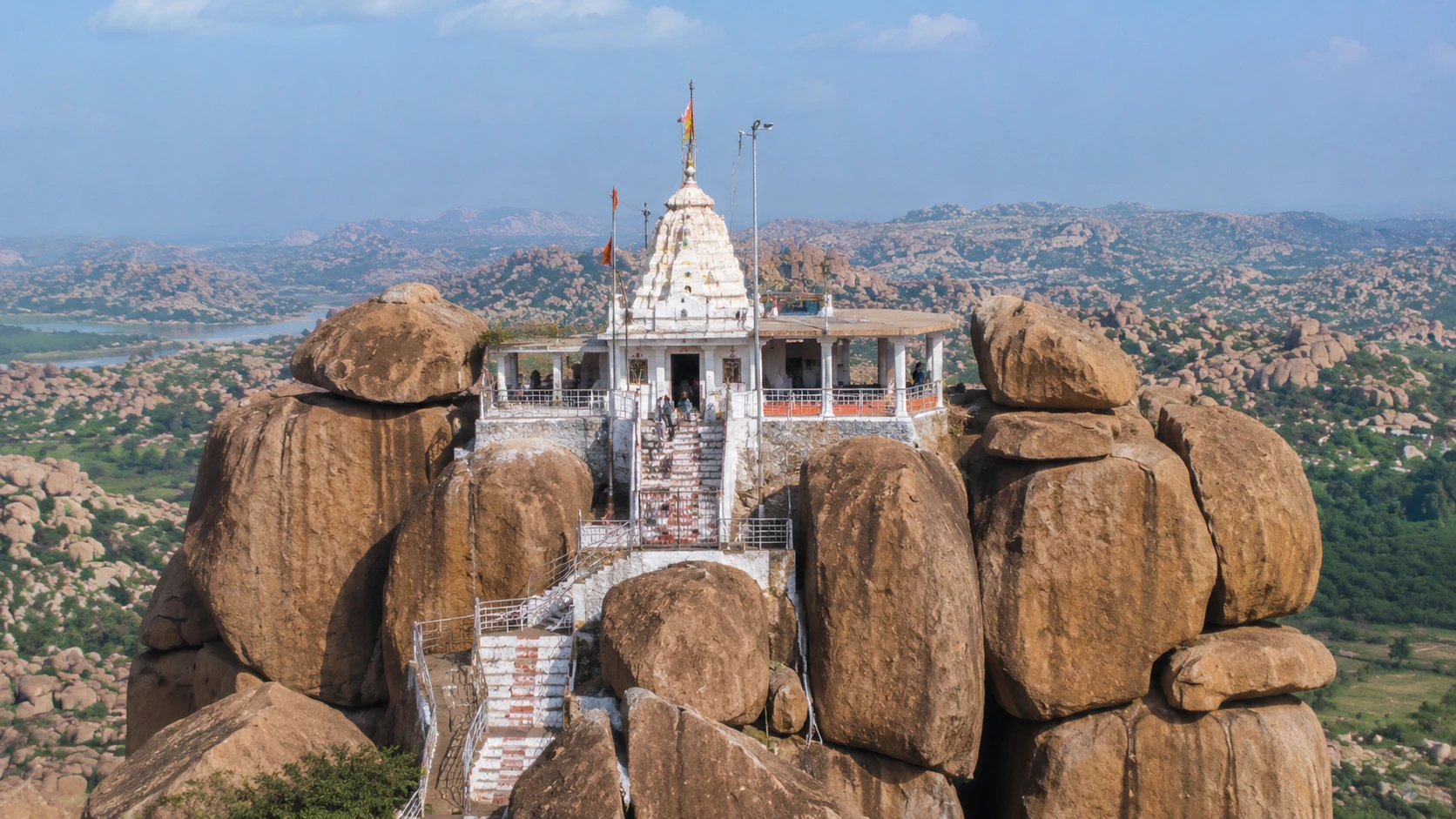
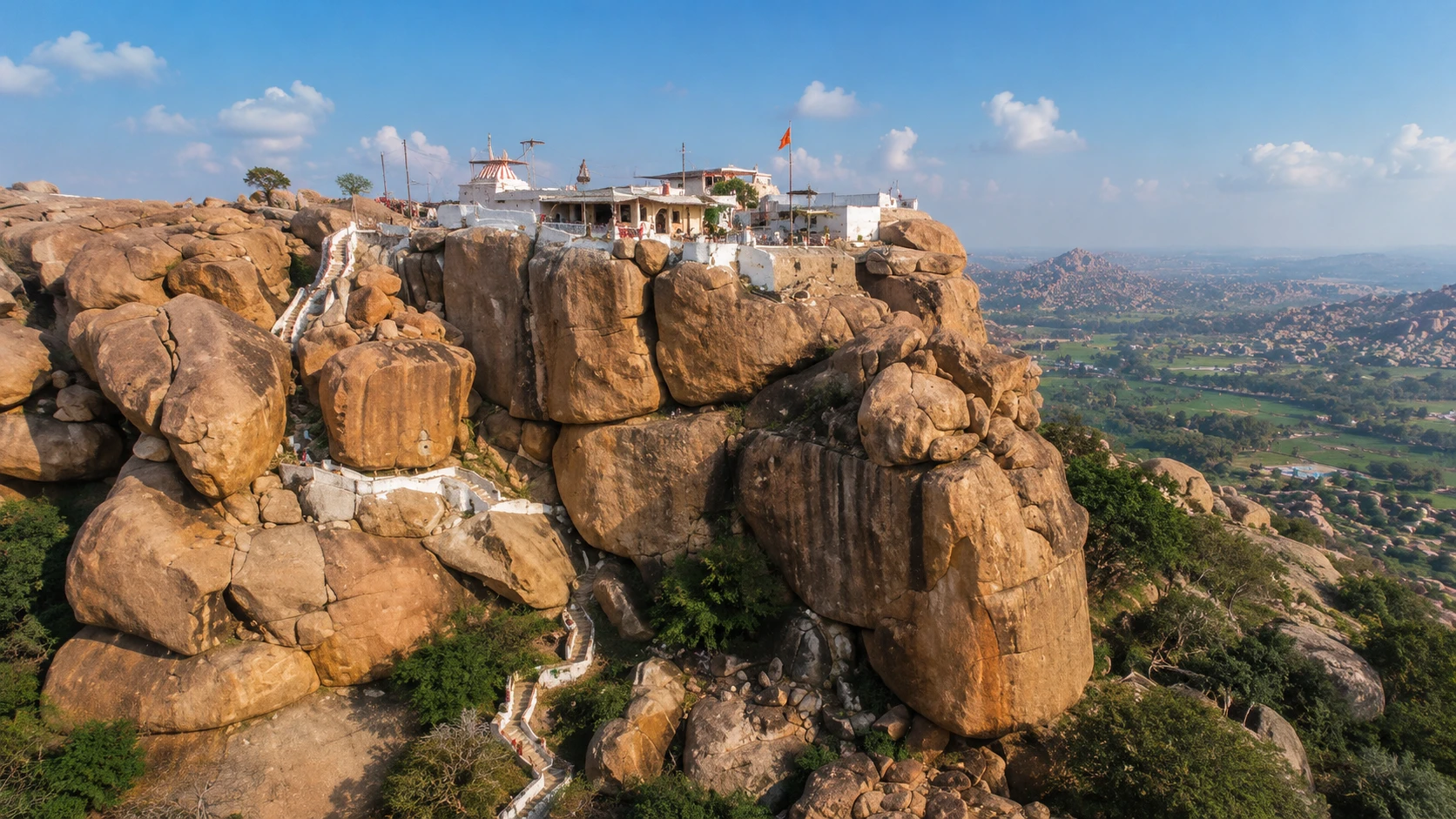
Modest hill-top shrine — small granite-and-painted-plaster sanctum atop the rock, characteristic of Karnataka hill-temple construction rather than monumental Vijayanagara temple architecture
Open
06:00 – 18:00
Aarti
06:30 · 12:00 · 17:30
Special
Hanuman Jayanti (Margashirsha Shukla Trayodashi in the Karnataka Madhva tradition, December–January) is the principal annual congregation; Sri Rama Navami brings additional pilgrim flow given the temple's identity as the birthplace of Rama's greatest devotee
The Sacred Legend · पवित्र कथा
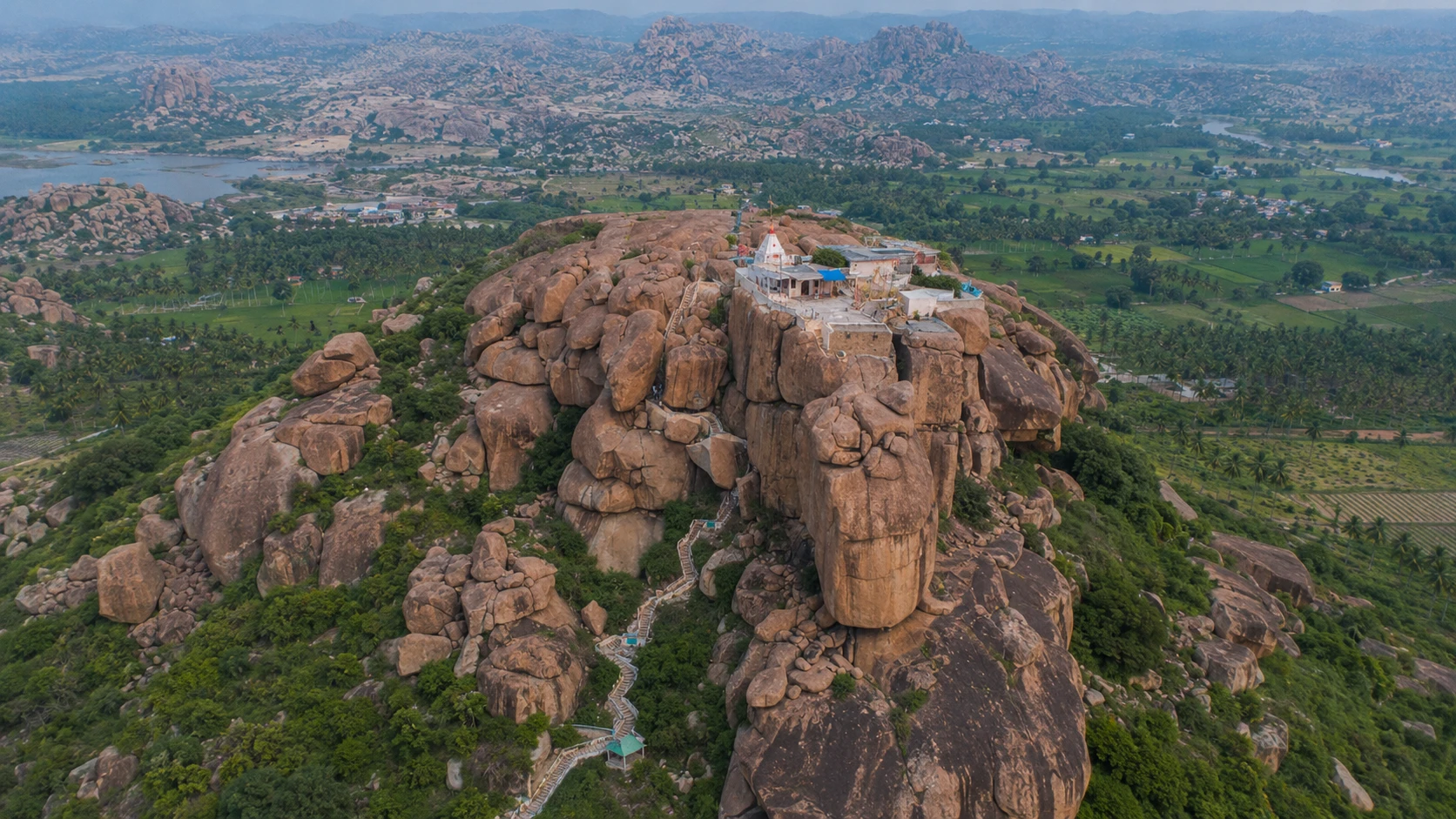
Across the Tungabhadra river from the great ruined city of Hampi, atop a granite hill rising sharply from the boulder-strewn landscape of Anegundi, stands the temple that calls itself Hanuman's birthplace. Anjaneyadri — the hill of Anjana, named for Hanuman's mother — is the site at which the Vaishnava tradition of southern India has, for as long as the tradition has had a sacred geography, located the moment when Anjana's tapas was rewarded and the son of Vayu came into the world. The temple atop the hill is dedicated to the Pancha Mukha form, the five-faced Hanuman in whom the protective and martial powers of the deity are concentrated; the form watches over the place of its own birth, and over the broader Kishkindha — the vanara kingdom of the Ramayana, traditionally identified with this entire Hampi-Anegundi landscape, where Hanuman first met Rama and where the alliance that would defeat Ravana was forged. Pilgrims who climb the five hundred and seventy-five steps to the hilltop shrine arrive at a small temple with a long memory: the place where, by the tradition's measure, Hanuman first opened his eyes.
Sacred Origin Storyपवित्र उत्पत्ति कथा
Source: Anjana-tapas birth narrative — preserved across Brahmanda Purana, regional Anjeyanadri sthala-puranas, and Valmiki Ramayana's Bala and Kishkindha Kanda references to Anjana and Hanuman's origin; Pancha Mukha form layered on this birthplace identity via the Adbhuta Ramayana / Krittivasi Ramayana Mahiravana episode
The story of Anjaneyadri begins with a woman performing tapas on a hill. Anjana — variously described across traditions as an apsara cursed to be born as a vanara, the wife of the vanara chieftain Kesari, and a daughter of the divine Punjikasthala — had performed prolonged austerities to be granted a son. She propitiated Vayu, the wind-god, who was moved by her devotion. In the most widely-told version of what happens next, the prasada-payasam being carried by Vayu from King Dasharatha's putrakameshti yajna at Ayodhya — the sacred sweet rice that the king and his queens were consuming to be granted heirs — was diverted by the wind-god to Anjana's hands as she sat in meditation on this hill. Anjana consumed the prasada, and from her, by the dual paternity of Vayu and the divine substance from Dasharatha's yajna, Hanuman was born. The hill became his Janma Bhumi — his birthplace — and was named after his mother. Anjana, the broader tradition holds, lived out her later years on the same hill in the proximity of her son's birth.
Why then is the temple atop Anjaneyadri dedicated specifically to the Pancha Mukha form of Hanuman rather than to a more youthful or birth-associated iconography? The answer lies in the layering of two narratives. The Pancha Mukha form — five faces in a single body, with Hanuman himself eastward, Narasimha southward, Garuda westward, Varaha northward, and Hayagriva upward — is the form Hanuman took during the Ramayana war to rescue Rama and Lakshmana from the underworld where the sorcerer Mahiravana had taken them, extinguishing five lamps in a single breath to break the spell that protected Mahiravana's life. The Pancha Mukha form is the form in which Hanuman's protective and martial powers are at their fullest. At his own birthplace, the protective form of the deity is the form most appropriate to install: not the infant or the youthful warrior, but the mature and total Hanuman, with all the powers he would acquire across his life condensed into a single five-faced body, watching over the hill from which he came.
The broader landscape around Anjaneyadri carries its own Ramayana association. The Hampi-Anegundi region is traditionally identified as Kishkindha, the vanara kingdom of the Ramayana's fourth book — Sugriva ruled here, Vali was killed here, Rama and Lakshmana first met Hanuman here on Matanga hill, and the alliance that would defeat Ravana was struck here. The hill of Hanuman's birth, in this geography, sits within the kingdom that his life would help define. A pilgrim climbing Anjaneyadri is therefore visiting not just a Hanuman temple but the geographic foundation-stone of the Kishkindha-Ramayana entire — the place where the story that connects all of these landscapes had its origin point.
Sources cited:
- Valmiki Ramayana, Bala Kanda (Sarga 17 — Anjana and Hanuman's origin) and Kishkindha Kanda (Sargas 65–67 — Hanuman's recollection of his childhood at Anjana's hill)
- Brahmanda Purana — variant accounts of Anjana's tapas and Hanuman's birth
- Adbhuta Ramayana — Pancha Mukha Anjaneya episode (Mahiravana / Patala-rescue narrative)
- Krittivasi Ramayana (Bengali, c. 15th century) — Mahiravana episode elaboration
- Pancha Mukha Anjaneya Kavacham (Sanskrit devotional stotra)
- Local Anjeyanadri / Anegundi sthala-purana traditions — preserved across regional Madhva-Vaishnava devotional literature
Historyइतिहास
The Hampi-Anegundi sacred geography has been continuously active as a Hindu landscape since at least the early-medieval period, with the Kishkindha identification — Hampi as the Ramayana's vanara kingdom — embedded in regional tradition well before the Vijayanagara empire established its capital here in 1336 CE. The rise of Vijayanagara under the Sangama dynasty and its successors made Hampi one of the largest and wealthiest cities in the medieval world, and the city's patronage of Hindu religious institutions across the region extended to the Hanuman shrines in the surrounding landscape — though the major Vijayanagara-period institutional consolidation of Hampi-area Hanuman worship is associated more directly with the Yantrodharaka Anjaneya temple at the foot of Matanga hill, consecrated by the Madhva acharya Sri Vyasaraja (c. 1460–1539 CE) as part of his programme of installing 732 Hanuman idols across the region. Anjaneyadri, as Hanuman's birthplace site rather than a Vyasaraja consecration site, sits in the broader Madhva-Vaishnava devotional ecology of the period without being a specifically Madhva-administered temple.
The fall of Vijayanagara at the Battle of Talikota in 1565 CE devastated the city itself but did not extinguish the temple traditions of the surrounding landscape. The Anjaneyadri shrine, modest in physical scale and located across the Tungabhadra from the destroyed urban centre, continued in worship through the post-Vijayanagara period. The broader Hampi ruins were designated a UNESCO World Heritage Site in 1986, placing the Vijayanagara archaeological monuments under heritage-conservation protection — but the Anjaneyadri Hanuman temple is a living shrine rather than a monument, distinct from the conserved-ruin zone, and continues in active daily worship today. The 575-step climb to the hilltop, the small painted shrine at the summit, the open view of the boulder-strewn Hampi landscape spreading out below: this is the temple as pilgrims have encountered it for centuries, accreted lightly across time rather than rebuilt monumentally in any single period.
What You'll Seeदर्शन में
The Pancha Mukha Anjaneya murti at the Anjaneyadri summit follows the canonical five-face configuration shared across the Pancha Mukhi Hanuman temple network: a single body with five heads arranged with Hanuman himself eastward at the centre, Narasimha southward, Garuda westward, Varaha northward, and Hayagriva upward. The murti carries the standard Hanuman vermilion application — sindoor-red, with details picked out in lighter and darker tones — and is depicted with multiple arms bearing weapons (gada, sword, ankusha, pasha) and devotional attributes (the palm-leaf bearing Rama's name, a kalasha). The shrine itself is a small painted-and-plastered structure at the granite summit, with the surrounding rock formations forming an integral part of the visual experience: pilgrims arriving at the top of the 575-step climb encounter not only the five-faced murti but the broad open panorama of the Tungabhadra valley and the Hampi ruins spreading out below, an iconographic framing in which the temple's significance is amplified by its geographic position rather than by architectural elaboration. Devotees offer vada-mala (the fried-lentil garland that is the Hanuman signature offering), sindoor and oil for the murti, and tulsi and betel leaves as supplementary offerings during the standard puja sequence.
Did You Know?क्या आप जानते हैं?
Anjaneyadri is traditionally identified as Hanuman's birthplace — the hill on which his mother Anjana performed the tapas that brought him into the world. The hill takes its name from her: Anjana-adri, Anjana's hill, hence Anjaneya, son of Anjana, the standard south Indian name for Hanuman. The temple atop the hill is dedicated to the Pancha Mukha (five-faced) form, in which Hanuman's protective and martial powers are at their fullest — installed, by the tradition's logic, in the form most appropriate to watch over the place of the deity's own origin.
Valmiki Ramayana, Bala Kanda Sarga 17 and Kishkindha Kanda Sargas 65–67; Brahmanda Purana; local Anjeyanadri sthala-purana traditions
The hilltop shrine is reached by a climb of approximately 575 stone steps cut into the granite face of Anjaneyadri. Most pilgrims complete the ascent in 25–40 minutes depending on pace and fitness. The climb is treated as part of the darshan rather than as an obstacle to it — pilgrims often pause at landings on the way up to recite the Hanuman Chalisa or the Pancha Mukha Anjaneya Kavacham, treating the ascent itself as a meditative preparation for arriving at Hanuman's birthplace. From the summit, the view extends across the Tungabhadra river to the entire Hampi ruins complex and the surrounding boulder-strewn Kishkindha landscape.
Living-tradition observation; widely-attested in Hampi pilgrimage and tourism literature
The Hampi-Anegundi landscape, including Anjaneyadri, is traditionally identified as Kishkindha — the vanara kingdom of the Ramayana's fourth book, where Sugriva ruled, Vali was killed, and Rama and Lakshmana first met Hanuman on Matanga hill. The identification places the entire surrounding geography within a single Ramayana-anchored sacred network: Anjaneyadri (Hanuman's birthplace), Matanga hill (first meeting with Rama), Rishyamuka hill (Sugriva's refuge from Vali), and Pampa-sarovar (where Rama searched for Sita) are all within walking or short-driving distance of each other, making the Hampi area one of the most densely-attested Ramayana geographies in India.
Valmiki Ramayana, Kishkindha Kanda; regional Karnataka sthala-purana traditions; Diana Eck, 'India: A Sacred Geography' (2012) on Hampi as Kishkindha
Festivalsत्योहार
Hanuman Jayanti (Margashirsha Trayodashi, Karnataka Madhva tradition)
हनुमान जयन्ती (मार्गशीर्ष त्रयोदशी, कर्नाटक माध्व परम्परा)
December–January (Margashirsha Shukla Trayodashi in the Karnataka Madhva-Vaishnava reckoning; in other regional traditions Hanuman Jayanti falls in Chaitra Purnima or Vaishakha, which differs from the local Karnataka observance)
Hanuman Jayanti is the principal annual festival at Anjaneyadri, and the Karnataka observance — Margashirsha Shukla Trayodashi in the Madhva-Vaishnava calendar — is the date most heavily marked at the temple, particularly given the temple's identity as Hanuman's birthplace site. The festival sees significantly enhanced pilgrim flow, special abhishekam and archana sequences, vada-mala arpana in larger quantities, and night-vigil recitations of the Hanuman Chalisa, Sundara Kanda, and Pancha Mukha Anjaneya Kavacham. The convergence — the birthplace celebrating the birth date — gives the day a layered devotional resonance that broader-region Hanuman temples cannot quite match.
Sri Rama Navami
श्री राम नवमी
March–April (Chaitra Shukla Navami)
Rama Navami — the birthday of Sri Rama — is observed at Anjaneyadri with particular devotional weight because the temple is the birthplace of Hanuman, Rama's greatest devotee. The day is treated as a celebration of the bond between Rama and Hanuman rather than a Rama-only observance: the recitation of the Sundara Kanda (the section of the Ramayana most directly featuring Hanuman's exploits in service of Rama) is the festival's central liturgical element. Pilgrim flow during Sri Rama Navami is significant though typically lower than during the Karnataka Hanuman Jayanti.
Traditional Offeringsपारंपरिक अर्पण
Primary Offerings
Vada-mala (garland of fried lentil rounds)
वड-माला
वट-माला
The vada-mala — a garland strung from fried rounds of urad dal flour — is the signature offering at Hanuman temples across south India and is the standard offering at Anjaneyadri. The savoury fried preparation is read in traditional devotion as Hanuman's preferred naivedya, a food of strength appropriate to the deity of physical and spiritual valour. Vada-mala garlands of varying sizes are available from vendors at the base of the climb and at the small market area near the temple; offered garlands are returned to devotees as prasad after the puja sequence.
Sindoor and oil (sindur-tail)
सिन्दूर एवं तेल
सिन्दूर, तैल
Hanuman is traditionally adorned with sindoor — vermilion paste — applied to his entire body, recalling the episode in which the young Hanuman, observing Sita applying sindoor and being told it was for Rama's long life, smeared his entire body with sindoor so that his own devotion to Rama would be magnified manifold. Oil mixed with sindoor is applied to the Anjaneyadri murti as part of the standard puja, with devotees offering both substances; the practice is particularly observed on Saturdays, traditionally Hanuman's day, and during the Karnataka Hanuman Jayanti window.
Tulsi (sacred basil) and betel leaves
तुलसी एवं पान-पत्र
तुलसी, ताम्बूल
Tulsi is the sacred plant of the broader Vaishnava tradition, and as Hanuman is the supreme devotee of Rama-Vishnu, tulsi leaves are offered to him as an extension of Vishnu-worship — a connection particularly strong at Anjaneyadri given its location within the Madhva-Vaishnava devotional ecology of the Hampi region. Betel leaves are offered as a respect-offering in the manner of welcoming a royal or honoured guest. Together with the vada-mala and the sindoor-oil, these constitute the standard Anjaneyadri offering set.
Offerings may be brought from outside or purchased from vendors at the base of the climb and at the small market area near the hilltop shrine. Vada-mala garlands are typically procured from on-site or nearby vendors rather than prepared at home, given the specific preparation required. For sponsored archana or special pujas, devotees should approach the on-site priests directly on arrival; there is no online seva-booking infrastructure as of this entry's verification date.
How to Reachकैसे पहुँचें
Anjaneyadri is in the village of Anegundi on the north bank of the Tungabhadra river, opposite the main Hampi ruins. The standard approach is via Hosapete (also called Hospet), which is the regional rail and road hub for Hampi-area visits.
By air: Hubli Airport (HBX) at approximately 165 km is the nearest regional airport, with limited direct connections to Bengaluru, Mumbai, and select metros. Bengaluru International Airport (BLR) at approximately 350 km is the more frequently-served gateway for international and metro-origin visitors, with onward overnight train, bus, or road transfer to Hampi.
By rail: Hosapete Junction (HPT) is the principal regional rail hub, approximately 27 km from Anjaneyadri via the Hampi route, with direct trains from Bengaluru, Hyderabad, Mumbai, and other major cities. From Hosapete, auto-rickshaws, taxis, and KSRTC bus services connect to Hampi village, from where Anjeyanadri is reached either by road via Anegundi (approximately 14 km by the bridge route) or by the more atmospheric coracle crossing of the Tungabhadra river followed by a short road or walking leg to the foot of the hill.
By road: KSRTC and private operators run frequent bus services from Bengaluru, Hubli, and other Karnataka cities to Hosapete. From Hosapete to Anegundi the standard approach is via the Tungabhadra dam road and the bridge crossing; the alternative coracle crossing is shorter in distance but available only during daylight hours and weather-dependent. Pilgrims who undertake the coracle crossing should ensure they return before sunset; the river current and the local operator coordination both require daylight.
From the foot of Anjeyanadri, the 575-step climb to the hilltop shrine takes 25–40 minutes for most pilgrims. The climb should be undertaken in daylight; the shrine generally closes at sunset and the descent in the dark is not advisable on the granite steps.
Plan Your Visitयात्रा की योजना
🌤 Best Season
October through March is the recommended season — cooler weather suited to the 575-step climb and the broader Hampi-area exploration. The summer months (April–June) can reach 40°C and above in the boulder-strewn Hampi landscape, making the granite-step climb genuinely uncomfortable and potentially unsafe in midday hours; pilgrims travelling in summer should restrict the climb to early morning (before 09:00) or late afternoon (after 16:30). The monsoon (June–September) brings rainfall that can make the granite steps slippery; coracle crossing of the Tungabhadra is not advisable during monsoon high-water conditions.
👘 Dress Code
Traditional Indian attire is preferred — saris, salwar-kameez, dhoti, or kurta-pyjama. Modest dress covering shoulders and knees is the practical standard. For the 575-step climb, comfortable walking footwear is essential; sandals are removed before entering the hilltop shrine and kept at the entrance. Pilgrims often wear traditional attire over comfortable climbing clothes, removing the outer layer before the final shrine entry.
📱 Phones & Photography
Photography is generally permitted in the outer shrine area and from the summit viewpoint, where the Hampi panorama is one of the most photographed views in Karnataka. Sanctum photography is at the priest's discretion and should be confirmed before taking images of the murti. Hampi as a UNESCO World Heritage Site has its own photography guidelines for the broader archaeological zone; visitors photographing in the surrounding ruins should follow Archaeological Survey of India and Karnataka State Tourism guidance for the monument areas.
🏨 Accommodation
Hosapete (Hospet) is the principal accommodation base for Hampi-area visits, offering a comprehensive range from budget hotels through mid-tier and luxury options. Hampi village (south bank of the Tungabhadra) has smaller heritage-oriented guesthouses and homestays often preferred by visitors who want to be close to the archaeological zone. The Anegundi side of the river, closer to Anjaneyadri, has fewer formal accommodation options but offers a quieter and more village-character experience. Karnataka State Tourism Development Corporation (KSTDC) operates hotels in Hosapete and at the Tungabhadra dam complex.
Sacred Soundsपवित्र ध्वनि
Did You Know? · क्या आप जानते हैं?
The same translation error that turned '33 Koti' into '33 crore' in Hinduism also happened in Buddhism. The Chinese translation of Buddhist texts rendered 'Sapta Koti Buddha' (7 Supreme Buddhas) as '7 Crore Buddhas.' The Tibetan translation got it right: 7 types, not 7 crore. One Sanskrit word, misread across two major world religions, generated two identical misconceptions independently.
Related Contentसंबंधित सामग्री
Related Scriptures
Related Temples
Tirumala Pancha Mukhi Hanuman
तिरुमला पंच मुखी हनुमान
Tirumala, Andhra Pradesh
Pancha Mukhi Hanuman (Kumbakonam)
पंच मुखी हनुमान कुम्भकोणम्
Kumbakonam, Tamil Nadu
Mantralayam Pancha Mukhi Anjaneya
मंत्रालयम पंच मुखी आंजनेय
Mantralayam, Andhra Pradesh
Pancha Mukha Anjaneya Swamy (Tiruvallur)
पंच मुख आंजनेय स्वामी
Tiruvallur, Tamil Nadu
Yantrodharaka Anjaneya (Hampi)
यंत्रोद्धारक आंजनेय
Hampi, Karnataka
Namakkal Anjaneyar
नमक्कल आंजनेयर
Namakkal, Tamil Nadu
Community Reflections
🕉️
Be the first to share your reflection.