Pancha Mukha Anjaneya Swamy (Tiruvallur)
पंच मुख आंजनेय स्वामी
The five-faced Anjaneyar in the Divya Desam town at Chennai's doorstep
Tiruvallur, Tamil Nadu, India
Pañcamukha Āñjaneya Svāmi, TiruvallūrAlso known as: Pancha Mukha Anjaneya Swamy Tiruvallur, Panchamuga Anjaneyar Kovil Thiruvallur, Tiruvallur Pancha Mukhi Hanuman, Five-faced Anjaneyar Thiruvallur
Era
The temple's specific founding date is not independently documented in available sources; Tiruvallur's broader sacred geography is anchored by the Veeraraghava Perumal temple, which is of Pallava-Chola antiquity as a Divya Desam. The Pancha Mukha Anjaneya Swamy temple sits within this long-attested Vaishnava ecology.
Architecture
South Indian Dravidian — urban town-temple structure typical of the northern Tamil Nadu temple-construction tradition
Open
06:00 – 20:00
Aarti
06:30 · 12:00 · 18:30
Special
Saturday worship is the busiest window, consistent with the south Indian Pancha Mukha Anjaneya tradition of Shani-dosha nivaran; the temple's Chennai-suburban location means that Saturday morning darshan draws commuter-devotees from across the metropolitan area
The Sacred Legend · पवित्र कथा
Tiruvallur is a Divya Desam town — one of the hundred and eight sacred Vaishnava sites sung by the Alvars — and its identity is anchored by the ancient Veeraraghava Perumal temple at its centre. Within this deeply Vaishnava sacred geography, the Pancha Mukha Anjaneya Swamy temple holds a natural place: Hanuman is the supreme devotee of Rama, who is himself an avatar of Vishnu, and a Pancha Mukha Anjaneya shrine in a town consecrated to Vishnu's service is the tradition completing its own circle. What distinguishes this temple from the other Pancha Mukha sites of the south Indian cluster is not antiquity or mythological singularity but proximity: Tiruvallur sits approximately forty kilometres northwest of Chennai, India's fourth-largest city, connected to it by suburban rail and frequent bus services. The Pancha Mukha Anjaneya Swamy temple is therefore the five-faced Hanuman most accessible to the Chennai metropolitan devotional ecology — the temple to which office-workers, students, and families from the city can come on a Saturday morning, offer vada-mala and sindoor, recite the Kavacham, and return by afternoon. In a cluster of Pancha Mukha temples that includes hilltop shrines, heritage-zone temples, and saint's-samadhi complexes, the Tiruvallur temple represents the form in which the five-faced Hanuman enters the everyday rhythm of urban devotional life.
Sacred Origin Storyपवित्र उत्पत्ति कथा
Source: Pancha Mukha Anjaneya tradition — Adbhuta Ramayana / Krittivasi Ramayana Mahiravana episode; contextualised within the broader Tiruvallur Divya Desam Vaishnava sacred geography
The Pancha Mukha form of Hanuman — five faces in a single body, Hanuman himself eastward at the centre, Narasimha southward, Garuda westward, Varaha northward, Hayagriva upward — originates in the Mahiravana episode of the Adbhuta Ramayana. During the war with Ravana, the sorcerer Mahiravana abducted Rama and Lakshmana to Patala, the underworld, where his life was protected by a spell requiring the simultaneous extinguishing of five lamps in five directions. Hanuman descended into Patala, assumed the Pancha Mukha form — gathering five great Vaishnava aspects into a single body — and extinguished the five lamps in a single breath, killing Mahiravana and rescuing Rama and Lakshmana. The form entered the Hanuman iconographic canon as the configuration in which his protective powers are at their most concentrated.
At Tiruvallur, the Pancha Mukha form sits within a specifically Vaishnava sacred geography. The town's principal identity is as a Divya Desam — one of the hundred and eight temples sung by the twelve Alvars, the Tamil Vaishnava poet-saints whose devotional hymns (the Nalayira Divya Prabandham) constitute one of the foundational devotional corpora of Sri Vaishnavism. The Veeraraghava Perumal temple at the centre of Tiruvallur is the Divya Desam site itself, dedicated to Vishnu in his Veeraraghava form. The presence of a Pancha Mukha Anjaneya shrine in this town follows the Sri Vaishnava devotional logic that Hanuman — as the supreme devotee of Rama, who is an avatar of Vishnu — is the natural gatekeeper and protector of any landscape consecrated to Vishnu's worship. The five faces of the Pancha Mukha form, each representing a distinct Vaishnava aspect (Hanuman the devotee, Narasimha the protector, Garuda the divine vehicle, Varaha the earth-rescuer, Hayagriva the knowledge-restorer), are, in this reading, a condensation of the Vaishnava theological universe into a single guardian figure.
What the Tiruvallur Pancha Mukha Anjaneya temple adds to this shared theological framework is accessibility. In a cluster of Pancha Mukha temples that spans hilltop shrines (Anjaneyadri), major pilgrimage complexes (Tirumala, Mantralayam), and temple-city circuits (Kumbakonam), Tiruvallur is the temple closest to a major metropolitan centre. Connected to Chennai by suburban rail and frequent road transport, the temple serves the weekly and fortnightly devotional rhythms of an urban population in a way that the more remote or pilgrimage-specific sites in the cluster do not. The Saturday-morning commuter-devotee who arrives from Chennai for Shani-dosha nivaran worship is as much a part of this temple's identity as the theological traditions it inherits.
Sources cited:
- Adbhuta Ramayana — Pancha Mukha Anjaneya episode (Mahiravana / Patala-rescue narrative)
- Krittivasi Ramayana (Bengali, c. 15th century) — Mahiravana episode elaboration
- Pancha Mukha Anjaneya Kavacham (Sanskrit devotional stotra)
- Nalayira Divya Prabandham — the broader Divya Desam framework within which Tiruvallur's sacred geography is constituted
- Tiruvallur sthala-purana traditions — broader Veeraraghava Perumal Divya Desam sacred geography
What You'll Seeदर्शन में
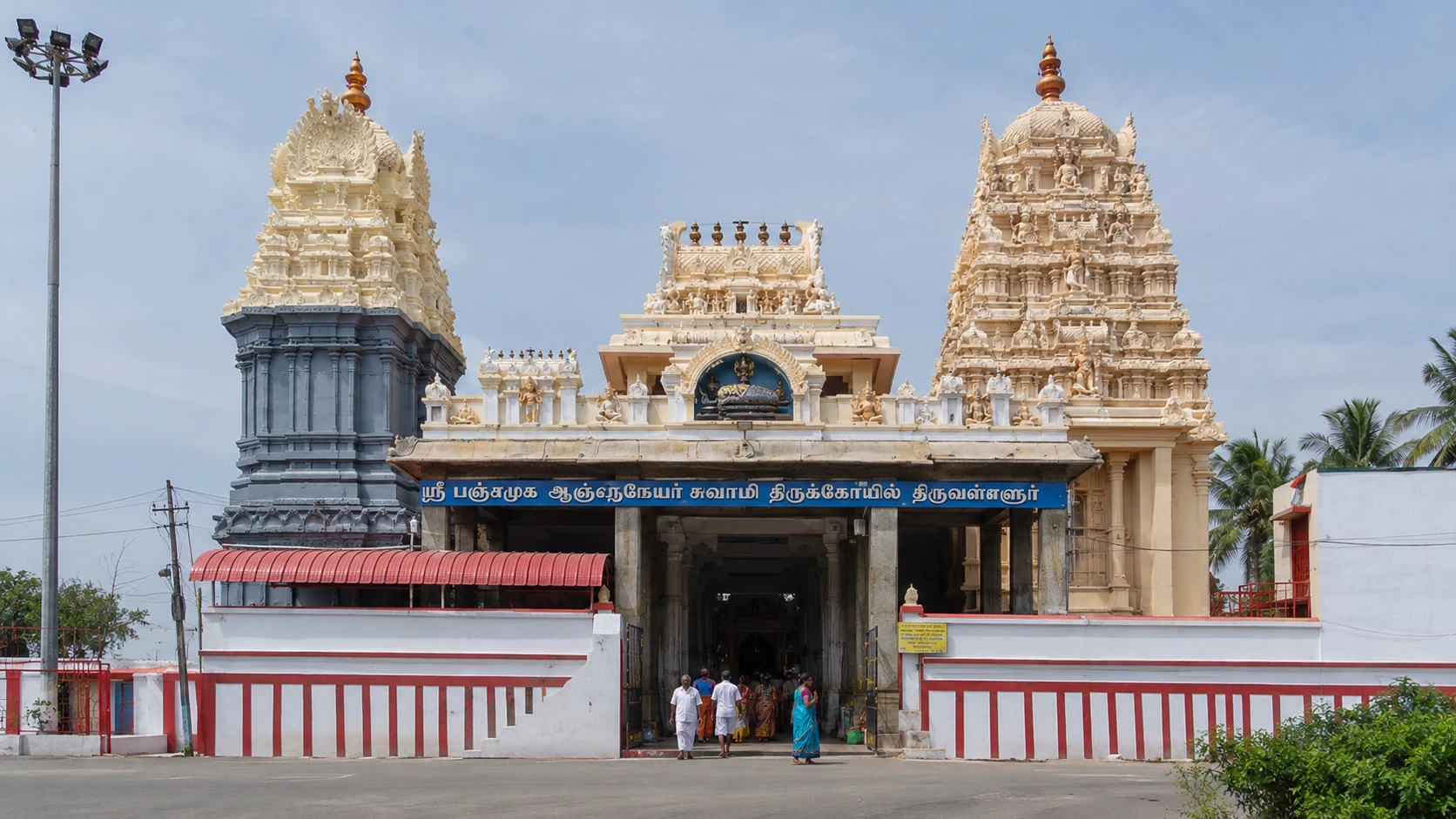
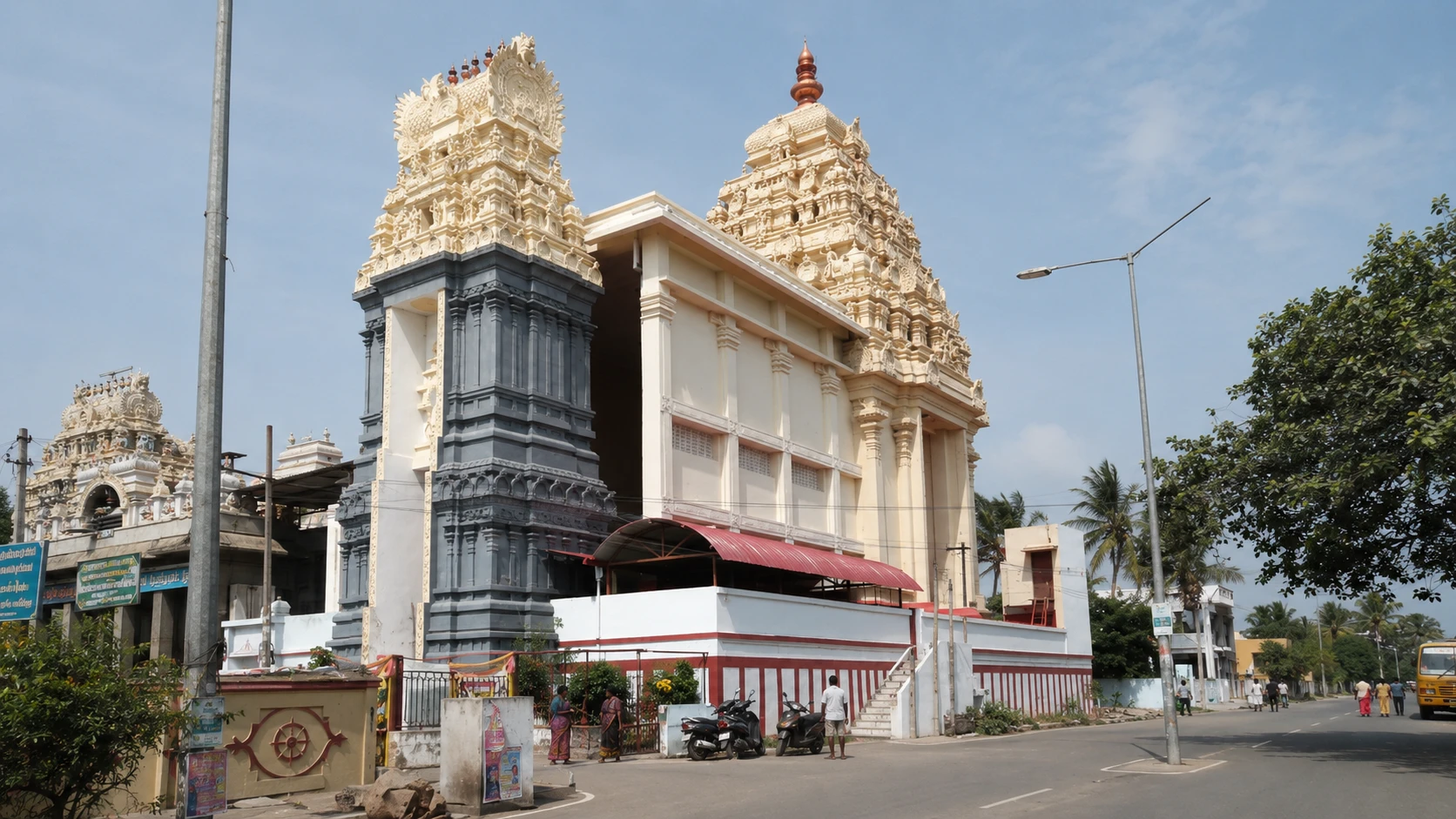
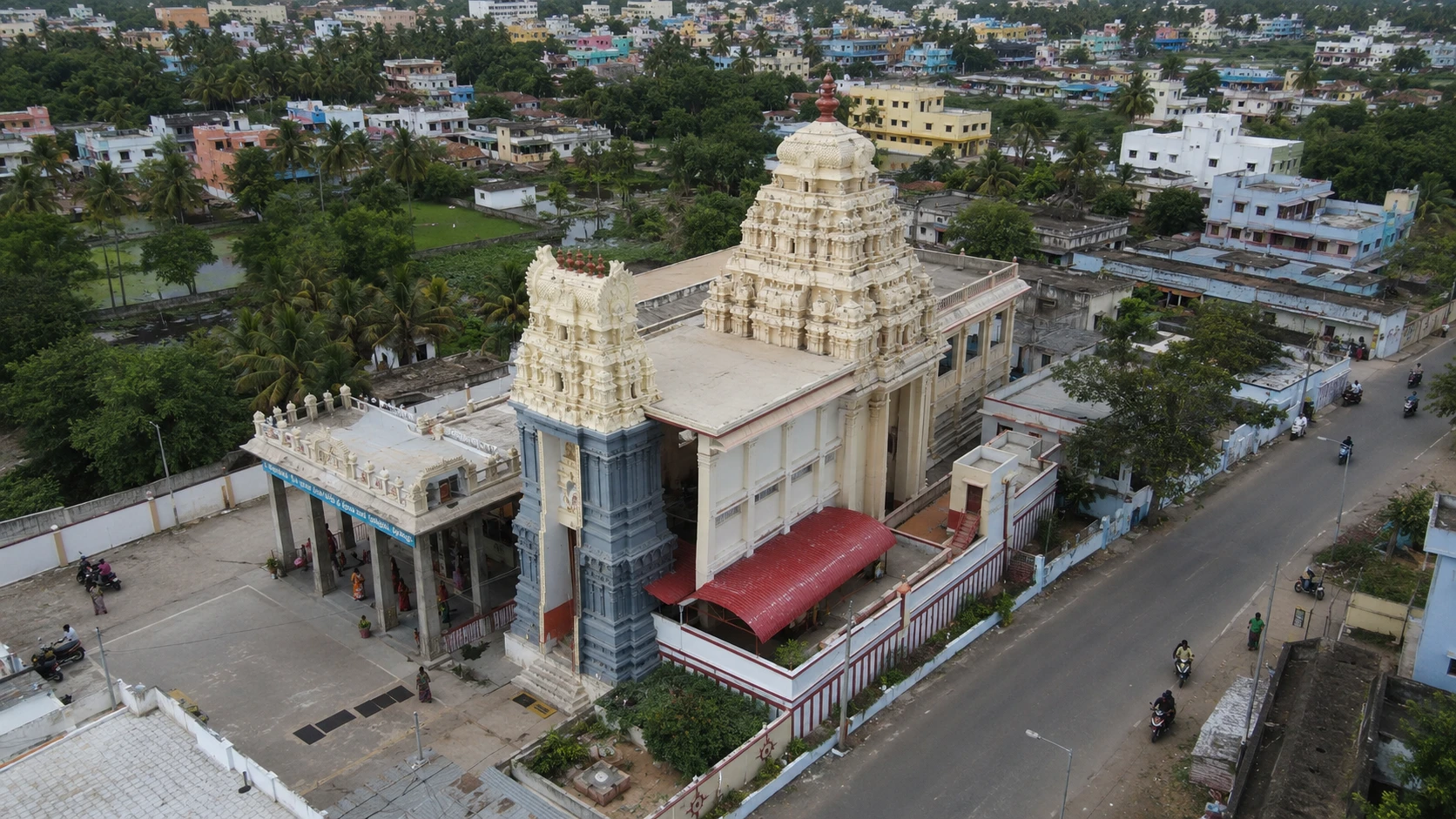
The Pancha Mukha Anjaneya Swamy murti at Tiruvallur follows the canonical five-face configuration shared across the south Indian Pancha Mukha temple network: Hanuman eastward at the centre, Narasimha southward, Garuda westward, Varaha northward, Hayagriva upward. The murti carries the standard Hanuman sindoor-red vermilion, with multiple arms bearing weapons and devotional attributes. The shrine is an urban town-temple structure — accessible, well-maintained, located within the broader temple-town geography of Tiruvallur rather than atop a hill or within a remote pilgrimage complex. The visual character of the temple reflects its function as a neighbourhood-and-metropolitan devotional hub: the offerings are fresh and frequently replenished, the sindoor-oil layer on the murti is thick from accumulated Saturday worship, and the atmosphere during Saturday morning puja hours is one of concentrated but unhurried devotion. Devotees offer vada-mala, sindoor-oil, tulsi, and betel leaves in the standard Pancha Mukha puja sequence.
Did You Know?क्या आप जानते हैं?
The Tiruvallur Pancha Mukha Anjaneya Swamy temple is the most metropolitan-accessible Pancha Mukha Anjaneya in the south Indian cluster — approximately 42 km from Chennai city centre and connected by suburban rail on the Chennai Beach–Tiruvallur line. For the Chennai metropolitan area's devotional ecology, the temple functions as a weekly-rhythm Shani-dosha nivaran shrine rather than an annual-pilgrimage destination, with Saturday-morning commuter-devotees from across the city forming a significant portion of the regular pilgrim base.
Chennai Suburban Railway timetable — Tiruvallur connectivity; living-tradition observation
Tiruvallur is a Divya Desam town — one of the hundred and eight sacred Vaishnava sites sung by the twelve Alvars in the Nalayira Divya Prabandham. The town's principal temple is the Veeraraghava Perumal temple (dedicated to Vishnu in his Veeraraghava form), and the Pancha Mukha Anjaneya Swamy temple sits within this Sri Vaishnava sacred geography as the protector-deity of a landscape consecrated to Vishnu's worship — following the devotional logic that Hanuman, as Rama's supreme devotee, is the natural guardian of any Vishnu-sacred site.
Nalayira Divya Prabandham (Alvar hymns); Tiruvallur sthala-purana traditions
The Pancha Mukha form gathers five great Vaishnava aspects into a single body — Hanuman the devotee (east), Narasimha the protector of devotees (south), Garuda the bearer of Vishnu (west), Varaha the rescuer of the earth (north), and Hayagriva the restorer of knowledge (upward). The Tiruvallur temple completes the five-temple south Indian Pancha Mukha cluster alongside Tirumala (Andhra Pradesh), Anjaneyadri at Hampi (Karnataka), Kumbakonam (Tamil Nadu), and Mantralayam (Andhra Pradesh) — each with a distinct site-specific tradition atop the shared five-face iconography.
Pan-south-Indian Pancha Mukha Anjaneya devotional network
Festivalsत्योहार
Hanuman Jayanti
हनुमान जयन्ती
Observed in alignment with the Tamil Vaishnava calendar (the specific date varies by local temple tradition between Margazhi / December–January and Thai / January–February; confirm with on-site priests for the specific date observed at this temple)
Hanuman Jayanti is the principal annual festival of the temple. The observance follows the south Indian Tamil reckoning rather than the north Indian Chaitra Purnima convention. Special abhishekam, archana, vada-mala arpana in enhanced quantities, and group recitation of the Pancha Mukha Anjaneya Kavacham and Hanuman Chalisa mark the festival day. Given the temple's Chennai-suburban accessibility, the Jayanti draws not only local Tiruvallur devotees but metropolitan visitors who travel specifically for the annual festival.
Veeraraghava Perumal Brahmotsavam (town-wide Vaishnava festival)
वीरराघव पेरुमाळ ब्रह्मोत्सवम् (नगर-व्यापी वैष्णव उत्सव)
Typically Panguni (March–April) or as determined by the Veeraraghava Perumal temple calendar
The annual Brahmotsavam of the Veeraraghava Perumal temple — Tiruvallur's principal Divya Desam — is the town's largest religious event, with processions of the utsava-murti through the streets and intensive worship across the broader temple-town geography. The Pancha Mukha Anjaneya Swamy temple participates in the festival fabric as part of the broader Vaishnava devotional landscape, with enhanced darshan and intensified pilgrim traffic during the Brahmotsavam window. For visitors combining Divya Desam darshan with the Pancha Mukha Anjaneya, the Brahmotsavam period offers both in their most concentrated form.
Traditional Offeringsपारंपरिक अर्पण
Primary Offerings
Vada-mala (garland of fried lentil rounds)
वड-माला
वट-माला
The vada-mala is the standard Hanuman offering, here offered within the Tiruvallur town-temple setting. Garlands are readily available from vendors near the temple. Saturday-morning offerings are the temple's busiest offering window, driven by the commuter-devotee pattern from Chennai.
Sindoor and oil (sindur-tail)
सिन्दूर एवं तेल
सिन्दूर, तैल
Sindoor-oil is applied to the Pancha Mukha murti during standard puja, recalling Hanuman's vermilion-smearing episode. The practice is observed with particular devotional intensity on Saturdays.
Tulsi (sacred basil) and betel leaves
तुलसी एवं पान-पत्र
तुलसी, ताम्बूल
Tulsi and betel leaves complete the standard Pancha Mukha Anjaneya offering set, linking Hanuman worship to the broader Vaishnava tradition — a connection particularly fitting at Tiruvallur given the town's Divya Desam Vaishnava identity.
Offerings are available from vendors near the temple. For Saturday-morning Shani-dosha worship, arriving early (before 08:00) is recommended to avoid the busiest-hour queues. The temple does not operate an online seva-booking infrastructure; all arrangements are made on-site.
How to Reachकैसे पहुँचें
Tiruvallur is approximately 42 km northwest of Chennai city centre and is one of the most accessible temple towns in Tamil Nadu for visitors based in the Chennai metropolitan area.
By suburban rail: Tiruvallur Railway Station (TVR) is on the Chennai Suburban Railway network — the Chennai Beach–Tiruvallur line provides direct suburban train service with frequent departures throughout the day. The journey from Chennai Beach or Chennai Central takes approximately 60–90 minutes depending on the service. This is the most practical and economical approach for Chennai-based visitors.
By mainline rail: Tiruvallur is also on the Chennai–Arakkonam broad-gauge mainline, with express and passenger train services connecting to destinations across Tamil Nadu and beyond.
By road: TNSTC and private bus services operate frequent services from Chennai (Koyambedu CMBT and other bus stands) to Tiruvallur. The NH-205 (Chennai–Tiruvallur–Arakkonam highway) is the principal road corridor. Driving time from central Chennai is approximately 75–90 minutes depending on traffic.
By air: Chennai International Airport (MAA) at approximately 55 km is the air gateway, with domestic and international connections. Pre-booked taxi or arranged transport from the airport to Tiruvallur takes approximately 90 minutes.
Within Tiruvallur, the temple is within the town's compact temple-area and is reachable on foot or by auto-rickshaw from the railway station.
Plan Your Visitयात्रा की योजना
🌤 Best Season
Year-round accessibility from Chennai makes any season practical for a visit. October through March is the most comfortable weather window. Summer (April–June) can reach 40°C; visitors may prefer early-morning Saturday darshan to avoid midday heat. The northeast monsoon (October–December) brings rain but does not close the temple. For the Veeraraghava Perumal Brahmotsavam period (typically Panguni, March–April), the town is at its busiest.
👘 Dress Code
Traditional Indian attire is preferred — saris, salwar-kameez, dhoti, or kurta-pyjama. Modest dress covering shoulders and knees is the practical standard. Footwear is removed before entering the temple.
📱 Phones & Photography
Photography in the outer temple area is generally permitted. Sanctum photography of the murti is at the priest's discretion.
🏨 Accommodation
Tiruvallur has a modest range of lodges and guesthouses serving temple-town pilgrims. However, given the town's proximity to Chennai, most visitors — particularly those coming for a Saturday darshan — visit as a day-trip from Chennai rather than staying overnight. Chennai offers the full range of metropolitan accommodation options.
Sacred Soundsपवित्र ध्वनि
Did You Know? · क्या आप जानते हैं?
The same translation error that turned '33 Koti' into '33 crore' in Hinduism also happened in Buddhism. The Chinese translation of Buddhist texts rendered 'Sapta Koti Buddha' (7 Supreme Buddhas) as '7 Crore Buddhas.' The Tibetan translation got it right: 7 types, not 7 crore. One Sanskrit word, misread across two major world religions, generated two identical misconceptions independently.
Related Contentसंबंधित सामग्री
Related Scriptures
Related Temples
Tirumala Pancha Mukhi Hanuman
तिरुमला पंच मुखी हनुमान
Tirumala, Andhra Pradesh
Anjaneyadri (Hampi)
अंजनेयाद्रि हम्पी
Hampi, Karnataka
Pancha Mukhi Hanuman (Kumbakonam)
पंच मुखी हनुमान कुम्भकोणम्
Kumbakonam, Tamil Nadu
Mantralayam Pancha Mukhi Anjaneya
मंत्रालयम पंच मुखी आंजनेय
Mantralayam, Andhra Pradesh
Namakkal Anjaneyar
नमक्कल आंजनेयर
Namakkal, Tamil Nadu
Yantrodharaka Anjaneya (Hampi)
यंत्रोद्धारक आंजनेय
Hampi, Karnataka
Community Reflections
🕉️
Be the first to share your reflection.