Tirumala Pancha Mukhi Hanuman
तिरुमला पंच मुखी हनुमान
The five-faced protector of the pilgrim approach to the seven hills
Tirumala, Andhra Pradesh, India
Pañcamukha Āñjaneya SvāmiAlso known as: Tirumala Pancha Mukha Anjaneya, Pancha Mukhi Anjaneya Swamy (Tirumala), Alipiri Pancha Mukhi Hanuman, Pancha Mukha Hanuman (Tirumala foothills)
Era
Site associated with the Tirumala pilgrim approach since at least the medieval consolidation of the Tirumala devotional complex (c. 12th–13th century onwards); the present shrine structure reflects later expansion within the broader TTD-administered pilgrimage geography
Architecture
South Indian Dravidian — modest hill-foothills shrine within the broader Tirumala temple-architectural tradition
Special
Pilgrim-approach darshan integrated into the standard Tirumala ascent route, particularly observed by devotees beginning the traditional walking ascent (Alipiri Mettu) up the seven hills
The Sacred Legend · पवित्र कथा
Before pilgrims begin the ascent to the seven hills of Tirumala — the most-visited Hindu pilgrimage site on earth, where the dark stone form of Sri Venkateswara stands in his hilltop garbhagriha — they pause at the foothill, at Alipiri, where the five-faced Hanuman stands guard. This is the Tirumala Pancha Mukhi Hanuman, who took five forms in a single body to rescue Rama and Lakshmana from the underworld in the Adbhuta Ramayana's telling, and who is venerated here as the protector of the pilgrim approach to Venkateswara. The shrine is small by the standards of the temples it serves as gatekeeper to, but its theological position is exact: between the city below and the deity above, the Pancha Mukha Anjaneya stands at the threshold — five faces watching all four directions and the sky overhead, because the journey to the god of the hills must pass through the protection of the god of all directions at once.
Sacred Origin Storyपवित्र उत्पत्ति कथा
Source: Pancha Mukha Anjaneya tradition — Adbhuta Ramayana and Krittivasi Ramayana (Bengali, c. 15th century) recensions of the Mahiravana / Ahiravana episode; Pancha Mukha Anjaneya Kavacham (popular devotional stotra)
The Pancha Mukha form of Hanuman emerges from a single episode of the Ramayana not found in Valmiki's canonical telling, but preserved in the Adbhuta Ramayana and elaborated in the late-medieval Krittivasi Ramayana of Bengal. During the war with Ravana, the sorcerer-king Mahiravana — variously described as Ravana's brother, son, or vassal across recensions — abducted Rama and Lakshmana through subterranean magic and carried them to Patala, the underworld. To free them, Hanuman descended into Patala. He found Mahiravana protected by a spell that required the simultaneous extinguishing of five lamps placed in five directions; only by snuffing all five at once could Mahiravana be killed. Hanuman assumed his Pancha Mukha form — five faces in a single body, each facing a different direction — and extinguished the five lamps in a single breath. Mahiravana fell, Rama and Lakshmana were rescued, and the Pancha Mukha form entered Hanuman's iconographic repertoire as the form in which his protective and martial powers are concentrated in their fullest expression.
The five faces of Pancha Mukha Anjaneya are canonically identified as: Hanuman himself (eastward, the central face), Narasimha (southward), Garuda (westward), Varaha (northward), and Hayagriva (upward, skyward). The five together represent the five great Vaishnava forms gathered into a single body — Hanuman the devotee, Narasimha the protector of devotees, Garuda the bearer of Vishnu, Varaha the rescuer of the earth, and Hayagriva the restorer of knowledge — making Pancha Mukha Anjaneya, in the tradition's reading, the most theologically condensed of all Hanuman forms.
At Tirumala, this form takes on a site-specific protective function. The shrine at the Alipiri foothills stands at the threshold between the city of Tirupati below and the hilltop temple of Venkateswara above. Pilgrims pause here at the start of the ascent — many traditionally undertake the climb on foot via the Alipiri Mettu (the stepped path) — and offer prayers to the Pancha Mukha Anjaneya as the protector of their pilgrimage. The theological logic is recognised across the broader Tirumala devotional geography: Hanuman is the supreme servant of Rama and, in the Tirumala tradition, of all Vishnu's forms including Venkateswara; that the protector at the foothill should be his Pancha Mukha form — the form in which his protective power is maximal — is the appropriate match for the gravity of the pilgrimage that begins here.
Sources cited:
- Adbhuta Ramayana — Pancha Mukha Anjaneya episode and kavacha
- Krittivasi Ramayana (Bengali, c. 15th century) — Mahiravana / Ahiravana episode
- Pancha Mukha Anjaneya Kavacham (popular devotional stotra in Sanskrit; multiple regional recensions)
- Tirumala Tirupati Devasthanams (TTD) — devotional literature on the Tirumala sub-shrines and the Alipiri pilgrim-approach geography
What You'll Seeदर्शन में
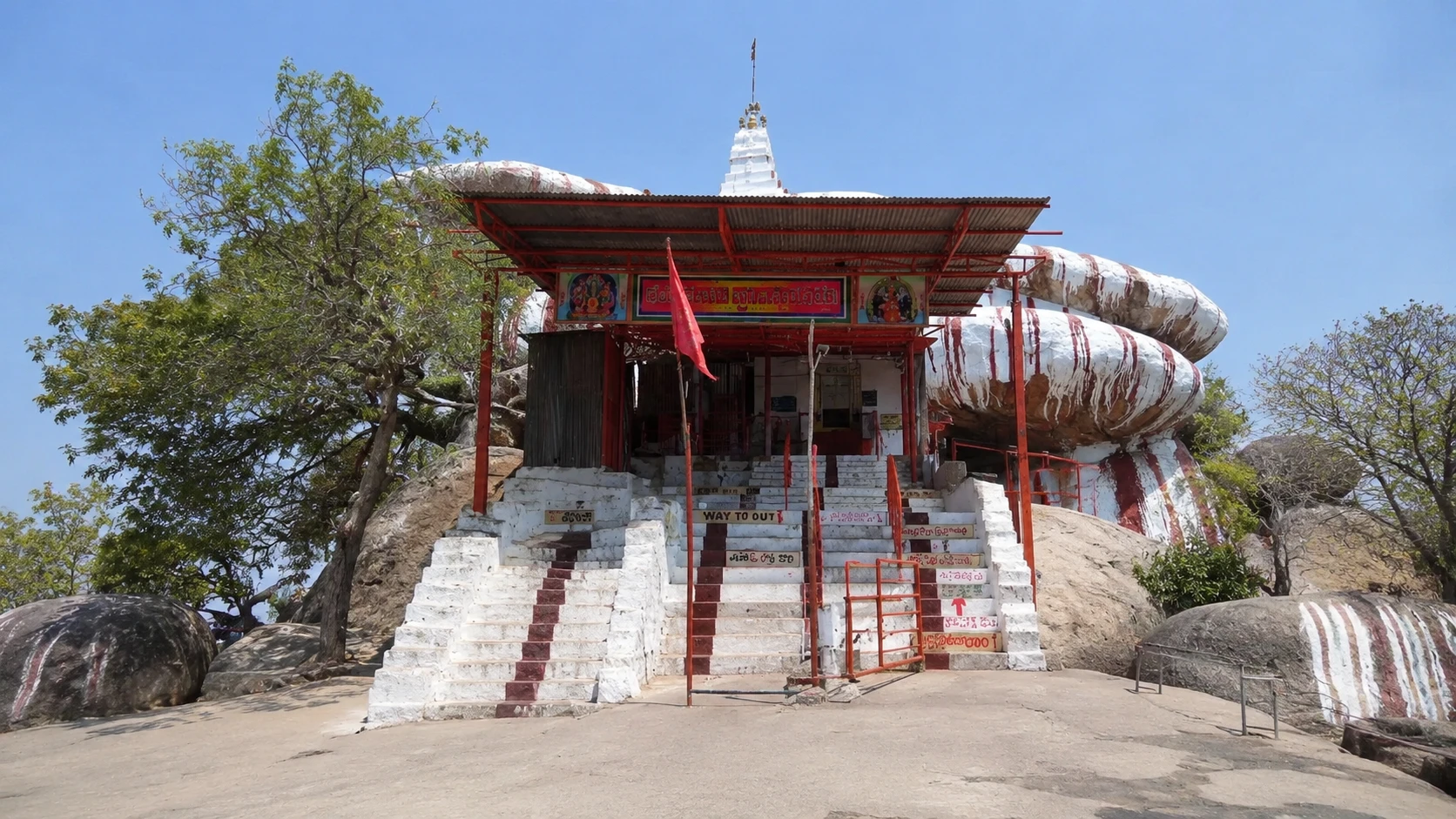
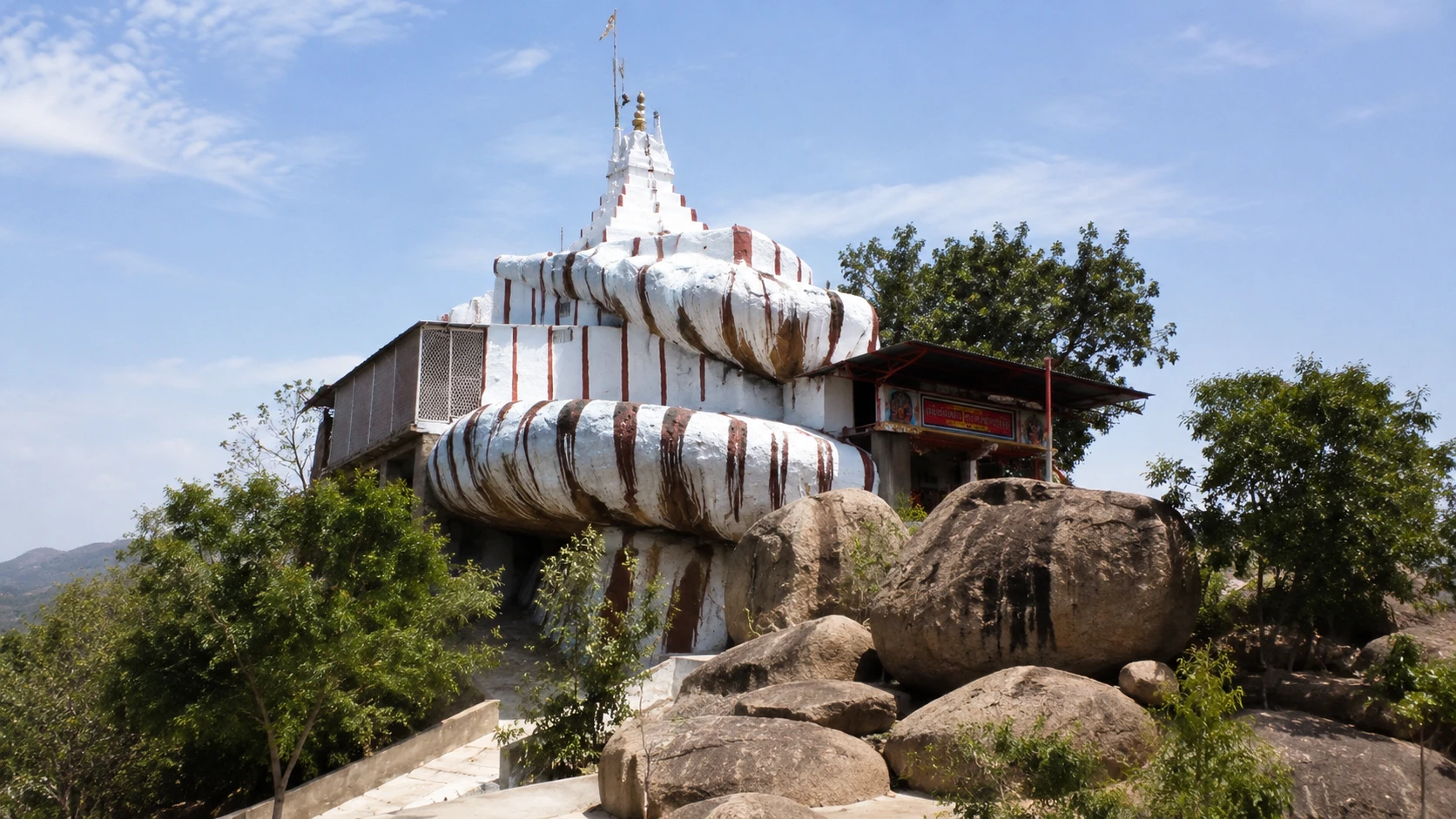
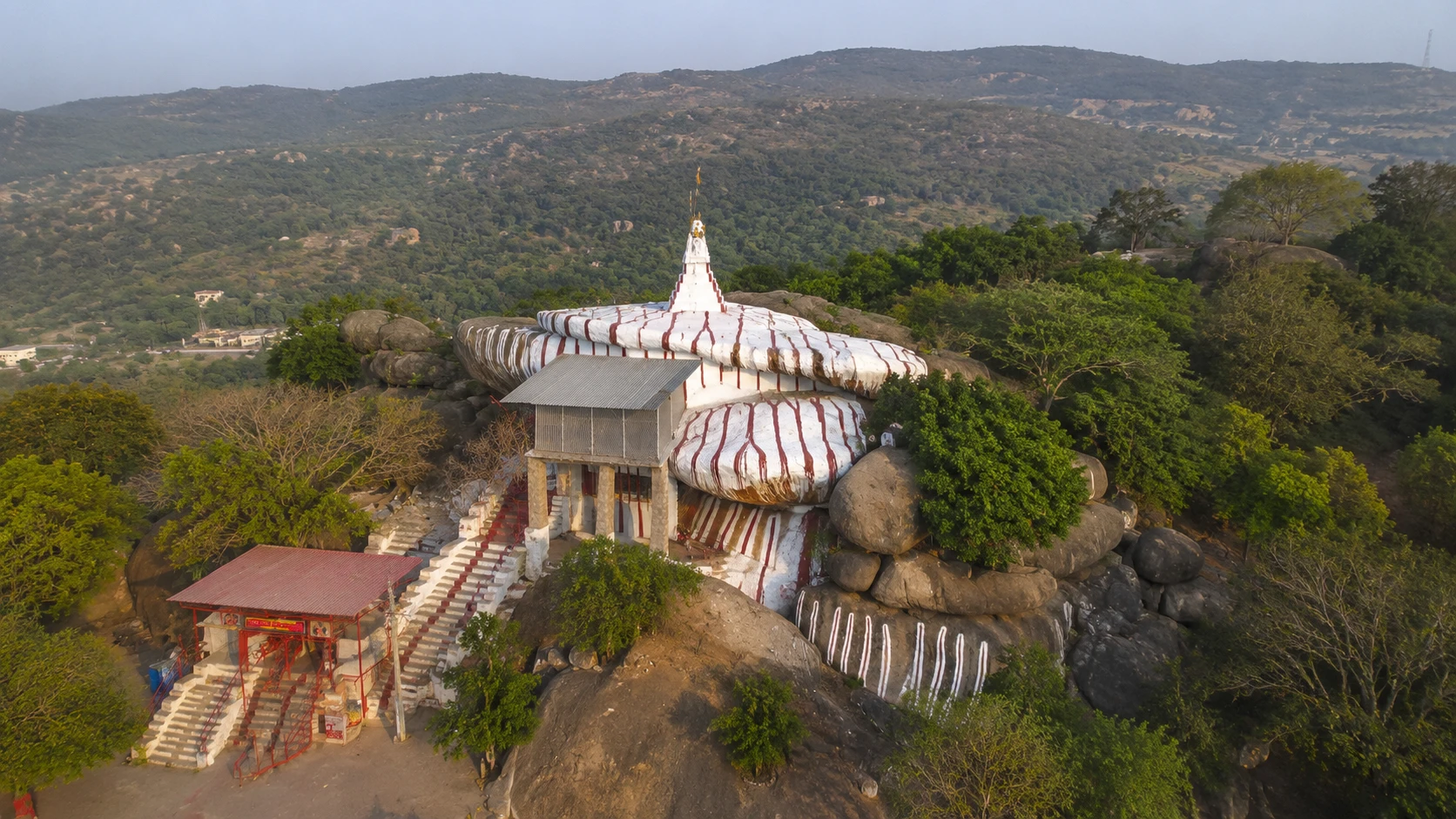
The Tirumala Pancha Mukhi Hanuman shrine displays the canonical Pancha Mukha form: five faces arranged on a single body, with the central east-facing visage as Hanuman himself and the four cardinal-and-vertical faces representing Narasimha (south), Garuda (west), Varaha (north), and Hayagriva (upward). The murti typically holds ten or more arms bearing weapons and devotional attributes — a gada (mace), a sword, the Sri Rama parna (palm-leaf bearing Rama's name), an ankusha (goad), a pasha (noose), and a kalasha (vessel) — with hand-positions and weapon-attributions varying modestly across iconographic schools but the five-faced core consistent. The form is painted in the traditional Hanuman vermilion (sindoor-red) with details picked out in gold and black. Devotees offer betel leaves, sindoor, and vada-mala (the garland of fried lentil-flour rounds that is Hanuman's signature offering) directly to the murti during the standard puja sequence. The shrine's architectural scale is modest by Tirumala-complex standards — this is a foothill protective shrine rather than a destination temple — but its visual identity is unmistakable: the five-faced Hanuman, vermilion-bright, standing watch over the pilgrim path that climbs from his shrine to the hilltop garbhagriha of Sri Venkateswara seven hills above.
Did You Know?क्या आप जानते हैं?
The Tirumala Pancha Mukhi Hanuman shrine stands at the Alipiri foothill — the traditional starting point of the pilgrim ascent to the Tirumala hills. Pilgrims undertaking the foot-climb on the Alipiri Mettu (stepped path) typically pause here at the beginning of the climb to seek the protection of the five-faced Hanuman before beginning the long ascent to Sri Venkateswara's hilltop garbhagriha seven hills above.
Tirumala Tirupati Devasthanams (TTD) — pilgrim-route documentation
The Pancha Mukha form is unique in Hindu iconography for assembling five great Vaishnava aspects into a single body — Hanuman himself (east), Narasimha (south), Garuda (west), Varaha (north), and Hayagriva (upward). The form is not found in Valmiki's Ramayana but emerges in the Adbhuta Ramayana and the late-medieval Krittivasi Ramayana of Bengal in connection with Hanuman's rescue of Rama and Lakshmana from the underworld where Mahiravana had taken them.
Adbhuta Ramayana; Krittivasi Ramayana; Pancha Mukha Anjaneya Kavacham
The Tirumala Pancha Mukhi Hanuman is one of five major Pancha Mukha Anjaneya temples spread across south India, the others being Anjaneyadri (Hampi, Karnataka), Pancha Mukhi Hanuman (Kumbakonam, Tamil Nadu), Mantralayam (Andhra Pradesh — associated with Sri Raghavendra Swami's 17th-century vrindavan), and the Pancha Mukha Anjaneya Swamy temple at Tiruvallur (Tamil Nadu). The cluster is unified by shared iconography — the same five-face configuration — rather than by formal pilgrimage circuit; each temple's site-specific tradition adds its own dimension to the underlying Pancha Mukha form.
Pan-south-Indian Pancha Mukha Anjaneya devotional network — distributed local traditions
Festivalsत्योहार
Hanuman Jayanti
हनुमान जयन्ती
Varies by regional reckoning — observed at Tirumala in alignment with the broader south Indian Vaishnava calendar, principally Vaishakha (April–May) and Margashirsha (December–January) observances
Hanuman Jayanti is the principal annual festival of the temple. Tirumala observes the festival within the broader south Indian Vaishnava reckoning — different from the north Indian Chaitra-Purnima observance — with special abhishekam, archana, and vada-mala arpana sequences. The day attracts pilgrims who specifically wish to begin or complete the Tirumala ascent on Hanuman's manifestation day, treating the foothill darshan as an integral part of the auspicious journey to Venkateswara.
Tirumala Brahmotsavam (associated observances)
तिरुमला ब्रह्मोत्सवम् (सम्बद्ध अनुष्ठान)
September–October (nine-day Brahmotsavam of the broader Tirumala complex)
The annual nine-day Brahmotsavam of Sri Venkateswara is the principal festival of the broader Tirumala devotional complex, drawing several hundred thousand pilgrims to the seven hills over the festival's window. The Pancha Mukhi Hanuman shrine at the Alipiri foothill participates in the festival as part of the broader ritual geography — pilgrims undertaking the ascent during Brahmotsavam often pause at the shrine as part of the heightened devotional sequence, and the temple's worship cycle is intensified through the period in coordination with the broader TTD-administered festival arrangements.
Traditional Offeringsपारंपरिक अर्पण
Primary Offerings
Vada-mala (garland of fried lentil rounds)
वड-माला
वट-माला
The vada-mala — a garland strung from fried rounds of urad dal (black gram) flour — is the signature offering at Hanuman temples across south India. The savoury fried preparation is read in traditional devotion as Hanuman's preferred naivedya, a food of strength and protein appropriate to the deity of physical and spiritual valour. At Pancha Mukha temples the vada-mala is particularly offered, with garlands of varying sizes available from vendors near the shrine; offered garlands are returned to devotees as prasad after the puja sequence.
Sindoor and oil (sindur-tail)
सिन्दूर एवं तेल
सिन्दूर, तैल
Hanuman is traditionally adorned with sindoor — vermilion paste — applied to his entire body, recalling the episode in which the young Hanuman, observing Sita applying sindoor to her hair-parting and being told it was for Rama's long life, smeared his entire body with sindoor so that his own devotion to Rama would be magnified manifold. Oil mixed with sindoor is applied to the murti as part of the standard puja, with devotees offering both substances; the practice is particularly observed on Saturdays, traditionally Hanuman's day.
Tulsi (sacred basil) and betel leaves
तुलसी एवं पान-पत्र
तुलसी, ताम्बूल
Tulsi is the sacred plant of the broader Vaishnava tradition, and as Hanuman is the supreme devotee of Rama-Vishnu, tulsi leaves are offered to him as an extension of Vishnu-worship. Betel leaves are offered as a respect-offering — the same gesture of welcoming used to receive a royal or honoured guest. Together with the vada-mala and the sindoor-oil, these constitute the standard Pancha Mukha Anjaneya offering set.
Offerings may be brought from outside or purchased from vendors near the temple approach. Vada-mala garlands are typically procured from on-site or nearby vendors rather than prepared at home, given the specific preparation required. For sponsored archana or special pujas, devotees should approach the on-site priests directly on arrival; broader TTD seva-booking infrastructure covers the main Tirumala Venkateswara temple primarily and does not typically extend to individual sub-shrine bookings.
How to Reachकैसे पहुँचें
The Tirumala Pancha Mukhi Hanuman shrine is at the Alipiri foothill — the traditional starting point of the Tirumala pilgrim ascent — within easy reach of Tirupati city, which is the principal transport hub for all visits to the Tirumala devotional complex.
By air: Tirupati International Airport (TIR) is approximately 17 km from the Alipiri foothill, with direct connections to Delhi, Mumbai, Bengaluru, Hyderabad, Chennai, and select international destinations. Pre-booked taxi or arranged transport is the standard onward arrangement. Chennai International Airport (MAA) at approximately 135 km is an alternative gateway for visitors arriving on international routes that don't serve Tirupati directly.
By rail: Tirupati Main Railway Station (TPTY) is approximately 14 km from Alipiri and is one of South India's most heavily-served pilgrim rail hubs, with direct trains from Chennai, Bengaluru, Hyderabad, Mumbai, Kolkata, and most major Indian cities. Auto-rickshaws and taxis from the railway station to the Alipiri foothill are widely available.
By road: APSRTC operates frequent bus services from Chennai, Bengaluru, Hyderabad, and Vijayawada to Tirupati; the Alipiri foothill is on the principal Tirupati–Tirumala road. Most pilgrims base themselves in Tirupati city for road accommodation and undertake the Alipiri darshan as part of the Tirumala ascent.
The Alipiri Mettu (the traditional stepped pilgrim path) leads from the foothill area near the Pancha Mukhi Hanuman shrine up to the Tirumala hilltop temple complex; the climb takes most pilgrims 4–8 hours depending on pace and fitness. For pilgrims taking the road route up the hills, the Pancha Mukhi Hanuman shrine is on or near the standard approach. Foothill darshan is generally undertaken at the beginning of the Tirumala visit rather than as a separate excursion.
Plan Your Visitयात्रा की योजना
🌤 Best Season
September through March is the recommended season — cooler weather suited to the Alipiri foothill darshan and the broader Tirumala ascent, with the Brahmotsavam window in September–October being the most heavily-attended period. The summer months (April–June) can reach 40°C and above in the Tirupati area; the monsoon (June–September) brings substantial rainfall but does not close the temple. Pilgrims undertaking the foot-ascent should avoid the hottest hours of summer afternoons.
👘 Dress Code
Traditional Indian attire is preferred — saris, salwar-kameez, dhoti, or kurta-pyjama. Shoulders and knees should be covered. Footwear is removed before entering the shrine and is kept at the entrance under attendant supervision. For pilgrims undertaking the Alipiri Mettu foot-ascent, practical climbing footwear is recommended for the climb itself, with traditional attire worn over.
📱 Phones & Photography
Photography policy at the shrine is at the priest's discretion and generally follows the broader Tirumala devotional complex conventions. The TTD's overall photography policy at Tirumala restricts sanctum photography across the temple network; pilgrims should not assume photography is permitted inside the Pancha Mukhi Hanuman shrine without confirming with the on-site priests. Outer-precinct photography is generally permitted.
🏨 Accommodation
Tirupati city offers a comprehensive range of accommodation from TTD-administered choultries and pilgrim guesthouses through budget hotels to mid-tier and luxury options. The TTD operates extensive pilgrim accommodation in Tirumala itself on the hilltop, with advance booking through the TTD online portal recommended for stays during Brahmotsavam and other festival periods. For most visitors, Tirupati city is the practical accommodation base for both the Pancha Mukhi Hanuman foothill darshan and the broader Tirumala ascent.
Sacred Soundsपवित्र ध्वनि
Did You Know? · क्या आप जानते हैं?
The same translation error that turned '33 Koti' into '33 crore' in Hinduism also happened in Buddhism. The Chinese translation of Buddhist texts rendered 'Sapta Koti Buddha' (7 Supreme Buddhas) as '7 Crore Buddhas.' The Tibetan translation got it right: 7 types, not 7 crore. One Sanskrit word, misread across two major world religions, generated two identical misconceptions independently.
Related Contentसंबंधित सामग्री
Related Scriptures
Related Temples
Anjaneyadri (Hampi)
अंजनेयाद्रि हम्पी
Hampi, Karnataka
Pancha Mukhi Hanuman (Kumbakonam)
पंच मुखी हनुमान कुम्भकोणम्
Kumbakonam, Tamil Nadu
Mantralayam Pancha Mukhi Anjaneya
मंत्रालयम पंच मुखी आंजनेय
Mantralayam, Andhra Pradesh
Pancha Mukha Anjaneya Swamy (Tiruvallur)
पंच मुख आंजनेय स्वामी
Tiruvallur, Tamil Nadu
Namakkal Anjaneyar
नमक्कल आंजनेयर
Namakkal, Tamil Nadu
Yantrodharaka Anjaneya (Hampi)
यंत्रोद्धारक आंजनेय
Hampi, Karnataka
Community Reflections
🕉️
Be the first to share your reflection.