Pancha Mukhi Hanuman (Kumbakonam)
पंच मुखी हनुमान कुम्भकोणम्
The five-faced Hanuman in the temple city of the Kaveri delta — where Saturday is Shani's reckoning and Hanuman's protection
Kumbakonam, Tamil Nadu, India
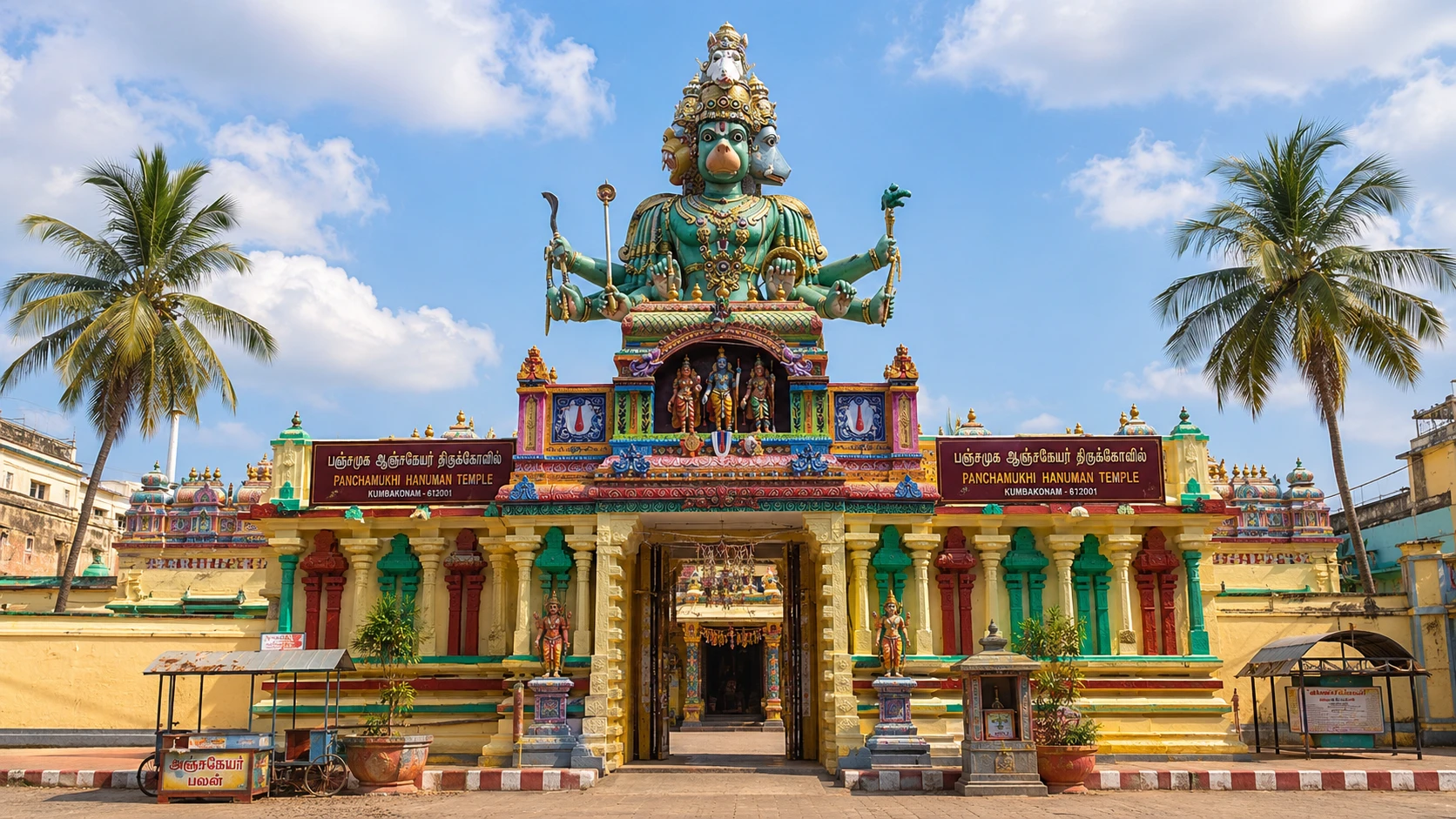
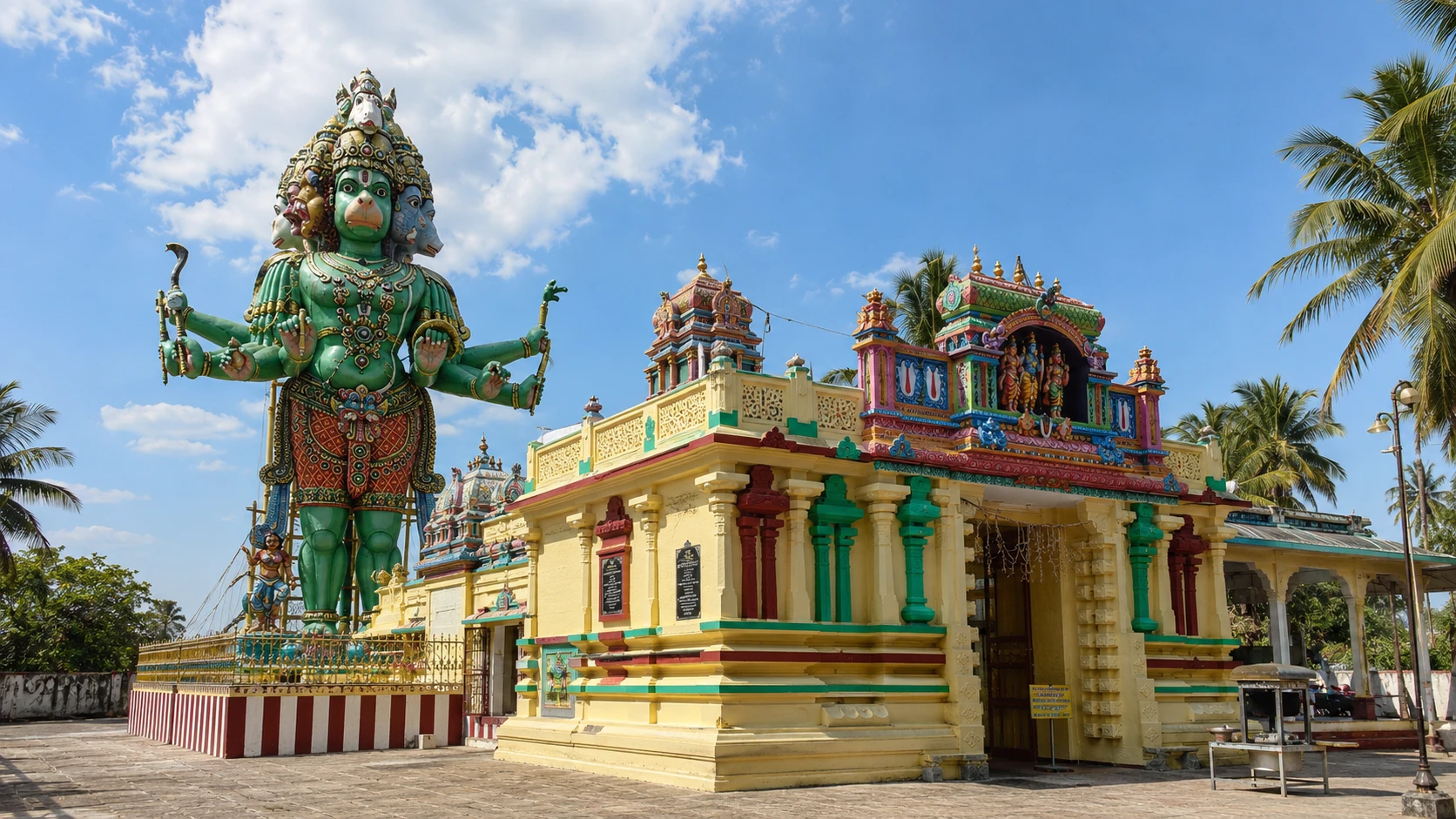
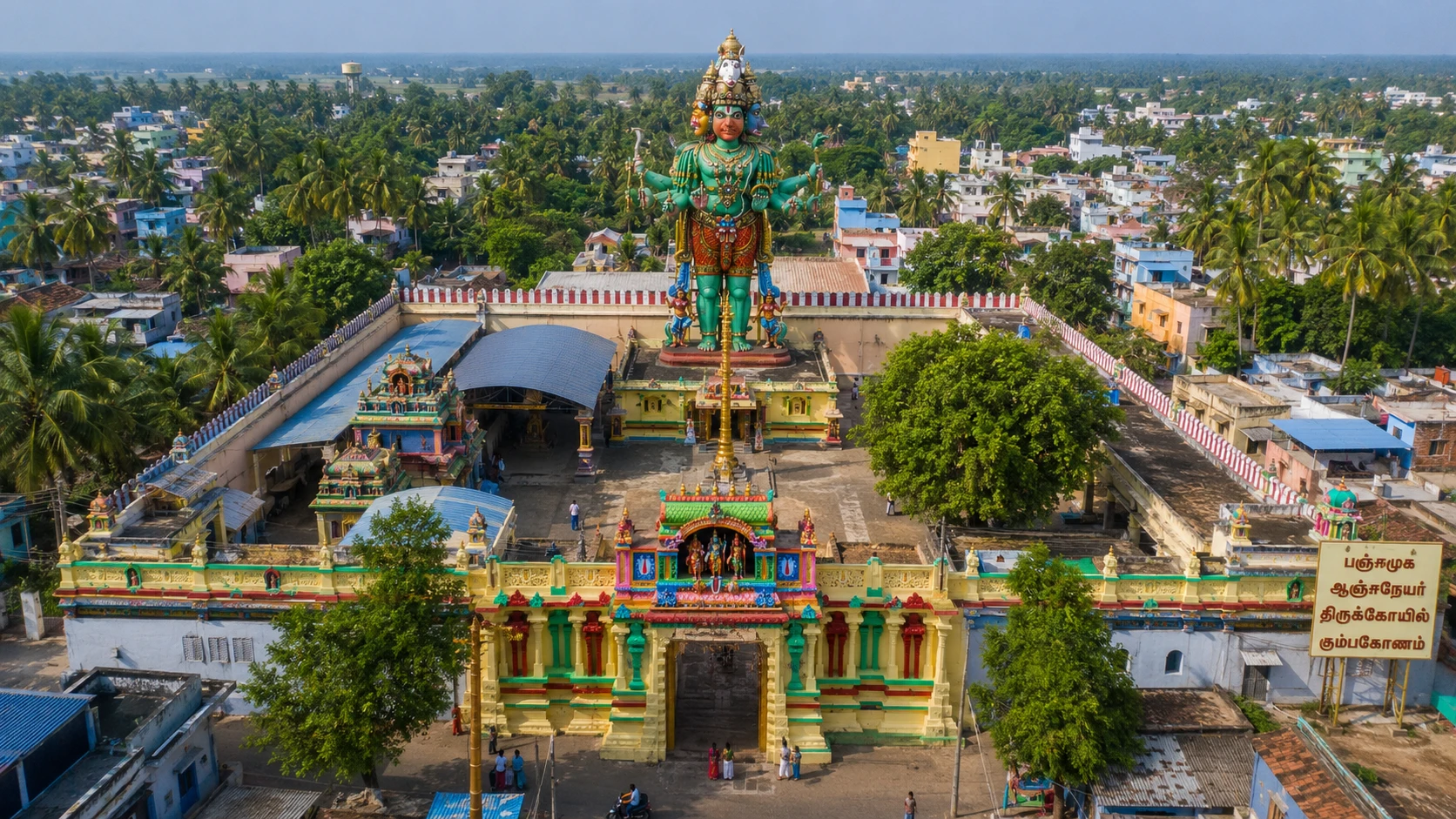
Pañcamukha Āñjaneya, KumbhakoṇamAlso known as: Pancha Mukha Anjaneya Swamy Temple Kumbakonam, Pancha Mukhi Hanuman Kumbakonam, Panchamuga Anjaneyar Kovil Kumbakonam, Five-faced Hanuman Kumbakonam
Era
The temple's specific founding date is not independently documented in available sources; it sits within the broader Kumbakonam sacred-city fabric which spans the Chola period (9th–13th century) through the Vijayanagara and Nayak periods (14th–18th century), with most smaller Kumbakonam temples dating in their current form to the Thanjavur Nayak and Maratha periods
Architecture
South Indian Dravidian — modest urban-temple structure within the dense Kumbakonam temple-street fabric, typical of Kaveri-delta town-temple construction
Open
06:00 – 20:00
Aarti
06:30 · 12:00 · 18:30
Special
Saturday (Shani-vara) worship is the temple's busiest window — devotees seeking Shani-dosha nivaran visit specifically on Saturdays for enhanced Pancha Mukha Anjaneya archana and the Kavacham recitation; the Saturday evening hours are particularly concentrated
The Sacred Legend · पवित्र कथा
Kumbakonam is a city of temples — more than a hundred and eighty of them within a few square kilometres of the Kaveri delta, Shaiva and Vaishnava and Shakta shrines layered atop each other across more than a thousand years of continuous patronage. In this landscape where the sacred and the everyday are indistinguishable, the Pancha Mukhi Hanuman temple holds a particular kind of gravity. It is the temple to which devotees come on Saturdays — the day governed by Shani, Saturn, the planet whose malefic gaze is believed to bring obstacles, delays, and misfortune — because Hanuman in his five-faced form is the one deity across the Vaishnava canon who has mastery over Shani. The Pancha Mukha Anjaneya, five faces watching five directions, is believed to ward off Shani-dosha with a directional completeness that no single-faced form can match. For many of the temple's regular devotees, the defining experience is therefore not a once-a-year pilgrimage but a weekly Saturday observance: arriving before the morning aarti, offering vada-mala and sindoor and oil, reciting the Pancha Mukha Anjaneya Kavacham, and leaving with the conviction that Hanuman's protection is renewed for another week.
Sacred Origin Storyपवित्र उत्पत्ति कथा
Source: Pancha Mukha Anjaneya tradition — Adbhuta Ramayana and Krittivasi Ramayana Mahiravana episode; supplemented at Kumbakonam by the broader pan-south-Indian Hanuman-Shani tradition (Parasara Samhita, Surya Siddhanta-derived astrological theology)
The Pancha Mukha form of Hanuman — five faces in a single body, Hanuman himself eastward at the centre, Narasimha southward, Garuda westward, Varaha northward, Hayagriva upward — originates in the Mahiravana episode of the Adbhuta Ramayana, in which Hanuman descended into Patala to rescue Rama and Lakshmana from the sorcerer-king Mahiravana. To break the spell protecting Mahiravana, Hanuman needed to extinguish five lamps placed in five directions simultaneously; he assumed the Pancha Mukha form — five great Vaishnava aspects gathered into a single body — and extinguished them in a single breath. The form entered Hanuman's iconographic canon as the configuration in which his protective and martial powers are at their most concentrated.
At Kumbakonam, the Pancha Mukha form acquires an additional devotional dimension that is not mythological in the Puranic sense but astrological in the jyotisha tradition. Hanuman is the one deity in the Vaishnava canon who holds mastery over Shani — Saturn, the slowest-moving and most-feared of the navagraha planets, whose transits through a devotee's horoscopic chart are believed to bring delays, obstacles, and suffering. The tradition that Hanuman has authority over Shani is drawn from the Parasara Samhita and from the broader astrological theology of south Indian temple traditions, in which Hanuman's strength, his unbroken celibacy, and his unwavering devotion to Rama are read as constituting an immunity to Shani's malefic influence — and, by extension, the capacity to extend that immunity to his devotees. The Pancha Mukha form is held to be the most efficacious Hanuman form for Shani-dosha protection because the five faces watch all directions simultaneously, leaving no quarter of the devotee's horoscopic space unprotected.
This astrological-devotional layer is what gives the Kumbakonam Pancha Mukha Anjaneya its distinctive character within the broader Pancha Mukhi temple cluster. The temple is not primarily a pilgrimage site in the annual-festival sense; it is a weekly-rhythm temple, with Saturday as its operative day. The devotees who sustain it are local families and regional visitors who return every week, or every fortnight, or every month — not once-a-year pilgrims — and the temple's daily life therefore has a regularity and intimacy characteristic of neighbourhood-devotional Hinduism rather than the event-based pattern of major marquee sites.
Sources cited:
- Adbhuta Ramayana — Pancha Mukha Anjaneya episode (Mahiravana / Patala-rescue narrative)
- Krittivasi Ramayana (Bengali, c. 15th century) — Mahiravana episode elaboration
- Pancha Mukha Anjaneya Kavacham (Sanskrit devotional stotra)
- Parasara Samhita — Hanuman's authority over Shani (astrological-devotional tradition)
- Kumbakonam sthala-purana traditions — broader Kaveri-delta sacred geography
What You'll Seeदर्शन में
The Pancha Mukha Anjaneya murti at Kumbakonam follows the canonical five-face configuration: Hanuman himself eastward at the centre, Narasimha southward, Garuda westward, Varaha northward, Hayagriva upward. The murti is finished in the standard Hanuman vermilion — sindoor-red, periodically refreshed by devotees' sindoor-oil offerings which give the form its characteristically thick, layered, almost sculptural surface texture over time. Multiple arms carry the standard Hanuman weapons and devotional attributes (gada, sword, ankusha, pasha, the Rama-inscribed palm-leaf, kalasha). The shrine is an urban-temple structure within the dense Kumbakonam temple-street fabric — no hilltop climb or dramatic landscape approach as at Anjaneyadri, but the intimate closeness of a neighbourhood temple where devotees can stand within arm's reach of the murti during the standard puja sequence. The sindoor-oil application is particularly thick on Saturdays, when the largest number of devotees arrive for the weekly Shani-dosha nivaran worship; the visual effect of the accumulated sindoor, the garlands of vada-mala hung on and around the murti, and the oil-lamp light of the Saturday evening puja is one of concentrated sensory devotion in a small space.
Did You Know?क्या आप जानते हैं?
The Kumbakonam Pancha Mukha Anjaneya temple's busiest day is Saturday — Shani-vara, the day governed by Saturn. Hanuman is the one deity in the Vaishnava tradition believed to hold mastery over Shani's malefic influence, and the Pancha Mukha (five-faced) form is considered the most efficacious Hanuman form for Shani-dosha protection because its five faces cover all directions simultaneously, leaving no quarter of the devotee's horoscopic space unguarded. Weekly Saturday worship rather than annual pilgrimage is the temple's primary devotional rhythm.
Parasara Samhita (Hanuman-Shani tradition); pan-south-Indian Pancha Mukha Anjaneya devotional practice
Kumbakonam is one of the most temple-dense cities in India, with over one hundred and eighty temples within a compact area of the Kaveri delta. The Pancha Mukha Anjaneya temple is one node in this extraordinary concentration — sharing its sacred neighbourhood with major Shaiva (Kumbeswarar), Vaishnava (Sarangapani Divya Desam, Ramaswamy), and Navagraha temples, many dating to the Chola, Nayak, and Maratha periods. The sacred density means that a pilgrim visiting the Pancha Mukha Anjaneya can walk to a dozen other significant temples within a kilometre.
Kumbakonam sthala-purana traditions; Tamil Nadu State Tourism — Kumbakonam temple documentation
Kumbakonam's Mahamaham tank festival — held once every twelve years when Jupiter transits into the sign of Leo — is one of the largest religious gatherings in south India, drawing millions of pilgrims to the city for a sacred bath at the Mahamaham tank. The last Mahamaham was in 2016; the next is expected in 2028. During the Mahamaham period, all of Kumbakonam's temples — including the Pancha Mukha Anjaneya — receive intensified pilgrim traffic as visitors combine the tank-bath with a multi-temple circuit of the city.
Tamil Nadu State Tourism — Mahamaham documentation; Kumbakonam sthala-purana traditions
Festivalsत्योहार
Hanuman Jayanti
हनुमान जयन्ती
Varies by south Indian regional reckoning — observed in alignment with the Tamil Vaishnava calendar (typically Margazhi / December–January or Thai / January–February, depending on the local tradition; the specific date observed at this temple should be confirmed with the on-site priests)
Hanuman Jayanti is the principal annual festival of the temple. The south Indian Vaishnava calendar observes Hanuman Jayanti on a date that differs from the north Indian Chaitra Purnima convention and from the Kannada Margashirsha Trayodashi observance; the Tamil reckoning varies between Margazhi and Thai Amavasya depending on local temple tradition. The festival day sees extended puja sequences, vada-mala arpana in significantly larger quantities than the weekly Saturday rhythm, Pancha Mukha Anjaneya Kavacham group recitation, and an evening procession of the utsava-murti (processional image) through the temple streets of Kumbakonam — a procession that weaves the Pancha Mukha Anjaneya through the broader urban-sacred geography of the temple city.
Mahamaham-period observances (12-yearly)
महामहम् कालीन अनुष्ठान (12-वार्षिक)
Typically February–March (when Jupiter transits into Leo); next expected 2028
The twelve-yearly Mahamaham tank festival is the principal pilgrim event for the city of Kumbakonam as a whole, drawing millions to the sacred Mahamaham tank for a once-in-twelve-years bath believed to carry the combined sanctity of all Indian tirthas. During the Mahamaham period, the Pancha Mukha Anjaneya temple participates in the broader city-wide festival fabric, with intensified worship and enhanced pilgrim traffic as visitors combine the tank-bath with a multi-temple circuit of Kumbakonam. The temple is not the primary focus of Mahamaham — the Mahamaham tank and the major Kumbeswarar and Sarangapani temples hold that distinction — but it is an integral part of the devotional circuit that pilgrims undertake during the period.
Traditional Offeringsपारंपरिक अर्पण
Primary Offerings
Vada-mala (garland of fried lentil rounds)
वड-माला
वट-माला
The vada-mala is the signature Hanuman offering across south India and is the standard offering at the Kumbakonam Pancha Mukha Anjaneya temple. Garlands of varying sizes are available from vendors in the temple streets; the offerings are particularly intensive on Saturdays when the temple's Shani-dosha devotee base arrives for the weekly worship cycle. Offered garlands are returned as prasad after the puja sequence.
Sindoor and oil (sindur-tail)
सिन्दूर एवं तेल
सिन्दूर, तैल
Sindoor-oil is applied to the Pancha Mukha murti during the standard puja, with devotees offering both substances as a renewal of Hanuman's traditional vermilion adornment. The practice is particularly observed on Saturdays and during the Hanuman Jayanti festival window. At Kumbakonam, the accumulated sindoor-oil from weekly Saturday offerings gives the murti a characteristically thick, layered surface that is itself a visible record of sustained community devotion.
Tulsi (sacred basil) and betel leaves
तुलसी एवं पान-पत्र
तुलसी, ताम्बूल
Tulsi is the sacred plant of the Vaishnava tradition, offered to Hanuman as an extension of Vishnu-worship given Hanuman's identity as the supreme Rama-devotee. Betel leaves are the standard respect-offering. Together with vada-mala and sindoor-oil, these constitute the standard Kumbakonam Pancha Mukha Anjaneya offering set.
Offerings may be brought from outside or purchased from vendors in the temple streets near the shrine. Kumbakonam's temple-street vendor ecology is well-established and offerings are easily procured on-site. For sponsored archana or special pujas, devotees should approach the on-site priests directly on arrival; there is no online seva-booking infrastructure. Saturday-specific Shani-dosha archana is the temple's most distinctive seva and can be arranged with the priests at the time of the Saturday visit.
How to Reachकैसे पहुँचें
Kumbakonam is well-connected within the south Indian rail and road network as one of Tamil Nadu's principal temple cities.
By air: Tiruchirappalli International Airport (TRZ) at approximately 96 km is the practical air gateway, with direct connections to Chennai, Bengaluru, Hyderabad, and select international destinations. Chennai International Airport (MAA) at approximately 280 km is the alternative for visitors on major international routes. Pre-booked taxi or arranged transport from either airport is the standard onward arrangement.
By rail: Kumbakonam Railway Station (KMB) is within the city itself, directly on the Chennai–Thanjavur–Tiruchirappalli mainline, with frequent daily trains from Chennai Egmore (~5–6 hours), Thanjavur (~40 minutes), Tiruchirappalli (~1.5 hours), and connections to Bengaluru, Madurai, and Coimbatore. The railway station is within auto-rickshaw distance of the temple.
By road: Tamil Nadu State Transport Corporation (TNSTC) operates frequent bus services from Chennai, Thanjavur, Tiruchirappalli, Madurai, and Pondicherry to Kumbakonam. The city's temple-street geography is compact and most temples including the Pancha Mukha Anjaneya are within walking or short auto-rickshaw distance of the bus stand and railway station.
Within Kumbakonam, the temple is within the dense temple-street area and is most practically reached on foot or by auto-rickshaw from the railway station or bus stand. Directions to the Pancha Mukha Anjaneya temple from locals and auto-rickshaw drivers are straightforward; the temple is well-known within the city.
Plan Your Visitयात्रा की योजना
🌤 Best Season
October through March is the recommended season — cooler weather suited to the multi-temple walking circuit that most Kumbakonam visitors undertake. The summer months (April–June) can reach 40°C and above in the Kaveri delta. The northeast monsoon (October–December) brings rain but does not close temples. The Mahamaham tank festival period (next expected 2028) sees the city at maximum capacity; visitors timing their trip for Mahamaham should book accommodation well in advance.
👘 Dress Code
Traditional Indian attire is preferred for the temple visit — saris, salwar-kameez, dhoti, or kurta-pyjama. Modest dress covering shoulders and knees is the practical standard. Footwear is removed before entering the temple and is kept at the entrance.
📱 Phones & Photography
Photography in the outer temple area is generally permitted. Sanctum photography of the murti is at the priest's discretion and should be confirmed before taking images. For the broader Kumbakonam temple-tour, individual temples have their own photography policies; checking at each shrine is recommended.
🏨 Accommodation
Kumbakonam offers a range of accommodation from temple-town guesthouses and lodges through mid-tier hotels, with some heritage-style options in the old town area. For higher-comfort requirements, Thanjavur (~40 km) and Tiruchirappalli (~96 km) offer a broader hotel range. During the Mahamaham period, accommodation in Kumbakonam is at extreme premium; advance booking through Tamil Nadu Tourism or known hotel operators is essential.
Sacred Soundsपवित्र ध्वनि
Did You Know? · क्या आप जानते हैं?
The same translation error that turned '33 Koti' into '33 crore' in Hinduism also happened in Buddhism. The Chinese translation of Buddhist texts rendered 'Sapta Koti Buddha' (7 Supreme Buddhas) as '7 Crore Buddhas.' The Tibetan translation got it right: 7 types, not 7 crore. One Sanskrit word, misread across two major world religions, generated two identical misconceptions independently.
Related Contentसंबंधित सामग्री
Related Scriptures
Related Temples
Tirumala Pancha Mukhi Hanuman
तिरुमला पंच मुखी हनुमान
Tirumala, Andhra Pradesh
Anjaneyadri (Hampi)
अंजनेयाद्रि हम्पी
Hampi, Karnataka
Mantralayam Pancha Mukhi Anjaneya
मंत्रालयम पंच मुखी आंजनेय
Mantralayam, Andhra Pradesh
Pancha Mukha Anjaneya Swamy (Tiruvallur)
पंच मुख आंजनेय स्वामी
Tiruvallur, Tamil Nadu
Namakkal Anjaneyar
नमक्कल आंजनेयर
Namakkal, Tamil Nadu
Ramaswamy Temple (Kumbakonam)
रामस्वामी मंदिर कुम्भकोणम्
Kumbakonam, Tamil Nadu
Community Reflections
🕉️
Be the first to share your reflection.