Kheer Bhawani
क्षीर भवानी मंदिर
The goddess of a displaced people, whose sacred spring is said to darken before calamity
Tulmul, Jammu and Kashmir, India
Kṣīra BhavānīAlso known as: Ragnya Devi temple, Maharagnya Devi, Maharagnya Bhagavati, Maa Ragnya, Tulmul mandir, Tula Mula, Tullamulla, Bhuvaneshwari (Kashmir Shaiva-Shakta identification)
Era
Pre-12th century origin (attested in Kalhana's Rajatarangini, c. 1148 CE); current marble shrine constructed by Maharaja Pratap Singh of Jammu and Kashmir, c. 1912
Architecture
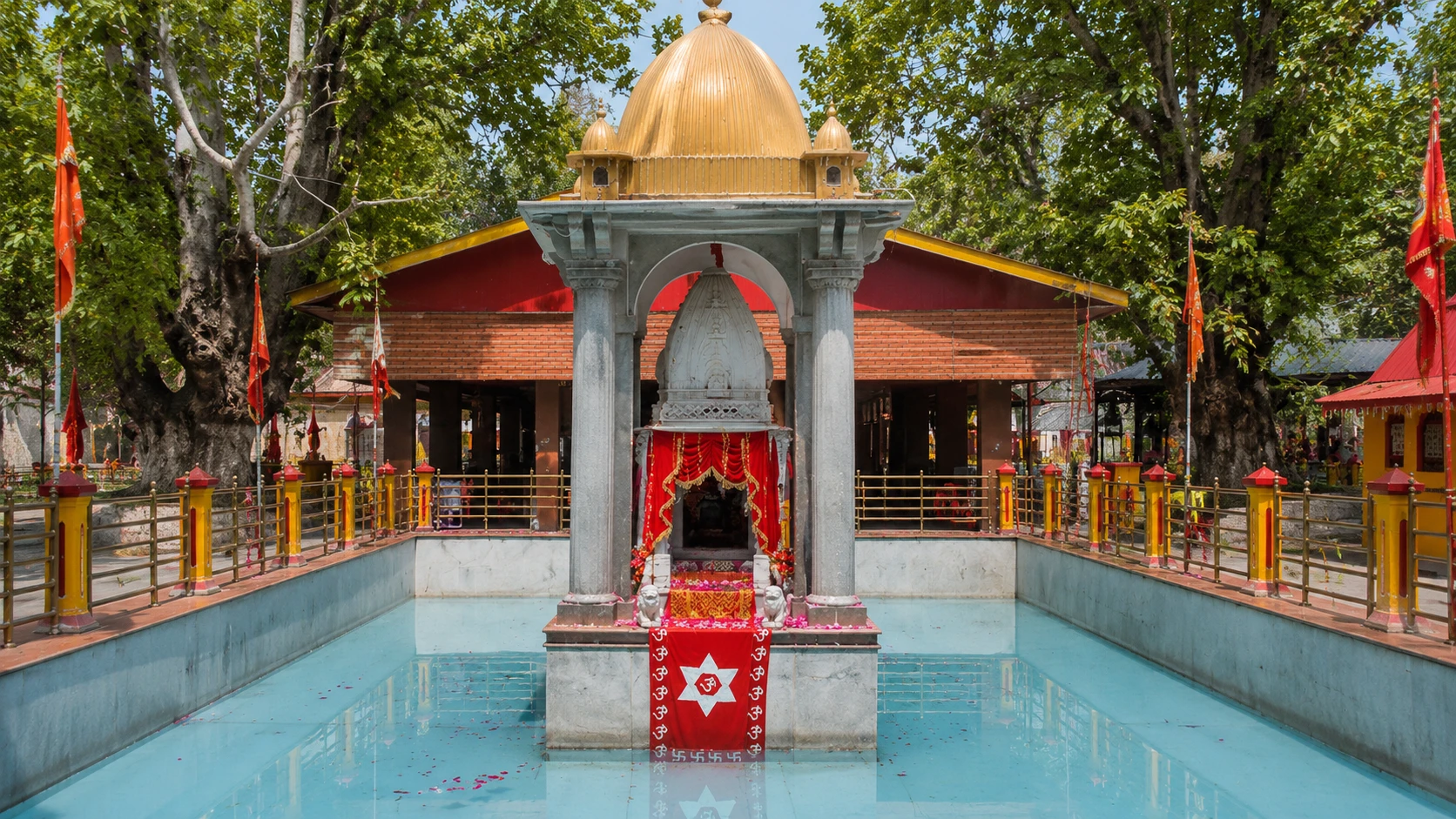
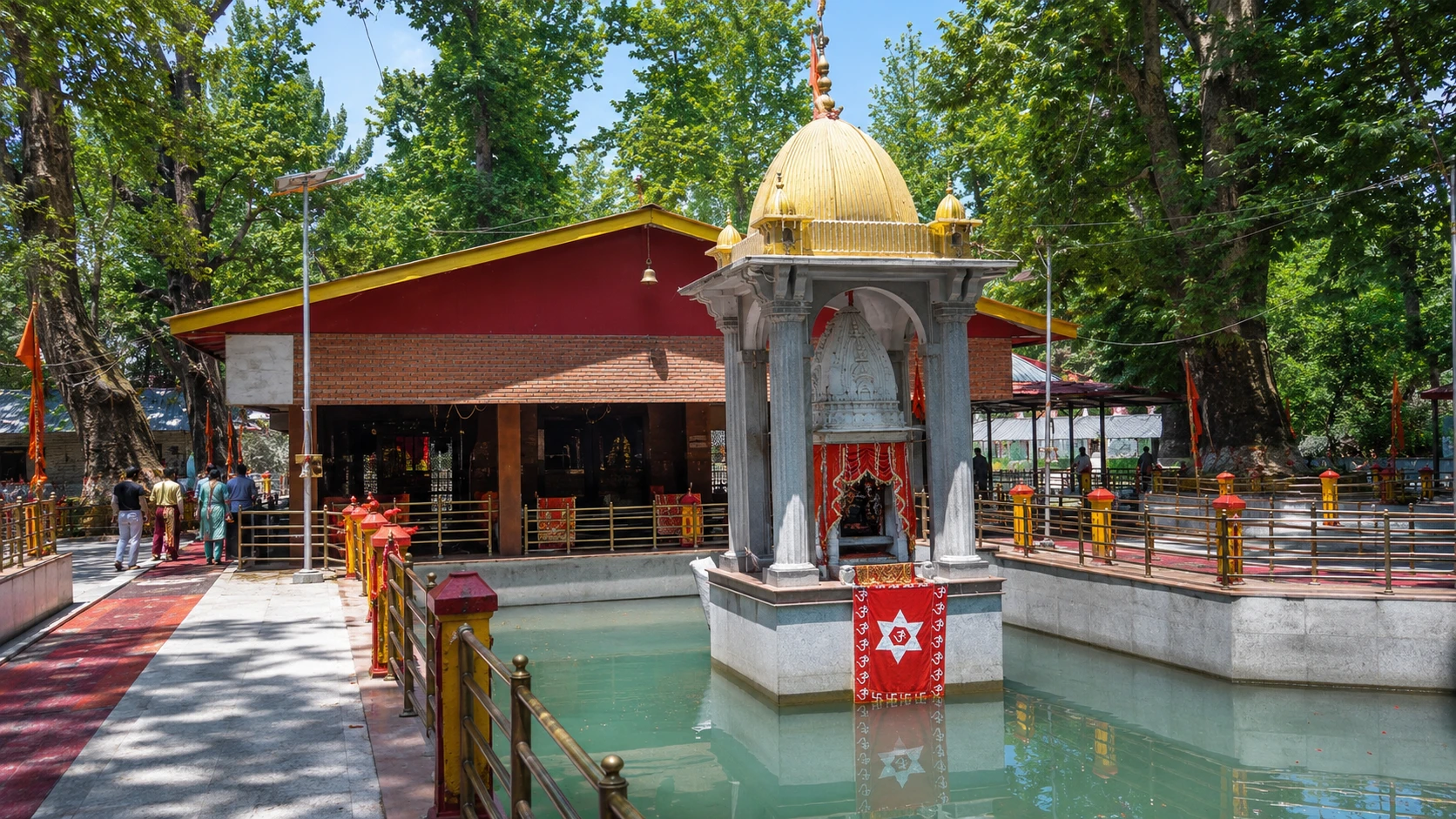
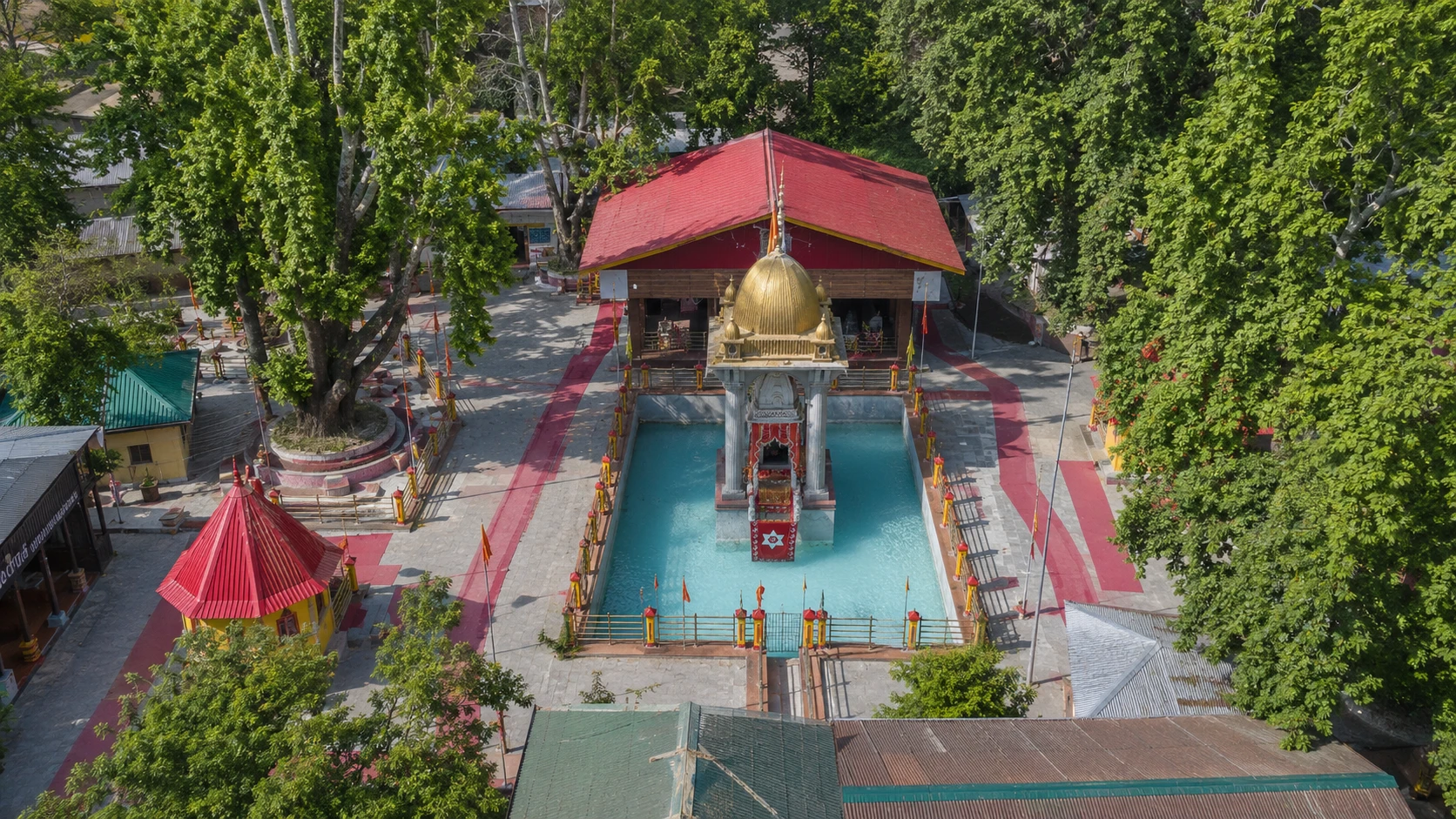
Late Dogra-era marble pavilion architecture — hexagonal/octagonal sanctum chamber over the sacred spring, set within an open compound with surrounding chinar trees
Open
06:00 – 19:00
Aarti
06:30 · 12:00 · 18:30
Special
Jyeshtha Ashtami mela window (May–June) — extended hours, special arrangements coordinated with J&K Tourism and security authorities; principal annual gathering of the displaced Kashmiri Pandit community
The Sacred Legend · पवित्र कथा
Kheer Bhawani is the temple of a community that no longer lives where its temple stands. The presiding goddess, Maa Ragnya, is the principal Devi of the Kashmiri Pandit community — a community whose mass departure from the Kashmir Valley in the winter of 1989–90 left this small marble shrine, with its hexagonal spring at the centre, as the most charged surviving site of their religious geography. The kund itself has carried a kind of testimony for over a century: settlement reports of colonial Kashmir record that its waters change colour, and Pandit oral tradition holds that the spring darkens before the community's calamities — said to have turned black before the Partition of 1947 and before the exodus of 1990. Every year in the bright half of Jyeshtha, on the eighth lunar day, thousands of displaced Pandits return to Tulmul for the Jyeshtha Ashtami mela — the single day on which a dispersed community gathers at the only place still recognisable as a centre. The temple has continued without pause through every rupture in the valley's modern history; the worship has not stopped, only the community that worships there has had to travel, often a very long way, to reach her.
Sacred Origin Storyपवित्र उत्पत्ति कथा
Source: Local Kashmir Shaiva-Shakta tradition; Ramayana-derived oral and written Kheer Bhawani mahatmya transmitted through Kashmiri Pandit lineage
The story of how the goddess came to Tulmul begins, as so many Hindu sacred-geography stories do, with a journey from one part of the subcontinent to another. According to the most widely-recited Kashmiri Pandit account, the goddess — known here as Maa Ragnya, Maharagnya Bhagavati — was originally worshipped in Sri Lanka by Ravana, the king of the rakshasas, who was a devout votary of the Devi despite the evil of his other actions. Over time, however, the goddess became displeased with Ravana — variously, by his abduction of Sita; by the proliferation of his blood-rituals; by the moral declension of his court — and she resolved to leave Lanka. During the Ramayana war, the account holds, the goddess revealed her wish to be carried north, away from Lanka and into a land where she could be worshipped in purity. Hanuman, the messenger of Rama, was tasked with her conveyance. He carried her on his shoulder across the length of the subcontinent and, guided by her, set her down in the Sind Valley of Kashmir, at a wooded spring near the village now called Tulmul. The waters of that spring rose around her seat, and the goddess took her residence in the kund itself — not in any murti, not in any sanctum, but in the water.
It is for this reason that Kheer Bhawani worship has, from its earliest documented form, been kund-centred rather than murti-centred. The hexagonal sacred spring within the temple is itself the goddess; the marble pavilion built over it is her shelter, not her image. Devotees approach the kund directly, offer kheer — sweet rice pudding cooked in milk and sugar — into its waters, and read the colour of those waters as her response to the moment. The colour-changing of the spring is the visible expression of the goddess's presence: when the waters are clear or pale-rose, she is at peace; when they darken to brown or red or black, she is said to be in shoka — sorrow at what is coming or what has come.
Kashmir Shaiva-Shakta tradition reads the goddess of Tulmul within the broader theological framework of the valley's tantric Devi tradition. In this reading, Ragnya is not merely a regional goddess transported from Lanka; she is Bhuvaneshwari — the goddess who is the world itself, the fourth of the Dasha Mahavidyas, the deity whose cosmic body is the manifest universe. The Lanka-transport story is the narrative shell through which her arrival into Kashmiri sacred geography is told; the underlying theological assertion is that the Devi of Tulmul is the supreme cosmic feminine recognised under the Kashmir Shaiva-Shakta lineage's own name for that supreme.
Sources cited:
- Kalhana, Rajatarangini, Tarangas 1 & 4 (Tula Mula attestation in Kashmir's classical-era sacred geography, c. 1148 CE)
- Kheer Bhawani Mahatmya — Kashmiri Pandit oral and manuscript tradition (multiple regional recensions)
- Walter R. Lawrence, 'The Valley of Kashmir' (Henry Frowde / Oxford, 1895) — colonial-era documentation of the temple and its kund phenomenon
- Marc Aurel Stein, 'Kalhana's Rajatarangini: A Chronicle of the Kings of Kashmir' (Constable, 1900) — translation and notes including Tula Mula and Naga-spring references
- Triloki Nath Dhar, 'Saints and Sages of Kashmir' (APH Publishing, 2004) — Kashmir Shaiva-Shakta theological framing
Other Traditions · अन्य परंपराएँ
Naga-transport variant — Kashmir's classical-era Naga sacred geography
An older stratum of Kashmiri sacred-geography tradition, recorded in Kalhana's Rajatarangini and in the broader Nilamata Purana corpus, places the goddess's arrival at Tulmul within the framework of Kashmir's Naga cult rather than within the Ramayana corpus. In this account, the goddess of Tulmul is the consort or sister of the Naga spirits who reside in the valley's sacred springs, and her transportation was effected through the subterranean Naga-channels that connect the springs of Kashmir to each other and to the great Naga-seat at Anantnag in southern Kashmir. The hexagonal geometry of the kund is read in this framework as the visual signature of Naga-association — the multi-sided form being the conventional Kashmir motif for serpent-spring sanctity. This account does not contradict the Ramayana-transport narrative; in the Kashmir tradition's mode of layering, both accounts are simultaneously valid — the Ramayana frame provides the goddess's external history of arrival, while the Naga frame provides her internal anchoring within Kashmir's pre-existing sacred geography.
Kashmir Shaiva-Shakta theological framing — Ragnya as Bhuvaneshwari
Within the Kashmir Shaiva-Shakta theological tradition (the lineage of Abhinavagupta, Kshemaraja, and in modern times Swami Lakshman Joo), the goddess of Tulmul is identified with Bhuvaneshwari — the fourth of the ten Mahavidyas in the pan-Indian tantric Devi tradition. Bhuvaneshwari is the goddess whose name means 'Lady of the Worlds' — the goddess who is the manifest universe itself, who contains all places within her cosmic body. In this reading, Ragnya's residence in a sacred spring is not unique to her — it is what one would expect of Bhuvaneshwari, the goddess whose body is the world and who therefore resides naturally in any source of life-giving water. The Lanka-transport and Naga-transport accounts become, in this framing, secondary explanations for why this particular goddess appears in this particular form at this particular place; the underlying identity of the deity is the cosmic feminine of the Mahavidya tradition. This theological framing is what binds Kheer Bhawani to the broader Sri Vidya and Mahavidya temple network of north India — to Lalita Tripura Sundari at Naimisharanya, to Chintpurni in the Himachal Devi-circuit, to the Dasha Mahavidya shrines of Vindhyavasini and Kalighat — through shared cosmological doctrine rather than through pilgrim flow.
Scholarly Context
Kheer Bhawani is a temple where modern academic scholarship and devotional tradition agree on the difficulty of dating origins and disagree on the framing of identity. The site is attested in Kalhana's Rajatarangini in the 12th century and in the older Nilamata Purana stratum, placing the temple's existence at minimum within Kashmir's pre-Islamic Hindu sacred geography. Its survival through the Kashmir Sultanate period (14th–16th centuries) and through the Mughal annexation is itself remarkable — much of the broader Kashmir Hindu temple infrastructure of that era did not survive, and Kheer Bhawani's continuity is part of why it carries the symbolic weight it does within Kashmiri Pandit memory. The current marble shrine structure is documented as a construction of Maharaja Pratap Singh of the Dogra Jammu and Kashmir state, dated to approximately 1912; the architectural style reflects late-Dogra-era patronage and incorporates European-influenced marble work consistent with that period's court architecture. The identification of Maa Ragnya with Bhuvaneshwari is theologically sophisticated and is internal to the Kashmir Shaiva-Shakta tradition; pan-Indian Mahavidya scholarship (David Kinsley, 'Tantric Visions of the Divine Feminine', 1997) treats the identification as one valid framing rather than as the only one. The temple's place in modern Kashmiri political and cultural memory is dominated, justly, by the 1989–90 exodus of the Kashmiri Pandit community and by the temple's role as the community-continuity ritual site in the decades since — both well-documented in modern accounts (Rahul Pandita's 'Our Moon Has Blood Clots', 2013; Sanjay Tickoo's reportage from Kashmir Pandit Sangharsh Samiti; Government of India Ministry of Home Affairs and J&K Migrant Cell records). The colour-changing kund is independently attested in Walter Lawrence's 1895 colonial-era settlement report and in Aurel Stein's 1900 Rajatarangini translation, and is part of the temple's documented identity well before the 20th-century political ruptures that have made it most famous.
Historyइतिहास
The documented history of Kheer Bhawani spans almost a thousand years and encompasses some of the most consequential transitions in Kashmir's religious and political life. The earliest textual reference to Tula Mula (the older Sanskrit name of Tulmul) appears in Kalhana's Rajatarangini, compiled around 1148 CE, which lists it among the sacred sites of the valley alongside the great Naga springs of Anantnag and Verinag. The site's continuity through the Kashmir Sultanate period (1339–1586) is itself a historical fact of significance: large parts of Kashmir's pre-Islamic temple infrastructure did not survive that period or its subsequent Mughal annexation under Akbar in 1586, but Kheer Bhawani — perhaps because of its modest physical scale, its remote location in the Sind Valley away from major political centres, or simply because the kund itself could not be removed or destroyed in the way a structural temple could — remained in continuous worship. The Sikh period (1819–1846) and the Dogra Maharajas of Jammu and Kashmir (1846–1947) extended fresh patronage to the site, culminating in Maharaja Pratap Singh's construction of the present marble shrine around 1912 — a small but architecturally polished structure with a hexagonal marble pavilion built directly over the kund and the surrounding compound landscaped with chinar trees.
The most consequential rupture in the temple's modern history is the forced displacement of the Kashmiri Pandit community from the Kashmir Valley between late 1989 and early 1990, in the period of the militancy's onset and the targeted attacks on Pandit households that immediately preceded and accompanied it. The community for whom Kheer Bhawani was the principal kula-devta shrine effectively departed the valley en masse; the temple has continued in worship since, but its devotee community has had to travel — from Jammu, Delhi, the broader Indian diaspora, and increasingly from international locations — to reach her. The Jyeshtha Ashtami mela has become, in this period, the single annual gathering at which the displaced Pandit community returns in significant numbers to Tulmul, with security and logistics coordinated through the J&K administration and the Government of India.
In the post-2010 period, infrastructure investment in the broader Kashmir Valley has gradually reached Tulmul. The temple has undergone renovation works under the J&K Tourism Department's Hindu-pilgrimage circuit programmes, and following the abrogation of Article 370 in August 2019, federal and state investment in Kashmir's Hindu sites has accelerated. The pilgrim flow during the annual mela has grown year-on-year. The day-to-day worship at the temple, however, remains in the hands of the priest families who maintained the site through the years of militancy — a continuity that older Pandit visitors particularly note when they return.
Historical Timelineऐतिहासिक कालक्रम
Tula Mula is attested in Kalhana's Rajatarangini, the chronicle of the kings of Kashmir composed around 1148 CE, which lists the site among the sacred springs of the valley alongside the great Naga seats. This places Kheer Bhawani's existence at minimum within the pre-Sultanate Hindu sacred geography of Kashmir, and the older Nilamata Purana stratum (dated by scholarly consensus to c. 6th–8th century CE) attests the broader Kashmir Naga-spring sacred-geography framework within which Tula Mula is one node.
The Rajatarangini's references to Tula Mula are brief and contextual rather than narrative — Kalhana lists sacred sites of the valley without telling their full stories — so the temple's identity in its current Ragnya / Maharagnya / Kheer Bhawani form cannot be projected back to the 12th century with certainty. What is certain is that the site was already established within Kashmir's sacred-spring geography by Kalhana's time.
Kheer Bhawani remains in continuous worship through the Kashmir Sultanate period (founded 1339 with Shah Mir's accession) and the early Mughal annexation under Akbar (1586). This continuity is itself historically distinctive: much of Kashmir's broader pre-Islamic Hindu temple infrastructure did not survive the Sultanate period — the chronicler Jonaraja's continuation of the Rajatarangini and Srivara's later Jaina-Rajatarangini both record significant temple destructions during the reigns of Sikandar Shah (r. 1389–1413) and Ali Shah (r. 1413–1419) in particular. Kheer Bhawani's modest physical scale, its remote location in the Sind Valley away from major political centres, and the fact that its central sacred element is a natural spring rather than a destructible built structure together account for its survival through the period.
Scholarship on the extent and intensity of temple destruction in Sultanate-era Kashmir is contested. Conservative readings (Mohibbul Hasan, 1959) acknowledge that destructions occurred but argue they have been overstated in later polemical accounts; revisionist readings (more recent scholarship including K. N. Pandita's work) argue the scale was greater than 20th-century Indian historiography acknowledged. Either reading allows for Kheer Bhawani's specific continuity, which is not in dispute.
Maharaja Pratap Singh of Jammu and Kashmir (r. 1885–1925) constructs the present marble shrine over the sacred kund. The structure is a small but architecturally polished hexagonal marble pavilion built directly over the spring, with the surrounding compound landscaped with chinar trees and basic pilgrim infrastructure. The construction reflects late-Dogra-era court patronage of Hindu religious sites within the princely state, alongside parallel patronage extended to Shaiva sites (notably the Shankaracharya temple in Srinagar) and the broader Kashmir Hindu temple-restoration programme of the Dogra Maharajas. The 1912 marble shrine remains the standing structure visited by pilgrims today, with subsequent maintenance and renovation but no major structural rebuilding.
The exact dating of the marble shrine's construction is given as c. 1912 in most modern Kashmiri Pandit sources and in J&K Tourism Department documentation, but the underlying state-archives basis for the specific year should be re-verified through the J&K State Archives at any future operational re-verification pass. The broader context — Pratap Singh-era Hindu temple patronage in the Dogra state — is firmly established.
The forced displacement of the Kashmiri Pandit community from the Kashmir Valley, in the period of the militancy's onset, leaves Kheer Bhawani's principal devotee community geographically separated from its temple. The displacement is precipitated by the targeted killings of Pandit individuals through 1989 (the assassinations of Tika Lal Taploo in September 1989, Justice Neelkanth Ganjoo in November 1989, and others) and the issuance of public notices and threatening loudspeaker announcements through January 1990 demanding that Pandit households leave the valley. Most estimates place the displaced population at between 200,000 and 350,000 Kashmiri Pandits, though the exact figure is contested. The temple at Tulmul continues in worship throughout this period through the local priest families and the small Pandit population that remained in the valley, but the community for whom this temple was the principal kula-devta shrine is now resident, in the main, outside Kashmir. The annual Jyeshtha Ashtami mela becomes, in the years that follow, the principal community-continuity ritual through which the displaced Pandit population returns to Tulmul.
The terminology applied to these events is contested and the choice of term carries political weight. Kashmiri Pandit community organisations and recent scholarship (Rahul Pandita, Siddhartha Gigoo) frequently use 'ethnic cleansing' or 'genocide' to describe the displacement. Some academic accounts (Sumantra Bose, Mridu Rai) use 'forced migration' or 'displacement'. The Government of India's official terminology in MHA documentation is generally 'migration'. The factual elements — the targeted killings preceding January 1990, the public threats issued in that month, the large-scale departure of Pandit households between January and early February 1990, the long-term non-return of the majority of the displaced community — are not in dispute across these framings, though specific casualty and displacement figures continue to be debated. This entry uses neutral descriptive language ('forced displacement', 'targeted killings') in the body and surfaces the terminological dispute in this scholarly note rather than adjudicating it.
Following the abrogation of Article 370 of the Indian Constitution in August 2019 and the reorganisation of Jammu and Kashmir as a Union Territory, federal and state investment in the maintenance, security, and pilgrim-infrastructure of Kashmir's Hindu religious sites — including Kheer Bhawani — has accelerated. The temple has received renovation funding under successive Government of India and J&K administration programmes; mela security and logistics have been formalised; pilgrim flow during the Jyeshtha Ashtami window has grown year-on-year, with both the resident-Pandit Sangharsh Samiti and the broader displaced Kashmiri Pandit organisations across India and the diaspora reporting increased annual attendance. The administrative reactivation has not, as of this entry's verification date, been accompanied by substantial Pandit community return-to-Kashmir on the demographic scale that some return programmes have aspired to; the pattern remains one of annual visitation for the mela rather than residential return.
The political evaluation of the 2019 abrogation of Article 370 is highly contested and lies outside the scope of this entry. What this historical event records is the empirical, on-the-ground administrative and pilgrimage-infrastructure consequences for Kheer Bhawani specifically: increased renovation funding, formalised security arrangements, growing annual mela attendance. These are documented through PIB releases and J&K Tourism Department reports and are independent of any political judgement on the underlying constitutional change. The non-return pattern (annual visitation rather than residential return) is documented through Kashmiri Pandit community organisations and is independently observable in the published mela attendance figures, which have grown without a corresponding shift in the resident Pandit population census.
What You'll Seeदर्शन में
The presiding deity at Kheer Bhawani is the hexagonal sacred spring itself. There is no central murti in the sense familiar from most Hindu temples — no anthropomorphic image of the goddess placed on a pedestal at the back of a sanctum chamber. The kund is the goddess, and the marble pavilion built over it by Maharaja Pratap Singh in c. 1912 is her enclosure. The pavilion's hexagonal plan follows the geometry of the spring beneath it: six sides of polished white marble, open on all sides through pillared arcades, with the surface of the kund visible directly from the circumambulation path. The water of the kund is the visual centre of the temple. Devotees ring the marble platform, look down at the surface of the spring, observe its colour, and read it. The kund's colour palette has been documented across more than a century — pale white or milky in times of peace, shading through soft rose and pale green in the ordinary devotional year, darkening through brown, red, and (rarely) black in periods which devotional tradition reads as portents of difficulty. Small subsidiary shrines around the central pavilion house a number of smaller stone and metal forms — a Shiva linga, a Hanuman murti (acknowledging his role in the Lanka-transport account), and a Ganesha image at the entrance — but these are devotional supplements rather than the centre of worship. The chinar trees of the surrounding grove are themselves treated as part of the sacred space; some are very old, and a number have devotional cloth tied around their trunks as offerings. Kheer Bhawani is therefore one of the few major Hindu temples in India where the sacred geometry is literally the geometry of the ground — a spring shaped by what tradition holds to be naga-architecture, framed by a marble pavilion that exists only to shelter it, and surrounded by trees that are themselves the goddess's grove. The encounter with the goddess at Tulmul is, fundamentally, an encounter with water.
Distinctive Practicesविशिष्ट परंपराएँ
Kheer offering and milk-pour into the kund
खीर अर्पण एवं कुण्ड में दुग्ध-धारा
Year-round daily practice; intensified during Jyeshtha Ashtami, Navaratri, and Shivaratri
The signature practice from which the temple takes its name. Devotees prepare or purchase kheer — sweetened milk-rice, traditionally cooked in pure cow's milk with sugar and a small quantity of cardamom — and bring it to the temple, where they offer it to the goddess by pouring a measured quantity into the kund itself. Pure milk (without rice) is also offered in the same manner, particularly on the most important devotional days. The act is not symbolic in the way most modern Hindu offerings have become; the kheer and the milk go directly into the sacred water, mingling visibly with the surface of the kund before dispersing. The goddess's acceptance is read in the colour her water shows afterwards. Devotees often note that the kund's water has remained startlingly clear even after decades of daily milk and kheer offerings — an observation that the temple's priests treat as part of the goddess's miracle and that hydrologists have not, to date, fully explained.
The kheer offering is the temple's central darshan-act because the kund is the goddess: to pour kheer into the kund is to feed the goddess directly, not to feed an image that represents her. The act collapses the conceptual distance between the offering and its recipient that most temple worship maintains. In the Bhuvaneshwari framing, the kund is the goddess as the world itself, and the kheer-offering is the devotee returning to the world the sweetness and nourishment the world has provided — a circular gesture of gratitude that mirrors the broader Vedic conception of yajna as cosmic exchange.
Reading the colour of the kund (varna-darshan)
कुण्ड के वर्ण का पठन (वर्ण-दर्शन)
Continuous — devotees observe the kund's colour as part of every visit; the practice intensifies around moments of personal or community decision-making
The colour of the kund's water is read by devotees as a form of communication from the goddess. The practice is unusually well-documented for what might otherwise be classed as folk belief: Walter Lawrence's 1895 Settlement Report records the colour-change phenomenon as observed and locally interpreted at that date, and the practice is independently noted in Aurel Stein's 1900 work and in subsequent ethnographic literature on Kashmir. The colour palette that devotional tradition reads is consistent across sources: pale white or milky for peace; soft rose or pale green for ordinary auspicious conditions; brown for difficulty approaching; red for serious difficulty; black for grave calamity. Pandit oral tradition holds that the kund turned black before the Partition of 1947 and before the exodus of 1989–90; some recent accounts also assert darkening before the 2014 floods. Devotees visiting the kund typically stand at the marble railing for some minutes, observing the surface, before proceeding to their other devotional acts. The practice is not divinatory in any directive sense — devotees do not ask the kund specific questions and read answers — but it is taken seriously as a way the goddess shows what she sees of the times.
The colour-darshan practice rests on the temple's central theological claim that the kund is the goddess. If the goddess is the water, then changes in the water are changes in the goddess — visible, public, available to anyone who looks. The practice trains devotees to read the divine as something present and visible rather than abstract; the goddess speaks not through dream-visions or oracular utterances mediated by priests but through the directly observable colour of her water. The colour-changes that have been read as warnings before great events are not understood as the goddess causing those events; they are understood as the goddess seeing them coming and showing her sorrow on her own surface.
Jyeshtha Ashtami mela — community return ritual
ज्येष्ठ अष्टमी मेला — समुदाय-वापसी अनुष्ठान
Annual, eighth day of the bright half of Jyeshtha (typically late May or early June)
The Jyeshtha Ashtami mela has been observed at Kheer Bhawani since at least the late-medieval period, but its character was transformed after the 1989–90 exodus. From the early 1990s onwards, the mela became the single annual occasion at which the displaced Kashmiri Pandit community returns in significant numbers to Tulmul. Pandits travel from Jammu, Delhi, Mumbai, Pune, and increasingly from the international diaspora (the United States, the United Kingdom, the Gulf countries) specifically for this gathering. The J&K Tourism Department, the J&K administration, and the Government of India have, in successive years, formalised the security and logistics arrangements for the mela — pilgrim coaches from Jammu, tented accommodation around the temple precinct, free food (langar) provision, medical camps, and security cordons. Recent years have seen attendance figures in the tens of thousands across the mela's two-to-three-day window. Devotionally the mela is a celebration of the goddess's manifestation; communally it is the most concentrated annual experience the displaced Pandit community has of itself as a community. For many participants, the return for the Jyeshtha Ashtami mela is the only occasion they will visit Kashmir in any given year.
The mela's spiritual significance has always rested on Jyeshtha Ashtami's character as the goddess's particular day — the eighth tithi of the bright half of Jyeshtha is read in Devi devotional tradition as the day on which Maharagnya's presence at Tulmul is at its strongest. But the practice has acquired additional meaning since 1990: the mela is the way a displaced community keeps faith with the goddess in the only way a displaced community can — by returning, once a year, in numbers, to the only place where she sits. Devotees often describe the mela in terms that fuse the religious and the communal: the goddess receives her people, the people see each other, the geography is reaffirmed as belonging to them through their physical presence in it. The mela is therefore the temple's most concentrated single expression of what it has come to mean.
Did You Know?क्या आप जानते हैं?
The kund at Tulmul is one of the few Hindu sacred sites where the colour-changing phenomenon is independently attested in colonial-era ethnographic record. Walter Lawrence, the British Settlement Commissioner of Kashmir, documented the colour-change in his 1895 official Settlement Report — three decades before Pratap Singh's marble pavilion was built, and almost a century before the 1989–90 exodus to which the phenomenon would later be poignantly connected by the Kashmiri Pandit community.
Walter R. Lawrence, 'The Valley of Kashmir' (Henry Frowde / Oxford, 1895)
Kheer Bhawani is unusual among major Hindu temples in being centred not on an anthropomorphic murti but on a natural spring. The hexagonal sacred kund — its multi-sided geometry read by tradition as evidence of naga-architecture — is the goddess herself, with the marble pavilion built by Maharaja Pratap Singh in c. 1912 functioning as her shelter rather than as her image-house. Devotees offer kheer directly into the water of the spring; the goddess's response is read in the colour the water shows after.
Field-attested architectural feature; documented in Walter Lawrence (1895) and subsequent records
Within the Kashmir Shaiva-Shakta tradition of Abhinavagupta and Swami Lakshman Joo, the goddess of Kheer Bhawani is identified with Bhuvaneshwari — the fourth of the ten Mahavidyas, the goddess whose name means 'Lady of the Worlds' and whose cosmic body is the manifest universe. The identification places this modest village temple in doctrinal kinship with the major Sri Vidya and Mahavidya centres of India — Kanchipuram, Tripurantakam, Madurai — through shared cosmological doctrine rather than through pilgrim flow.
Abhinavagupta, Tantraloka; Lakshman Joo, 'Kashmir Shaivism: The Secret Supreme' (1985); David Kinsley, 'Tantric Visions of the Divine Feminine' (1997)
Kheer Bhawani is the principal kula-devta (family/community deity) site of the Kashmiri Pandit community. Unlike most major Hindu temples, whose devotional reach is broadly pan-Indian and not constituted around a single sub-community, Kheer Bhawani's significance is community-anchored: it is the temple of a specific people, and its meaning has been substantially transformed since 1989–90 by the displacement of that people from the land in which the temple stands.
Rahul Pandita, 'Our Moon Has Blood Clots' (2013); Kashmir Pandit Sangharsh Samiti documentation; J&K Migrant Cell records
Kheer Bhawani survived continuous worship through the Kashmir Sultanate period (1339–1586) when much of the broader Kashmir Hindu temple infrastructure did not. Modest physical scale, remote location in the Sind Valley away from major political centres, and the central sacred element being a natural spring rather than a destructible built structure together account for the temple's exceptional continuity — a feature that has acquired additional weight in recent decades as the symbol of devotional persistence through periods of political disruption.
Jonaraja, Dvitiya Rajatarangini; Srivara, Jaina-Rajatarangini; Mohibbul Hasan, 'Kashmir Under the Sultans' (1959)
Visitor Accessप्रवेश जानकारी
Kheer Bhawani welcomes devotees of all backgrounds for darshan, but access takes place within the security infrastructure that the Government of India and the J&K administration maintain around Hindu religious sites in the Kashmir Valley. Visitors should expect routine security checks at the temple precinct's outer perimeter and at the immediate sanctum entrance, and should carry a government-issued photographic identity document. Photography inside the marble pavilion enclosing the kund is at the discretion of the priests on duty and is generally not permitted during principal aartis or during the Jyeshtha Ashtami mela. Outside the security framing, the worship itself is conducted with traditional north Indian Devi-temple openness — devotees of any tradition or background may approach the kund, offer kheer or milk, observe the colour of the water, and participate in the standard puja sequences.
Contemporary Context
The security framing around Kheer Bhawani is a feature of the post-1989 operational reality of Kashmir's Hindu religious sites rather than a feature of temple policy in any traditional sense. The temple priests and management coordinate with the J&K administration for security arrangements, particularly during the Jyeshtha Ashtami mela. Non-J&K-resident visitors should consult the most recent Ministry of External Affairs and Ministry of Home Affairs advisories before travel, and may wish to check with the J&K Tourism Department regarding any current registration or notification requirements for non-residents. The Sri Vidya / Bhuvaneshwari initiation-restricted mantras (the full sequenced Bhuvaneshwari bija practice in Kashmir Shaiva-Shakta or south Indian Sri Vidya transmission) are not published on this entry and are not transmitted through general temple visit; devotees interested in initiation should approach an authorised acharya within a recognised lineage.
Festivalsत्योहार
Jyeshtha Ashtami mela
ज्येष्ठ अष्टमी मेला
May–June (Jyeshtha Shukla Ashtami)
Jyeshtha Ashtami — the eighth day of the bright half of Jyeshtha — is the goddess's particular day at Kheer Bhawani and the principal annual gathering of the temple's worship year. Since the 1989–90 exodus, the mela has additionally become the single annual occasion at which the displaced Kashmiri Pandit community returns in significant numbers to Tulmul, with travel from across India and the international diaspora coordinated specifically around this gathering. The J&K Tourism Department and the J&K administration formalise the security, transport, and logistics for the mela in successive years; attendance has grown from a few thousand in the early 1990s to figures in the tens of thousands in recent years. For most participants, the mela is the most concentrated communal experience of Kashmiri Pandit identity available in any given year — devotionally a celebration of the goddess's manifestation, communally an annual reaffirmation of belonging to a geography from which the community has been displaced.
Sharadiya Navaratri
शारदीय नवरात्रि
September–October (Ashwin Shukla Pratipada to Navami)
The autumn Navaratri is observed at Kheer Bhawani with the nine-night Devi observance pattern that is standard across north Indian Devi worship, modulated by Kashmir-specific elements. Pandit families resident in Kashmir maintain household observances paralleled at the temple; visiting Pandits from outside the valley generally observe the festival at their resident locations rather than travelling for the Sharadiya Navaratri specifically, which is in any case a less weather-favourable season for Valley travel than the late-May Jyeshtha Ashtami window.
Chaitra Navaratri
चैत्र नवरात्रि
March–April (Chaitra Shukla Pratipada to Navami)
The spring Navaratri at Kheer Bhawani is observed with the same nine-night cycle as Sharadiya. The festival falls just as Kashmir is emerging from winter, when road access to the Valley is restored and pilgrim travel becomes practical again; for non-resident Pandits planning a return that is not specifically the Jyeshtha Ashtami mela, the Chaitra Navaratri window is the earlier of the year's two practicable festival options. The observances themselves follow the standard north Indian Navaratri sequence with the nine-form goddess adornment cycle.
Herath (Mahashivaratri)
हेरथ (महाशिवरात्रि)
February–March (Phalguna Krishna Chaturdashi)
Mahashivaratri is observed in Kashmiri Pandit tradition as Herath — the community's most distinctively Kashmir-rooted festival, with a household-centred liturgy that has been transmitted through diaspora communities since 1990 and that is observed at Kheer Bhawani as well. While Shivaratri is principally a Shaiva festival, Kashmir Shaiva-Shakta tradition treats the goddess and Shiva as theologically inseparable; Kheer Bhawani's observance of Herath reflects this integration, with worship at the kund accompanied by Shiva-linga worship at the subsidiary shrines around the marble pavilion. For Pandit families, Herath is the festival most closely associated with home and continuity; for visitors travelling specifically for the festival, the late-February cold limits attendance to the more devoted-and-able pilgrims.
Traditional Offeringsपारंपरिक अर्पण
Primary Offerings
Kheer (sweetened milk-rice)
खीर (मीठा दुग्ध-चावल)
क्षीर पाक
Kheer — rice cooked in sweetened milk with cardamom — is the temple's signature offering and the practice from which it takes its name. Devotees prepare or purchase kheer and pour a measured quantity directly into the sacred kund. The offering is unusual in being made into the water rather than placed before an image: the kund is the goddess, and the kheer goes to her without intermediation. The pale, milk-white colour the kund's water shows in times of peace is read by tradition as the goddess's acceptance of accumulated centuries of kheer-offerings. Pure milk (without rice) is offered in the same manner on principal devotional days. In the Bhuvaneshwari framing, the kheer-offering is the devotee returning to the world the sweetness and nourishment the world has provided — a circular gesture of gratitude.
Pure milk (gau-dugdha)
शुद्ध दूध (गौ-दुग्ध)
गव्य दुग्ध
Pure cow's milk is offered into the kund in the same direct manner as kheer, particularly on Jyeshtha Ashtami and during the Navaratri festival windows. The milk-offering is the simplest form of the temple's signature practice; devotees who do not have time or capacity to prepare kheer offer milk alone. Theologically the two offerings are continuous — kheer is milk transformed by fire and rice and sweetness, milk is the unmediated form of the same substance — and either is taken by the goddess equally. The hydrological fact that the kund's water has remained startlingly clear over more than a century of daily milk and kheer offerings is part of the temple's modern miracle-narrative and has not been fully explained by conventional hydrology.
Red flowers and red chunari
लाल पुष्प एवं लाल चुनरी
रक्त-पुष्प
Red is the colour of Devi worship across the Shakta tradition, and red flowers — particularly lotus, rose, and hibiscus — are the standard floral offering at Kheer Bhawani. The red chunari (cloth shawl) is offered to the goddess and to the subsidiary murtis around the kund as a vastra-arpana (clothing offering); offered chunaris are kept in the temple's care and a portion is returned to devotees as prasadi-vastra (blessed cloth) which devotees often keep in their home shrines. For displaced Pandit families, the prasadi-vastra from Kheer Bhawani carries layered meaning — it is the goddess's blessing taken home from the geography the family no longer lives in.
Sugar candy (mishri)
मिश्री
मिश्रि
Mishri — crystalline sugar candy — is offered as a sweet naivedya alongside or in place of more elaborate sweets. Mishri is preferred at Kheer Bhawani over fried or syrup-heavy sweets typical at plains-Indian Devi temples; the offering ties to the kheer-and-milk theme of the temple's distinctive offering set and is theologically consistent with the goddess's preference for pure dairy and sweet substances. Distributed back to devotees as prasad after the puja, mishri is the most portable Kheer Bhawani prasad for visitors taking blessings home.
Coconut (nariyal)
नारियल
नारिकेल
The coconut — its three eyes read as the three gunas, its tough outer husk as the maya surrounding the inner sweetness of the Self — is a standard pan-Indian Devi offering and is presented at Kheer Bhawani during sankalpa (intentional vow-taking) for any wish. The coconut is broken before the goddess at the subsidiary shrine area rather than at the kund itself (the kund receives only liquid and floral offerings), and the offered coconut's flesh is returned to the devotee as prasad alongside the mishri and the prasadi-vastra. For devotees making a return-pilgrimage to Tulmul from outside Kashmir, the coconut offering often accompanies sankalpas connected to family, displacement, or the wish to return to the Valley.
Unique to This Temple
Direct milk-pour into the kund
कुण्ड में सीधी दुग्ध-धारा
What makes Kheer Bhawani's offering practice distinctive is not the offered substances themselves — kheer, milk, red flowers, sugar — which are typical north Indian Devi offerings. What makes it distinctive is that the kheer and milk go directly into the sacred kund, mingling visibly with the goddess's own water-body before dispersing. Devotees stand at the marble railing and tip their offerings into the spring; the act of offering is an act of direct contact with the goddess, without an intermediary surface or image. This is one of the few mainstream Hindu temple-practices in which the offering and the deity are not even visually separable.
Jyeshtha Ashtami mela langar and prasad distribution
ज्येष्ठ अष्टमी मेला लंगर एवं प्रसाद वितरण
During the annual Jyeshtha Ashtami mela, the J&K administration, the temple committee, and a number of Kashmiri Pandit community organisations coordinate large-scale community-kitchen (langar) and prasad distribution for the tens of thousands of pilgrims who attend. The langar is open to all visitors without distinction of background. The prasad — typically including the temple's standard mishri-and-kheer combination, with regional Kashmiri sweets added during the mela — is distributed in measured servings that often constitute, for many visitors, the most concrete physical Kashmir-prasad they will receive in a given year. The community-kitchen practice is particularly characteristic of the displaced-community-return dimension of the mela; the langar is one of the practical mechanisms through which a dispersed community physically re-experiences itself as a community for the duration of the gathering.
Kheer for the kund offering may be brought from outside, purchased from vendors near the temple approach, or — during the Jyeshtha Ashtami mela window — obtained through the temple committee's coordinated supply. The temple does not operate the large institutional offering counters typical of major plains-India Devi shrines; arrangements outside the mela window are informal and arranged in person with the priests on arrival. Devotees seeking to sponsor specific pujas or sevas should approach the on-site priests directly. There is no online seva-booking infrastructure as of this entry's verification date. For non-resident visitors, coordination with the J&K Tourism Department for the mela window is the appropriate route for accommodation and pilgrim-coach logistics.
How to Reachकैसे पहुँचें
Kheer Bhawani is approximately 28 km north-east of Srinagar, in the Ganderbal district of the Kashmir Valley. The standard approach for visitors arriving from outside Kashmir is via Srinagar.
By air: Sheikh ul-Alam International Airport, Srinagar (SXR) is the practical air gateway, with direct connections to Delhi, Mumbai, Bengaluru, and select international destinations. From the airport, road transfer to Tulmul takes approximately 60–75 minutes via the Srinagar–Ganderbal corridor. Pre-booked taxi or arranged transport is the standard onward arrangement.
By road: The Srinagar–Ganderbal road is the principal approach corridor. Most non-J&K-resident visitors arrange transport through Srinagar — taxi services from the Lal Chowk / Dal Lake area or from Srinagar Airport are widely available. For visitors travelling from Jammu or further south, the Srinagar–Jammu National Highway (NH-44) is the principal road corridor; this route is subject to seasonal closure during heavy winter snow and to occasional security or weather-related delays year-round. During the Jyeshtha Ashtami mela, dedicated pilgrim coaches operate from Jammu to Tulmul under J&K Tourism coordination.
By rail: The Banihal–Baramulla rail line operates regional trains within the Kashmir Valley, but the connection to the broader Indian rail network is via Banihal (the southern terminus of the Valley rail line) and then by road or air to Jammu Tawi, which is the principal rail gateway to J&K. The Udhampur–Srinagar–Baramulla Rail Link (USBRL), under phased completion through the mid-2020s, will provide direct rail connectivity between Jammu and Srinagar when fully operational; visitors should consult Indian Railways for the most current status of through-services on the USBRL.
For visiting during the Jyeshtha Ashtami mela window, advance coordination with the J&K Tourism Department is strongly recommended; pilgrim accommodation, transport, and security arrangements during the mela are managed centrally rather than left to individual travel arrangements.
Plan Your Visitयात्रा की योजना
🌤 Best Season
April through October is the broadly recommended season — Valley roads are open, the climate is mild-to-warm, and the principal annual festival (Jyeshtha Ashtami mela in late May or early June) falls within this window. The winter months (November through March) bring substantial snowfall to the Kashmir Valley and frequently close the Srinagar–Jammu highway; visitors travelling in winter should expect possible road delays, sub-zero temperatures, and reduced pilgrim infrastructure at the temple itself. The summer monsoon impact on Kashmir is more modest than in plains India but localised rainfall can affect the Srinagar–Ganderbal road in July–August.
👘 Dress Code
Traditional Indian attire is preferred for the temple visit — saris, salwar-kameez, or kurta-pyjama. Modest dress that covers shoulders and knees is the practical standard. For Kashmir's climate, warm layers are necessary outside the May–September window; even in summer mornings and evenings can be cool. Footwear is removed before entering the marble pavilion enclosing the kund and is kept at the entrance under priest or attendant supervision. Conservative dress is particularly observed during the Jyeshtha Ashtami mela and the two Navaratri festival windows.
📱 Phones & Photography
Photography in the outer temple precinct and chinar grove is generally permitted. Photography inside the marble pavilion enclosing the kund is at the discretion of the priests on duty and is generally not permitted during principal aartis or during the Jyeshtha Ashtami mela. Video recording inside the pavilion is generally not permitted. The temple does not maintain a published photography policy, and Kashmir's broader security framing means that visitors should not photograph security personnel, security-adjacent infrastructure, or anything outside the immediate temple precinct without checking with the relevant authorities first. For purposes of devotion, no photography is required; the kund itself is the darshan, and devotees are encouraged to look directly rather than through a screen.
🏨 Accommodation
Tulmul itself does not maintain large-scale visitor accommodation outside the Jyeshtha Ashtami mela window, when tented camps and short-term arrangements are coordinated by the J&K Tourism Department. For routine visits, most pilgrims base themselves in Srinagar — which offers the full range of accommodation from budget guesthouses through dharamshalas to mid-tier and luxury hotels — and undertake Tulmul as a half-day visit. The Dal Lake houseboats remain a distinctive Srinagar accommodation option. During the mela window, advance coordination with the J&K Tourism Department for pilgrim accommodation is strongly recommended; walk-in arrangements during the peak two-to-three day window are generally not viable.
Sacred Soundsपवित्र ध्वनि
Did You Know? · क्या आप जानते हैं?
The same translation error that turned '33 Koti' into '33 crore' in Hinduism also happened in Buddhism. The Chinese translation of Buddhist texts rendered 'Sapta Koti Buddha' (7 Supreme Buddhas) as '7 Crore Buddhas.' The Tibetan translation got it right: 7 types, not 7 crore. One Sanskrit word, misread across two major world religions, generated two identical misconceptions independently.
Related Contentसंबंधित सामग्री
Related Scriptures
Related Temples
Vaishno Devi
वैष्णो देवी
Katra, Jammu and Kashmir
Lalita Devi (Naimisharanya)
ललिता देवी मंदिर
Naimisharanya, Uttar Pradesh
Chhinnamastika (Chintpurni)
छिन्नमस्तिका (चिंतपूर्णी)
Chintpurni, Himachal Pradesh
Kamakhya Temple
कामाख्या मंदिर
Guwahati, Assam
Meenakshi Temple
मीनाक्षी मंदिर
Madurai, Tamil Nadu
Mansa Devi (Haridwar)
मनसा देवी मंदिर
Haridwar, Uttarakhand
Chandi Devi (Haridwar)
चंडी देवी मंदिर
Haridwar, Uttarakhand
Annapurna Mandir (Varanasi)
अन्नपूर्णा मंदिर
Varanasi, Uttar Pradesh
Community Reflections
🕉️
Be the first to share your reflection.