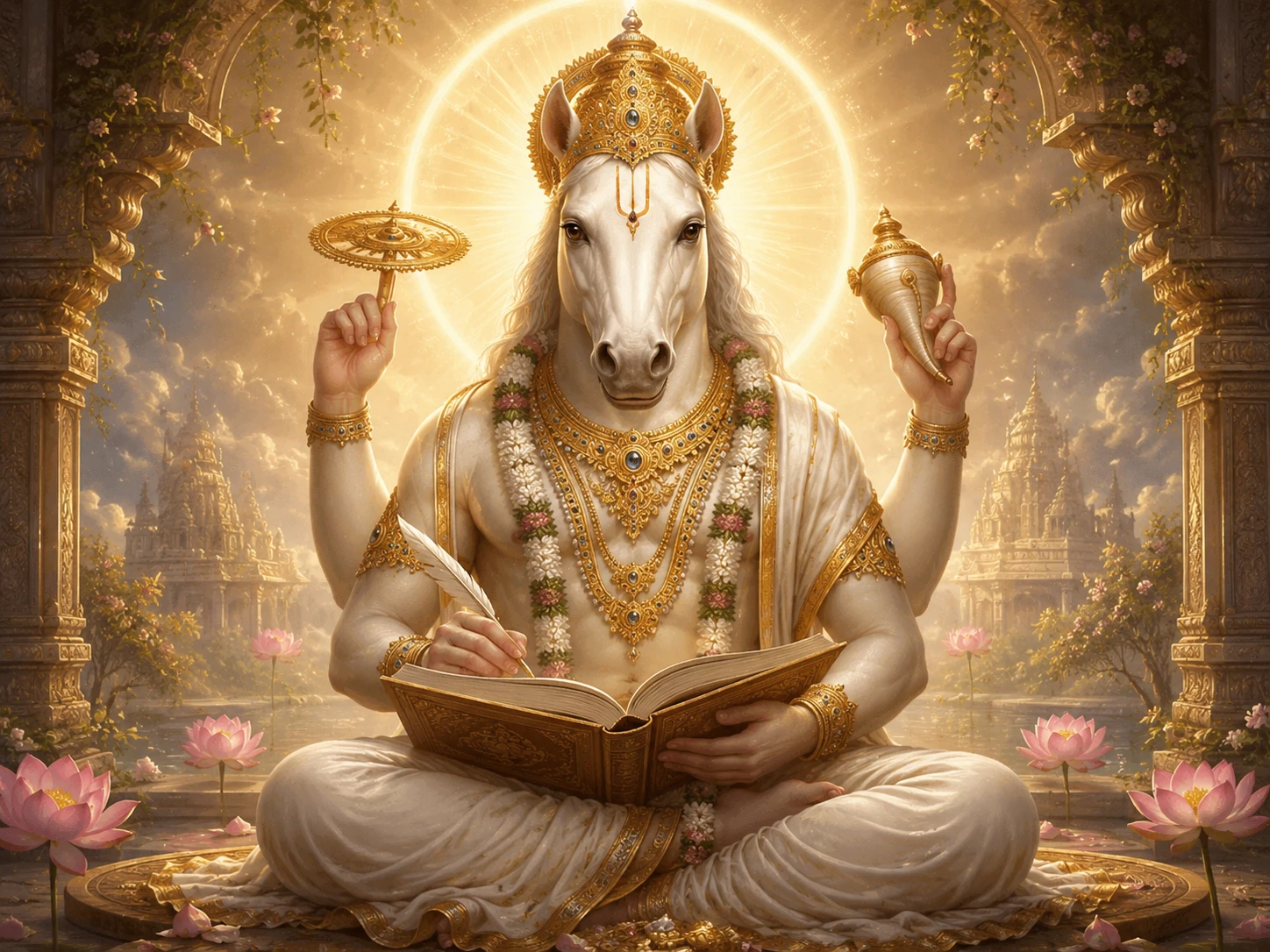
Hayagriva -- The Horse-Headed Deity of Knowledge
हयग्रीव -- अश्वमुख ज्ञान देवता
Hayagriva is the horse-headed form of Vishnu, a theologically specific incarnation whose central concern is the preservation and transmission of knowledge. His Sanskrit name combines haya (horse) and griva (neck), and his iconographic signature is immediate and unmistakable: the body of a man, typically young and handsome, with four arms and standard Vaishnava attributes -- but the head of a white horse, long-faced and serene, with visible teeth and a flowing mane. The incongruity of the imagery is deliberate. Hayagriva is not a figurative deity; the horse-head is a specific theological claim about what knowledge is like. The horse is the animal associated in the Vedic period with speed, power, and the ritual yajna; Hayagriva's horse-head signifies that divine knowledge arrives with the speed, force, and sacrificial gravity of the Vedic horse. In the Srivaishnava tradition, Hayagriva is specifically the deity of Vedic learning, of Sanskrit mastery, of any structured intellectual pursuit. Students writing exams, scholars beginning research projects, musicians learning new ragas, doctors preparing for surgery -- all these and more invoke Hayagriva as their presiding deity. His worship is not esoteric; it is the practical theology of learning itself. Every mind that seeks to learn is invoking, whether explicitly or not, what the Hindu tradition has named Hayagriva.
The central Hayagriva narrative is the rescue of the Vedas from the asuras Madhu and Kaitabha, told in the Bhagavata Purana (canto 5, adhyaya 18) and elaborated in the Devi Bhagavata. At the beginning of a new cosmic cycle, when Brahma emerged from Vishnu's navel-lotus to begin the work of creation, the Vedas had just been spoken and were lying near the creator's side. Two asuras, Madhu and Kaitabha, born from the wax of Vishnu's ear during his cosmic sleep, snatched the Vedas and carried them away to the depths of the primordial ocean. Without the Vedas, Brahma could not begin creation; cosmic order could not be established. The gods appealed to Vishnu. Vishnu, responding to the crisis, took the horse-headed form of Hayagriva -- a form specifically adapted to pursuing asuras through water because of its aquatic strength and endurance -- dove into the cosmic ocean, defeated Madhu and Kaitabha, and recovered the Vedas. He returned them to Brahma, who could then proceed with creation. The narrative makes a theologically specific claim: the Vedas are not self-existing; they must be actively preserved by divine intervention. Every generation of human Vedic transmission is, at the theological level, a continuation of Hayagriva's initial rescue. The horse-headed deity is the reason anyone can study the Vedas today. This theological framing gives Vedic study, in orthodox Hindu understanding, a gravity that goes beyond ordinary academic work; it is participation in a divine transmission whose first act was Hayagriva's.
ज्ञानानन्दमयं देवं निर्मलस्फटिकाकृतिम् । आधारं सर्वविद्यानां हयग्रीवमुपास्महे ॥
jñānānandamayaṃ devaṃ nirmalasphaṭikākṛtim | ādhāraṃ sarvavidyānāṃ hayagrīvam upāsmahe ||
We meditate upon Hayagriva, the deity who is the embodiment of knowledge and bliss, whose form is like pure crystal, who is the foundation of all learning.
— Hayagriva dhyana-shloka, originally from the Pancharatra Agamas; prefixed to the Hayagriva Stotra by Vedanta Desika (13th-14th century)
The iconography of Hayagriva is consistently detailed across temple and text. He is seated on a white lotus in padmasana, his body white or slightly golden, his horse-head pale and serene with visible teeth in a partial smile. He has four arms. The upper right hand holds the sudarshana chakra (discus); the upper left holds the panchajanya shankha (conch). The lower right hand is typically shown in jnana-mudra (the teaching gesture, with thumb and forefinger touching) or holds an akshamala (rosary); the lower left hand holds a book, usually depicted as a palm-leaf manuscript that explicitly represents the Vedas. The treatment of the book is theologically specific: Hayagriva holding the Vedas visually embeds the narrative of his Veda-rescue. Behind him, his vehicle is Garuda (the eagle), though some depictions show him seated without any visible vahana because his identification with the Vedic horse makes a mount somewhat redundant. His consort is Lakshmi-Hayagrivi in the Srivaishnava tradition. The moonlike whiteness of his form is specified in the classical dhyana-shloka (jnanananda-mayam devam nirmala-sphatikakritim) as 'pure crystal.' Crystal-white is the colour of sattva in Sanskrit aesthetic theory -- the clear, unclouded, luminous quality of pure knowledge. Every aspect of Hayagriva's iconography contributes to the single theological claim: divine knowledge is clear, serene, fully formed, and actively upheld.
The worship of Hayagriva is particularly associated with two living South Indian Vaishnava lineages: the Srivaishnava tradition descending from Ramanuja and elaborated by Vedanta Desika, and the Madhva Vaishnava tradition descending from Madhvacharya and elaborated by Vadiraja. Vedanta Desika (1269-1370 CE), the great fourteenth-century Srivaishnava acharya, is the most important Hayagriva devotee in the tradition's history. According to Srivaishnava narrative, Desika was propitiated by Garuda atop a hill in Tiruvahindrapuram (Tiruvanthipuram), Cuddalore district, Tamil Nadu, where Garuda appeared to him and gave him a small Hayagriva murti along with the Hayagriva mantra. Upon chanting the mantra, Hayagriva himself appeared to Desika and blessed him with mastery of all 64 arts. Desika subsequently composed the Hayagriva Stotra (33 verses), which remains one of the most revered hymns in the Srivaishnava corpus and is chanted daily at major Srivaishnava temples and in the homes of orthodox Srivaishnava families worldwide. The small Hayagriva murti Garuda gave Desika is reported to have been carried by him throughout his life and is preserved, according to tradition, at the Parakala Mutt in Mysore, the principal institutional seat of the Vadagalai school of Srivaishnavism. The mutt has preserved this murti for approximately 700 years, and it continues to be worshipped daily with full agamic protocol.
Major Hayagriva Temples and Mutts
| Site | Location | Significance |
|---|---|---|
| Parakala Mutt / पराकाल मठ | Mysuru, Karnataka / मैसूरु, कर्नाटक | Preserves the Hayagriva murti reportedly given by Garuda to Vedanta Desika; principal Vadagalai institution. / परंपरा के अनुसार गरुड़ द्वारा वेदांत देशिक को दी गई हयग्रीव मूर्ति सुरक्षित रखता है; प्रमुख वडगलै संस्थान। |
| Chennakesava Temple / चेन्नकेशव मंदिर | Melkote, Karnataka / मेलकोटे, कर्नाटक | Major Srivaishnava site on a Hoysala-era hilltop, with a specifically venerated Hayagriva shrine. / होयसल-युगीन पहाड़ी पर प्रमुख श्रीवैष्णव स्थल, विशेष रूप से पूजित हयग्रीव स्थान के साथ। |
| Thirukadigai / थिरुकडिगै | Sholinghur, Tamil Nadu / शोलिंगुर, तमिलनाडु | One of 108 Divya Desams; Yoga Narasimha and Yoga Hayagriva together on the hill. / 108 दिव्य देशमों में से एक; पहाड़ी पर योग नरसिंह और योग हयग्रीव एक साथ। |
| Sri Yoga Hayagriva Temple / श्री योग हयग्रीव मंदिर | Chennai, Tamil Nadu / चेन्नई, तमिलनाडु | Contemporary temple in Nanganallur attracting students before exam season. / नंगनल्लूर का समकालीन मंदिर जो परीक्षा मौसम से पहले छात्रों को खींचता है। |
| Sri Hayagriva Madhava Temple / श्री हयग्रीव माधव मंदिर | Hajo, Assam / हाजो, असम | One of the northeastern Hayagriva shrines; considered sacred by Hindus and Buddhists. / पूर्वोत्तर के हयग्रीव मंदिरों में से एक; हिंदुओं और बौद्धों द्वारा पवित्र माना जाता है। |
The Hajo Hayagriva Madhava Temple in Assam represents one of the few Hayagriva sites outside the South Indian Vaishnava heartland. Buddhist pilgrims from Bhutan and Tibet have historically visited Hajo believing that the Buddha attained parinirvana at the site; the shared sacrality illustrates how Hayagriva's identity crosses Hindu-Buddhist lines in cross-border regional traditions.
The Madhva Vaishnava devotion to Hayagriva, parallel to but distinct from the Srivaishnava one, centers on the fifteenth-century acharya Vadiraja Tirtha (1480-1600 CE). Vadiraja was one of the great philosophical lights of the Madhva tradition and the pontiff of the Sode Mutt, one of the Ashta Mathas (eight monasteries) of Udupi, Karnataka. According to the Madhva hagiography, Vadiraja had a specific daily practice: he would prepare a special prasadam -- horse gram (kudure kadale in Kannada, hayagrama in Sanskrit) -- and offer it at his household shrine. According to the tradition, Hayagriva himself would descend daily in the form of a white horse and accept the offering. Vadiraja would then receive the horse's blessings before consuming the prasadam himself. This narrative is preserved in Madhva texts and is commemorated annually at Sode. The Madhva scholarly tradition traces much of its philosophical rigour to Hayagriva's continuous inspiration; Vadiraja himself credited his extensive scholarly output -- which includes philosophical works, stotras, and commentaries -- to the deity's daily presence. The Madhva Hayagriva iconography differs slightly from the Srivaishnava: the horse-head is emphasized more strongly, the white color is often interpreted as specifically silver rather than merely pale, and the stotras tend to emphasize Vadiraja's personal encounter narrative rather than Desika's theological framework.
The Hayagriva Stotra by Vedanta Desika consists of 33 verses and is one of the most studied devotional texts in the Srivaishnava tradition. Each verse is a precise theological statement combined with an aesthetic appreciation of the deity's form. Srivaishnava pedagogy traditionally teaches the stotra to students in a specific order: verses 1 through 9 establish the theological framework, verses 10 through 26 describe the deity's form in detail, and verses 27 through 33 request specific blessings and close the hymn. The stotra is chanted at the Parakala Mutt every morning at 5 AM during the daily abhisheka of Desika's Hayagriva murti. At Srivaishnava households in Chennai, Bengaluru, Mumbai, and throughout the diaspora, families chant the stotra before a child begins schooling, before college exams, before any major intellectual undertaking, and before the start of new calendar years. The stotra is short enough (approximately 20 minutes at normal pace) to be recitable daily, but detailed enough to reward continued study. Commentaries by later Srivaishnava acharyas, particularly Kumara Tatacharya in the sixteenth century and Mukkur Lakshmi Narasimhachariar in the twentieth, have systematically elaborated each verse's theological implications. A first-year undergraduate at any Srivaishnava-affiliated institution in South India is likely to encounter the Hayagriva Stotra as part of freshman year orientation.
Hayagriva has a distinct and important presence in Tibetan Buddhism, where he is one of the wrathful deities (herukas) invoked in advanced tantric practice. The Tibetan Hayagriva, known as Tamdrin in Tibetan and Hayagriva-Vajrayogini in Sanskrit Vajrayana texts, is depicted very differently from the Hindu form: fearsome, red-bodied, with a crown of skulls, flaming hair with a small horse head emerging from the top, and a wrathful expression with fangs and tongue. The Tibetan Hayagriva is invoked in purification rituals, for the removal of obstacles to spiritual practice, and as a protector deity by several lineages including the Nyingma and Gelug schools. The fourteenth Dalai Lama holds Hayagriva as one of his personal tutelary deities and has conducted major Hayagriva empowerments for public audiences on several occasions, including one in Bodhgaya in 2006 attended by approximately 100,000 devotees. The transmission of Hayagriva from Hindu to Buddhist context happened over the seventh through ninth centuries CE, as Indian tantric traditions flowed northward into Tibet. The Hindu and Tibetan forms of Hayagriva are theologically recognizable as the same deity despite dramatically different iconography: both preserve the horse-head as the identifying feature, and both are invoked specifically in connection with the mastery and preservation of sacred knowledge. A Gelug monk in Dharamshala performing a Hayagriva sadhana and a Srivaishnava brahmin in Chennai chanting the Hayagriva Stotra are, at the deep theological level, invoking the same structural presence.
Thiru Vaheendhrapuram hill in Tamil Nadu's Cuddalore district, where Vedanta Desika received his vision of Hayagriva from Garuda, continues to function as an active pilgrimage site for the Srivaishnava community. The hill is a small rocky outcrop near the Gadilam river, accessible by a flight of approximately 700 stone steps or by a paved motor road for those unable to climb. At the top are two temples: the original hilltop temple where Desika is said to have meditated, and a newer Hayagriva shrine that commemorates the vision. The annual Desika Jayanti festival, held in Purattasi (September-October) according to the Tamil calendar, draws pilgrims from across South India and from the global Srivaishnava diaspora; in recent years attendance has crossed 50,000 per year. Students preparing for the CA intermediate exam, engineering entrance tests, civil services, medical school admissions, and PhD vivas make specific pilgrimages to the site before their examinations, following a ritual sequence: climb the hill in the predawn darkness, sit at the rock where Desika is said to have sat, recite the Hayagriva Stotra from memory, and descend by sunrise. This practice is followed by thousands of South Indian students annually. A Chennai-based IIT aspirant making this pilgrimage before JEE Advanced is doing what generations of her family have done before her; the ritual has persistent practical meaning in a way that transcends literal theological belief.
The association of Hayagriva with horse gram (kala chana in Hindi, horse gram in English, Macrotyloma uniflorum in Latin) is worth noting as a specific culinary-theological link. Horse gram is a hardy legume native to South India that has been cultivated there for at least 5,000 years. In Sanskrit the pulse is called kulattha or hayagrama -- 'horse food' -- and Ayurvedic texts classify it as warming, drying, and nutritive. Vadiraja's daily offering to Hayagriva was specifically horse gram, cooked in a traditional Madhva preparation that combines it with jaggery, coconut, and specific spices. The dish is still prepared annually at the Sode Mutt on Vadiraja's jayanti (March-April) and at many Madhva households on the fourth of every Madhva calendar month. Modern nutritional science has documented horse gram's high protein content (approximately 22 percent by weight), its significant iron content, and its traditional role in treating kidney stones -- findings that match Ayurvedic descriptions from texts that predate the scientific analyses by centuries. A Karnataka-based Udupi restaurant's seasonal kala chane ki usal preparation is a direct descendant of the Madhva temple-kitchen tradition. The specific association of a specific food with a specific deity, built around etymological and ritual connections, is characteristic of how Hindu tradition embeds theology in everyday life; Hayagriva and horse gram are inseparable in Karnataka Madhva culture.
The theology of Hayagriva addresses a specific question in Hindu cosmology: what is the relationship between knowledge and preservation? The Vedic tradition holds that knowledge (jnana) is not a human construction but an eternal cosmic principle -- the Vedas are apaurusheya (not human-authored) and are heard (shruti) by rishis rather than composed by them. Yet knowledge, at the same time, is subject to disruption, theft, and loss -- the Madhu-Kaitabha episode explicitly dramatizes this vulnerability. Hayagriva's theology resolves the apparent paradox: knowledge is eternal in essence but requires active preservation in manifestation, and this preservation is one of Vishnu's primary functions. What Vishnu preserves, under the Hayagriva name, is not just the physical Vedic texts but the entire principle of organized understanding. Every teacher who teaches well, every student who studies rigorously, every librarian who catalogs accurately, every scholar who pursues truth through method is participating in Hayagriva's work. The horse-headed deity is, in effect, the Hindu theological name for the cognitive infrastructure of civilization. A contemporary Indian academic working on a doctoral thesis at Harvard or at JNU may not consciously invoke Hayagriva, but the tradition holds that the deity is present wherever the work of organized understanding is being done. The invocation is functional even without explicit acknowledgment.
The use of Hayagriva imagery and mantras in contemporary Indian educational contexts is widespread and specific. Srivaishnava schools (pathashalas) across Tamil Nadu, Karnataka, and Andhra Pradesh begin their academic year with Hayagriva puja. The Sanskrit-medium Vidyapeethas affiliated with traditional Vaishnava sampradayas -- including the Maharishi University in Swargashram, the Kalady Sankaracharya Sanskrit University in Kerala, and the Kanchi Kamakoti Peetham's educational initiatives -- often include Hayagriva as part of their institutional iconography. In modern contexts, Chennai's Madras University, Bengaluru's Bangalore University, and several other South Indian universities conduct annual Hayagriva homas on Saraswati Puja day during Navaratri, with the explicit goal of blessing the student population's academic endeavours. The Chennai-based Hindu Temple Society of North America has established Hayagriva shrines at several American temples -- including one at the Pittsburgh Venkateswara Temple -- where Indian-American students before SAT, ACT, and college applications undertake specific Hayagriva observances. The deity's domain -- knowledge -- is one of the few Hindu theological areas that has smoothly transitioned from classical Sanskrit study into the institutional framework of modern education, which perhaps reflects the universality of the underlying concern. Every educational system, whether traditional or modern, traditional or modern, needs a presiding principle for the successful conduct of study. In Hindu civilization, that principle has a name.
The Sholinghur temple in Tamil Nadu's Ranipet district deserves specific mention because it combines Hayagriva with another deity in a particularly famous pairing. The temple, one of the 108 Divya Desams of the Srivaishnava tradition, sits on a hill with two shrines: a lower shrine to Yoga Narasimha (Vishnu's man-lion form) and an upper shrine to Yoga Hayagriva. Pilgrims climb approximately 1,305 steps to reach the Yoga Hayagriva shrine at the top. The pairing of Narasimha and Hayagriva -- the fierce protector and the serene knowledge-deity -- is theologically specific and reflects a mature Srivaishnava understanding: the same Vishnu who destroys obstacles (as Narasimha) also preserves and transmits knowledge (as Hayagriva). Devotees who climb to both shrines in a single day are said to receive both protective and intellectual blessings in combination. The Sholinghur pilgrimage is particularly popular among students preparing for competitive examinations and among young professionals beginning new careers. The temple's Hayagriva murti is seated in padmasana, four-armed, and pre-dates the Vijayanagara period in some accounts; inscriptions at the site refer to Sholinghur as an important Srivaishnava centre as early as the twelfth century. Contemporary Tamil students make the pilgrimage in the weeks before Class 12 board examinations and JEE/NEET tests; the week before the February 2026 board exams, local reports estimated approximately 15,000 students visited the temple.
For a contemporary Hindu student, scholar, or professional who wants to begin a Hayagriva practice, the simplest entry point is the Hayagriva dhyana-shloka recited daily. Jnanananda-mayam devam nirmala-sphatikakritim, adharam sarva-vidyanam hayagrivam upasmahe. Recite the verse three times before beginning any substantial intellectual work -- before opening a textbook, before sitting down to write, before a lecture one is about to deliver, before entering an examination hall. The recitation takes 30 seconds and requires no external infrastructure. For those who want a deeper practice, the full Hayagriva Stotra of Vedanta Desika can be learned by heart over a few months; the stotra is available in Sanskrit with English translation from many publishers, and several online resources including the Parakala Mutt's website offer audio recordings by trained pandits. Recitation of the full stotra is traditionally recommended on Wednesdays (Hayagriva's day in some traditions), at the beginning of academic years, and before major intellectual undertakings. A visit to any of the major Hayagriva sites -- Parakala Mutt, Tiruvanthipuram, or Chennakesava Melkote -- is a further enrichment for those who can travel. The deity is not demanding; he asks only that the work of understanding be pursued with seriousness, dedication, and appropriate acknowledgment that knowledge is a gift to be received with gratitude rather than a possession to be hoarded. The practice structures the mind toward what knowledge itself requires.
Recite the Hayagriva Dhyana-Shloka before Study
Recite the Hayagriva dhyana-shloka three times before any intellectual work -- study, writing, exam preparation, research -- and at the start of each academic year. Traditionally it is paired with Wednesday observance. The Hayagriva Stotram is on Eternal Raga with its meaning.
Tags
Eternal Raga · शाश्वत राग
Institutional voice — scholarly articles on Sanatan Dharma
Deepen Your Understanding
अपनी समझ और गहरी करें
deities avatars
Narayana -- Cosmic Vishnu Beyond Avatara
Before Krishna lifted Govardhan and Rama crossed the ocean, there was Narayana lying on the serpent Ananta in the milk ocean. The avatars come and go. Narayana remains. This is the theological Vishnu at the base of every Vaishnava tradition, from Ramanuja's Sri Vaishnavism to the Badrinath pilgrimage to the Ashtakshari mantra every devotee chants.
deities avatars
Dashavatara -- Why Vishnu Comes Back Ten Times
Fish, tortoise, boar, half-lion, dwarf, axe-warrior, prince, cowherd, enlightened teacher, future horseman. The ten avatars of Vishnu are not random folklore. Read them in sequence and you get something startling -- a narrative that mirrors evolutionary biology, tracks the rise and fall of political systems, and argues that God does not sit above history but enters it, gets dirty, and does the work. The Dashavatara is Hinduism's answer to the question every civilisation asks: why does the world keep breaking, and who fixes it?
deities avatars
Matsya Avatar -- The Fish Who Saved the World from the Flood
A tiny fish asks a king for protection, outgrows every vessel he puts it in, and turns out to be Vishnu, come to carry the seeds of a new world through the flood. The first of the ten avatars, from its earliest telling in the Shatapatha Brahmana to the Bhagavata Purana.
scriptural exegesis
Krishna's 16,108 Queens -- The Story Behind the Number
The number sounds absurd until you understand what it means. Krishna did not 'collect' 16,108 wives. He rescued 16,100 women from a demon's prison, and when no one in society would accept them back -- because they were 'tainted' -- he married every single one to restore their honour. Add 8 named queens (the Ashtabharya) married through love, valour, or diplomacy, and you get the most misunderstood number in Hindu mythology. This is not a harem story. It is the largest social rehabilitation programme in ancient literature.
deities avatars
Garuda -- The Divine Eagle
Garuda is the king of birds, the vahana of Vishnu, the sworn enemy of serpents, and the thief who once stole amrita from heaven to free his mother. His name became the national symbol of Indonesia. A temple in Tirumala preserves a statue of him that has been bowing to Venkateswara for a thousand years. This is the Hindu bird-god whose iconography appears on coins, airlines, and military insignia from Kabul to Jakarta.
rituals traditions
Guru Purnima -- The Full Moon of the Teacher
On the full moon of Ashadha, Hindus honour the guru -- and through every teacher, the sage Vyasa, who arranged the Vedas and composed the Mahabharata. Why the day is also called Vyasa Purnima, what the word guru means, and how the day is kept.
Hayagriva has a distinct and important presence in Tibetan Buddhism, where he is one of the wrathful deities (herukas) invoked in advanced tantric practice. The Tibetan Hayagriva, known as Tamdrin in Tibetan and Hayagriv…
More in Deities & Avatars
33 Koti Devata -- Why Hinduism Has 33 Types of Gods, Not 33 Crore
13 min read
Agni -- The Fire God
19 min read
Annapurna -- Goddess of Food
19 min readThe same translation error that turned '33 Koti' into '33 crore' in Hinduism also happened in Buddhism. The Chinese translation of Buddhist texts rendered 'Sapta Koti Buddha' (7 Supreme Buddhas) as '7 Crore Buddhas.' The…
Deities AvatarsCommunity Reflections
🕉️
Be the first to share your reflection.