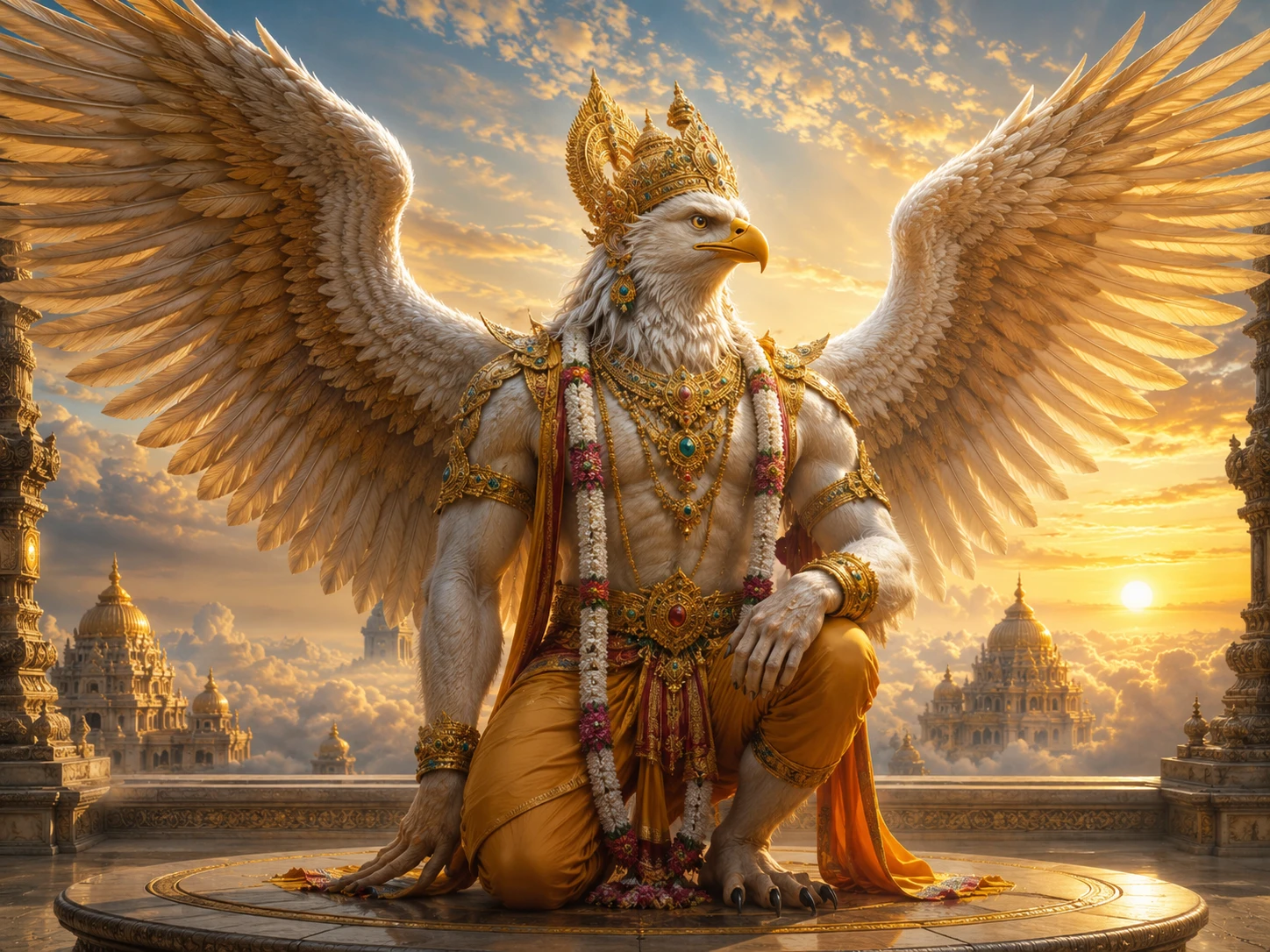
Garuda -- The Divine Eagle
गरुड़ -- दिव्य पक्षीराज
Garuda is the king of birds in Hindu theology, the vahana of Vishnu, and one of the most iconographically widespread deities in the religious landscape of South and Southeast Asia. He is shown across Hindu, Buddhist, and Jain art for over two thousand years, and his image appears today on the coat of arms of Indonesia, on the logo of the Indonesian national airline (named Garuda Indonesia), on the presidential seal of Mongolia, and on the emblems of several Indonesian army units and police divisions. Within India he appears at the gateway of every major Vishnu temple: at Tirumala, at Srirangam, at the Padmanabhaswamy Temple, at the Ranganathaswamy Temple at Srirangapatna, and at thousands of smaller Vaishnava shrines. He is the only Hindu deity to serve as both a mount (ridden by Vishnu) and a devotee (receiving worship in his own right). He is the only Hindu deity whose name is used for an entire Purana. And he is the only Hindu deity whose literary history extends, through textual and iconographic evidence, to the pre-Gupta period of the first centuries CE. Garuda is old, widely distributed, and theologically central.
The birth narrative of Garuda is one of the most dramatic in Hindu mythology, told in detail in the Mahabharata's Adi Parva and retold across the Puranas. The sage Kashyapa had two wives: Kadru, the mother of the nagas (serpents), and Vinata, the mother of Aruna (the dawn) and Garuda. Kadru tricked Vinata into a wager over the colour of the celestial horse Uchchaihshravas; Vinata lost and became enslaved to Kadru and her serpent children. The young Garuda, learning of his mother's bondage, asked the nagas what price would secure her freedom. They named an impossible price: the amrita, the nectar of immortality, which at that time was held in heaven under the guard of Indra and the devas. Garuda accepted the challenge. He flew to heaven, defeated the defences Indra had arranged, seized the amrita-pot, and returned with it. Before handing it to the nagas, he set it down on kusha grass and told them to bathe ritually first. While the serpents bathed, Vishnu arrived and reclaimed the amrita for the devas. The nagas, returning to find the pot gone, tried to lick the grass on which it had sat. The sharp kusha edges split their tongues -- and this, says the text, is the origin of the serpent's forked tongue. Vinata was freed by Garuda's act, and Vishnu, impressed, made Garuda his permanent vahana. The narrative establishes everything central about Garuda: filial devotion, enmity with serpents, alliance with Vishnu, and willingness to challenge heaven itself for what is right.
ॐ तत्पुरुषाय विद्महे सुवर्णपक्षाय धीमहि । तन्नो गरुडः प्रचोदयात् ॥
oṃ tatpuruṣāya vidmahe suvarṇapakṣāya dhīmahi | tanno garuḍaḥ pracodayāt ||
Om. Let us know the great person. Let us meditate upon the one with golden wings. May Garuda kindle our insight.
— Garuda Gayatri, Mahanarayana Upanishad (verse 27 in Taittiriya Aranyaka 10.1)
The iconography of Garuda is distinctive and has remained remarkably consistent across two millennia. He is depicted as a half-human, half-bird figure: the upper body of a powerfully built man, with two arms that may carry a discus, a club, or a water pot, and a lower body with eagle-like talons. His head bears a crown, and from his shoulders extend enormous golden or white wings. His beak is sometimes shown instead of a human mouth, with a sharp curved profile; some iconographic traditions preserve the beak only while others replace it with a human face. His skin is golden, sometimes red or green, depending on the regional tradition. He is typically shown in flight, either carrying Vishnu and Lakshmi on his back or standing in the namaste-mudra position before the deity. In Southeast Asian iconography, particularly in Bali, Java, and Cambodia, Garuda is shown in a more anthropomorphic form, almost humanoid with only the wings indicating his avian nature. The sculpture at Angkor Wat, carved in the twelfth century, shows Garuda-Vishnu in nearly identical posture to Indian sculptures of the same period, suggesting the iconographic template travelled fully-formed from India across the Indian Ocean. The Garuda-stambha, a tall pillar surmounted by Garuda's image, stands before every major Vaishnava temple in India and continues to be erected at new temples today.
The permanent enmity between Garuda and the nagas, established by the amrita narrative, runs through Hindu, Buddhist, and Jain texts. Garuda is the naga-antaka (destroyer of serpents), the bhujaga-bhuj (eater of snakes), and is invoked in mantras for protection against snake venom. The Garuda mantra, extracted from the Garuda Purana, is traditionally used by snakebite victims awaiting medical treatment and by travellers through snake-infested country. Villages in rural India where cobras were a real threat have historically kept small Garuda images at thresholds, and the symbolism continues to appear in popular protection amulets. The Atharva Veda already contains snake-venom mantras that invoke Garuda-like bird deities, suggesting the theological association is pre-Vedic in origin. The theological reading is specific: Garuda represents the aerial principle that defeats the chthonic (earth-bound) principle of the serpent. He represents clarity over coiled confusion, height over depth, swiftness over stealth. A snake-handler in rural Karnataka who wears a Garuda pendant is not performing a superstition unrelated to his work; he is invoking a specific theological symbolism that Hindu tradition has articulated across several thousand years of practical and ritual engagement with serpent dangers. The symbolism does not replace anti-venom treatment. It supplements it with a framework of meaning.
Major Garuda Temples and Shrines
| Site | Location | Significance |
|---|---|---|
| Garuda Sannidhi, Tirumala / गरुड़ सन्निधि, तिरुमाला | Andhra Pradesh / आंध्र प्रदेश | A thousand-year-old Garuda shrine facing Venkateswara at one of India's richest temples. / एक हज़ार साल पुराना गरुड़ मंदिर, जो भारत के सबसे समृद्ध मंदिरों में से एक पर वेंकटेश्वर के सम्मुख है। |
| Garudachala Temple / गरुड़ाचल मंदिर | Tamil Nadu / तमिलनाडु | The Thirukadigai temple at Sholinghur, one of 108 Divya Desams, built on a hill shaped like Garuda. / शोलिंगुर का थिरुकडिगै मंदिर, 108 दिव्य देशमों में से एक, गरुड़ जैसी पहाड़ी पर निर्मित। |
| Garuda Temple, Nagaon / गरुड़ मंदिर, नागाँव | Karnataka / कर्नाटक | One of the few standalone Garuda temples; known for its serpent-protection rituals. / कुछ गिने-चुने स्वतंत्र गरुड़ मंदिरों में से एक; नाग-रक्षा अनुष्ठानों के लिए जाना जाता है। |
| Changu Narayan / चांगु नारायण | Nepal / नेपाल | A fifth-century Vishnu temple where a Garuda statue guards the shrine. UNESCO site. / पाँचवीं सदी का विष्णु मंदिर जहाँ एक गरुड़ मूर्ति मंदिर की रक्षा करती है। यूनेस्को स्थल। |
| Angkor Wat / अंकोर वाट | Cambodia / कंबोडिया | Twelfth-century Khmer temple complex with extensive Garuda-Vishnu sculpture on its galleries. / बारहवीं सदी का ख़मेर मंदिर परिसर जिसकी गैलरियों पर विस्तृत गरुड़-विष्णु मूर्तियाँ हैं। |
Every major Vaishnava temple in India has a Garuda image facing the main sanctum. The Garuda Sevai at Venkateswara Temple, Tirumala, and the Garuda-ratha festival at Srirangam are among the most elaborate Garuda-centric rituals in any Hindu pilgrimage site.
The Garuda Purana is one of the eighteen major Puranas of Hinduism, and in its current form it contains approximately 19,000 verses organized into two sections. It is distinctive because its narrator is Garuda himself, questioning Vishnu on matters of dharma, the afterlife, and cosmology. The Preta Khanda, the second section of the Purana, is specifically focused on what happens to the soul after death: the judgment by Yama, the specific naraks (hells) and svargas (heavens), the timing and nature of pitru rituals, and the path of the soul from this life to the next. For this reason the Garuda Purana is the text most frequently recited after a family bereavement in Hindu tradition. When a Hindu dies, the relatives traditionally arrange a pandit to read the Preta Khanda aloud during the twelve-day mourning period, with family members attending daily sessions. The practice is called Garuda Purana shravana, 'hearing the Garuda Purana.' The purpose is twofold: to help the departing soul understand the path ahead, and to help the surviving family accept the reality of death through a detailed theological framework. The text is long enough that a full reading takes several days; most families do abridged readings, with full readings reserved for elaborate funerals. The Preta Khanda remains widely purchased in paperback editions in Hindi, Tamil, Telugu, and several other Indian languages.
Garuda is the national symbol of Indonesia, appearing on the Pancasila shield that constitutes the country's coat of arms. The Indonesian Garuda holds a banner in its talons reading 'Bhinneka Tunggal Ika' (Unity in Diversity), and the entire emblem synthesises Indonesian Islamic, indigenous, and Hindu-Buddhist heritage. Indonesia is the world's most populous Muslim-majority country, and yet it retained the Hindu deity as its national symbol when it gained independence in 1945 -- a decision made by the founders Sukarno and Hatta specifically to honour the pre-Islamic Hindu-Buddhist heritage of Java, Sumatra, and Bali. The national airline is called Garuda Indonesia, the army has a Garuda Contingent, and the presidential aircraft is named Garuda-1. This cross-religious retention of a Hindu symbol is genuinely unusual in world religious history. Islamic Malaysia does not use a Hindu symbol; Buddhist Thailand uses the Garuda as its royal emblem but with explicit Buddhist reframing. Indonesia's decision to preserve the Hindu identity of the symbol, without syncretic modification, is a specific act of civilisational inheritance. A Jakarta businessman flying Garuda Indonesia home from Singapore is travelling under the name of the divine eagle of Vishnu, and the fact is commemorated in the airline's safety video.
Garuda's role as Vishnu's vahana establishes a structural template that applies across Hindu theology: every major deity has a specific vahana (vehicle), and the vahana's qualities reveal something about the deity. Shiva's vahana is Nandi the bull (steadfast dharma). Lakshmi's is the owl (seeing in darkness). Saraswati's is the swan (discriminating wisdom). Kartikeya's is the peacock (victory over vanity). Brahma's is the hamsa (cosmic swan). Ganesha's is the mouse (the small overcoming the large). Durga's is the lion or tiger (fearlessness). In this scheme, Vishnu's Garuda represents swiftness and elevation -- the qualities needed to preserve the world. A preserver who moves slowly cannot respond to crises; one who stays on the ground cannot see the whole pattern. Vishnu rides Garuda not as a king riding a horse but as a principle mounted on its proper mode of transport. The relationship is taken by Vaishnava theology as theologically foundational. Garuda represents what Vishnu requires to be Vishnu. Without the eagle, the preserver is incomplete. The iconography therefore always shows them together -- Vishnu's stance on Garuda's back is the full visual statement of the deity. Separating them, showing Vishnu standing alone, is a partial representation at most.
The Garuda-stambha outside every major Vishnu temple serves a specific architectural and ritual function. It is a tall pillar, typically of stone, surmounted by a bronze or stone image of Garuda with hands folded in namaskar facing the main sanctum. The devotee entering the temple first offers salutations to Garuda at the stambha; only after this preliminary acknowledgement does the devotee proceed to darshan of Vishnu. The theological logic is that the vahana is a senior devotee whose mediation is required for the main deity's grace to be received. A contemporary scholar of Srivaishnavism in Chennai would describe it precisely: Garuda is the first acharya, and every subsequent acharya-parampara in the Srivaishnava lineage traces itself, at a theological level, through Garuda's discipleship to Vishnu. The Garuda Panchashat and the Garuda Dandaka are two stotras composed by Vedanta Desika in the fourteenth century that formalize this theology. Desika himself credits his poetic ability to Garuda's grace and claims that the stotras were received in vision rather than composed through ordinary inspiration. These stotras are still chanted at major Srivaishnava temples, particularly on Garuda Panchami, the fifth day of the waxing moon in Shravana, which is Garuda's specific festival day.
Garuda appears in the Mahabharata as more than just Vishnu's vahana; he plays specific narrative roles. In the Adi Parva, his birth story is told at length. In the Vana Parva, Krishna tells the Pandavas the story of Garuda-Galava-Vishvamitra, in which Garuda helps the sage Galava pay his guru-dakshina. In the Udyoga Parva, Garuda is present at Krishna's council before the war. Most famously, in the Stri Parva after the war, Garuda carries Krishna to rescue the bodies of dead warriors. The Ramayana also uses Garuda at a specific moment: during the battle with Indrajit, when Rama and Lakshmana fall unconscious under the nagapasha (serpent weapon), Garuda arrives and frees them by his mere presence, because nagas flee from Garuda. This episode, in Valmiki Ramayana's Yuddha Kanda (canto 49), is one of the few in the epic where a deity outside Rama's immediate circle intervenes directly in the action. Garuda's presence there makes a theological point: the weapon of cosmic bondage (nagapasha symbolizing karma's binding) dissolves when the principle of elevation (Garuda as aerial principle) appears. The brothers do not need a counter-weapon; they need only the presence of the right principle. This theological teaching is sometimes invoked in contemporary bhakti commentary to explain why certain spiritual blockages cannot be forced open; they require a shift in orientation rather than a forceful countermove.
Garuda's travel across Southeast Asia during the first millennium CE is one of the best-documented chapters in the spread of Hindu iconography. Sculptures and temple reliefs from Angkor Wat and Angkor Thom in Cambodia, from Prambanan on the island of Java, from the Preah Ko temple complex in pre-Angkor Khmer territory, and from the extensive Borobudur Buddhist complex (where Garuda appears on a Buddhist level with Hindu-derived iconography) testify to a process by which the eagle-deity became regionally central. Archaeologists date the transmission to approximately the fourth to eighth centuries, with iconographic forms stabilising by the time of the great Khmer monuments (ninth to twelfth centuries). The transmission was not uniform; each region adapted the image to its own aesthetic and theological preferences. Balinese Garuda is muscular and golden; Javanese Garuda is more humanoid; Khmer Garuda is taller and more elaborately crowned. The Mongolian Garuda, which appears on the state emblem of the Republic of Mongolia adopted in 1992, is distinctive for appearing over a Buddhist chakra -- reflecting Mongolian Tibetan Buddhism's inheritance of Indian deity iconography via Tibet. A Delhi art historian studying Southeast Asian sculpture will tell you that Garuda is the single most useful image for tracing the path of Hindu cultural transmission eastward: his iconography is distinctive, his ritual significance is specific, and his presence in a region indicates a level of cultural contact more specific than general Buddhist diffusion.
Contemporary Garuda worship in India is concentrated at Tirumala, where the Garuda Sannidhi receives continuous offerings. Devotees visiting Tirumala for Venkateswara darshan stop first at Garuda Sannidhi, present coconuts and offerings, and recite the Garuda Stotram. On Garuda Panchami, the fifth day of the waxing moon in Shravana (usually July or August), the Tirumala temple conducts special Garuda Seva processions in which Venkateswara is taken out on a gold Garuda vahana through the streets of Tirupati. The procession is one of the most elaborate at any Indian temple, with lakhs of pilgrims lining the route. Similar Garuda-seva festivals are held at Srirangam, at the Padmanabhaswamy Temple, and at the smaller Divya Desam sites across Tamil Nadu. For Srivaishnava families, Garuda Panchami is a fast day; simple food is eaten, the Garuda Dandaka is recited, and no new undertakings are begun. The festival has also been revived in recent decades in the Hindu diaspora. ISKCON temples in North America and Europe conduct Garuda-puja on Shravana Panchami; a 2020 observation at the Alachua, Florida ISKCON farm drew roughly 500 devotees. The bird-deity continues to travel. For a person who cannot visit any of these temples in person, a small Garuda image kept on the household puja shelf and addressed each Tuesday (Mangalavara, Garuda's day in some traditions) with a short prayer is the minimal acknowledged observance. The deity does not require scale. Attention matters more.
The Vedic precursor of Garuda appears in the Rig Veda as Suparna, 'the one with beautiful wings,' who flies up to heaven to bring back the Soma plant for the gods. Rig Veda 10.123 and several other hymns describe this bird, and the narrative structurally anticipates the later Mahabharata story of Garuda stealing amrita. Scholars of Vedic literature, including Jan Gonda and Asko Parpola, have traced the continuity: Suparna is the Vedic template; Garuda is the elaborated Puranic figure. The name Suparna itself appears as one of Garuda's epithets in the Mahabharata, and Vishnu Sahasranama lists 'Suparnah' as name number 199 of the thousand names of Vishnu. This preservation of the older name within the composite identity of the later deity is a pattern that runs through Hindu theology: older Vedic forms are rarely discarded; they are retained as specific aspects or epithets within more developed iconographic identities. A student of Sanskrit encountering Garuda in the Adi Parva is therefore also, at an implicit textual level, encountering a figure whose wing-flight to heaven echoes the ancient Vedic bird who brought Soma down. The continuity runs for nearly three thousand years of documented religious history.
For a contemporary Hindu who wants to begin a Garuda practice, the entry point is protection and focus. Sit before any image of Vishnu or Krishna with Garuda carved at the base. Light a small oil lamp. Recite the Garuda Gayatri three times: Om Tatpurushaya Vidmahe, Suvarnapakshaya Dhimahi, Tanno Garudah Prachodayat. Then recite the Garuda Panchashat of Vedanta Desika if available (or simply read a few verses from the Garuda Purana, which is freely available in digital form). Sit for two minutes visualizing an eagle in flight, the wings extended, the body ascending. The practice is particularly recommended for Hindus dealing with workplace conflict, family tensions, or unresolved grievances; the theological logic is that Garuda's quality of rising above earth-bound complications is what the practitioner temporarily borrows during the practice. A second practice, specifically for those suffering from snake phobia or fear of pests, is to keep a small Garuda image at the entrance of the home or under the pillow during sleep. The protection is not literal talismanic; it is the tradition's way of naming a quality -- fearlessness against creeping threats -- and using an image to anchor the quality in the mind. A Delhi executive who has a panic response to discovering a lizard in her apartment may find, after a few days of this practice, that her response moderates. The deity cooperates with intention. The bird-deity does not demand elaborate ritual infrastructure; he asks only for the mental posture of rising.
Recite the Garuda Gayatri on Garuda Panchami
Chant the Garuda Gayatri 108 times on a mala on Garuda Panchami (Shravana Shukla Panchami) or on any Tuesday. It is traditionally recited for protection on journeys and from snakes, and for swift clarity. The Garuda Gayatri is not yet on Eternal Raga; the mantra library has Vishnu's hymns.
Tags
Eternal Raga · शाश्वत राग
Institutional voice — scholarly articles on Sanatan Dharma
Deepen Your Understanding
अपनी समझ और गहरी करें
scriptural exegesis
Samudra Manthan -- When Gods and Demons Ran a Joint Venture and the Universe Almost Died
A cosmic ocean. A mountain for a churning rod. A serpent king for a rope. Gods on one end, demons on the other. And out came 14 treasures -- including wealth, beauty, medicine, immortality, and one poison so lethal it could end creation itself. The Samudra Manthan is not mythology. It is the original playbook for collaboration, crisis management, and how to handle it when your joint venture partner tries to cheat you.
deities avatars
Dashavatara -- Why Vishnu Comes Back Ten Times
Fish, tortoise, boar, half-lion, dwarf, axe-warrior, prince, cowherd, enlightened teacher, future horseman. The ten avatars of Vishnu are not random folklore. Read them in sequence and you get something startling -- a narrative that mirrors evolutionary biology, tracks the rise and fall of political systems, and argues that God does not sit above history but enters it, gets dirty, and does the work. The Dashavatara is Hinduism's answer to the question every civilisation asks: why does the world keep breaking, and who fixes it?
scriptural exegesis
Krishna's 16,108 Queens -- The Story Behind the Number
The number sounds absurd until you understand what it means. Krishna did not 'collect' 16,108 wives. He rescued 16,100 women from a demon's prison, and when no one in society would accept them back -- because they were 'tainted' -- he married every single one to restore their honour. Add 8 named queens (the Ashtabharya) married through love, valour, or diplomacy, and you get the most misunderstood number in Hindu mythology. This is not a harem story. It is the largest social rehabilitation programme in ancient literature.
deities avatars
Narayana -- Cosmic Vishnu Beyond Avatara
Before Krishna lifted Govardhan and Rama crossed the ocean, there was Narayana lying on the serpent Ananta in the milk ocean. The avatars come and go. Narayana remains. This is the theological Vishnu at the base of every Vaishnava tradition, from Ramanuja's Sri Vaishnavism to the Badrinath pilgrimage to the Ashtakshari mantra every devotee chants.
rituals traditions
Tirtha Yatra -- Why Hindus Travel to Get Closer to God
The word 'Tirtha' does not mean 'holy place.' It means 'crossing point' -- a ford where the river of worldly existence can be crossed to reach the far shore of liberation. Hindu pilgrimage is not tourism with a spiritual label. It is the deliberate journey to locations where the boundary between the material and the divine is believed to be thinnest -- where the crossing is easiest. From Kashi to Kailash, from Char Dham to Kumbh Mela, the tradition maps a sacred geography onto the physical landscape of the subcontinent, turning the act of travel itself into a spiritual practice.
tantra mantra yantra
Mahamrityunjaya Mantra -- Conquering Death
A 16-year-old boy clings to a Shiva Linga as the god of death throws a noose around his neck. Shiva emerges from the Linga, kicks Yama in the chest, and declares the boy immortal. That boy is Markandeya. That mantra is the Mahamrityunjaya. It appears in the Rig Veda, the Yajur Veda, and the Atharva Veda -- the only healing mantra attested in three of the four Vedas. It is chanted in ICU corridors, before surgeries, at bedsides, and in cremation grounds. This is not a mantra about avoiding death. It is a mantra about not being afraid of it.
Garuda is the national symbol of Indonesia, appearing on the Pancasila shield that constitutes the country's coat of arms. The Indonesian Garuda holds a banner in its talons reading 'Bhinneka Tunggal Ika' (Unity in Diver…
More in Deities & Avatars
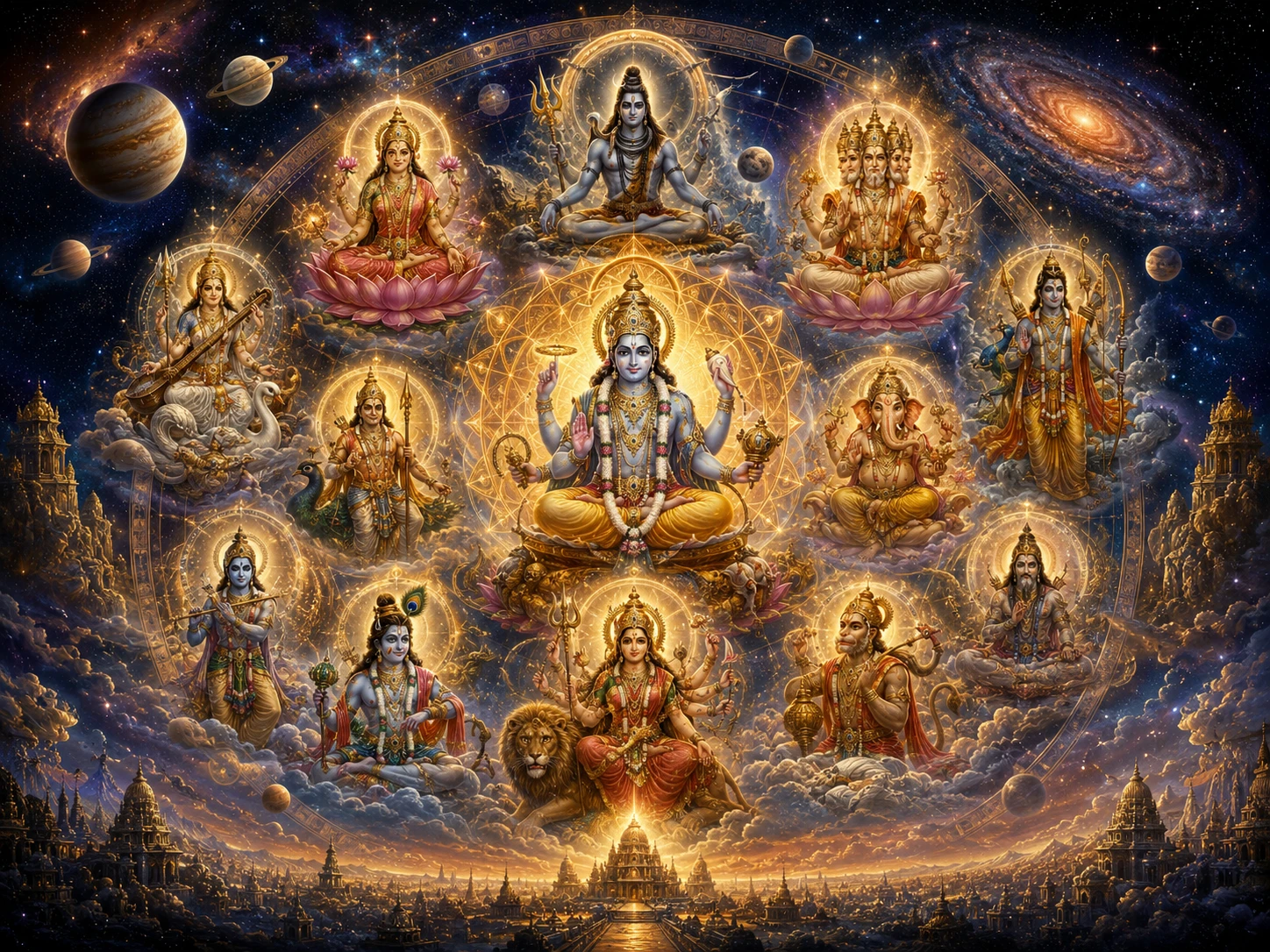
33 Koti Devata -- Why Hinduism Has 33 Types of Gods, Not 33 Crore
13 min read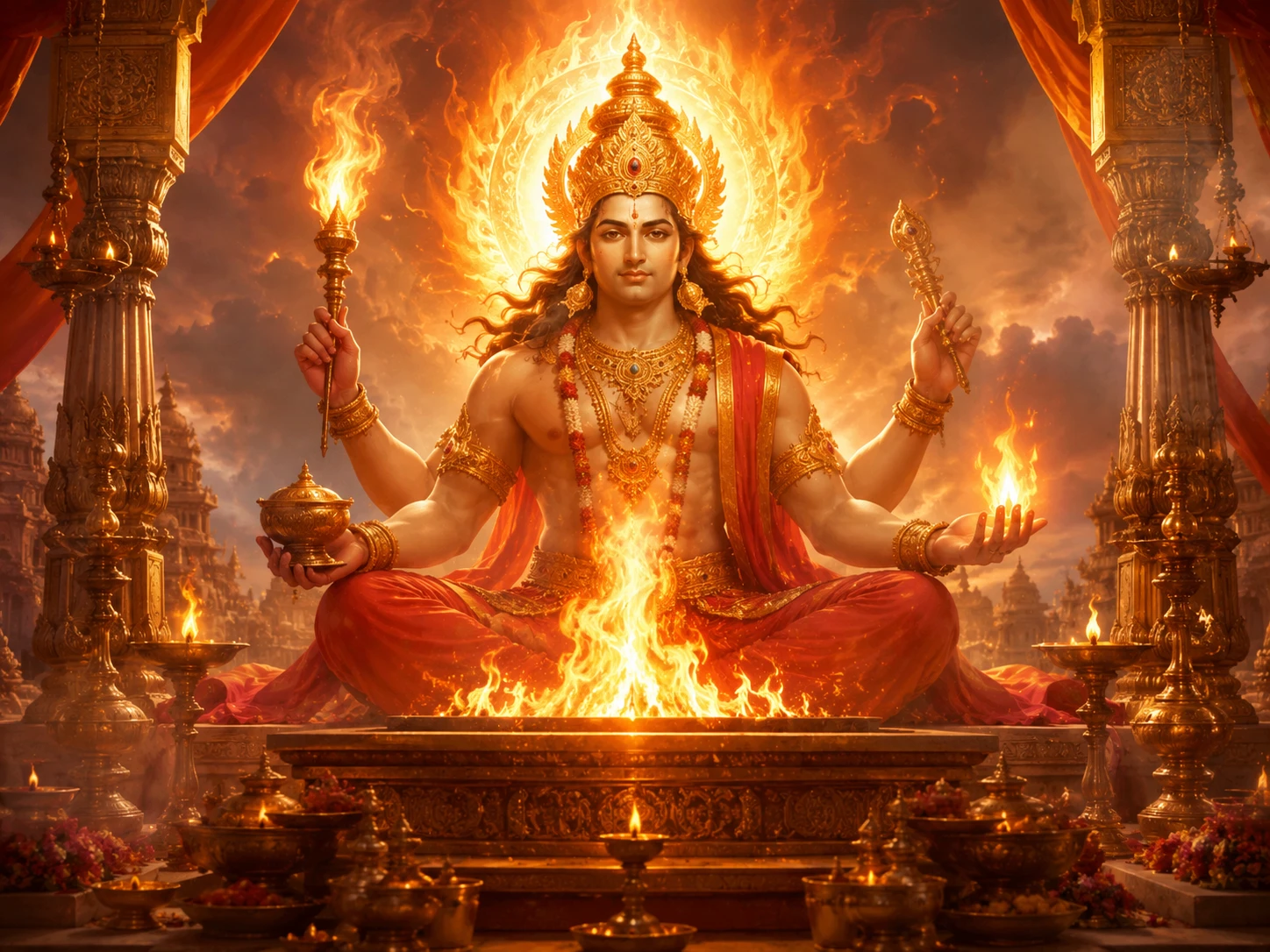
Agni -- The Fire God
19 min read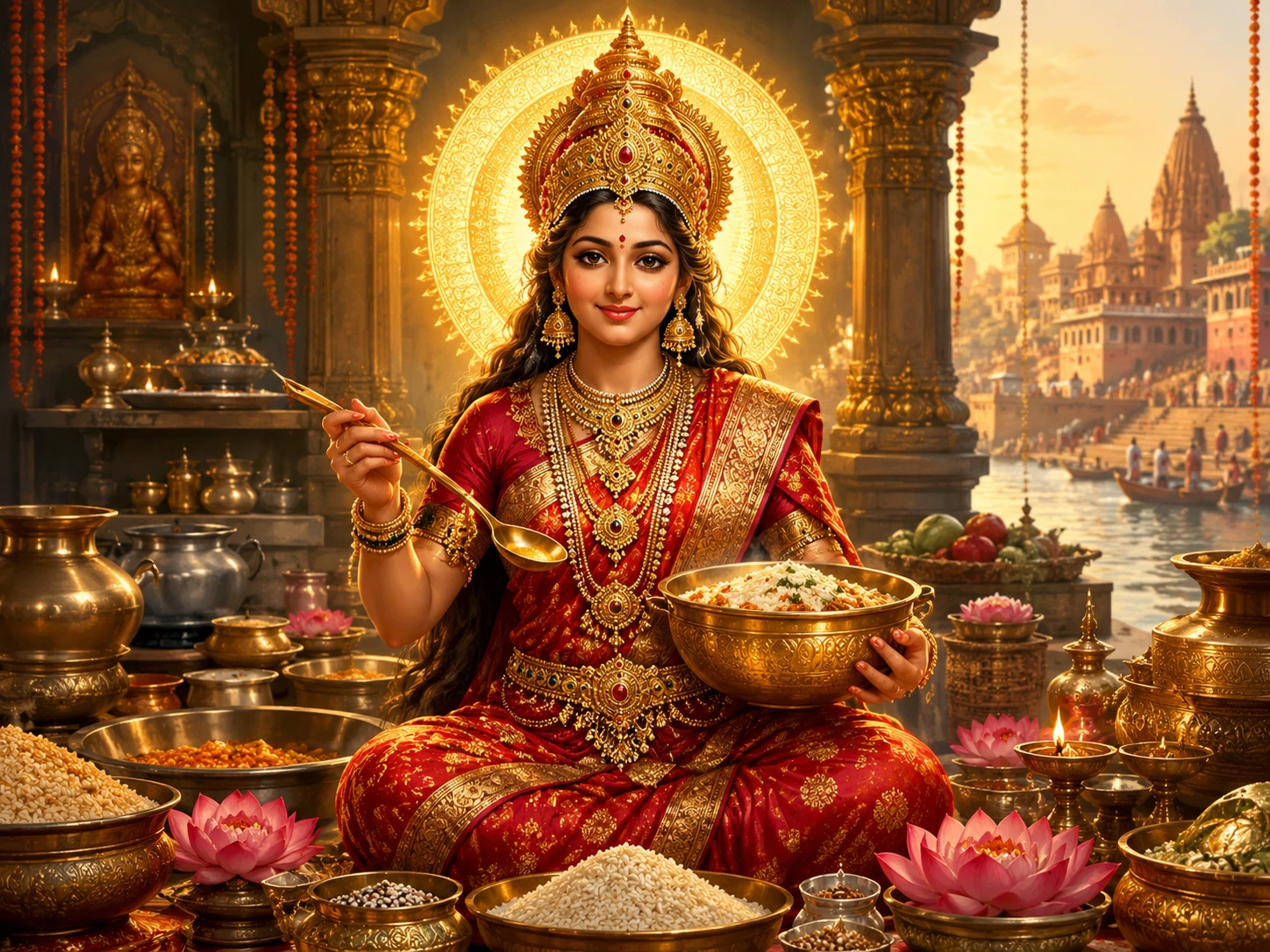
Annapurna -- Goddess of Food
19 min readThe same translation error that turned '33 Koti' into '33 crore' in Hinduism also happened in Buddhism. The Chinese translation of Buddhist texts rendered 'Sapta Koti Buddha' (7 Supreme Buddhas) as '7 Crore Buddhas.' The…
Deities AvatarsCommunity Reflections
🕉️
Be the first to share your reflection.