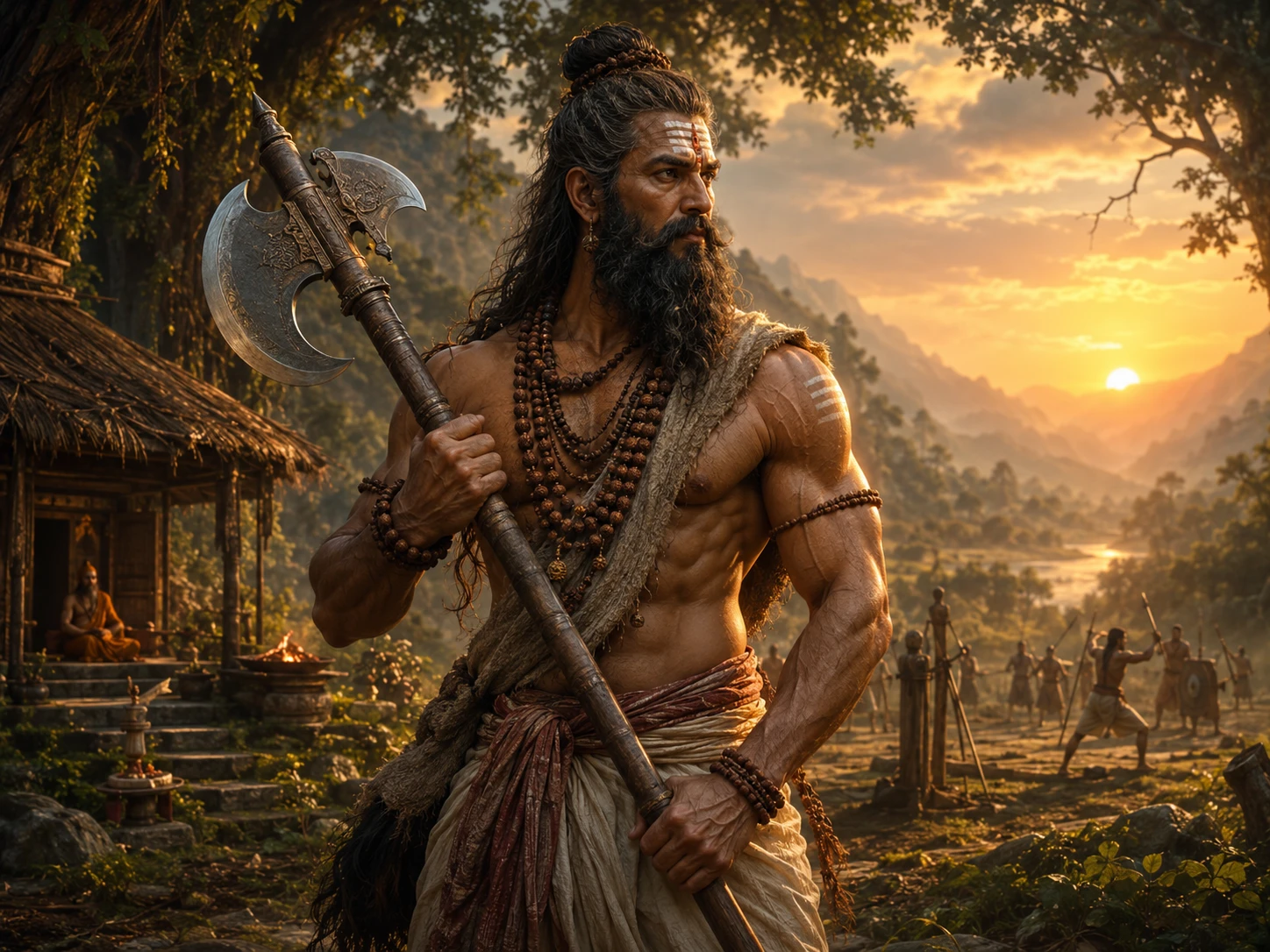
Parashurama -- The Immortal Warrior-Brahmin
परशुराम -- अमर योद्धा-ब्राह्मण
Parashurama is the sixth avatar of Vishnu in the classical dashavatara list, distinguished from the other avatars by his specifically brahmin origin and his armed-brahmin character. His name combines parashu (axe) and Rama (another common divine name meaning 'the delightful one'), giving 'Rama-with-the-axe.' He is, in Vaishnava understanding, the avatar who appears when the kshatriya varna (warrior caste) has become so corrupt that cosmic order cannot be restored through any ordinary means; Vishnu then takes birth in a brahmin household and acts with warrior force to reset the social equilibrium. His narrative is told at length in the Mahabharata (especially in the Vana Parva and the Shanti Parva), in the Ramayana (his encounter with Rama Dasharatha), in the Bhagavata Purana, and in regional texts specific to the Konkan and Kerala coasts. Parashurama is among the most theologically complex of the avatars because he violates the normative Hindu expectation that brahmins should confine themselves to scholarship and ritual while kshatriyas engage in warfare; his very existence is a corrective to that norm during periods when kshatriya dharma has collapsed. He is, in this specific sense, the brahmin-who-fights, and his axe is the tool of that unusual theological category.
Parashurama was born to the sage Jamadagni and his wife Renuka. Jamadagni was one of the seven great sages of the Saptarishi and descendant of Bhrigu, one of the mind-born sons of Brahma. Renuka was the daughter of King Prasenajit of the Ikshvaku dynasty, making her a princess who had married a sage. Their fifth son, Rama (later called Parashurama), was born at their ashram near the Malaprabha river in the present-day Karnataka region. As a boy, Parashurama performed intense tapas directed toward Shiva, who eventually appeared and granted him the parashu (a specific divine battle-axe) along with mastery of all forms of weapons and divine astras. This weapon-mastery at a brahmin's hermitage marked Parashurama as theologically unusual even as a child. The immediate trigger for his famous cleansing of the earth came from a specific incident: the king Kartavirya Arjuna, a thousand-armed ruler who had received a boon that he could conquer all opposition, visited Jamadagni's ashram and was hosted with the aid of the miraculous cow Kamadhenu, whom Jamadagni owned. Impressed by the cow's ability to provide unlimited food, Kartavirya Arjuna demanded she be given to him. Jamadagni refused. The king attacked the ashram, seized the cow by force, and killed the sage. Parashurama, returning to find his father dead, vowed to eliminate the adharmic kshatriya class that had produced such a king.
ॐ जामदग्न्याय विद्महे महावीराय धीमहि । तन्नो परशुरामः प्रचोदयात् ॥
oṃ jāmadagnyāya vidmahe mahāvīrāya dhīmahi | tanno paraśurāmaḥ pracodayāt ||
Om. Let us know the son of Jamadagni. Let us meditate upon the great warrior. May Parashurama kindle our insight.
— Parashurama Gayatri Mantra (traditional Smarta corpus; widely recited at Akshaya Tritiya and among Konkan-Kerala Vaishnava communities)
The narrative of Parashurama's twenty-one rounds of kshatriya-cleansing is theologically specific and worth examining carefully. The Mahabharata's Vana Parva (chapter 117) and the Bhagavata Purana (canto 9, adhyaya 16) recount that after his father's death, Parashurama first killed Kartavirya Arjuna and his army. But then, because Kartavirya Arjuna's descendants continued to produce adharmic kshatriyas generation after generation, Parashurama systematically eliminated kshatriya kings twenty-one times over approximately seven generations, each time allowing kshatriya dharma to be re-established before finding it necessary to intervene again. The number 21 is not literal; Hindu tradition uses it to indicate complete and definitive action. After each cleansing, kshatriya women who had escaped gave birth to new kshatriya lineages, and dharma slowly reconstituted. The theological point is that Parashurama's cleansing was not vengeance but corrective structural action; he did not eliminate kshatriyas as a varna but only those specific individuals whose adharma had made them a cosmic threat. The tradition carefully preserves the distinction: good kshatriyas, including those who eventually produced Rama of Ayodhya, were never targets. The cleansings are mentioned without moral comment in the texts; they are presented as necessary cosmic maintenance, like the periodic pralaya (cosmic dissolution) that ends each kalpa. A contemporary Hindu reading these narratives with modern political sensibilities may find them troubling, but the classical framing is not about ethnic violence; it is about the specific theology of how cosmic order is restored when the warrior varna has collectively defaulted on its dharmic obligations.
The Konkan-Kerala creation legend, preserved in the Kerala Mahatmya section of the Skanda Purana and in regional oral traditions, is the most distinctive element of Parashurama's narrative and the reason he is particularly revered in the Konkan and Kerala coasts. After completing his twenty-one cleansings of adharmic kshatriyas, Parashurama approached the sage Varuna (the lord of waters) and requested a piece of land on which he could perform atonement tapas for the violence of his mission, even though it had been dharmically necessary. Varuna granted the request by agreeing that wherever Parashurama threw his axe, the sea would retreat. Parashurama ascended to the Sahyadri ranges (the Western Ghats) and threw his axe westward into the sea. The sea retreated approximately 160 kilometres, creating the coastal strip that now extends from Gujarat's Saurashtra through Maharashtra, Goa, Karnataka, and Kerala to Kanyakumari. This landmass is the Parashurama Kshetra. The legend is geographically specific enough that every village and town on the Konkan-Kerala coast has a local origin story connecting it to Parashurama's creation. Konkanis and Keralans across caste lines consider themselves, in some sense, inhabitants of Parashurama's gift-land. Contemporary geographic scholarship has documented that the western coastal plain of India did in fact emerge through gradual sea-level change over the last 10,000 years, though the precise correlation with the mythological narrative is left to interpretation. The theological point is not geology but relationship: the Konkan and Kerala coasts exist, in traditional belief, because of Parashurama's specific gift.
Parashurama's Major Appearances Across Hindu Epics
| Text | Episode | Significance |
|---|---|---|
| Mahabharata / महाभारत | Teacher of Bhishma, Drona, Karna / भीष्म, द्रोण, कर्ण के शिक्षक | Trained the greatest warriors of the war; his instruction shaped the epic's combat. / युद्ध के सबसे महान योद्धाओं को प्रशिक्षित किया; उनकी शिक्षा ने महाकाव्य के युद्ध को आकार दिया। |
| Ramayana / रामायण | Challenge to Rama Dasharatha / राम दशरथ को चुनौती | Appears after Sita's swayamvara; Rama breaks his Vishnu-bow, confirming Rama as the next avatar. / सीता-स्वयंवर के बाद प्रकट होते हैं; राम उनका विष्णु-धनुष तोड़ते हैं, राम को अगले अवतार के रूप में पुष्टि करते हुए। |
| Bhagavata Purana / भागवत पुराण | 21 cleansings and Konkan creation / 21 सफ़ाइयाँ और कोंकण सृष्टि | Canto 9 adhyaya 16 narrates the full avatar-sequence; authoritative for his cosmic role. / स्कंध 9 अध्याय 16 पूर्ण अवतार-क्रम कहता है; उनकी ब्रह्मांडीय भूमिका के लिए प्रामाणिक। |
| Mahabharata Karna-Parva / महाभारत कर्ण पर्व | Karna's curse / कर्ण का शाप | Parashurama curses Karna to forget his weapons at the critical moment, affecting the war's outcome. / परशुराम कर्ण को शाप देते हैं कि वह महत्वपूर्ण क्षण पर अपने शस्त्र भूल जाए, युद्ध के परिणाम को प्रभावित करते हुए। |
| Kerala Mahatmya / केरल महात्म्य | Creation of the Konkan-Kerala coast / कोंकण-केरल तट की सृष्टि | The land's origin story; basis of regional religious identity. / भूमि की उद्गम-कथा; क्षेत्रीय धार्मिक पहचान का आधार। |
Parashurama's unusual longevity -- he appears across the Ramayana (treta yuga), Mahabharata (dvapara yuga), and is said to be still alive in the current kali yuga -- is explained by his chiranjeevi (immortal) status, one of seven traditionally listed immortals in Hindu scripture. This cross-yuga presence makes him unique among the avatars; no other avatar of Vishnu persists across cosmic ages.
The Ramayana encounter between Parashurama and Rama Dasharatha is one of the most theologically significant moments in the epic and deserves careful examination. Immediately after Sita's swayamvara in Mithila, where Rama had broken Shiva's bow, the wedding party was travelling back to Ayodhya when Parashurama confronted them. He had heard about the breaking of Shiva's bow, considered this an insult to his own guru (since Shiva had given him his axe), and appeared with Vishnu's own bow in hand, challenging Rama to string it. The theological tension is precise: Parashurama, the current Vishnu-avatar, is challenging Rama, the next Vishnu-avatar, to prove his identity. Rama accepted the bow, strung it, drew an arrow, and announced that he would release it at some target. Parashurama, recognizing the arrow's divine force, acknowledged Rama's status as the incarnation of the same Vishnu whose power had previously animated him, and made a choice: he gave Rama the siddhis (spiritual attainments) he had himself accumulated through tapas, and retired to Mahendra mountain. The scene establishes that Parashurama's avatar-mission had concluded and that Rama was now the operative Vishnu in the world. The passing of divine authority from one avatar to the next is a rare scene in Hindu mythology; it occurs explicitly only here. Parashurama's gracious acceptance of his successor, without ego or resistance, is considered a model of spiritual maturity. The tradition reads this moment as instructional for all those who must recognize when their work is complete and withdraw to allow the next generation to act.
Parashurama's role as guru to Bhishma, Drona, and Karna in the Mahabharata is one of the epic's most tragic sub-narratives. Bhishma, the grand-uncle of both the Pandavas and the Kauravas, learned his military science and statecraft from Parashurama, and their relationship ended in a formal duel at Kurukshetra (separate from the main Kurukshetra war) in which Parashurama was eventually forced to concede. Drona, the military preceptor of both the Pandavas and Kauravas, likewise learned from Parashurama, who gave him the full range of divine astras. Drona's skill in battle was therefore directly traceable to his Parashurama-training. Karna's relationship with Parashurama was the most tragic of the three. Karna, born to Kunti before her marriage to Pandu, was raised by a sut (charioteer) family and therefore socially classed as a non-kshatriya, which debarred him from certain advanced weapons-training that only kshatriyas received. Karna disguised himself as a brahmin and went to Parashurama, who -- as the brahmin-friend deity -- agreed to teach him. Toward the end of the training, Parashurama learned that Karna was not actually a brahmin and cursed him: Karna would forget his divine mantras at the moment he most needed them. This curse would later determine the outcome of the Kurukshetra war; Karna, unable to remember his weapon-mantras during his final combat with Arjuna, died with the curse in effect. The Parashurama-Karna relationship is read in Indian tradition as a teaching about the limits of honesty and the cost of deception even in the service of worthy ends.
Parashurama is one of the seven chiranjeevis (immortals) of Hindu tradition, alongside Ashwatthama (son of Drona), King Mahabali, Vibhishana (Ravana's virtuous brother), Hanuman, Vyasa (compiler of the Vedas), and Kripa (teacher of the Pandavas). The traditional list is encoded in a memorized Sanskrit verse: ashwatthama-balir-vyaso-hanumanshcha-vibhishanah, kripah-parashuramashcha-saptaite-chiranjeevinah. Each of the seven has been granted, through some specific divine arrangement, the privilege of life spanning multiple yugas. Parashurama is specifically said to still reside on Mahendragiri (a hill on the border of present-day Andhra Pradesh and Odisha), where he performs eternal tapas. In some traditions, it is said that Parashurama will emerge again at the transition from Kali Yuga to the next Satya Yuga, as the guru of Kalki, the future tenth avatar. The Odisha-Andhra border region contains several small shrines dedicated to Parashurama's current residence; the Mahendragiri hill itself is a minor pilgrimage site during Akshaya Tritiya (Parashurama Jayanti). The chiranjeevi tradition is theologically specific: these seven are not gods but mortal beings granted extended life, serving as permanent reference-points for the world across cosmic ages. Their continued presence is said to guarantee that dharma can never fully disappear from earth. A North Indian devotee visiting Haridwar or Rishikesh who is told by a pandit that Parashurama may appear at any moment as a mysterious warrior-brahmin is hearing a teaching whose origins are specifically Puranic and still theologically live.
Parashurama Jayanti falls on Akshaya Tritiya, the third day of the waxing moon in Vaishakha (April-May), one of the most auspicious days in the Hindu calendar. The date is traditionally considered the day of Parashurama's birth, and the combination of his Jayanti with Akshaya Tritiya's general auspiciousness makes this day particularly important in regions with strong Parashurama traditions -- specifically the Konkan (Maharashtra, Goa, Karnataka coast) and Kerala. In Maharashtra, the festival is observed in Brahmin communities, particularly those tracing lineage to the Chitpavan Brahmins (a Konkan brahmin community that traditionally traces its origin to Parashurama). Chitpavan families perform a specific Parashurama puja on this day, often at family shrines where a small Parashurama image is installed, and visit the Parashuram temple at Lote Parshuram near Chiplun in Maharashtra's Ratnagiri district -- one of the most important Parashurama pilgrimage sites. In Kerala, the festival is observed at temples dedicated to Parashurama at Thiruvallam, near Thiruvananthapuram, and at Parashurama temples at Kollam, Ernakulam, and several other coastal towns. The day's observance includes morning bath in the sea (if near the coast), recitation of the Parashurama Gayatri 108 times, offering of coconuts and specific seasonal fruits, and reflection on the Parashurama theology of dharmic correction. For Keralans and Konkanis, Akshaya Tritiya is also a day of gratitude for the land itself: the sea that Parashurama pushed back is the sea whose proximity defines coastal Indian identity to this day.
The theology of Parashurama's relationship with his mother Renuka and her death deserves specific attention as one of the most morally complex episodes in Hindu mythology. Renuka was the daughter of King Prasenajit and had married the sage Jamadagni. The Mahabharata and the Brahmanda Purana tell the story that Renuka's power of chastity was such that she could carry water from the river in an unbaked earthen pot, the grains of the pot holding together through her spiritual force. One morning, while fetching water, she caught sight of the gandharva king Chitraratha bathing in the river with his wives and felt, for one brief moment, an admiring glance. The unbaked pot immediately crumbled, and her spiritual power was compromised. Jamadagni, detecting the failure, ordered his sons one by one to kill their mother as punishment. Four sons refused, and Jamadagni cursed them to insanity. Parashurama, the fifth son, obeyed his father's order and beheaded Renuka with his axe. Satisfied with Parashurama's obedience, Jamadagni offered him any boon; Parashurama requested his mother's restoration and his brothers' sanity, and the sage granted both. Renuka was restored to full life and power. The theology of this episode is widely debated in Hindu commentary. The orthodox reading holds that Parashurama's obedience to his father was absolute dharma, and his request to restore his mother shows that the violence was not his intent but his father's command. A feminist reading critiques the episode as demonstrating the hierarchical subordination of women in classical Hindu patriarchy. Both readings are available in the tradition; contemporary Hindus who engage with this narrative must choose their own interpretation.
The Chitpavan Brahmin community of the Konkan region traces its origin directly to Parashurama and maintains an active devotional relationship with the deity to this day. According to the Sahyadri Khanda of the Skanda Purana, after creating the Konkan land by pushing back the sea, Parashurama found no brahmins living there to perform the required rituals and yajnas. He therefore resurrected fourteen corpses found on the coast, purified them through specific rituals, and established them as the first brahmins of the newly created land. These fourteen became the ancestors of the Chitpavan Brahmins (chit-pavan meaning 'pure from the pyre'). The community, historically concentrated in Maharashtra's Konkan coast and spreading inland to Pune and neighbouring districts, has been culturally and politically influential in modern Indian history; several key figures of the Indian independence movement (including Lokmanya Tilak and V.D. Savarkar) were Chitpavan Brahmins. The community maintains specific Parashurama-related customs: annual pilgrimages to Parashurama temples on Akshaya Tritiya, specific wedding rituals invoking Parashurama as the community's original ancestor, and household shrines where Parashurama occupies a central place. The 2020 census estimated the Chitpavan population at approximately 2 million across India and the diaspora. Their continuous Parashurama-worship across the past 1,500 years (the community's earliest documentation) represents one of the longest-running localized deity-lineage relationships in Hindu tradition. A young Chitpavan professional working in Mumbai today is, at the ancestral level, continuing a lineage her family traces directly to Parashurama's specific act of community-creation.
Major Parashurama temples in India, beyond the Konkan-Kerala heartland, include the Lote Parshuram temple near Chiplun in Maharashtra's Ratnagiri district (considered the most important Parashurama shrine in the country, with a specific stone-image of the deity said to have emerged self-manifested); the Parashurama Temple at Thiruvallam near Thiruvananthapuram, Kerala, dating to the eighth century and maintained by the Kerala temple board; the Akhandalamani Temple at Aradi in Odisha's Bhadrak district, which combines Parashurama veneration with Shiva worship; and the Parashurama Kund in Arunachal Pradesh's Lohit district, a remote pilgrimage site where tradition holds that Parashurama washed away his guilt from the killing of his mother by bathing in the kund. Thousands of smaller shrines are dispersed across coastal and inland India, typically associated with local kshatriya-brahmin settlement histories or with Akshaya Tritiya observance traditions. Unlike the major Shaiva or Vaishnava temple networks, Parashurama temples tend to be regional rather than pan-Indian pilgrimage circuits; they serve specific community traditions rather than general Hindu devotion. A Chitpavan Brahmin from Pune, an Odia devotee from Bhadrak, a Nair Malayalee from Thiruvananthapuram, and an Arunachali pilgrim at Parashurama Kund are all Parashurama-devotees, but their specific sampradayas, narratives, and ritual practices have developed regionally. The common thread is the deity himself; the variations reflect the immense geographic and cultural diversity of the Indian subcontinent that his mission-land covers.
The modern political and cultural uses of Parashurama iconography deserve acknowledgment. In recent decades, Parashurama has been invoked by specific brahmin community organizations and by certain political movements, particularly in Maharashtra, Gujarat, and Uttar Pradesh, where a large Parashurama statue was unveiled at Jewar in 2023 and became a subject of extensive public commentary. Some contemporary uses emphasize Parashurama's armed-brahmin identity in ways that raise concerns among scholars and commentators about selective historical reading. The classical texts are theologically specific: Parashurama is a cosmic-order-restorer, not a communal symbol, and his narrative makes explicit that his targets were specific adharmic individuals rather than any caste, ethnic group, or religious community. A mature contemporary engagement with Parashurama theology would preserve this distinction: the deity can be legitimately invoked for the cultivation of righteous courage, for the protection of dharma against specific adharmic actors, and for the honouring of brahmin-warrior synthesis as a valid if unusual theological category. He cannot be legitimately invoked as a communal symbol or as authorization for violence against any group defined by identity rather than by action. The classical narrative is quite clear on this point. Whether contemporary uses honour the classical distinction is a matter of ongoing public discussion in India, and thoughtful Hindus are divided on the question. Parashurama's own teaching -- that he retired from action once his mission was complete and recognized his successor without resistance -- suggests a model of spiritual maturity that contemporary political uses often forget.
For a contemporary Hindu who wants to begin a Parashurama practice, the entry point is specific to intention. For those seeking inner strength and the willingness to confront injustice where it appears, the recommended practice is the recitation of the Parashurama Gayatri 108 times on Tuesdays or on Akshaya Tritiya, with reflection on specific situations in one's own life that call for courageous action. For those of Chitpavan or Kerala Konkani background, traditional family practices should be honoured: attendance at the community's annual Akshaya Tritiya observance, visits to regional Parashurama temples, and participation in the specific ritual customs the community has preserved. For those interested in the martial-spiritual synthesis Parashurama represents, the practice extends into the study of traditional Indian martial arts -- Kalaripayattu in Kerala, Mardani Khel in Maharashtra -- which in their classical forms trace their lineage to Parashurama's teaching. For general Hindu practice, a pilgrimage to any major Parashurama temple (Lote Parshuram in Maharashtra, Thiruvallam in Kerala, Parashurama Kund in Arunachal Pradesh) is recommended at least once in a lifetime, ideally on Akshaya Tritiya. The deity does not demand constant daily attention; his theology emphasizes decisive action at specific moments rather than continuous devotional routine. What he asks is that the devotee, when the moment for righteous action arrives, respond fully and without hesitation -- and then, when the mission is complete, withdraw with calm and let the next agent do the next thing. That is the Parashurama discipline.
Recite the Parashurama Gayatri on Akshaya Tritiya
Chant the Parashurama Gayatri 108 times on a mala on Akshaya Tritiya (Vaishakha Shukla Tritiya, also Parashurama Jayanti), on Tuesdays, and before any situation that calls for courageous, righteous action. It is not yet on Eternal Raga; the mantra library has Vishnu's hymns.
Tags
Eternal Raga · शाश्वत राग
Institutional voice — scholarly articles on Sanatan Dharma
Deepen Your Understanding
अपनी समझ और गहरी करें
deities avatars
Dashavatara -- Why Vishnu Comes Back Ten Times
Fish, tortoise, boar, half-lion, dwarf, axe-warrior, prince, cowherd, enlightened teacher, future horseman. The ten avatars of Vishnu are not random folklore. Read them in sequence and you get something startling -- a narrative that mirrors evolutionary biology, tracks the rise and fall of political systems, and argues that God does not sit above history but enters it, gets dirty, and does the work. The Dashavatara is Hinduism's answer to the question every civilisation asks: why does the world keep breaking, and who fixes it?
deities avatars
Narayana -- Cosmic Vishnu Beyond Avatara
Before Krishna lifted Govardhan and Rama crossed the ocean, there was Narayana lying on the serpent Ananta in the milk ocean. The avatars come and go. Narayana remains. This is the theological Vishnu at the base of every Vaishnava tradition, from Ramanuja's Sri Vaishnavism to the Badrinath pilgrimage to the Ashtakshari mantra every devotee chants.
deities avatars
Matsya Avatar -- The Fish Who Saved the World from the Flood
A tiny fish asks a king for protection, outgrows every vessel he puts it in, and turns out to be Vishnu, come to carry the seeds of a new world through the flood. The first of the ten avatars, from its earliest telling in the Shatapatha Brahmana to the Bhagavata Purana.
deities avatars
Who is Shiva?
He is the ash-smeared ascetic who is also the ideal husband. The destroyer of the universe who is called 'The Auspicious One.' The god of death who drank poison to save all life. He sits in meditation on a Himalayan peak, and simultaneously dances the cosmos into existence and annihilation. No deity in Hinduism contains more contradictions -- and no deity resolves them more completely. This is not a mythology explainer. This is an attempt to stand at the foot of the mountain and look up.
rituals traditions
Guru Purnima -- The Full Moon of the Teacher
On the full moon of Ashadha, Hindus honour the guru -- and through every teacher, the sage Vyasa, who arranged the Vedas and composed the Mahabharata. Why the day is also called Vyasa Purnima, what the word guru means, and how the day is kept.
rituals traditions
Tirtha Yatra -- Why Hindus Travel to Get Closer to God
The word 'Tirtha' does not mean 'holy place.' It means 'crossing point' -- a ford where the river of worldly existence can be crossed to reach the far shore of liberation. Hindu pilgrimage is not tourism with a spiritual label. It is the deliberate journey to locations where the boundary between the material and the divine is believed to be thinnest -- where the crossing is easiest. From Kashi to Kailash, from Char Dham to Kumbh Mela, the tradition maps a sacred geography onto the physical landscape of the subcontinent, turning the act of travel itself into a spiritual practice.
Parashurama is one of the seven chiranjeevis (immortals) of Hindu tradition, alongside Ashwatthama (son of Drona), King Mahabali, Vibhishana (Ravana's virtuous brother), Hanuman, Vyasa (compiler of the Vedas), and Kripa …
More in Deities & Avatars
33 Koti Devata -- Why Hinduism Has 33 Types of Gods, Not 33 Crore
13 min read
Agni -- The Fire God
19 min read
Annapurna -- Goddess of Food
19 min readThe same translation error that turned '33 Koti' into '33 crore' in Hinduism also happened in Buddhism. The Chinese translation of Buddhist texts rendered 'Sapta Koti Buddha' (7 Supreme Buddhas) as '7 Crore Buddhas.' The…
Deities AvatarsCommunity Reflections
🕉️
Be the first to share your reflection.