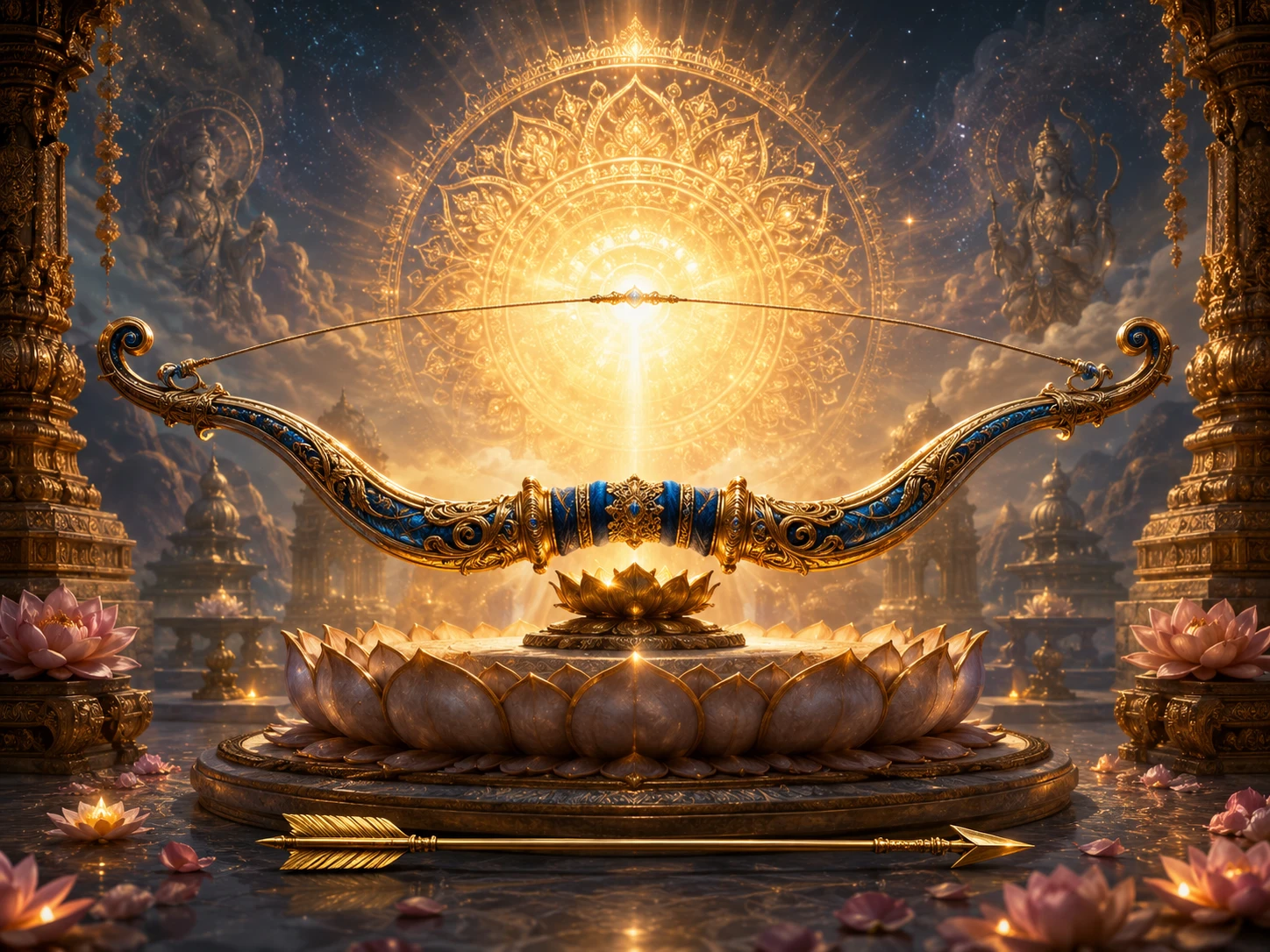
The Bow as Master-Symbol -- Why Hindu Civilisation Made Archery the Image of Everything
धनुष: प्रमुख प्रतीक -- हिन्दू सभ्यता ने धनुर्विद्या को हर वस्तु का प्रतिरूप क्यों बनाया
The Weapon That Named the Science
When Indians picture Rama, they see the bow. Not the sword. Not the mace. The bow. Across two thousand years of temple sculpture, court painting, calendar art, comic-book illustration, and now phone-wallpaper imagery from the Ayodhya Ram Lalla pratishtha of 22 January 2024, the iconography is consistent. Rama is the dhanurdhari -- the bow-bearer. The same goes for Arjuna, Lakshmana, Bharata, Karna, even Drona. Of every named weapon in the classical Indian arsenal -- sword, mace, spear, javelin, axe, discus, lasso, conch, bow -- only one gave its name to the entire science of warfare. Dhanurveda. The knowledge of the bow. The other weapons are taught inside dhanurveda. The bow IS the knowledge.
Why did this happen? The Indian tradition could have called the discipline khadga-veda, the science of the sword, after the kshatriya's most personal weapon. It could have called it gada-vidya, mace-knowledge, after the most ancient weapon-form on the subcontinent. It chose the bow. Every classical text -- the Agni Purana's military section, the Vishnudharmottara Purana's chapters on warfare, the lost Dhanurveda attributed to Vishvamitra, the Ushanas Dhanurveda, the Kamandaki Nitisara -- treats the bow as the central weapon and the others as its auxiliaries. The reason is buried in the bow itself. A bow does not work the way other weapons work. A sword cuts because of the sword. A mace breaks because of the mace. A bow does nothing on its own. It works only when a human being draws it -- with attention, with breath, with steadiness, with the intention to release at exactly the right instant. The bow extends the wielder's mind into a target ten metres or two hundred metres away. No other weapon does this. The Indian tradition saw what the bow really was -- a model of the relationship between consciousness and result -- and built its entire warrior-culture, its entire metaphysics of action, around that one observation.
This article is not about which bow belonged to whom. That is the work of the Famous Bows of the Mahabharata and the catalogue of named arsenals. This article is about what the bow MEANS. Six cosmic bows that anchor Hindu theology. The svayamvara as bow-test that decides marriage and kingship. The Mundaka Upanishad's image of the soul as arrow flying toward Brahman. The Bhagavad Gita's moment when Arjuna's Gandiva slips from his hand and the entire warrior-self collapses with it. And the unbroken line from Drona's archery test for the Pandavas to Limba Ram setting world records in 1992 to Deepika Kumari winning World Cup gold in 2025. The bow is the master-symbol of Hindu civilisation because the bow is the master-symbol of attention itself.
प्रणवो धनुः शरो ह्यात्मा ब्रह्म तल्लक्ष्यमुच्यते। अप्रमत्तेन वेद्धव्यं शरवत्तन्मयो भवेत्॥
pranavo dhanuh sharo hyaatmaa brahma tallakshyamuchyate apramattena veddhavyam sharavat tanmayo bhavet
The Pranava (Om) is the bow. The arrow, indeed, is the Atman. Brahman is said to be the target. With unwavering attention it must be pierced. Like the arrow that becomes one with the target, the seeker becomes one with Brahman.
— Mundaka Upanishad 2.2.4. The single most cited verse in any classical Indian text on the bow as metaphor for consciousness. Quoted by Adi Shankara, Ramanuja, Madhva, and every major Vedanta acharya in their commentaries on the path of meditation.
Six Cosmic Bows -- The Theological Anchors
Hindu theology places six bows at the centre of its cosmic geography. Each is held by a deity or hero whose role in the larger cosmic story is partly defined by which bow he carries. The bow is not a generic accessory. The specific bow names a specific kind of cosmic responsibility.
Pinaka belongs to Shiva. It is the destroyer-bow, the one that ends rather than begins. The Pinaka was the bow Shiva placed at Janaka's court as the test for Sita's hand. When Rama broke it -- not bent it, not strung it, broke it -- the entire cosmic significance was that the destroyer's bow had reached the end of its role and could be retired in favour of the preserver's lineage. Sharanga belongs to Vishnu. It is the preserver-bow, the one that maintains. Krishna received it from Indra when Krishna assumed his role as protector of Dwaraka, and it appears in Vishnu's iconography as one of the four objects in his four hands. Ajagava is older and stranger. The Vishnu Purana attributes it to Brahma but other texts assign it variously to Prithu, the first righteous king. Ajagava is the bow of dharmic kingship -- the weapon by which a sovereign establishes that he rules by right rather than by force.
The other three are heroic bows. Gandiva belongs to Arjuna. It came from Soma to Varuna to Agni, and from Agni to Arjuna at the burning of the Khandava forest. Its bowstring is unbreakable, its arrows infinite. Gandiva is the bow of dharma yuddha when wielded by the right hand and the bow of moral catastrophe when it slips from the wrong moment, as it does in Bhagavad Gita 1.29 when Arjuna's nerve fails and the bow falls from his grasp. Kodanda belongs to Rama. The name itself means 'the one with a curved frame' -- a generic term that became a proper noun specifically because Rama's bow was the most-described bow in any Hindu narrative. Vijaya belongs to Karna. It was given to him by Parashurama, who was eventually deceived into believing Karna was a brahmin and gifted him the secret mantras of celestial weapons. Vijaya means victory, and the bow lived up to its name on every day except the eighteenth, when Karna's chariot wheel sank into the earth and his accumulated curses converged at once. Six bows. Three theological -- Pinaka, Sharanga, Ajagava. Three heroic -- Gandiva, Kodanda, Vijaya. Together they map the entire cosmic grid of Hindu civilisation: destruction, preservation, righteous rule, warrior dharma, royal example, tragic glory.
The Six Cosmic Bows at a Glance
| Bow | धनुष | Holder | Cosmic Role | Defining Moment |
|---|---|---|---|---|
| Pinaka (पिनाक) | पिनाक | Shiva | Destroyer-bow, the weapon of dissolution. | Broken by Rama at Sita's swayamvara, Mithila court, in Valmiki Ramayana Bal Kanda. |
| Sharanga (शार्ङ्ग) | शार्ङ्ग | Vishnu / Krishna | Preserver-bow, the weapon of cosmic maintenance. | Held by Krishna in Mahabharata battles after the Khandava-prastha episode. |
| Ajagava (अजगव) | अजगव | Brahma / Prithu | Bow of righteous kingship, the weapon of dharmic sovereignty. | Wielded by Prithu to compel the Earth to yield her treasures, Vishnu Purana 1.13. |
| Gandiva (गाण्डीव) | गाण्डीव | Arjuna | Hero-bow of dharma yuddha, infinite-arrow capacity. | Slipped from his hand in Bhagavad Gita 1.29 -- the moment the warrior-self failed. |
| Kodanda (कोदण्ड) | कोदण्ड | Rama | Bow of the maryada-purushottama, the ideal king. | Used at the killing of Vali in Kishkindha and Ravana in Lanka, Valmiki Ramayana. |
| Vijaya (विजय) | विजय | Karna | Bow of tragic glory, gifted by Parashurama under deception. | Failed Karna only on the eighteenth day, when his accumulated curses converged. |
Other bows in the tradition include Bhishma's bow (unnamed), Drona's bow (also unnamed in canon), Ravana's Chandrahasa-bow (often confused with his sword of the same name), and the smaller bows of Lakshmana and Bharata. The six listed here are the bows the tradition has placed at the centre of its theological geography.
The Svayamvara as Bow-Test
Hindu epic literature has many svayamvara scenes -- a princess choosing her husband from a gathering of suitors -- and a striking number of them turn on a bow. Sita's svayamvara required lifting and stringing the Pinaka, a bow so heavy that lesser kings could not move it from its resting position. Draupadi's svayamvara required hitting a small revolving fish suspended above a pool of oil while looking only at the reflection in the oil, using a stiff and resistant bow. Rukmini's elopement-marriage was preceded by a bow-contest in which her brother Rukmi was decisively outdone by Krishna. The pattern is too consistent to be incidental. The bow is the test by which the tradition decides who is worthy of marriage and, very often, who is worthy of kingship.
Why the bow rather than any other test? Because the bow tests the four faculties on which Hindu kingship rests at once. It tests strength, because the bow must be drawn against its own resistance. It tests technique, because the bow rewards trained release and punishes any flinch in the holding hand. It tests presence, because the bow demands a moment of complete attention to the target with the breath held. And it tests lineage, because most of the great bows in epic literature could only be drawn by someone whose right to draw them was established by birth or by sustained practice. A man who succeeded at the bow-test had demonstrated, in a single act, that he had the body of a warrior, the training of a kshatriya, the focus of a yogi, and the right to rule. No other test in the Hindu corpus combines these four. The sword-test, when it appears, tests strength and aggression. The chariot-test tests skill and partnership. Only the bow-test tests strength, skill, presence, and lineage in the same draw of the same string. That is why the tradition repeated it so often. The bow was the only weapon that could measure a man's totality.
The svayamvara tradition has not entirely faded. The marriage-pavilion bow imagery -- the dhanush-baan motif on traditional kankan, on wedding cards, on the groom's sehra in some North Indian communities -- carries the ancient association forward. When a North Indian groom arrives at the marriage venue carrying a small ceremonial bow, the gesture is older than any of the regional traditions that perform it. He is enacting the svayamvara test in symbolic form, declaring himself a Rama-figure capable of defending his bride. The bride's family, in turn, performs the role of Janaka offering the test in good faith. The whole structure of the Hindu marriage as a public test of suitability rather than a private contract grows out of this ancient bow-anchored idea: marriage is a kingdom-level decision, and the candidate must demonstrate kingdom-level capacity.
वेपथुश्च शरीरे मे रोमहर्षश्च जायते। गाण्डीवं स्रंसते हस्तात्त्वक्चैव परिदह्यते॥
vepathushcha sharire me roma-harshashcha jaayate gaandivam sramsate hastaat tvak chaiva paridahyate
My whole body trembles, my hair stands on end. The Gandiva is slipping from my hand, and my skin burns all over.
— Bhagavad Gita 1.29 (numbered 1.30 in some editions). Spoken by Arjuna at the moment his courage fails before the Kurukshetra war begins. The slipping of the Gandiva is the symbolic centre of the entire crisis that the Gita then resolves.
The Warrior-Self Lives in the Bow
Bhagavad Gita 1.29 is the most psychologically precise verse on the bow in any Hindu text. Arjuna does not say that he is afraid. He does not say that he is reconsidering. He reports a list of physical symptoms -- trembling body, hair standing on end, burning skin -- and then a single equipment failure. The Gandiva is slipping from his hand. He says this last because in the kshatriya understanding it is the most important thing he can say. A warrior whose Gandiva slips is a warrior whose identity has detached from his hand. He is no longer a warrior in any operationally meaningful sense. The bow is the limb that tests whether the inner warrior is still present. When the inner warrior departs, the bow is the first thing to know it.
This is why the entire Bhagavad Gita is, at one level, the project of putting the Gandiva back into Arjuna's hand. Krishna's eighteen chapters of teaching are not abstract philosophy. They are the practical work of restoring a single specific psychological-physical condition: a hand that can hold a particular bow. The Gita ends, in chapter 18 verse 73, with Arjuna saying 'nashto mohah smritir labdha' -- delusion is destroyed, memory is regained -- and the implication is operational. He can now lift the Gandiva. The whole text is bookended by the bow. It begins with Arjuna's bow slipping from his hand and it ends, by implication, with Arjuna's hand once again steady on the bow. Vyasa wrote this structure deliberately. The teaching that fits between the two moments is the teaching that closes the gap between a warrior who has lost his nerve and a warrior who has recovered it. That gap is the entire Gita. The bow is the diagnostic instrument that tells you whether the gap is still open.
What works for Arjuna works analogously for every reader. The Gita has been read for two thousand five hundred years not because everyone is preparing for a war but because everyone, eventually, has a moment when a Gandiva slips from his or her hand. The slipping may not be physical -- it may be the sudden inability to write the next chapter, the pen feeling foreign, the mind blanking before the manuscript. It may be the founder who cannot face the next investor pitch in Bandra Kurla Complex, the doctor who cannot enter the next ward in AIIMS Delhi after a long night of losses, the parent who cannot summon the calm to handle the next school crisis. In every such moment, what is slipping is not the actual instrument. It is the warrior-self that holds the instrument. The Gita's pedagogy is that you do not get the bow back by gripping harder. You get it back by remembering who you are. That is the move Arjuna makes between chapter 1 and chapter 18, and it is the move that the bow is uniquely equipped to model. No other weapon in the Hindu corpus can fall from a hand and become a metaphor for an entire crisis. The bow can. That is why it sits at the centre of the warrior's most famous moment of failure and most famous moment of recovery.
Drona's most famous archery test took place in Hastinapura. He hung a wooden bird on a tree and asked each student in turn what they could see. Yudhishthira saw the tree, the bird, the branches, the surrounding scene. Duryodhana saw the bird and Drona standing nearby. Arjuna, when asked, said he could see only the eye. He took the shot, and the eye fell. The Mahabharata records this moment as the diagnostic test of true archery -- the test of ekagrata, one-pointedness. Three thousand years later, the same test is essentially what selects archers for India's Olympic team. The Tata Archery Academy in Jamshedpur, founded in 1996 with funding from Tata Steel, has produced Limba Ram (world record holder in 1992), Deepika Kumari (multiple World Cup gold medals across 2010-2025), Atanu Das (Olympic team member), Bombayla Devi, and Komalika Bari (junior world champion 2019, from Jharkhand's Adivasi archery tradition). The academy's training methodology emphasises exactly what Drona tested -- the elimination of every visual field except the target. Indian archers from Jharkhand, Manipur, and Mizoram have, between 2010 and 2025, won more international medals than archers from most European nations. The bow that Drona drew at Hastinapura runs in a direct line through the akhara to the academy in Jamshedpur to the Paris Olympics podium. The tradition has not paused.
धनुर्गृहीत्वौपनिषदं महास्त्रं शरं ह्युपासानिशितं संधयीत। आयम्य तद्भावगतेन चेतसा लक्ष्यं तदेवाक्षरं सोम्य विद्धि॥
dhanur grihitvaaupanishadam mahaastram sharam hyupaasaa-nishitam sandhayeeta aayamya tad-bhaavagatena chetasaa lakshyam tadevaaksharam somya viddhi
Take up the great weapon of the Upanishad as the bow. Place upon it the arrow sharpened by meditation. Draw it back with a mind absorbed in the thought of That. O dear one, know That Imperishable as the target.
— Mundaka Upanishad 2.2.3. The verse immediately preceding the more famous Mundaka 2.2.4. Together these two verses form the most influential teaching on the bow as metaphor in the Hindu corpus, cited by every commentarial school from Shankara onward.
Why the Bow Became the Master-Symbol
Three features explain why Hindu civilisation made the bow the master-symbol of everything from cosmic theology to royal coronation to meditative practice to married life. The bow rewards equally what it demands. It demands strength, training, presence, and lineage -- and it rewards every successful application of these with a clean, satisfying release that no other weapon produces. A swordsman finishes his stroke and feels the impact. A mace-fighter finishes his swing and feels the shock. An archer finishes his release and feels nothing. The bow becomes weightless at the moment of mastery. That weightlessness is what generates the mystical association. The Mundaka's image of the soul flying like an arrow toward Brahman comes directly from the experience of an archer who has felt the arrow leave the string. There is no resistance. There is only the absorption of the self into the target.
The bow scales. A small ceremonial bow held by a five-year-old at his upanayana ceremony, a competition recurve held by a fifteen-year-old at the Khelo India games, a hunting longbow held by a Bhil tribesman in Madhya Pradesh, a war-bow held by a kshatriya in the Mahabharata, the cosmic Pinaka held by Shiva at the dissolution of the universe -- these are all the same instrument, scaled up. The geometry does not change. The technique does not change. A child who can draw a small bow understands at six what an emperor with a great bow understands at sixty. This scaling property is unique among classical weapons. A child cannot meaningfully use a sword, a mace, or a spear. A child can absolutely use a bow. The bow therefore becomes the only weapon that can be present at every life-stage from upanayana to coronation to forest-renunciation. Hindu civilisation, with its long emphasis on ashrama-dharma -- the appropriate practice for each life-stage -- found in the bow a tool that crossed every ashrama without breaking.
The bow has a third feature that almost nothing else in the Hindu material culture has. It is geometrically perfect at rest. A strung bow draws a perfect curve, the bowstring a perfect chord, the arrow a perfect axis. Indian classical art had reasons to love that geometry: the bow translates immediately into mandala, into yantra, into the geometric meditation aids that Hindu spiritual practice has always preferred over figurative ones. Every yantra in tantric tradition is, at its base, a geometric arrangement of lines around a central point. The bow is the same arrangement -- a curve, a string, an axis, a target -- presented as physical instrument rather than diagram. When the Mundaka says that Om is the bow and the Atman is the arrow and Brahman is the target, the verse is already drawing a yantra. The reader who has seen a strung bow at any wedding, any temple, any sports academy, any household altar with Rama and Sita, has already seen the yantra. He does not need to be taught what the verse means. He already knows.
This is why the bow remained the master-symbol of Hindu civilisation when other classical weapon-symbols faded. The mace became wrestler's equipment. The sword became colonial garrison weaponry and then ceremonial sheath. The chariot disappeared with its context. The bow alone retained its full register -- weapon, ritual object, sport equipment, marriage emblem, meditation metaphor, coronation token, child's first plaything. When the murti at Ayodhya was unveiled in January 2024, the most prominent object in the Ram Lalla composition was the small bow placed in the deity's left hand. The sculptors did not invent that detail. They received it from a tradition that, for at least three thousand years, has known that a Rama without a bow is not Rama, and a civilisation without the bow as master-symbol is not the Hindu civilisation. Sita's swayamvara, Arjuna's Gandiva, the Mundaka's arrow toward Brahman, Drona's wooden bird, Limba Ram's 1992 record, the Ayodhya pratishtha of 2024 -- the same instrument, the same draw, the same release, the same target. The bow is what holds the civilisation together. It is the instrument by which Hindu thought has always taught itself to see the relationship between attention, action, and result.
This is also why the bow has survived as the most-tattooed Hindu motif among diaspora communities from Edison and Jersey City to Wembley and Singapore. A second-generation Indian engineer in California who has never lifted a real bow will still recognise the dhanush-baan tattoo on his cousin's wrist as a reference to Rama, to Arjuna, to a particular kind of focused life. The image carries instantly, without translation. No other classical Hindu weapon has that universal portability across centuries, regions, and languages. The bow has it because the bow is not really about war. It is about the relationship between the steady hand and the distant goal, and that relationship belongs to every life in every age.
Read the Mundaka Upanishad in Full
Read the complete Mundaka Upanishad with the bow-and-arrow teaching at 2.2.3 and 2.2.4 in context. The full text takes about thirty minutes and rewards every reader with the source-image of the bow as model of consciousness.
Tags
Eternal Raga · शाश्वत राग
Institutional voice — scholarly articles on Sanatan Dharma
Deepen Your Understanding
अपनी समझ और गहरी करें
divine arsenal
The Celestial Bows -- Pinaka, Gandiva, Sharanga, Vijaya and the Sacred Art of Dhanurvidya
Five bows shaped the fate of two great epics. Forged by Vishwakarma and Brahma, wielded by Shiva, Rama, Arjuna, Vishnu, and Karna -- these were not mere weapons but extensions of cosmic will. Know their origins, their powers, and the warriors who earned them.
divine arsenal
Weapon Ethics in Ramayana vs Mahabharata -- The Two Faces of Dharma Yuddha
Both epics agree on the rules of war. Only one of them keeps them. The Ramayana presents dharma-yuddha as it should be; the Mahabharata records what happens when it bends. Read together, the two epics form Hindu civilisation's complete ethical curriculum on the use of force.
divine arsenal
Gadayuddha as Martial Science -- Twenty Techniques, One Tradition Still Standing
Gadayuddha is not just the most famous duel in the Mahabharata. It is a complete martial discipline -- twenty named techniques, a measured weapon, a documented pedagogy, and a tradition that runs unbroken from Balarama's training ground to the akharas of Varanasi where Olympic wrestlers still train today.
scriptural exegesis
Krishna -- The Charioteer Who Steered the Cosmos
He was Vishnu's purna avatar in human form, born in a Mathura prison, raised in a Vrindavan cowherd village, king of Dwaraka, charioteer to Arjuna, the speaker of the Gita, the witness who watched the Mahabharata unfold and quietly guided every consequential decision in it. The other characters in this cluster are people. Krishna is something else. The Mahabharata is, in the end, his story.
philosophy darshana
The Four Mahavakyas -- Upanishadic Sentences That Changed Civilisation
Four sentences. Twelve words of Sanskrit. Three thousand years of commentary. The Mahavakyas are the most compressed, most powerful, and most debated statements in all of Indian philosophy. Each one claims that the individual self and the ultimate reality of the universe are not two different things. And each one has been interpreted to mean something completely different by every major school of Vedanta.
scriptural exegesis
The Bhagavad Gita -- An Overview of the Song of God
Seven hundred verses spoken between two armies, in the minutes before a war. What the Bhagavad Gita is, where it sits in the Mahabharata, how its eighteen chapters are arranged, and why a dialogue about duty on a battlefield became the most read book of Hindu thought.
Drona's most famous archery test took place in Hastinapura. He hung a wooden bird on a tree and asked each student in turn what they could see. Yudhishthira saw the tree, the bird, the branches, the surrounding scene. Du…
More in Divine Arsenal
Akshauhini -- The Epic Army Structure Where Every Digit Sums to 18
14 min read
Ancient Indian Martial Arts -- Kalaripayattu to Malla-Yuddha
14 min read
Astra Invocation and Withdrawal -- The Ritual of Weapons
16 min readThe same translation error that turned '33 Koti' into '33 crore' in Hinduism also happened in Buddhism. The Chinese translation of Buddhist texts rendered 'Sapta Koti Buddha' (7 Supreme Buddhas) as '7 Crore Buddhas.' The…
Deities AvatarsCommunity Reflections
🕉️
Be the first to share your reflection.