The Twelve Jyotirlingas -- Shiva's Pillars of Light
द्वादश ज्योतिर्लिंग -- शिव के ज्योति-स्तम्भ
Brahma and Vishnu were arguing over which of them was the greater, the Shiva Purana says, when a column of fire appeared between them, so vast that neither its top nor its base could be seen. They agreed that whoever found its end would be the greater. Vishnu took the form of a boar and dug down; Brahma became a swan and flew upward. Neither found an end. Then Shiva emerged from the pillar, and both bowed before him. The image of this moment -- Shiva appearing out of the linga of light -- is called Lingodbhava, and it is carved on the outer wall of countless Shiva temples.
A jyotirlinga is a "linga of light". Tradition holds that there are twelve places where Shiva manifested himself in this luminous form, and that the lingas worshipped there are not set up by human hands in the ordinary way but are his own self-manifested presence. Together they form one of the great pilgrimage circuits of India, spanning the whole subcontinent.
The Twelve Jyotirlingas
| Jyotirlinga | Place | State |
|---|---|---|
| Somnath | Prabhas Patan, on the coast of Saurashtra | Gujarat |
| Mallikarjuna | Srisailam, on the Krishna river | Andhra Pradesh |
| Mahakaleshwar | Ujjain, on the Shipra | Madhya Pradesh |
| Omkareshwar | An island in the Narmada | Madhya Pradesh |
| Kedarnath | In the Garhwal Himalayas | Uttarakhand |
| Bhimashankar | In the Sahyadri hills, source of the Bhima | Maharashtra |
| Kashi Vishwanath | Varanasi, on the Ganga | Uttar Pradesh |
| Trimbakeshwar | Near Nashik, source of the Godavari | Maharashtra |
| Vaidyanath | Deoghar (Parli Vaijnath in Maharashtra is also revered as this jyotirlinga) | Jharkhand |
| Nageshwar | Near Dwarka (Aundha Nagnath in Maharashtra also claims the title) | Gujarat |
| Rameshwaram | On an island off the south-east coast | Tamil Nadu |
| Grishneshwar | Near Ellora | Maharashtra |
For two of the twelve, Vaidyanath and Nageshwar, more than one temple is honoured by different traditions as the jyotirlinga; the table gives the most widely accepted location first.
सौराष्ट्रदेशे विशदेऽतिरम्ये ज्योतिर्मयं चन्द्रकलावतंसम्। भक्तिप्रदानाय कृपावतीर्णं तं सोमनाथं शरणं प्रपद्ये ॥
saurāṣṭradeśe viśade'tiramye jyotirmayaṃ candrakalāvataṃsam| bhaktipradānāya kṛpāvatīrṇaṃ taṃ somanāthaṃ śaraṇaṃ prapadye ||
In the land of Saurashtra, pure and most beautiful, he who is made of light, crowned with the crescent moon, descended out of compassion to grant devotion -- I take refuge in that Somanatha.
— Dwadasha Jyotirlinga Stotram, verse 1
Each of the twelve has its own story and character. Somnath, by tradition the first, was built, according to legend, by the Moon god Soma to be freed from a curse; its temple has been destroyed and rebuilt many times through history, most recently in 1951. Mahakaleshwar at Ujjain faces south, the direction of death, as the Lord of Time who conquers it, and is famous for its pre-dawn bhasma aarti with sacred ash. Kedarnath stands at about 3,580 metres, reached on foot and open only from spring to the onset of winter. Kashi Vishwanath, in the city where dying is held to bring liberation, is for many the holiest of all. And Rameshwaram is where, in the Ramayana tradition, Rama worshipped Shiva before crossing to Lanka.
A hymn, the Dwadasha Jyotirlinga Stotram, gives a verse to each shrine in turn, beginning with Somanatha in Saurashtra, and closes with a verse on the merit of reciting it. A shorter verse naming all twelve is recited daily by many Shiva devotees, with the traditional promise that remembering the twelve morning and evening wipes away the sins of seven lives.
The Lingodbhava story is the reason the linga has no visible top or bottom in its symbolism: it stands for the infinite, which neither Brahma nor Vishnu could measure. In many south Indian temples the Lingodbhava image is placed in a niche on the western wall of the sanctum, with Vishnu as a boar at its base and Brahma as a swan at its top.
Visiting all twelve is a lifetime ambition for many devotees, and today organised yatras make it possible in a few weeks; others visit one at a time across many years, often beginning with the shrine nearest home. The season matters for some: Kedarnath closes for winter, and Shravan and Mahashivaratri bring enormous crowds to all of them. Whichever is visited, the tradition's point is the same as the Lingodbhava story. Shiva cannot be measured or possessed -- but he can be met, in a particular place, by anyone who comes with devotion.
Recite the Dwadasha Jyotirlinga Stotram
The hymn that names all twelve jyotirlingas, verse by verse with meaning. Each shrine also has its own page in the Temples section.
Tags
Eternal Raga · शाश्वत राग
Institutional voice — scholarly articles on Sanatan Dharma
Deepen Your Understanding
अपनी समझ और गहरी करें
sacred symbols
Shiva Linga -- Symbol, Form, and Misunderstanding
The most searched, most misunderstood, and most deliberately distorted symbol in Hinduism. The word 'Linga' means 'sign' or 'mark' in Sanskrit -- the same word Panini uses in grammar for 'gender marker' and the Nyaya school uses for 'evidence in logical inference.' The Shvetashvatara Upanishad says Shiva has no linga -- meaning He is beyond all characteristics, including gender. The Linga Purana says the Linga is the formless Brahman made graspable. Colonial-era mistranslation turned this into something else entirely. Here is what the texts actually say.
deities avatars
Who is Shiva?
He is the ash-smeared ascetic who is also the ideal husband. The destroyer of the universe who is called 'The Auspicious One.' The god of death who drank poison to save all life. He sits in meditation on a Himalayan peak, and simultaneously dances the cosmos into existence and annihilation. No deity in Hinduism contains more contradictions -- and no deity resolves them more completely. This is not a mythology explainer. This is an attempt to stand at the foot of the mountain and look up.
rituals traditions
Mahashivaratri -- The Great Night of Shiva
One night a year, the cosmos tilts toward Shiva. Temples stay open past midnight. Millions fast, chant, and keep vigil through the darkest night of the lunar month. The Shiva Purana says this is the night Shiva performed the Ananda Tandava -- the cosmic dance -- for the first time. It is also the night Shiva drank the Halahala poison to save creation. And the night Shiva married Parvati. Three origin stories. One night. The only Hindu festival that asks you to stay awake through the darkness rather than celebrate the light.
rituals traditions
Tirtha Yatra -- Why Hindus Travel to Get Closer to God
The word 'Tirtha' does not mean 'holy place.' It means 'crossing point' -- a ford where the river of worldly existence can be crossed to reach the far shore of liberation. Hindu pilgrimage is not tourism with a spiritual label. It is the deliberate journey to locations where the boundary between the material and the divine is believed to be thinnest -- where the crossing is easiest. From Kashi to Kailash, from Char Dham to Kumbh Mela, the tradition maps a sacred geography onto the physical landscape of the subcontinent, turning the act of travel itself into a spiritual practice.
scriptural exegesis
Shiva Purana -- The Shaiva Mahapurana Whose Own Place on the List Is Disputed
Ask which eighteen texts make up the Maha Puranas and most lists will name the Shiva Purana without hesitation. Ask a Sanskritist who has actually compared manuscripts, and some will tell you the Vayu Purana belongs in that slot instead, and that the two texts were confused with each other for over a century. What is not in dispute is what the Shiva Purana actually argues: that Shiva is the formless absolute behind everything, and the linga is the one honest way to worship him.
sacred symbols
Bilva -- Why the Bel Leaf Is Offered to Shiva
A plain three-part leaf that Shiva is said to love above flowers and gold. Why the bilva or bel leaf is offered on the linga, what its three leaflets stand for, the hunter of the Shivaratri story, and how to offer it.
The Lingodbhava story is the reason the linga has no visible top or bottom in its symbolism: it stands for the infinite, which neither Brahma nor Vishnu could measure. In many south Indian temples the Lingodbhava image i…
More in Rituals & Traditions
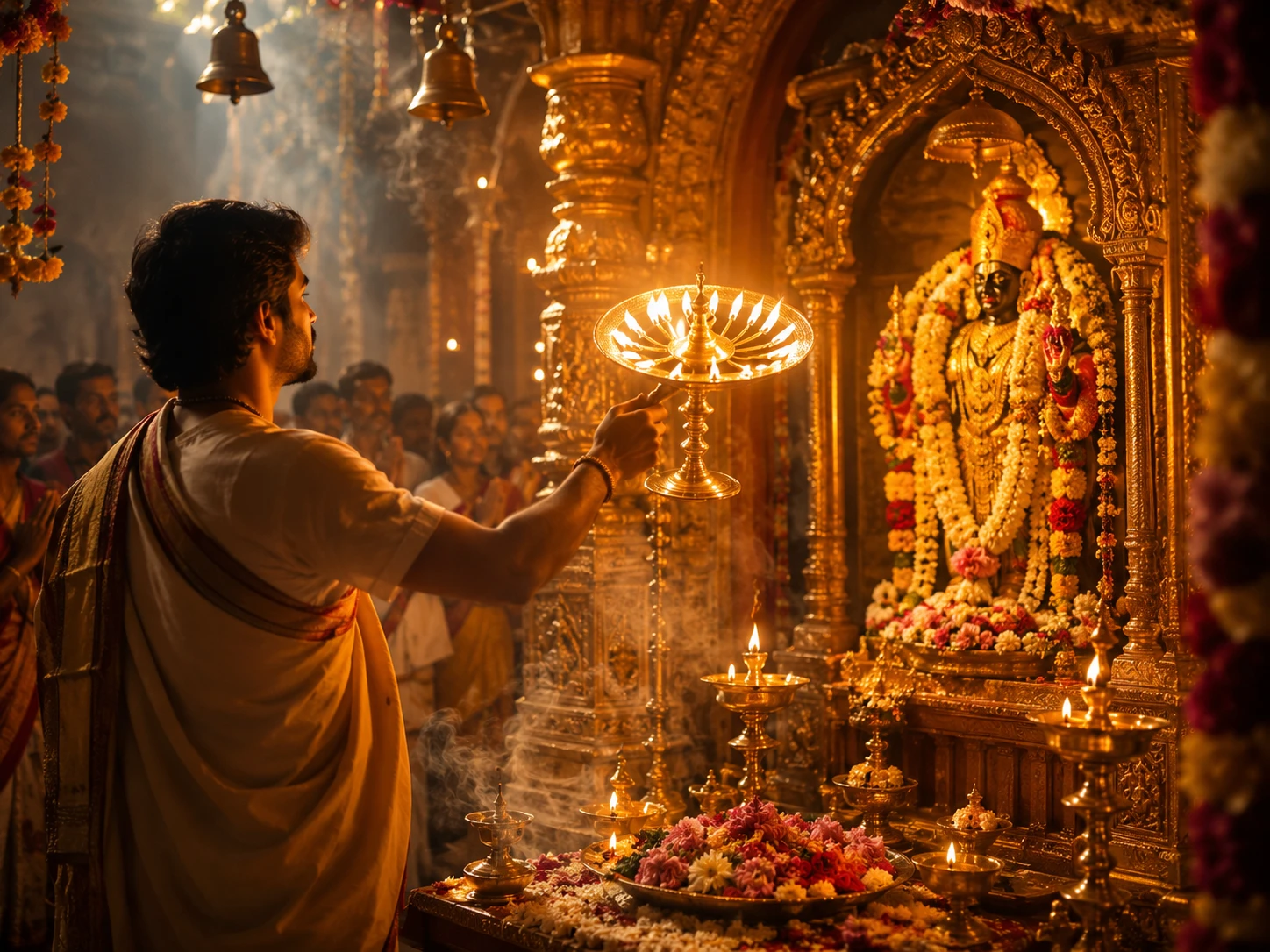
Aarti -- Why Hindus Circle Light Before God
13 min read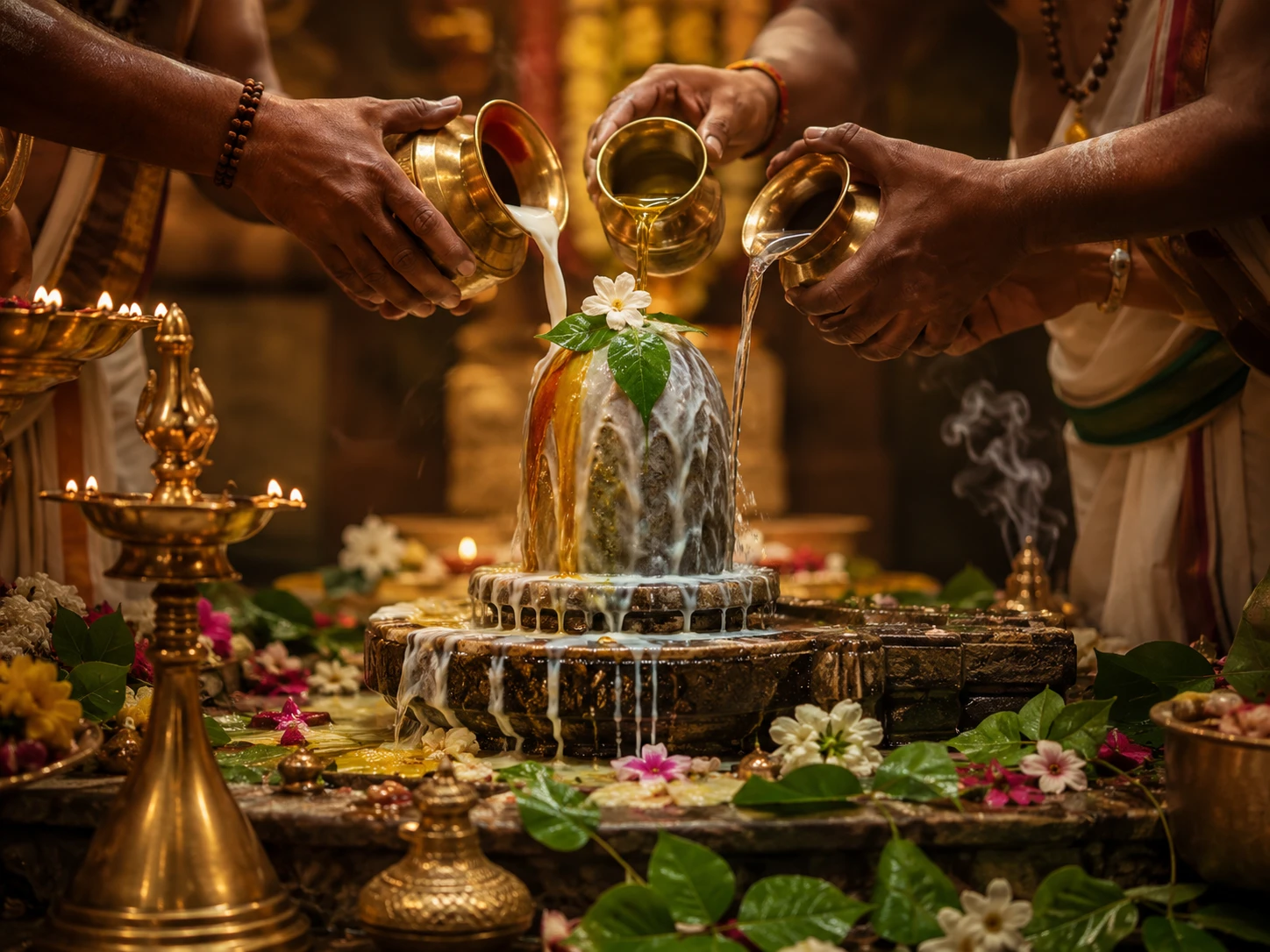
Abhisheka -- Why Hindus Bathe Their Gods
10 min read
Akshaya Tritiya -- The Day Nothing Given Away Runs Out
12 min readThe same translation error that turned '33 Koti' into '33 crore' in Hinduism also happened in Buddhism. The Chinese translation of Buddhist texts rendered 'Sapta Koti Buddha' (7 Supreme Buddhas) as '7 Crore Buddhas.' The…
Deities AvatarsCommunity Reflections
🕉️
Be the first to share your reflection.