
Kali Puja -- The Same Night as Diwali, a Different Goddess Entirely
काली पूजा -- दीवाली की वही रात, पर एक बिलकुल अलग देवी
Kali Puja, also called Shyama Puja, falls on Kartik Amavasya, the new moon night that the rest of India keeps as Diwali's main night of Lakshmi Puja. In 2026 that date is 8 November. The shared date is not a coincidence of two unrelated calendars; it is the same tithi read through two different regional theologies. Across most of North, West, and South India, Amavasya night belongs to Lakshmi, goddess of wealth, welcomed into a home cleaned and lit for her arrival. In Bengal, Assam, and Odisha, the same night belongs to Kali, and Eternal Raga's own Diwali article already notes this in passing while covering the five-day Diwali cluster: this article covers what that Bengali observance actually involves, in its own right rather than as a footnote to Diwali.
The regional split is genuine and worth stating without softening it into a false unity. A Bengali household on Amavasya night is not doing a Kali-flavoured version of Lakshmi Puja, and a Marwari household in the same city is not doing a Lakshmi-flavoured version of Kali Puja; both are complete, independent traditions that happen to land on the same dark night, for reasons rooted in each region's own devotional history rather than in a single shared festival that simply changed its main deity.
ॐ क्रीं कालिकायै नमः।
oṃ krīṃ kālikāyai namaḥ.
Om, salutations to Kalika -- the widely used beeja (seed) mantra of Kali, its single syllable Kreem held to contain her power of transformation in concentrated form.
— Traditional Kali beeja mantra, chanted at Kali Puja and throughout the year at Shakta temples including Kalighat and Dakshineswar
Midnight, Not Dusk
The clearest ritual marker separating Kali Puja from Diwali's evening Lakshmi Puja is timing. Where Lakshmi is invited at dusk into a home lit and swept clean for her, Kali Puja is performed at Nishita Kaal, the depth of midnight, when the Amavasya darkness is considered to be at its most complete and, in tantric readings of the night, most spiritually potent. Bengali households and temples alike hold the main puja in these late hours, and the day preceding it, Bhoot Chaturdashi, has its own distinct set of practices that most of India's equivalent day, Naraka Chaturdashi, does not share: fourteen lamps, choddo pradip, are lit around the house at dusk to guide ancestral spirits and ward off malevolent ones, and a specific dish of fourteen bitter and leafy greens, choddo shak, is eaten, a combination most Bengali households can name from memory though its exact botanical list varies by family.
Worship itself centres on red hibiscus flowers, red being considered Kali's preferred colour, and on recitation from the Kalika Purana and various Kali stotras rather than the more household-familiar Lakshmi Chalisa recited elsewhere on Diwali night. At a small number of older Shakta temples, most prominently Kalighat in Kolkata, ritual animal sacrifice, historically a significant part of Kali worship at such sites, is still practised on specific days including around Kali Puja, though in a far more limited and regulated form than in earlier centuries, and many contemporary households and temples substitute a pumpkin, ash gourd, or sugarcane in its place. Indian courts have in recent years declined to ban the practice outright at temples that maintain it, treating it as a regional religious custom rather than one this article is positioned to adjudicate; what can be said plainly is that the practice varies sharply by temple and family, and is far from universal even within Bengali Kali worship.
One Amavasya Night, Two Regional Traditions
| Diwali / Lakshmi Puja | Kali Puja / Shyama Puja | |
|---|---|---|
| Where it is primary | Most of North, West, and South India | Bengal, Assam, Odisha |
| Ritual timing | Dusk to evening | Nishita Kaal, midnight |
| Preceding day | Naraka Chaturdashi (oil bath, some regional lamp customs) | Bhoot Chaturdashi (choddo pradip lamps, choddo shak greens) |
| Central colour / offering | Lotus, sweets, gold | Red hibiscus, red vermilion |
Both observances mark the same tithi, but neither is a variant of the other. Households in mixed regions or mixed-heritage families sometimes keep both, treating them as two separate observances rather than one festival with two names.
Two figures did more than anyone else to shape how Kali is understood in devotional Bengal today. Ramprasad Sen (c. 1720-1781), a court poet under Raja Krishnachandra of Nadia, composed some three hundred Bengali songs to Kali known collectively as Shyama Sangeet, and was, by most accounts, the first Shakta poet to address her not as a distant terrifying power but as a mother, sometimes even a small child, in the plain, rustic Bengali of everyday village life. Roughly a century later, Sri Ramakrishna Paramahamsa (1836-1886) served as priest of the Dakshineswar Kali temple, founded in 1855 by the widow Rani Rashmoni after a vision in which the goddess herself directed her to build it. Ramakrishna's own intense, often ecstatic devotion to the temple's Kali murti, worshipped there as Bhavatarini, is widely credited with helping recast Kali in the modern Hindu imagination as an accessible, maternal figure rather than only a fearsome tantric one, a shift his disciple Swami Vivekananda carried onward through the Ramakrishna Mission.
Two Goddesses, One Season, No Real Rivalry
It would be a mistake to read Kali Puja and Diwali's Lakshmi Puja as competing claims on the same night, one somehow more correct than the other. Bengal keeps its own Lakshmi observance in the same broad festival season, Kojagari Lakshmi Puja on Sharad Purnima, a full lunar month before Kartik Amavasya, so that Bengali households are not choosing Kali over Lakshmi so much as spacing their devotion to each goddess across two different full-moon-to-new-moon points of the same season, a pattern distinct from, and not reducible to, how North India schedules Sharad Purnima and Diwali. Durga Puja, Bengal's largest annual festival, arrives roughly a month before Kali Puja in the same autumn cluster and is a separate observance again, centred on Durga rather than Kali, even though both are forms of Devi and even though some households treat Kali Puja as a quieter, more intimate coda to Durga Puja's immense public scale.
What holds across all of this regional variation is a single honest point: which goddess a Hindu household turns to on Kartik Amavasya night has never been settled by a single national answer, and Kali Puja is the clearest yearly proof of that. Eternal Raga's Kali page and its Diwali page each describe one half of the same night; read together, and not as competing claims, they describe how differently the Hindu calendar's darkest night has always been kept.
Chant the Kali Beeja Mantra at Nishita Kaal
Chant 'Om Kali Ma' on a mala at Nishita Kaal. If you are keeping Kali Puja at home rather than at a temple, light a single red or oil lamp at midnight and chant before it, matching the hour of Nishita Puja rather than Diwali's earlier dusk timing. The Om Kali Ma japa page and the Mahakali Stotram are both on Eternal Raga. (Kali's beej, Kreem, is traditionally taken only with initiation.)
Tags
Eternal Raga · शाश्वत राग
Institutional voice — scholarly articles on Sanatan Dharma
Deepen Your Understanding
अपनी समझ और गहरी करें
deities avatars
Kali -- The Fierce Mother Who Devours Time Itself
Black-skinned, wild-haired, wearing a garland of fifty severed heads and a skirt of severed arms, standing on Shiva's chest with her tongue extended in shock -- Kali is the most misunderstood deity in Hinduism and the most theologically radical. She is not a demon. She is not 'dark energy.' She is Time in feminine form, the cosmic mother who destroys everything so that everything can be reborn. Ramakrishna called her 'Ma.' Millions still do.
rituals traditions
Diwali -- Five Days of Light
Diwali is not one night of firecrackers. It is a five-day arc from Dhanteras to Bhai Dooj, layering wealth, ancestors, Lakshmi, community, and sibling bonds into a single liturgical sequence. Its origins span Rama's return, Krishna's Narakasura victory, Jain Mahavira's nirvana, and Sikh Bandi Chhor Divas -- making it the most theologically layered festival in the Indian calendar.
tantra mantra yantra
Dasha Mahavidya -- Ten Wisdom Goddesses Who Map the Entire Universe
One holds her own severed head. Another is an ugly old widow. A third paralyses enemies by seizing their tongues. The Dasha Mahavidya are not comfortable goddesses. They are the ten dimensions of reality that most religions are too afraid to acknowledge -- from transcendent beauty to terrifying destruction, from cosmic abundance to abject poverty. Together, they form the most complete map of feminine divinity ever conceived.
rituals traditions
Durga Puja -- The Ritual System Behind the World's Largest Art Festival
Behind the spectacular pandals and the Instagram-worthy lighting lies a ritual system of extraordinary precision. From the moment the sculptor draws the first line on Mahalaya to the heartbreaking immersion on Dashami, every step of Durga Puja follows a choreography that is part Vedic ritual, part Tantric sadhana, and part Bengali genius. UNESCO recognised it in 2021. Here is what they recognised.
rituals traditions
Sharad Purnima -- The Full Moon That Ends the Monsoon
One full moon, three names, three quite different focal points. In Vrindavan it is Raas Purnima, the night of Krishna's circular dance with the gopis. In Bengal it is Kojagari Purnima, the night Lakshmi is believed to ask who is still awake. In most North Indian kitchens it is simply the night kheer gets left out under the sky. Sharad Purnima is not to be confused with Kartik Purnima, the full moon that follows it a month later.
Two figures did more than anyone else to shape how Kali is understood in devotional Bengal today. Ramprasad Sen (c. 1720-1781), a court poet under Raja Krishnachandra of Nadia, composed some three hundred Bengali songs t…
More in Rituals & Traditions
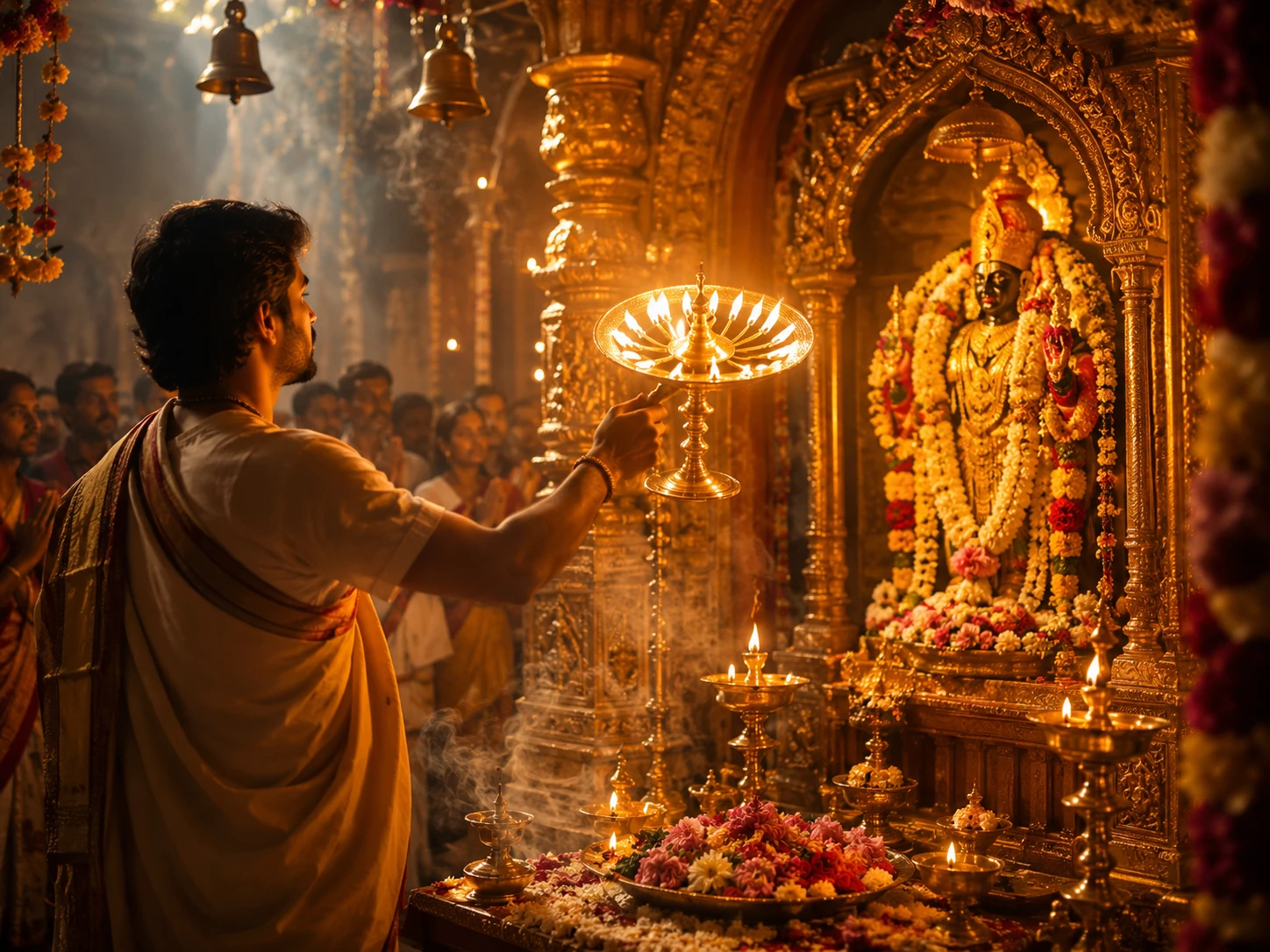
Aarti -- Why Hindus Circle Light Before God
13 min read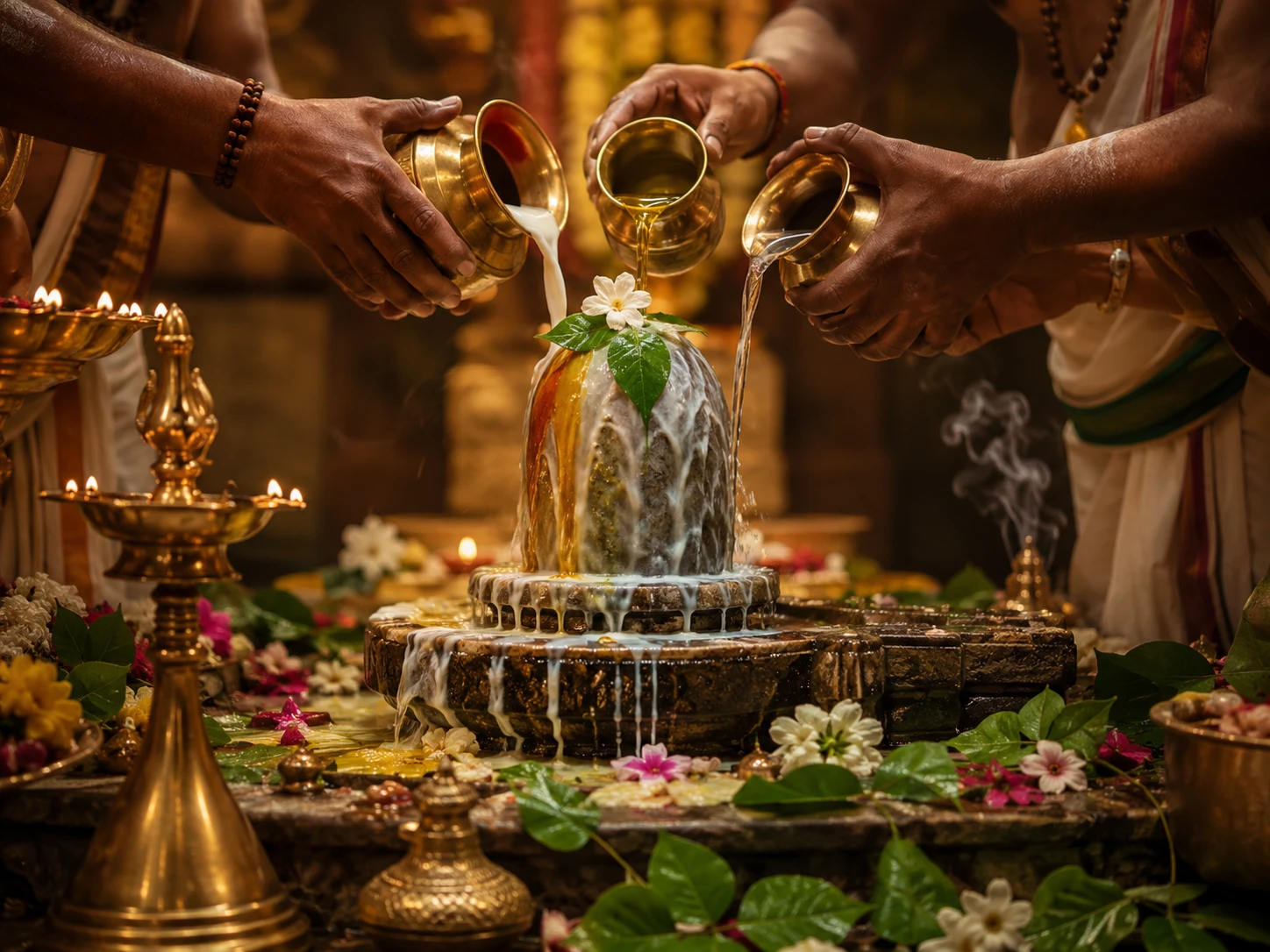
Abhisheka -- Why Hindus Bathe Their Gods
10 min read
Akshaya Tritiya -- The Day Nothing Given Away Runs Out
12 min readThe same translation error that turned '33 Koti' into '33 crore' in Hinduism also happened in Buddhism. The Chinese translation of Buddhist texts rendered 'Sapta Koti Buddha' (7 Supreme Buddhas) as '7 Crore Buddhas.' The…
Deities AvatarsCommunity Reflections
🕉️
Be the first to share your reflection.