Onam -- The Festival Where Kerala Welcomes Back Its Banished King
ओणम -- त्योहार जब केरल अपने निर्वासित राजा का स्वागत करता है
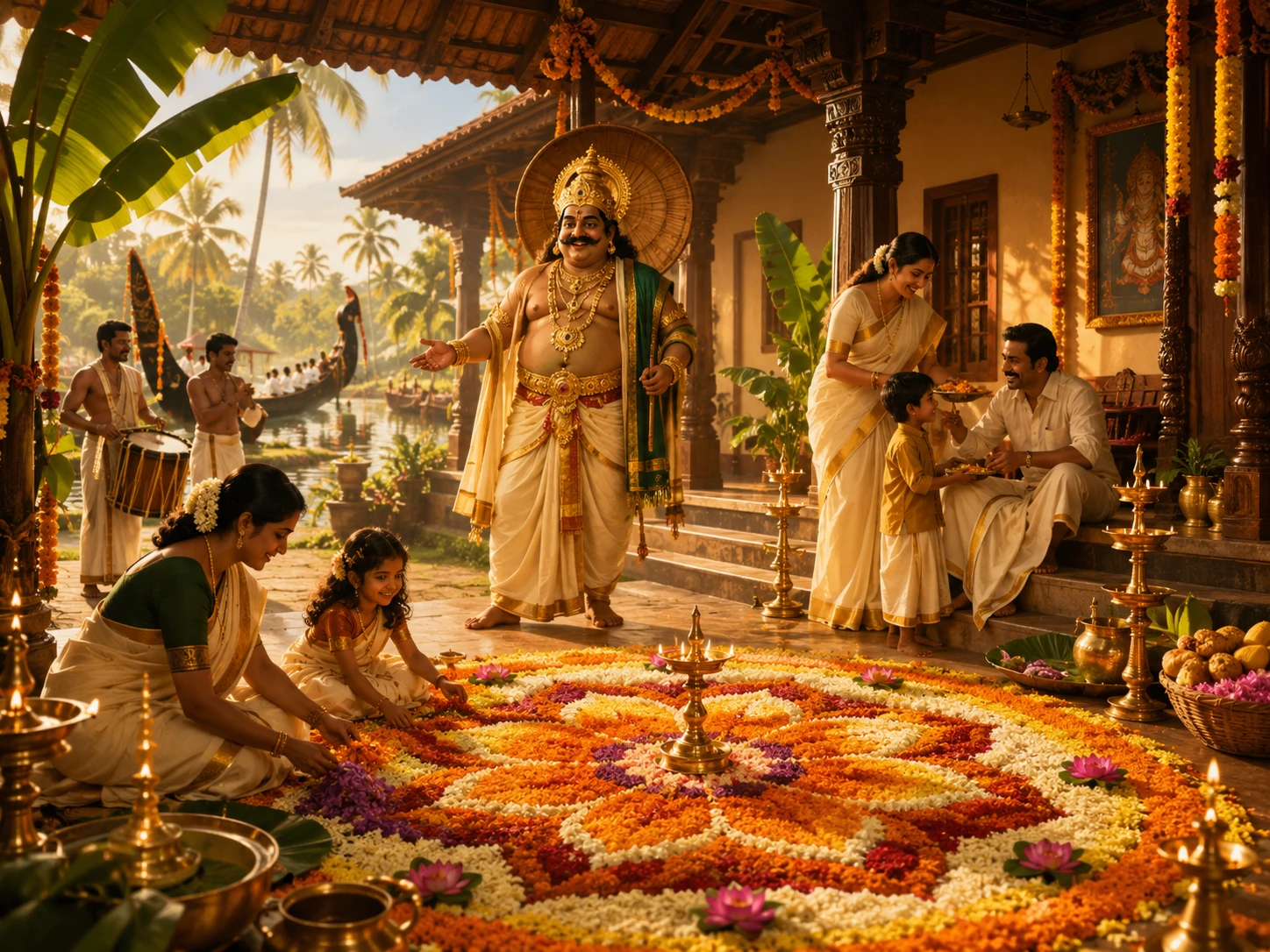
Onam is Kerala's state festival, celebrated for ten days in the Malayalam month of Chingam (August-September), culminating on Thiruvonam -- the day the star Shravana (Thiruvonam in Malayalam) is ascendant. It is simultaneously a harvest festival, a homecoming celebration, and a mythological commemoration of the most beloved king in Kerala's collective memory: Mahabali.
The Mahabali story is one of Hinduism's most morally complex narratives. Mahabali (Maveli in Malayalam) was an Asura king -- grandson of Prahlada, great-grandson of Hiranyakashipu -- who through tapas, dharma, and generosity created a kingdom so perfect that the proverb was born: 'Maveli Nadu vaneedum kalam, manushyar ellarum onnu pole' -- when Maveli ruled, all people were equal. There was no poverty, no crime, no dishonesty, no inequality. It was, quite literally, a golden age.
But Mahabali's growing power alarmed the Devas. Indra, threatened by Bali's expanding dominion, appealed to Vishnu. Vishnu incarnated as Vamana -- a dwarf Brahmin boy -- and approached Bali during a grand Yajna. Vamana asked for just three paces of land. Bali, true to his nature of boundless generosity, agreed despite his guru Shukracharya's warning that the Brahmin boy was Vishnu in disguise. Vamana then expanded to cosmic size: with his first step, he covered the earth; with his second, the heavens. For the third, there was nowhere left. Bali offered his own head. Vamana pushed Bali down to Patala (the netherworld) with his foot on Bali's head.
But here is what makes the story extraordinary: Vishnu was so moved by Bali's selfless surrender that he granted him a boon -- Bali could return to his people once every year. That annual return is Onam. Every year, Mahabali rises from Patala to visit Kerala, and the people prepare their best -- their most beautiful flower carpets, their most elaborate feasts, their cleanest homes -- to show their beloved king that his kingdom still thrives.
The emotional core of Onam is not victory. It is love across exile. The people love a king who was taken from them. The king loves a people he can visit only once a year. And the festival is the annual reunion -- ten days of showing Maveli that even though he was banished, his legacy of equality, generosity, and justice lives on in the hearts of Keralites.
This makes Onam unique in the Hindu festival landscape. It is the only major festival where the 'antagonist' of the Puranic narrative (Bali, the Asura) is the hero of the celebration, and the 'protagonist' (Vishnu as Vamana) is viewed with ambivalence. Kerala's relationship with this story is a masterclass in narrative independence: the Keralite does not reject the Puranic text, but interprets it from Bali's perspective rather than Vamana's. This is not heresy. It is the tradition's own capacity for multi-perspectival storytelling.
इदं विष्णुर्विचक्रमे त्रेधा नि दधे पदम्। समूढमस्य पांसुरे॥
idaṁ viṣṇur vicakrame tredhā ni dadhe padam samūḍham asya pāṁsure
Vishnu strode across (the universe), placing his foot in three steps. His dust-covered (footprint) pervades all existence.
— Rigveda 1.22.17 (Vishnu's three strides -- earliest reference to the Trivikrama/Vamana concept)
Onam -- Ten Days of Celebration
| Day | दिन | Name | Key Activity |
|---|---|---|---|
| Day 1 | दिन 1 | Atham | Pookalam (flower carpet) begins, small design |
| Day 2-4 | दिन 2-4 | Chithira to Anizham | Pookalam grows daily, shopping, home cleaning |
| Day 5 | दिन 5 | Thriketa | Boat race preparations begin |
| Day 6-7 | दिन 6-7 | Moolam to Pooradam | Cultural programmes, Pulikali (tiger dance) |
| Day 8 | दिन 8 | Uthradom (First Onam) | Major shopping day, preparations peak |
| Day 9 | दिन 9 | Thiruvonam (Main Onam) | Onasadya (26-dish feast), Mahabali arrives |
| Day 10 | दिन 10 | Avittam (Third Onam) | Vallam Kali (snake boat race), farewell to Mahabali |
The Onasadya served on Thiruvonam is one of the most elaborate vegetarian feasts in Indian cuisine: 26+ dishes served on a banana leaf in a specific arrangement. It includes rice, sambar, rasam, avial, olan, kalan, pachadi, thoran, erissery, payasam, banana chips, papadam, and more. The meal is eaten seated on the floor, and the placement of each dish on the banana leaf follows a precise traditional arrangement.
The Nehru Trophy Boat Race (Vallam Kali) held on Punnamada Lake in Alappuzha during Onam season is one of India's most spectacular sporting events. Chundan Vallam (snake boats) -- up to 30 metres long, crewed by over 100 rowers -- race in synchronised strokes while a rhythmic chant (Vanchipattu) is sung. The event draws 200,000+ spectators and is broadcast nationally. The boats are community-owned, with each village maintaining its own Chundan Vallam as a source of collective pride. The tradition dates back centuries and combines athletic competition, community bonding, and artistic expression into a single event -- like a regatta, a choir performance, and a village festival rolled into one.
Create a Pookalam and Offer Gratitude
On the next Onam (or any day you wish to practise gratitude), make a small pookalam with whatever flowers you have at your doorstep, then chant 'Om Namo Narayanaya' 108 times on a mala in gratitude for abundance. The pookalam is Kerala's visual prayer: beauty arranged with devotion, offered to a king who taught that true kingship is generosity. The mantra's page on Eternal Raga gives its meaning and how to chant it.
Eternal Raga · शाश्वत राग
Institutional voice — scholarly articles on Sanatan Dharma
Deepen Your Understanding
अपनी समझ और गहरी करें
deities avatars
Dashavatara -- Why Vishnu Comes Back Ten Times
Fish, tortoise, boar, half-lion, dwarf, axe-warrior, prince, cowherd, enlightened teacher, future horseman. The ten avatars of Vishnu are not random folklore. Read them in sequence and you get something startling -- a narrative that mirrors evolutionary biology, tracks the rise and fall of political systems, and argues that God does not sit above history but enters it, gets dirty, and does the work. The Dashavatara is Hinduism's answer to the question every civilisation asks: why does the world keep breaking, and who fixes it?
scriptural exegesis
Vamana and Bali -- The Avatar Who Took Three Steps And A Kingdom
An asura king so generous he was loved across the three worlds. A Vishnu avatar so small he had to look up to ask for charity. A bargain measured in three footsteps. The Vamana-Bali story is the Bhagavata's most layered teaching on what divine grace actually looks like when it appears to take everything from you.
rituals traditions
Pongal -- Tamil Nadu's Four-Day Harvest Festival That Worships the Sun, the Cow, and the Overflowing Pot
When the rice-milk pot overflows on Thai Pongal morning and the family shouts 'Pongal-o-Pongal!', Tamil Nadu is performing one of the oldest agricultural thanksgivings on earth. Four days of celebration -- Bhogi (discarding the old), Thai Pongal (thanking the Sun), Mattu Pongal (honouring cattle), and Kaanum Pongal (family outings) -- encode an entire civilisation's relationship with the land, the sun, and the animals that make agriculture possible. Pongal is not just a festival. It is Tamil Nadu's love letter to the harvest.
rituals traditions
Makar Sankranti -- The Only Hindu Festival Tied to the Sun, Not the Moon
Almost every Hindu festival follows the lunar calendar. Makar Sankranti is the exception. It falls on a fixed solar date -- January 14 (or 15) -- when the sun crosses from Sagittarius (Dhanu) into Capricorn (Makara), marking the beginning of Uttarayana, the northern journey of the sun. This astronomical event triggers the most geographically diverse celebration in India: Pongal in Tamil Nadu, Lohri in Punjab, Bihu in Assam, Uttarayan in Gujarat, and Til-Gul in Maharashtra -- all on the same day, all celebrating the same sun, all in completely different ways.
rituals traditions
Vishu -- The Kerala New Year Where the First Thing You See Decides Your Year
On the first day of the Malayalam month of Medam (April 14-15), every Keralite wakes to a carefully arranged sight: a brass lamp illuminating a display of golden Konna flowers, rice, fruits, vegetables, gold coins, a mirror, and a Krishna idol. This is Vishukkani -- the 'first sight of Vishu' -- and the tradition holds that what you see first on this morning determines the quality of your entire year. So the family ensures that the first sight is abundance, beauty, and the divine.
rituals traditions
Annadana -- Why Feeding Is the Highest Form of Charity in Hindu Tradition
The Taittiriya Upanishad declares: 'Do not turn away anyone who comes for food.' The Mahabharata ranks Annadana above all other forms of giving. The Sikh Langar feeds 100,000 people daily at the Golden Temple alone. The Akshaya Patra Foundation, inspired by ISKCON, serves mid-day meals to 2 million schoolchildren every day. In a civilisation that equates food with Brahman (Annam Brahma), feeding another person is not charity -- it is worship.
rituals traditions
Vijayadashami / Dussehra -- The Day India Celebrates Victory (But Whose Victory Depends on Where You Are)
In Delhi, a 100-foot Ravana effigy burns while lakhs cheer. In Kolkata, Durga is immersed in the Hooghly while millions weep. In Mysuru, a golden howdah procession moves through illuminated streets. In Tamil Nadu, tools and books are worshipped. Same day, same Tithi, four completely different festivals -- all called Vijayadashami. This is not inconsistency. It is the genius of a civilisation that encodes a single principle (victory of dharma over adharma) in multiple regional languages of celebration.
The Nehru Trophy Boat Race (Vallam Kali) held on Punnamada Lake in Alappuzha during Onam season is one of India's most spectacular sporting events. Chundan Vallam (snake boats) -- up to 30 metres long, crewed by over 100…
More in Rituals & Traditions
Aarti -- Why Hindus Circle Light Before God
13 min read
Abhisheka -- Why Hindus Bathe Their Gods
10 min read
Akshaya Tritiya -- The Day Nothing Given Away Runs Out
12 min readThe same translation error that turned '33 Koti' into '33 crore' in Hinduism also happened in Buddhism. The Chinese translation of Buddhist texts rendered 'Sapta Koti Buddha' (7 Supreme Buddhas) as '7 Crore Buddhas.' The…
Deities AvatarsCommunity Reflections
🕉️
Be the first to share your reflection.