Vishu -- The Kerala New Year Where the First Thing You See Decides Your Year
विशु -- केरल का नव वर्ष जहाँ पहली दृष्टि वर्ष तय करती है
Vishu falls on the first day of the Malayalam month of Medam -- when the sun enters Mesha Rashi (Aries) in the sidereal zodiac. This typically corresponds to April 14 or 15 in the Gregorian calendar, making it a solar new year celebration (like Puthandu in Tamil Nadu, Bihu in Assam, and Vaisakhi in Punjab -- all falling within the same week).
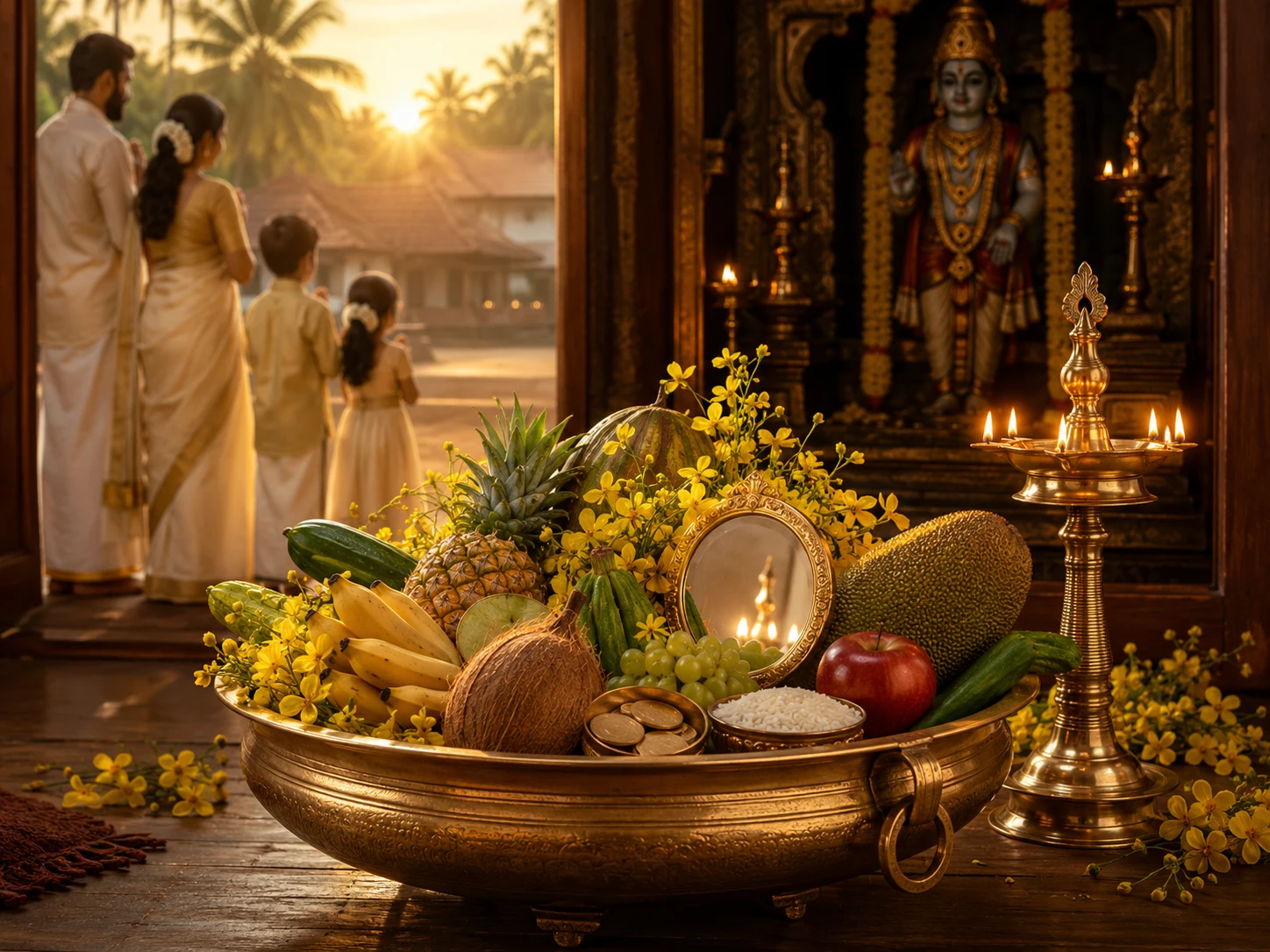
The centrepiece of Vishu is the Vishukkani -- literally, 'the first thing seen on Vishu.' The night before, the eldest woman of the household (typically the grandmother or mother) arranges a Kani in front of the family deity. The arrangement is placed in a brass Urli (wide-mouthed vessel) or on a wooden platform and includes: a lit Nilavilakku (traditional brass lamp), golden Konna flowers (Cassia fistula, Kerala's state flower, which blooms precisely during Vishu season), raw rice, fresh coconut halves, betel leaves and areca nuts, golden cucumber (Vellarikka), seasonal fruits and vegetables, a mirror, gold ornaments or coins, new cloth (Kasavu mundu), and a small Krishna Vigraha (idol) -- often the baby Krishna (Unnikrishnan).
The visual composition is deliberate: gold (Konna, coins, ornaments) for prosperity, white (rice, cloth, coconut) for purity, green (vegetables, betel) for growth, and the mirror to reflect the viewer's own face back at them -- reminding the devotee that the divine they seek is also within.
On Vishu morning, family members are led to the Kani with their eyes closed. The eldest opens their eyes first, and the sight of abundance, beauty, and divinity is the first visual impression of the new year. Children then receive Vishukkaineettam -- monetary gifts from elders, typically given in new currency notes. The family wears new clothes (Puthukodi), bursts firecrackers (Vishu Padakkam), and sits down to a feast (Vishu Sadya) served on banana leaves.
The philosophy is elegant: you cannot control what the year will bring, but you can control what you see first. By engineering the first sight of the year to be auspicious, beautiful, and abundant, the tradition creates a psychological anchor of optimism. The Vishukkani is not a superstitious charm. It is a deliberate act of priming -- programming the mind to expect abundance, to look for beauty, and to begin from a place of gratitude rather than anxiety.
For the Keralite NRI in San Jose or Dubai who misses Vishu: the Vishukkani can be arranged anywhere. A brass lamp, fresh flowers (any golden flowers work if Konna is unavailable), fruits, rice, a mirror, a coin, and a small Krishna photo. Wake your children with eyes closed, lead them to the Kani, and let their first sight of the new year be what every parent wishes for their child: light, beauty, and the promise that the world is generous.
तमसो मा ज्योतिर्गमय।
tamaso mā jyotir gamaya
Lead me from darkness to light.
— Brihadaranyaka Upanishad 1.3.28 (invoked in the context of Vishukkani -- the first light of the new year)
Vishu, Puthandu, Bihu, Vaisakhi -- India's April New Years
| Festival | त्योहार | Region | Date | Key Ritual | Signature |
|---|---|---|---|---|---|
| Vishu | विशु | Kerala | Apr 14-15 | Vishukkani (first auspicious sight) | Konna flowers, mirror, Krishna |
| Puthandu | पुथाण्डु | Tamil Nadu | Apr 14 | Kanni (similar to Vishukkani) | Mango, neem, jaggery tray |
| Rongali Bihu | रोंगाली बिहू | Assam | Apr 14-15 | Bihu dance, community feasting | Gamosa cloth, Pitha sweets |
| Vaisakhi | वैशाखी | Punjab | Apr 13-14 | Bhangra, Gurdwara visit, harvest celebration | Wheat harvest, Lassi, Jalebi |
| Poila Boishakh | পহেলা বৈশাখ | Bengal | Apr 14-15 | Mangal Shobhajatra procession | Panta Ilish (fermented rice + hilsa) |
All five festivals fall within the same 48-hour window because they mark the same astronomical event: the sun's entry into Mesha (Aries) in the sidereal zodiac. The cultural expressions differ radically -- from Kerala's contemplative Vishukkani to Assam's exuberant Bihu dance -- but the cosmic trigger is identical.
The Konna flower (Cassia fistula, also called Golden Shower or Indian Laburnum) blooms precisely during the Vishu season -- its timing is so reliable that Keralites use it as a natural calendar marker. The tree produces cascading clusters of bright golden flowers that last only 2-3 weeks, perfectly framing the Vishu window. The Kerala Forest Department has noted that climate change is subtly shifting the Konna blooming season, occasionally causing it to flower early or late relative to the traditional Vishu date -- an ecological disruption that Keralites notice viscerally because the absence of Konna on Vishu morning feels like celebrating a birthday without a cake.
Create Your Own Vishukkani
On the next Vishu (or any morning you want to begin with abundance), arrange a kani the night before: a lamp, flowers, fruit, rice, a mirror, a coin and a small image of the deity. Wake with eyes closed and open them to beauty. Then chant 'Om Namo Bhagavate Vasudevaya' 108 times on a mala. Your year begins with light. The mantra's page on Eternal Raga gives its meaning and how to chant it.
Tags
Eternal Raga · शाश्वत राग
Institutional voice — scholarly articles on Sanatan Dharma
Deepen Your Understanding
अपनी समझ और गहरी करें
rituals traditions
Onam -- The Festival Where Kerala Welcomes Back Its Banished King
Every year in the month of Chingam (August-September), Kerala erupts in ten days of celebration -- flower carpets, boat races, feasts of 26 dishes, tiger dances, and the return of a king who was pushed underground by a god. Onam celebrates Mahabali -- the generous Asura king who ruled Kerala's golden age until Vamana (Vishnu's dwarf avatar) tricked him into the netherworld. But the twist: Kerala loves Bali more than Vamana. This is the only Hindu festival that sympathises with the 'villain' -- because in Kerala's telling, Bali was no villain at all.
rituals traditions
Ugadi / Gudi Padwa -- The Hindu New Year That Begins With Bitterness and Sweetness Together
On Chaitra Shukla Pratipada -- the first day of the first month of the Hindu calendar -- the new year begins not with champagne but with a spoonful of neem and jaggery mixed together. Bitter and sweet in the same bite. This is Ugadi (in Karnataka, Andhra, Telangana) and Gudi Padwa (in Maharashtra) -- the Hindu New Year that teaches you the year's first lesson before breakfast: life will give you both. Accept both with equanimity.
rituals traditions
Makar Sankranti -- The Only Hindu Festival Tied to the Sun, Not the Moon
Almost every Hindu festival follows the lunar calendar. Makar Sankranti is the exception. It falls on a fixed solar date -- January 14 (or 15) -- when the sun crosses from Sagittarius (Dhanu) into Capricorn (Makara), marking the beginning of Uttarayana, the northern journey of the sun. This astronomical event triggers the most geographically diverse celebration in India: Pongal in Tamil Nadu, Lohri in Punjab, Bihu in Assam, Uttarayan in Gujarat, and Til-Gul in Maharashtra -- all on the same day, all celebrating the same sun, all in completely different ways.
rituals traditions
Pongal -- Tamil Nadu's Four-Day Harvest Festival That Worships the Sun, the Cow, and the Overflowing Pot
When the rice-milk pot overflows on Thai Pongal morning and the family shouts 'Pongal-o-Pongal!', Tamil Nadu is performing one of the oldest agricultural thanksgivings on earth. Four days of celebration -- Bhogi (discarding the old), Thai Pongal (thanking the Sun), Mattu Pongal (honouring cattle), and Kaanum Pongal (family outings) -- encode an entire civilisation's relationship with the land, the sun, and the animals that make agriculture possible. Pongal is not just a festival. It is Tamil Nadu's love letter to the harvest.
rituals traditions
Muhurta -- Why Hindus Obsess Over the Right Moment
Your grandmother checked the panchang before scheduling your mundan. Your parents consulted an astrologer before fixing your wedding date. Your colleague will not sign a business contract without checking the Choghadiya. The Hindu tradition divides every 24-hour day into 30 Muhurtas of 48 minutes each -- some auspicious, some neutral, some to be avoided -- and this time-quality framework has governed Indian life from Vedic fire rituals to modern real estate transactions.
vedic sciences
Kaal Ganana -- The Hindu Measure of Time
From a single blink of the eye (Nimesha) to one Day of Brahma (4.32 billion years) -- explore the complete cosmic time hierarchy of Hindu cosmology, anchored in Vishnu Purana 1.3, with its remarkable parallels to modern science.
rituals traditions
Puja at Home -- The Complete Beginner's Guide
You have a small mandir shelf in your apartment. A brass diya your mother gave you. A photo of a deity you feel drawn to. And absolutely no idea what to do next. This guide is for you -- the 22-year-old in Pune who just moved out, the NRI in New Jersey setting up a puja corner for the first time, the curious soul who wants to start but does not know where.
The Konna flower (Cassia fistula, also called Golden Shower or Indian Laburnum) blooms precisely during the Vishu season -- its timing is so reliable that Keralites use it as a natural calendar marker. The tree produces …
More in Rituals & Traditions
Aarti -- Why Hindus Circle Light Before God
13 min read
Abhisheka -- Why Hindus Bathe Their Gods
10 min read
Akshaya Tritiya -- The Day Nothing Given Away Runs Out
12 min readThe same translation error that turned '33 Koti' into '33 crore' in Hinduism also happened in Buddhism. The Chinese translation of Buddhist texts rendered 'Sapta Koti Buddha' (7 Supreme Buddhas) as '7 Crore Buddhas.' The…
Deities AvatarsCommunity Reflections
🕉️
Be the first to share your reflection.