Ugadi / Gudi Padwa -- The Hindu New Year That Begins With Bitterness and Sweetness Together
उगादि / गुड़ी पड़वा -- हिन्दू नव वर्ष जो कड़वाहट और मिठास एक साथ शुरू होता है
The Hindu calendar begins on Chaitra Shukla Pratipada -- the first bright lunar day of the month of Chaitra (March-April). This day is celebrated as Ugadi in Karnataka, Andhra Pradesh, and Telangana, and as Gudi Padwa in Maharashtra. It also coincides with Sajibu Cheiraoba (Manipur), Cheti Chand (Sindhi New Year), and marks the beginning of Chaitra Navaratri in North India.
The word 'Ugadi' derives from 'Yuga' (era) + 'Adi' (beginning) -- the beginning of a new era. 'Gudi Padwa' combines 'Gudi' (a victory flag) with 'Padwa' (Pratipada, the first day). Both names encode the same principle: today is Day One. Whatever happened last year is complete. The ledger resets.
The most distinctive ritual of Ugadi is the consumption of Ugadi Pachadi (in Andhra/Telangana) or Bevu-Bella (in Karnataka) -- a preparation that deliberately combines six tastes: sweet (jaggery), sour (tamarind), bitter (neem flowers), salty (salt), spicy (chilli/pepper), and astringent (raw mango). Each taste represents a dimension of life experience: joy, surprise, sadness, fear, anger, and disgust. By eating all six in a single spoonful on the first morning of the year, the devotee makes a philosophical statement: I accept the full spectrum of human experience. I will not chase only sweetness and flee from bitterness. I will meet whatever comes with equanimity.
This is an extraordinarily mature way to begin a year. Compare it to the Western New Year tradition of champagne and optimistic resolutions -- a ritual built entirely on sweetness and hope. The Hindu New Year begins with the explicit acknowledgement that bitterness is coming too. And the neem does not cancel the jaggery. They coexist. In the same spoonful. In the same year. In the same life.
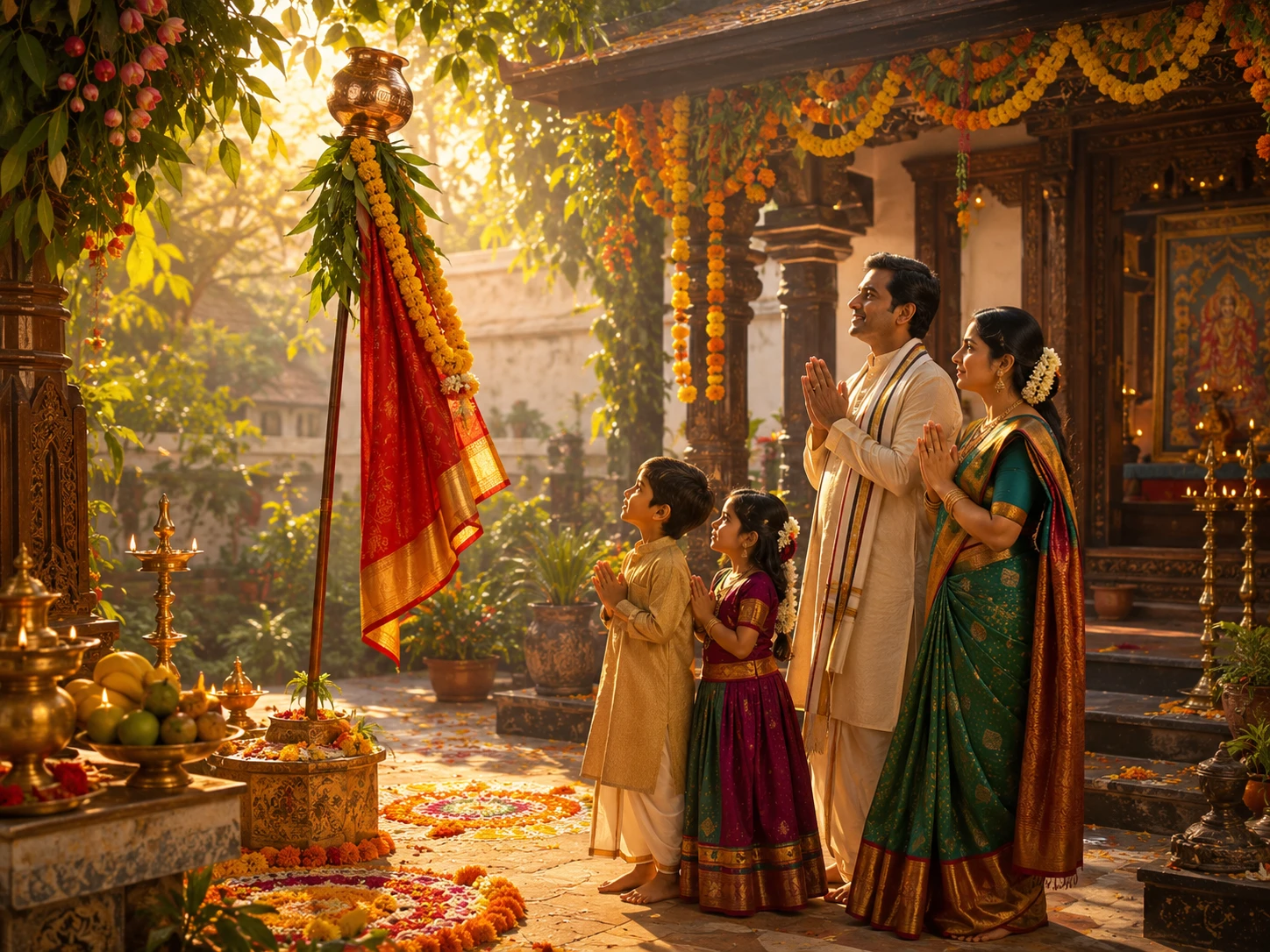
In Maharashtra, Gudi Padwa features the raising of a Gudi -- a bright green or yellow silk cloth draped over a bamboo stick, topped with a garland of flowers, neem leaves, a sugar crystal garland, and an inverted copper or silver pot (kalash). The Gudi is hoisted outside the home's main entrance and represents victory, prosperity, and the welcoming of the new year. The tradition links the Gudi to the victory flag of the Maratha Empire -- Shivaji Maharaj's armies raised Gudis after victories, and the association of Gudi Padwa with Maratha pride remains strong.
In Karnataka, Panchanga Shravanam (listening to the new year's Panchanga -- astrological almanac) is a central ritual. Families gather at temples or community halls where a priest reads the predictions for the coming year: rainfall patterns, crop prospects, political developments, and auspicious/inauspicious periods. This is the original annual forecast -- delivered not by an economist or a meteorologist but by a Jyotishi reading the Panchanga. In an era of Bloomberg terminals and IMD weather apps, the Panchanga Shravanam persists because it addresses a need that data alone cannot: the desire to feel that the coming year has been acknowledged by the cosmos, not just by the calendar.
चैत्रे मासि जगद्ब्रह्मा ससर्ज प्रथमेऽहनि। शुक्लपक्षे समग्रे तु तदा सूर्योदये सति॥
caitre māsi jagad-brahmā sasarja prathame 'hani śukla-pakṣe samagre tu tadā sūryodaye sati
In the month of Chaitra, on the first day of the bright fortnight, at sunrise -- Brahma created the world.
— Brahma Purana (Creation narrative associated with Ugadi)
Hindu New Year Celebrations Across India
| Region | क्षेत्र | Festival | Month | Key Ritual |
|---|---|---|---|---|
| Karnataka | कर्नाटक | Ugadi | Chaitra Shukla 1 | Bevu-Bella (neem-jaggery), Panchanga Shravanam |
| Andhra, Telangana | आन्ध्र, तेलंगाना | Ugadi | Chaitra Shukla 1 | Ugadi Pachadi (6 tastes) |
| Maharashtra | महाराष्ट्र | Gudi Padwa | Chaitra Shukla 1 | Gudi flag hoisting, Shrikhand-Puri feast |
| Sindhi | सिन्धी | Cheti Chand | Chaitra Shukla 1-2 | Jhulelal worship, river offerings |
| Manipur | मणिपुर | Sajibu Cheiraoba | Chaitra Shukla 1 | Family feast, hill climbing |
| Kashmir | कश्मीर | Navreh | Chaitra Shukla 1 | Viewing rice, calendar, mirror at dawn |
| Assam | असम | Rongali Bihu | Mid-April (solar) | Dance, feasting, agricultural thanksgiving |
While Chaitra Shukla Pratipada is the most widely recognised Hindu New Year, some traditions follow different calendars: Tamil New Year (Puthandu) in mid-April, Malayalam New Year (Vishu) in April, Bengali New Year (Poila Boishakh) in April, and Punjabi New Year (Vaisakhi) in April -- all solar-calendar based. The diversity of 'New Year' dates across India reflects the coexistence of lunar and solar calendrical systems.
The Ugadi Pachadi's six-taste formula is a precise Ayurvedic prescription. Ayurveda classifies all food into six rasas (tastes): Madhura (sweet), Amla (sour), Tikta (bitter), Lavana (salty), Katu (pungent), and Kashaya (astringent). A balanced meal should ideally include all six. The Ugadi Pachadi delivers all six in a single preparation -- making it not just a philosophical symbol but a nutritionally complete first bite of the year. The neem specifically is a potent blood purifier and anti-microbial, traditionally consumed at the start of spring (when seasonal infections peak) as preventive medicine. The new year begins with both a life lesson and a dose of preventive healthcare.
Begin Your Year with Equanimity
On the next Ugadi or Gudi Padwa, prepare Ugadi pachadi at home (neem flowers, jaggery, tamarind, salt, chilli and raw mango). Eat the first spoonful mindfully, taking each taste as one dimension of the coming year. Then chant 'Om Brahma Devaya Namah' 108 times on a mala, honouring the Creator who began creation on this very tithi. The mantra meditation library on Eternal Raga has more mantras for japa.
Tags
Eternal Raga · शाश्वत राग
Institutional voice — scholarly articles on Sanatan Dharma
Deepen Your Understanding
अपनी समझ और गहरी करें
vedic sciences
Kaal Ganana -- The Hindu Measure of Time
From a single blink of the eye (Nimesha) to one Day of Brahma (4.32 billion years) -- explore the complete cosmic time hierarchy of Hindu cosmology, anchored in Vishnu Purana 1.3, with its remarkable parallels to modern science.
rituals traditions
Makar Sankranti -- The Only Hindu Festival Tied to the Sun, Not the Moon
Almost every Hindu festival follows the lunar calendar. Makar Sankranti is the exception. It falls on a fixed solar date -- January 14 (or 15) -- when the sun crosses from Sagittarius (Dhanu) into Capricorn (Makara), marking the beginning of Uttarayana, the northern journey of the sun. This astronomical event triggers the most geographically diverse celebration in India: Pongal in Tamil Nadu, Lohri in Punjab, Bihu in Assam, Uttarayan in Gujarat, and Til-Gul in Maharashtra -- all on the same day, all celebrating the same sun, all in completely different ways.
rituals traditions
Navratri -- Nine Nights That Transform India
For nine nights, India becomes a different country. In Gujarat, millions dance garba till dawn. In Bengal, the streets turn into open-air art galleries. In Varanasi, nine temples light up in sequence. In Mysore, the palace blazes with 100,000 bulbs. Navratri is not a single festival -- it is nine nights of goddess worship that unite India's most diverse traditions into one cosmic celebration.
rituals traditions
Rama Navami -- The Birth of the Man Who Became God's Gold Standard
On the ninth day of Chaitra Shukla, at the Abhijit Muhurta of high noon, in the Punarvasu Nakshatra, in the city of Ayodhya, in the Treta Yuga -- Vishnu incarnated as Rama. Not as a god performing miracles but as a man navigating impossible moral choices. Rama Navami celebrates not just a divine birth but the arrival of Maryada Purushottam -- the supreme person of propriety -- whose life became the civilisational template for dharmic conduct in a world where every right choice costs something.
rituals traditions
Muhurta -- Why Hindus Obsess Over the Right Moment
Your grandmother checked the panchang before scheduling your mundan. Your parents consulted an astrologer before fixing your wedding date. Your colleague will not sign a business contract without checking the Choghadiya. The Hindu tradition divides every 24-hour day into 30 Muhurtas of 48 minutes each -- some auspicious, some neutral, some to be avoided -- and this time-quality framework has governed Indian life from Vedic fire rituals to modern real estate transactions.
rituals traditions
Sankalpa -- The Ritual GPS That Locates You in the Cosmos Before Every Puja
Before any Hindu ritual begins, there is a quiet declaration that most people rush through without understanding. It names the current cosmic age, the ruling Manu, the Yuga, the year, the season, the month, the fortnight, the day, the star, the continent, the country, the river, your name, your lineage, and your exact intention. This declaration -- Sankalpa -- is the most sophisticated geo-temporal tagging system in any religious tradition. It tells the universe: I am here, I am this person, and I intend to do this specific act.
rituals traditions
Diwali -- Five Days of Light
Diwali is not one night of firecrackers. It is a five-day arc from Dhanteras to Bhai Dooj, layering wealth, ancestors, Lakshmi, community, and sibling bonds into a single liturgical sequence. Its origins span Rama's return, Krishna's Narakasura victory, Jain Mahavira's nirvana, and Sikh Bandi Chhor Divas -- making it the most theologically layered festival in the Indian calendar.
The Ugadi Pachadi's six-taste formula is a precise Ayurvedic prescription. Ayurveda classifies all food into six rasas (tastes): Madhura (sweet), Amla (sour), Tikta (bitter), Lavana (salty), Katu (pungent), and Kashaya (…
More in Rituals & Traditions
Aarti -- Why Hindus Circle Light Before God
13 min read
Abhisheka -- Why Hindus Bathe Their Gods
10 min read
Akshaya Tritiya -- The Day Nothing Given Away Runs Out
12 min readThe same translation error that turned '33 Koti' into '33 crore' in Hinduism also happened in Buddhism. The Chinese translation of Buddhist texts rendered 'Sapta Koti Buddha' (7 Supreme Buddhas) as '7 Crore Buddhas.' The…
Deities AvatarsCommunity Reflections
🕉️
Be the first to share your reflection.