The Saptarishi -- Who Are the Seven Sages?
सप्तर्षि -- सात ऋषि कौन हैं?
On a clear night in the northern sky, seven bright stars form the shape the West calls the Big Dipper or the Plough. In India they have long been called the Saptarishi Mandala, the circle of the seven sages. Through the night and the year they wheel slowly around the pole star, as the sages themselves are said to keep their watch through every age of the world.
The Saptarishi are the great seers of the Vedic tradition: the rishis through whom the hymns were received and handed on. Tradition holds that in each manvantara -- each of the fourteen long ages ruled by a Manu -- a new group of seven holds this office, preserving the Veda and the order of the world. That is why the lists of names differ between texts: they are naming the seven of different ages.
कश्यपोऽत्रिर्वसिष्ठश्च विश्वामित्रोऽथ गौतमः । जमदग्निर्भरद्वाज इति सप्तर्षयः स्मृताः ॥
kaśyapo'trirvasiṣṭhaśca viśvāmitro'tha gautamaḥ | jamadagnirbharadvāja iti saptarṣayaḥ smṛtāḥ ||
Kashyapa, Atri, Vasishtha, Vishvamitra, Gautama, Jamadagni and Bharadvaja -- these are remembered as the seven sages.
— Srimad Bhagavata Purana 8.13.5
The Bhagavata gives this list for the present age, the manvantara of Vaivasvata Manu, and the same seven names appear in the Brihadaranyaka Upanishad. An older and also widely quoted list names the seven mind-born sons of Brahma, the first sages of creation: Marichi, Atri, Angiras, Pulastya, Pulaha, Kratu and Vasishtha. Both lists matter, for different reasons -- the first for the sages of our own age, the second for the sages at the very beginning of creation.
The Seven Sages of the Present Age
| Sage | Known for |
|---|---|
| Kashyapa | Father of gods, demons and many creatures through the daughters of Daksha; the land of Kashmir is traditionally linked with his name |
| Atri | Seer of many Rigvedic hymns; husband of Anasuya; father of Dattatreya, Chandra and Durvasa |
| Vasishtha | Family priest of the Ikshvaku kings and guru of Rama; husband of Arundhati; seer of the seventh book of the Rigveda |
| Vishvamitra | A king who became a brahmarshi by austerity; seer of the Gayatri mantra and the third book of the Rigveda |
| Gautama | Husband of Ahalya; seer of Rigvedic hymns; the Nyaya Sutras are attributed to a sage of this name |
| Jamadagni | Father of Parashurama; a descendant of Bhrigu |
| Bharadvaja | Seer of the sixth book of the Rigveda; father of Drona; host to Rama at Prayaga |
Next to the middle star of the Big Dipper's handle -- the star Indian astronomy identifies with Vasishtha -- a faint companion is visible to good eyes. It is called Arundhati, after Vasishtha's wife, the model of fidelity. In many Hindu weddings the couple are shown, or symbolically pointed towards, the star Arundhati with the pole star, and asked to be as constant as they are.
The seven sages are still present in ordinary Hindu life through the gotra, the lineage named when a family performs a ritual. Gotras trace descent from a rishi, and the great gotras are named after these sages and a few others, such as Bhrigu and Agastya. Traditionally a marriage within the same gotra was avoided, because the couple were held to share an ancestor.
The Gita gives the sages a place in creation itself. Krishna says that the seven great sages of old, and the four Manus, were born from his mind, and that from them all creatures in the world descend.
महर्षयः सप्त पूर्वे चत्वारो मनवस्तथा । मद्भावा मानसा जाता येषां लोक इमाः प्रजाः ॥
maharṣayaḥ sapta pūrve catvāro manavastathā | madbhāvā mānasā jātā yeṣāṃ loka imāḥ prajāḥ ||
The seven great sages of old and the four Manus came from my nature, born of my mind; from them come all these creatures in the world.
— Bhagavad Gita 10.6
The sages are honoured together on Rishi Panchami, the fifth day of the bright fortnight of Bhadrapada, when many women keep a fast and worship the seven with Arundhati. Even without a festival, the night sky keeps them in view. Find the Plough, follow the two stars at the end of its bowl to the pole star, and you have traced the path the tradition imagined: seven teachers circling the one fixed point of the sky.
Read how the ages of Manu are counted
The fourteen manvantaras, each with its own Manu, Indra and seven sages.
Tags
Eternal Raga · शाश्वत राग
Institutional voice — scholarly articles on Sanatan Dharma
Deepen Your Understanding
अपनी समझ और गहरी करें
vedic sciences
The 14 Manus -- Cosmic Reset Buttons of Hindu Time
Hindu cosmology does not have one Adam. It has fourteen. Each Manvantara -- a cosmic era of 306.72 million years -- is governed by a different Manu who repopulates the earth, establishes dharma, and oversees a fresh team of gods, sages, and an Indra. We are currently in the 7th Manvantara, ruled by Vaivasvata Manu, son of Surya. Seven Manus have served. Seven are yet to come. And Vishnu takes a new avatar for each.
deities avatars
Kashyapa's Wives -- How One Sage Fathered Gods, Demons, and Everything In Between
Why are gods and demons always at war? Because they are cousins -- half-brothers sharing the same father, the sage Kashyapa. Aditi's sons became the Devas. Diti's sons became the Daityas. Vinata's sons became Garuda and Aruna. Kadru's sons became the serpents. And the family dynamics that produced them explain the entire cosmic conflict of Hindu mythology.
scriptural exegesis
Brahma's Children -- The First Generation of Creation
Brahma tried three times to populate the universe. First he created four sons who refused to reproduce and became monks. Then he got so angry that Rudra burst from his forehead. Finally he created ten Prajapatis from his mind -- and through them, every god, demon, human, animal, and plant in existence traces its origin. This is the original org chart of the cosmos.
scriptural exegesis
Vishvamitra -- The King Who Became a Brahmarshi
A warrior-king humbled by a sage's cow, he gave up his throne and spent thousands of years in austerity until even his rival Vasishtha called him brahmarshi. The seer of the Gayatri mantra and the teacher who led Rama to Sita -- the story of Vishvamitra.
scriptural exegesis
Markandeya -- The Sage Who Conquered Death
A boy given sixteen years to live, who clung to a Shiva linga when Death came for him; a sage who survived the end of the world and saw a child floating on a banyan leaf. The two great stories of Markandeya, the deathless rishi of the Puranas.
vedic sciences
The 27 Nakshatras and Their Junction Stars -- Bharat's Lunar Map of the Sky
Long before Greenwich drew a line through London, the Rishis of Bharat had already divided the ecliptic into 27 precise segments of 13 degrees 20 minutes each, anchoring each to a brightest star called the Yogatara. The Surya Siddhanta catalogued their positions with an accuracy that modern astronomy still respects.
Next to the middle star of the Big Dipper's handle -- the star Indian astronomy identifies with Vasishtha -- a faint companion is visible to good eyes. It is called Arundhati, after Vasishtha's wife, the model of fidelit…
More in Scriptural Exegesis
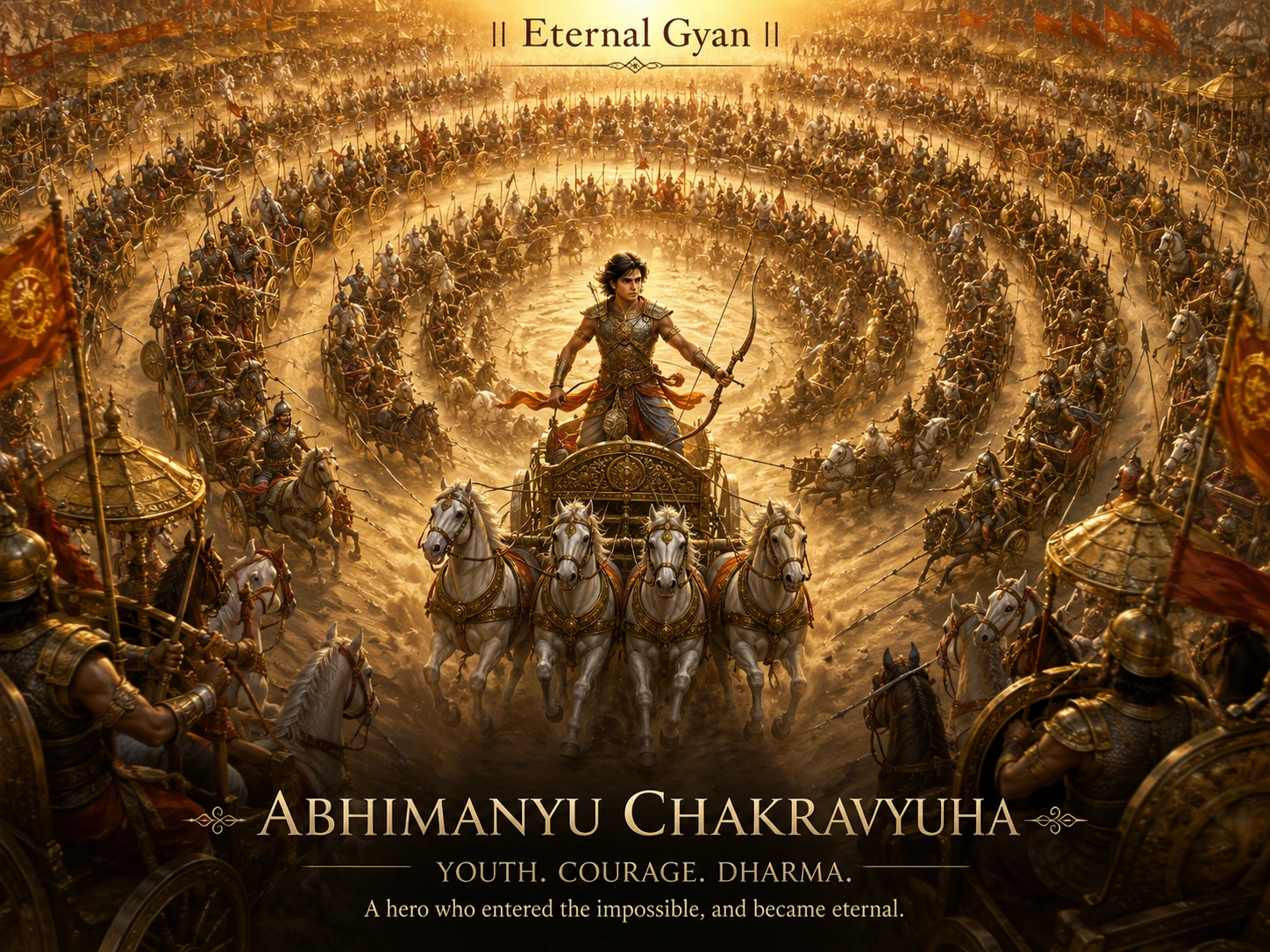
Abhimanyu and the Chakravyuha -- The Boy Who Knew How to Enter but Not How to Leave
14 min read
Adbhuta Ramayana -- The Ramayana Where Sita Becomes Kali
9 min read
After Kurukshetra -- What Happened Next
14 min readThe same translation error that turned '33 Koti' into '33 crore' in Hinduism also happened in Buddhism. The Chinese translation of Buddhist texts rendered 'Sapta Koti Buddha' (7 Supreme Buddhas) as '7 Crore Buddhas.' The…
Deities AvatarsCommunity Reflections
🕉️
Be the first to share your reflection.