Mantra and Meter -- The Chandas Connection
मन्त्र और छन्द -- छन्दस् का सम्बन्ध
When a 2026 student of Sanskrit opens her textbook to a famous mantra, she sees the words and typically stops there. The Gayatri Mantra. The Mahamrityunjaya. The Purusha Sukta. She reads the words, memorises a translation, perhaps learns to recite the Sanskrit, and considers her work done. What she has missed is the half of the mantra that is not in the words at all. Every Vedic and classical Sanskrit mantra is composed in a specific meter, and the meter is not decoration. It is integral to how the mantra works. Change the meter and you change the mantra, even if every syllable remains identical. Remove the meter entirely and chant the same words in prose, and you do not have the mantra at all. The Vedic tradition knew this and named one of its six Vedangas, the auxiliary disciplines, specifically for meter -- Chandas. The science of meter was considered so important that no student of the Vedas was considered prepared until she had mastered it. Modern yoga and mantra culture, in its enthusiasm for accessible practice, has often stripped meter away from mantra teaching. This article attempts to put it back.
The foundational text on Sanskrit meter is the Chandashastra of Pingala, composed probably between the 4th and 2nd centuries BCE. Pingala was a Sanskrit grammarian and prosodist, traditionally identified as a younger brother of the great grammarian Panini, though historical dating is uncertain. His Chandashastra is a short work of eight chapters that systematises every possible pattern of long and short syllables in Sanskrit poetry into a rigorous combinatorial scheme. Pingala invented, incidentally, what is now recognised as the binary number system -- he used two symbols, laghu (light or short) and guru (heavy or long), to represent every meter as a sequence of binary digits. A thousand years before European mathematicians worked out binary arithmetic, Pingala was using it to classify Vedic meters. His work is still the standard reference for Sanskrit prosody. Every Sanskrit meter has a specific pattern of laghu and guru syllables, and that pattern determines the meter's emotional and vibrational effect. Two mantras in different meters with the same content produce different effects on the practitioner. The Chandashastra makes this technical rather than mystical -- it is a matter of syllable count, syllable weight, and rhythmic distribution, measurable and reproducible.
ॐ भूर्भुवः स्वः। तत्सवितुर्वरेण्यं। भर्गो देवस्य धीमहि। धियो यो नः प्रचोदयात्॥
oṃ bhūr bhuvaḥ svaḥ | tat savitur vareṇyaṃ | bhargo devasya dhīmahi | dhiyo yo naḥ pracodayāt ||
Om, in the three worlds -- earth, atmosphere, heaven -- we meditate on the excellent radiance of that divine Savitri, who may inspire our thoughts.
— Gayatri Mantra, Rigveda 3.62.10, attributed to Rishi Vishvamitra; composed in Gayatri meter (three padas of eight syllables each, totalling 24 syllables after the vyahritis)
The Gayatri Mantra is the most widely cited example of the meter-content connection, partly because the meter is named after this specific mantra. Gayatri meter consists of three padas, or feet, of eight syllables each, for a total of twenty-four syllables. The mantra from Rigveda 3.62.10, which begins tat savitur varenyam, is the canonical example of the meter. The opening Om bhur bhuvah svah that precedes most recitations is a Vedic preamble, not part of the 24-syllable Gayatri body. When the tradition counts the syllables, it counts only the three eight-syllable lines. The specific arrangement of long and short syllables within these twenty-four slots produces the distinctive Gayatri rhythm, which every trained Vedic reciter can identify by ear and which every trained mantra practitioner can feel as a particular pulse in the body when the mantra is recited correctly. Recite the same words at the wrong tempo or with the wrong emphasis on long versus short syllables, and the pulse breaks. The mantra becomes, in the technical sense, a different mantra that happens to use the same words. This is why traditional mantra transmission always includes pronunciation and rhythm, not just textual content. The oral transmission is the point; the written text is a secondary aid.
Anushtubh is the most common meter in classical Sanskrit poetry after the Vedic period, and understanding it illuminates why classical mantras have the rhythm they do. Anushtubh consists of four padas of eight syllables each, for a total of 32 syllables. The Bhagavad Gita is composed almost entirely in Anushtubh meter. The Ramayana's core narrative verses, the bulk of the Puranas, most epic poetry, and a vast number of stotras and mantras use this meter. Its structural rule is simple -- eight syllables per pada, with specific restrictions on where long and short syllables can appear in certain positions of certain padas. The resulting rhythm is calm, steady, and narrative. Reading the Gita in Anushtubh, even without understanding a word of Sanskrit, the listener feels the steady pulse that carries Krishna's teaching through eighteen chapters without losing momentum. This is not accidental. Vyasa, to whom the tradition attributes the Gita's composition, chose Anushtubh deliberately because the content required a meter that could sustain extended teaching without becoming either lyrical (Gayatri) or grand (Trishtubh or Jagati). The meter fits the content, and the content would not work in another meter. A student who tries to paraphrase the Gita in prose loses something irrecoverable -- the rhythmic scaffolding that makes the teaching stick in memory and feel in the body.
Principal Sanskrit Meters and Their Characteristic Uses
| Meter | Syllables per Line | Total Syllables | Characteristic Quality | Famous Examples |
|---|---|---|---|---|
| Gayatri | 8 x 3 = 24 | 24 | Concise, invocational, meditative | Gayatri Mantra (Rigveda 3.62.10) |
| Ushnik | 7 x 4 = 28 | 28 | Gentle, lyrical, petitioning | Several Atharva Veda hymns |
| Anushtubh | 8 x 4 = 32 | 32 | Narrative, steady, teaching | Bhagavad Gita; Ramayana; most Puranas |
| Brihati | 9 x 4 = 36 | 36 | Expanded, full, praise-oriented | Rigveda hymns to major deities |
| Pankti | 8 x 5 = 40 | 40 | Five-part balance; ritual invocation | Specific Yajurveda formulas |
| Trishtubh | 11 x 4 = 44 | 44 | Grand, elevated, cosmic | Most of Rigveda; Nasadiya Sukta; Purusha Sukta |
| Jagati | 12 x 4 = 48 | 48 | Flowing, continuous, majestic | Rigveda cosmological hymns |
The Vedic tradition recognises these seven as principal meters, with a further nineteen variations that build on them. Pingala's Chandashastra classifies all 26 categories by syllable count and long-short patterns. Each meter's characteristic quality comes from its specific rhythm and is as definable as a musical raga's character.
Trishtubh meter deserves specific attention because it carries the grandest Vedic mantras. Trishtubh consists of four padas of eleven syllables each, totalling 44 syllables. Most of the Rigveda is composed in Trishtubh. The Nasadiya Sukta, the famous creation hymn that begins with the line describing what was before the universe existed, is in Trishtubh. The Purusha Sukta, the cosmological hymn of the Cosmic Person whose self-sacrifice created the world, is in Trishtubh. Most hymns to Indra, Varuna, Agni, and Vishnu use this meter. The distinctive quality of Trishtubh is its elevated, cosmic, grand character. When a Vedic reciter moves from the 24-syllable compression of Gayatri to the 44-syllable expansiveness of Trishtubh, the effect is perceptible in the body -- the breath opens, the torso lifts, the attention broadens to take in a larger cosmic horizon. This is not metaphor. It is a measurable physiological effect of rhythm on respiration, posture, and attention. Trishtubh is the meter chosen for subjects that need cosmic scale. Gayatri would be too short to contain a creation hymn. Anushtubh would be too plain. Jagati would be too flowing. Only Trishtubh sustains the grandeur required. The meter is the vehicle. The content rides the vehicle. Choose the wrong vehicle and the content cannot arrive.
The practical implication of the meter-mantra relationship for a 2026 practitioner is specific. When you receive a mantra from a Guru, you receive not only the syllables but the meter, the pronunciation, the tempo, and the specific rhythmic pattern of stress within each pada. These elements together constitute the mantra. Receiving them separately, through a printed book or an Instagram post, is an incomplete reception. This is why the oral transmission tradition, in which a qualified teacher speaks the mantra and the disciple repeats it until the rhythm is correctly absorbed, is considered essential in classical Hindu tradition. The book tells you the words. Only the teacher gives you the mantra. A 2026 student who learns the Mahamrityunjaya Mantra from YouTube may have the syllables but not the mantra -- not because YouTube is inherently bad, but because the specific teacher's recitation may not preserve the correct traditional rhythm. The Shraddha Trust in Pune and the Vedic Heritage Portal of the Ministry of Culture offer verified recitations by trained Vaidikas whose lineages preserve traditional rhythms accurately. These are better sources for beginners than casual internet searches. For serious practice, direct oral transmission from a qualified teacher remains the gold standard, and no digital recording can fully replace it.
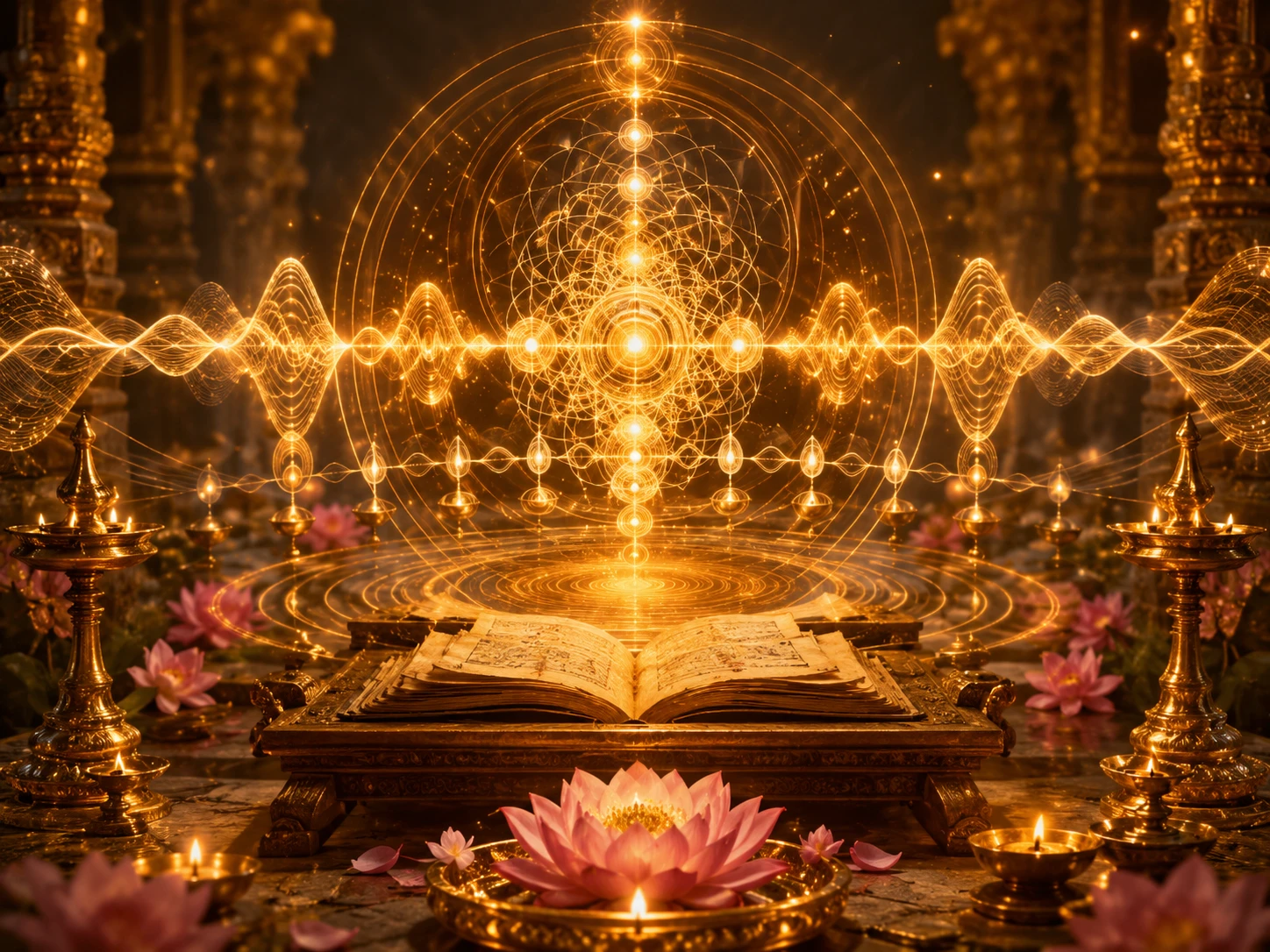
The vibrational theory behind meter-mantra connection deserves specific explanation. Classical Sanskrit tradition holds that every phoneme, every syllable, and every rhythmic pattern produces a specific vibration, and that vibrations can combine constructively or destructively just as physical waves can. A mantra in the correct meter produces a coherent vibrational pattern that resonates with specific aspects of the practitioner's subtle body and consciousness. A mantra in the wrong meter produces incoherent vibrations that cancel or distort the intended effect. The tradition further holds that specific meters resonate with specific chakras. Gayatri, with its 24 syllables in three padas, resonates particularly with the Vishuddha chakra at the throat and the Manipura at the solar plexus. Anushtubh resonates with Anahata at the heart. Trishtubh resonates with Ajna and Sahasrara at the higher centres. These correspondences are not arbitrary. They reflect the specific rhythmic signatures of each meter and how those signatures align with the oscillatory patterns traditional yogic anatomy attributes to each chakra. A 2026 practitioner who wants to work on heart-centred qualities -- compassion, trust, emotional openness -- benefits more from Anushtubh-metered chanting than from Gayatri-metered chanting, not because Gayatri is inferior but because its meter operates at a different level. Matching meter to intended subtle body effect is a skill traditional teachers cultivate in their students over years.
The modern Indian recitation tradition that preserves these meters at high quality is centred in a few specific lineages. The Vaidikas of Kanchi Kamakoti Peetham and Sringeri Sharada Peetham maintain continuous oral transmission of Vedic chanting that has passed through generations without loss of rhythmic integrity. The Vedic schools at Varanasi Hindu University, the Rashtriya Sanskrit Vidyapeeth at Tirupati, and Jagadguru Ramanandacharya Rajasthan Sanskrit University at Jaipur train students in traditional recitation with strict rhythmic correction. The Ghana Pathin tradition, in which an advanced student can recite a Vedic verse in 13 different permutations without error, is the gold standard for preservation and still exists in families passing the training down from father to son for over a hundred generations. These Ghana Pathins are India's oral archive of meter, and some of them have cognitive accuracy of recall that has been verified by researchers at the Indian Institute of Science to be beyond what standard memory training produces. A 2026 student serious about meter should seek out recordings or ideally live recitation from Ghana Pathin Vaidikas, available through some Karnataka and Kerala temple programmes during Veda Adhyayanam festivals. Hearing correct meter live in a trained mouth is a different experience from reading it on paper or hearing it in a studio recording, and the difference matters for a practitioner trying to internalise the rhythm.
A specific error pattern worth naming is the tendency of modern Bollywood and devotional music to set traditional mantras to melodies and rhythms that do not match the original Vedic meters. A popular Bollywood film song may set the Gayatri Mantra to a four-beat tabla rhythm, which is structurally incompatible with the Gayatri meter's three-pada structure. The result sounds pleasant and may move listeners emotionally, but it is not the Gayatri Mantra functioning as a mantra. It is the Gayatri words in a different vibrational container. This is not a moral failing on the part of Bollywood. Film music serves its own aesthetic purposes and is not obligated to preserve Vedic meter. But a listener who thinks she has heard the Gayatri Mantra because she has heard the film version has not heard the mantra. The same applies to many contemporary recordings that set Vedic or classical Sanskrit texts to Western musical forms, harmonies, and rhythms. The result may be beautiful but is not functionally equivalent to the original. A 2026 seeker wanting actual mantra practice should distinguish carefully between devotional music, which serves its own legitimate purposes, and traditional recitation, which serves the mantra's specific vibrational work. The two domains overlap in inspiration but not in technical function.
Contemporary scholarship on Sanskrit meter has been active and productive. The Oriental Research Institute at Mysore, the Bhandarkar Oriental Research Institute at Pune, and the French Institute of Pondicherry have produced detailed studies on meter-rhythm relationships in Vedic and classical Sanskrit. Georg Buhler's 19th century work on the Chandashastra, still in print, remains a foundational reference. The more recent Sanskrit Metre by Emma Westerberg (2011) provides a modern English-language treatment accessible to practitioners without Sanskrit training. Academic scholars working on historical linguistics and metrical reconstruction include Michael Meier-Brugger at Berlin and Stephanie Jamison at UCLA, whose work on the Rigveda has refined scholarly understanding of how early Vedic meter differed from the classical meters that came later. The Muktabodha digital library and the Sansknet project at the University of Hyderabad have digitised a significant corpus of Sanskrit texts with metrical annotations, allowing students to search for verses by meter rather than just by content. A 2026 Sanskrit student has more tools for understanding meter than at any previous point, and serious engagement with these tools rewards the effort handsomely. The metrical dimension of Sanskrit is one of the most beautiful parts of the language and one that casual learners almost always miss. A student who begins noticing meter in her own recitation practice quickly realises that every classical Indian art form -- music, dance, poetry, ritual -- shares this same metrical substrate, and the insight transforms how she hears not only Sanskrit verse but all of Indian classical culture.
For a practical starting point in 2026, a student who wants to build meter awareness can begin with three specific exercises. First, choose a familiar mantra -- the Gayatri Mantra is ideal -- and count the syllables carefully, pada by pada, noting which are laghu and which are guru. This simple exercise, done a few times, transforms the mantra from a block of words into a patterned structure. Second, listen to three different recitations of the same mantra by different Vaidikas, ideally from different lineages, and note whether the syllable count and long-short pattern stay consistent while the tempo varies. A trained ear can hear the structural consistency beneath surface variation, and this hearing is the beginning of meter awareness. Third, try reciting the mantra while physically tapping the rhythm on your hand, one tap per syllable, emphasising the long syllables with a slightly harder tap. After a week of this practice, the rhythm begins to live in the body rather than only in the ears, and this embodied rhythm is the foundation for real mantra practice. None of these three exercises requires advanced Sanskrit. They require only attention and repetition. A college student in Bangalore, Delhi, or Chennai can start them tonight and see progress within weeks. The payoff is permanent.
A final observation concerns the civilisational significance of chandas preservation. India is one of the few cultures that successfully maintained a living oral tradition of rhythmically precise ritual recitation for over three thousand years. Most comparable oral traditions worldwide lost their rhythmic integrity as the cultures that carried them passed through political disruption, language change, or intergenerational loss. The Zoroastrian Avesta, for instance, has preserved its words but not its original rhythm. Ancient Greek and Latin poetic meters are known in theory but cannot be performed with the confidence that Vedic meter can, because no continuous oral transmission survives. The Hindu tradition is unusual, perhaps unique, in having maintained a functioning oral pipeline from the Rigvedic era to the present. This is a civilisational achievement of the first rank, accomplished by the mostly unrecognised labour of generations of Vaidika families who trained their sons in the exact pronunciation and rhythm of thousands of verses. A 2026 Indian who has never heard a trained Ghana Pathin recite should consider making the effort to do so at least once. What you hear is not just ancient text. It is a living instrument, tuned and retuned across a hundred generations, still sounding in the same way today that it sounded when the Rigvedic hymns were first composed. That continuity is itself a form of sacredness that no written text can replicate. This is an inheritance worth protecting. Every Indian citizen inherits it by default, whether she uses it or not.
In 2008, UNESCO inscribed the tradition of Vedic chanting on the Representative List of the Intangible Cultural Heritage of Humanity, specifically citing the preservation of original meter and rhythm as one of the world's most remarkable achievements in oral transmission. The inscription documented that India's Ghana Pathin lineages preserve chanting techniques -- including the eleven distinct recitation patterns of jata, mala, shikha, rekha, dhvaja, danda, ratha, and ghana -- that allow Vedic verses to be recited in combinatorial permutations while maintaining exact syllable accuracy and meter. UNESCO researchers studying the tradition found that senior Ghana Pathins could reliably recite a given verse in 13 different permutations without introducing any errors, a feat of memory and rhythmic discipline that the researchers described as exceeding what even professional Western classical musicians manage with notated scores. The inscription did not lead to substantial funding or formal protection for these lineages, which continue to decline demographically in the 21st century. Some Kerala and Andhra Pradesh temples have begun programmes to document and support surviving Ghana Pathin families, but the overall trajectory is one of attrition rather than preservation. A 2026 Indian who wants to hear this tradition alive should not assume it will still be available in 2050.
Feel the Metre in Your Chanting
The Gayatri metre has three padas of eight syllables. Chant the Gayatri mantra slowly, counting the syllables of each pada on your fingers -- the first pada reaches eight only when vareṇyam is sounded vareṇiyam, as Vedic recitation does. Do this three times, then once with your eyes closed, noticing whether you feel the three-pada rhythm in your body. Ten minutes daily for a month rebuilds the metre awareness modern mantra teaching often leaves out. The Gayatri's page on Eternal Raga gives its text and meaning.
Tags
Eternal Raga · शाश्वत राग
Institutional voice — scholarly articles on Sanatan Dharma
Deepen Your Understanding
अपनी समझ और गहरी करें
tantra mantra yantra
Matrika Shakti -- The Sacred Alphabet as Cosmic Blueprint
The Sanskrit alphabet is not a human invention. It is a cosmological map -- each letter a compressed Shakti, each vowel a tattva, the whole Varnamala a sonic replica of the universe unfolding from pure consciousness to gross matter. When Shiva's damaru sounded fourteen times, it did not produce grammar. It produced reality.
tantra mantra yantra
The Science of Mantra -- How Sacred Sound Rewires Consciousness
A mantra is not a prayer. It is not a wish. It is a precision instrument of consciousness -- a vibrational key engineered in Sanskrit thousands of years ago to unlock specific states of mind. Modern neuroscience is only now catching up.
tantra mantra yantra
Bindu, Nada, Kala -- Manifestation
Three Sanskrit terms carry the entire Shakta cosmology of how Brahman becomes universe. Bindu is the condensed point before all creation. Nada is the first vibration, the primordial sound that is not yet sound. Kala is the first differentiation, the division that makes many from one. Every Sri Yantra, every mantra, every breath a trained upasaka takes passes through these three stages in reverse, collapsing back from kala through nada to bindu.
tantra mantra yantra
The Gayatri Mantra -- 24 Syllables That Illuminate the Mind
The most chanted verse in human history is not a prayer for wealth, power, or protection. It is a prayer for light -- for the divine radiance to illuminate the intellect. 24 syllables from Rig Veda 3.62.10, attributed to Rishi Vishwamitra, have shaped Indian civilisation for over three thousand years.
vedic sciences
Panini and Ashtadhyayi -- The Science of Sanskrit Grammar
In the 5th century BCE, a man in Gandhara wrote approximately 4,000 rules that could generate every valid sentence in Sanskrit. No exceptions. No ambiguity. His system anticipated formal grammar, programming languages, and natural language processing by two and a half millennia. His name was Panini, and his Ashtadhyayi is not a grammar book -- it is an algorithm.
scriptural exegesis
The Four Vedas -- An Overview of Hinduism's Oldest Scriptures
Rig, Yajur, Sama and Atharva: what each Veda contains, how every Veda is layered from hymns to Upanishads, why the Vedas are called shruti, "what was heard", and how they were carried for thousands of years without being written down.
tantra mantra yantra
Nadis and the Subtle Body
Your body has 72,000 nadis. You will not find them in a surgical dissection. They are channels of prana, the subtle life energy, running through the subtle body that underlies the physical. Three are principal -- Ida running down the left, Pingala down the right, and Sushumna running through the centre of the spine. Every pranayama, every mudra, every mantra practice is shaping the flow of these invisible highways.
In 2008, UNESCO inscribed the tradition of Vedic chanting on the Representative List of the Intangible Cultural Heritage of Humanity, specifically citing the preservation of original meter and rhythm as one of the world'…
More in Tantra, Mantra & Yantra
Agama vs Tantra vs Veda -- Three Streams of Hindu Practice
14 min read
Agni Dhyana -- What Meditation on Fire Is Actually Grounded In
8 min read
Ashta Siddhi -- The Eight Yogic Powers and How Hanuman Embodies Them
13 min readThe same translation error that turned '33 Koti' into '33 crore' in Hinduism also happened in Buddhism. The Chinese translation of Buddhist texts rendered 'Sapta Koti Buddha' (7 Supreme Buddhas) as '7 Crore Buddhas.' The…
Deities AvatarsCommunity Reflections
🕉️
Be the first to share your reflection.