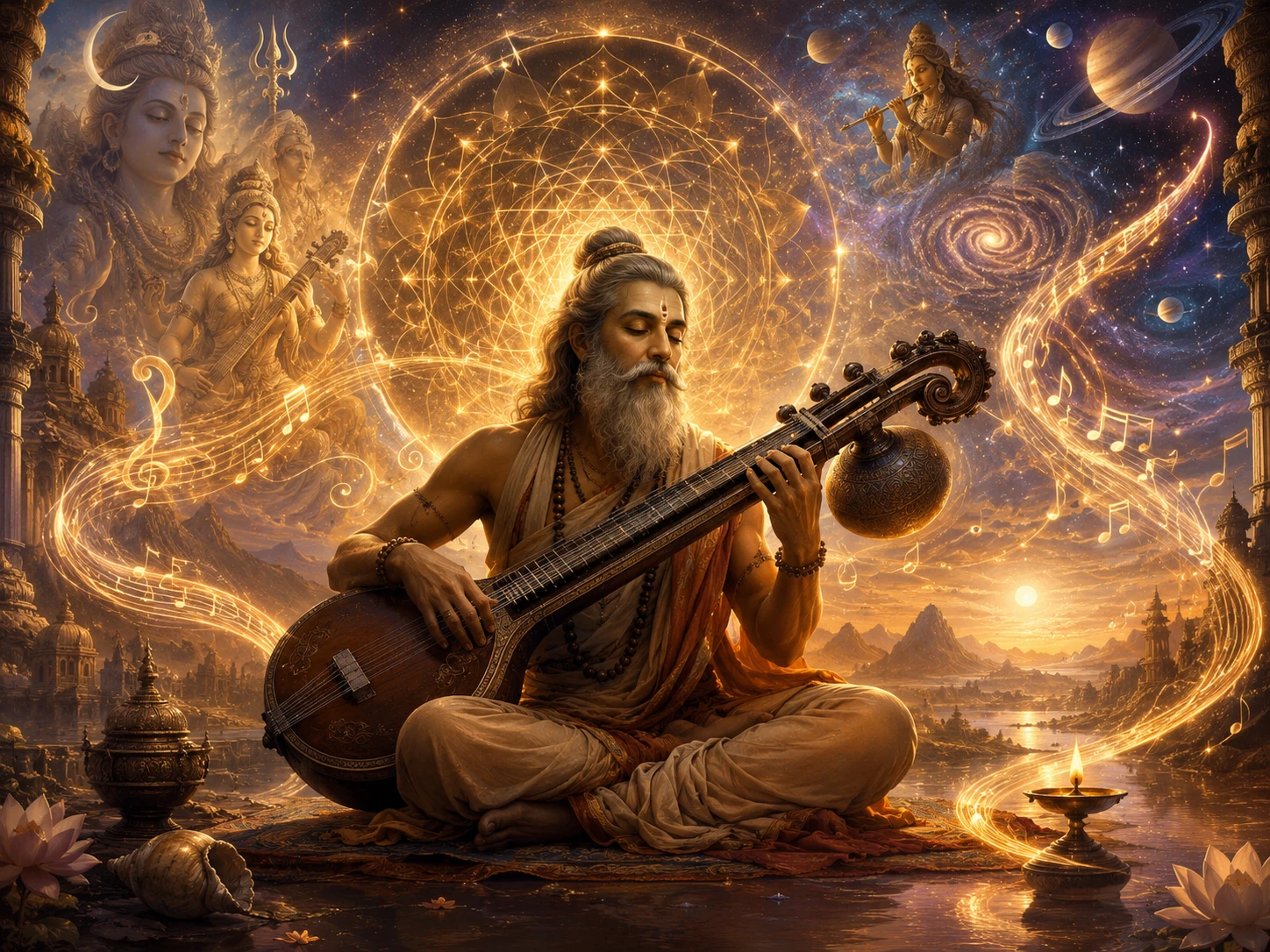
Nada Brahma -- Sound as Creation in Hindu Sangeet Shastra
नाद ब्रह्म -- हिन्दू संगीत शास्त्र में ध्वनि और सृष्टि
When the sage Bharata Muni sat down to compose the Natya Shastra around two thousand years ago, he did not begin with rhythm or melody. He began with a question -- where does sound come from, and why does it move us. His answer, inherited from the Vedic seers and refined across centuries, became the foundation of Indian classical music. Sound is not decoration. Sound is the universe organizing itself into something a human ear can recognize.
The Hindu tradition calls this premise Nada Brahma. Sound is Brahman, the ultimate reality. Every raag a musician sings in 2026, whether at the Sawai Gandharva Bhimsen Mahotsav in Pune or on a YouTube cover from a teenager's bedroom in Lucknow, descends from this single conviction. Sangeet, the union of vocal music, instrumental music, and dance, is treated in the Sanskrit tradition not as entertainment but as a path. The Yajnavalkya Smriti goes so far as to say that one who masters the veena and tala attains moksha effortlessly. The Sangeet Ratnakara opens by declaring that to worship Nada is to worship Brahma, Vishnu, and Shiva simultaneously, since the three are themselves of the nature of sound.
This article maps the spine of that tradition. From the Sama Veda's musical chant to Bharata's stagecraft manual, from Matanga's introduction of the word raga to Sharangadeva's grand synthesis at the Yadava court of Devagiri, the foundational texts of Indian sangeet form an unbroken chain. Read together, they explain why a Bhairav at dawn moves a listener differently from a Yaman at dusk, why Pt. Bhimsen Joshi's rendition of Mile Sur Mera Tumhara felt like a national prayer, and why every parent in India who enrolls a child for vocal classes is, knowingly or not, plugging into a 3,000-year-old current.
This article is also the anchor for the rest of the Eternal Gyan music cluster. Subsequent articles go deep into specific raags, the time-of-day theory that decides when each raag is sung, the ten Thaat classification that organizes the modern Hindustani repertoire, and the gharana lineages that pass this knowledge from guru to shishya. None of those articles can be read properly without first grasping the premise that holds them together. The premise is simple, ancient, and radical -- the same vibration that creates the universe creates a song, and the trained ear can hear both at once.
वेदानां सामवेदोऽस्मि देवानामस्मि वासवः। इन्द्रियाणां मनश्चास्मि भूतानामस्मि चेतना॥
vedanam sama-vedo'smi devanam asmi vasavah indriyanam manash chasmi bhutanam asmi chetana
Among the Vedas, I am the Sama Veda. Among the gods, I am Indra. Among the senses, I am the mind. Among living beings, I am consciousness.
— Bhagavad Gita 10.22
Krishna's choice of the Sama Veda, in the tenth chapter of the Gita, is not casual. He is naming his own vibhuti, his special manifestation, among the four Vedas. Of the four, the Sama is the one set to melody. The implication is direct -- among the bodies of revealed knowledge, the one that sings is the divine one.
To grasp this, one has to understand that classical music in India did not emerge from court entertainment. It emerged from the act of chanting the Vedas. The Sama Veda contains roughly 1,875 mantras, but 95 percent of them are mantras already present in the Rig Veda. What makes the Sama Veda distinct is not new content but musical notation -- specific tones, pitches, and prolongations indicated by markers above the syllables. The Saman chant is the earliest preserved system of melodic notation in human history. When you hear a Vedic priest at a Yagna in Varanasi today rising and falling on the same syllable, drawing one mantra across thirty seconds where ordinary speech would take three, you are listening to a notation system older than written Greek.
From this ritual seed, three streams flowed across the centuries. The first was Gandharva sangeet, the music of celestial musicians, considered sacred and bound to the temple. The second was Marga sangeet, the systematized art music codified by Bharata in the Natya Shastra. The third was Desi sangeet, the regional folk traditions of villages and tribes. Bharata's contribution was to give the second stream a complete grammar -- shrutis (microtonal divisions of the octave), swaras (the seven notes), gramas (parent scales), murchhanas (modal transformations), and jatis (early raga prototypes). The Natya Shastra's treatment of music runs across six chapters and remains the single most comprehensive technical treatment of Indian music for the next thousand years.
For nearly a millennium after Bharata, the term raga did not exist as we use it today. It first appears in Matanga Muni's Brihaddeshi, composed somewhere between the 6th and 8th centuries CE, where the older jati system began transitioning into what we now recognize as raga -- a melodic framework with characteristic phrases, distinctive ascending and descending patterns, and an emotional identity. Matanga's contribution was as much linguistic as musical. By giving the new musical category a name, he made it possible to talk about it, debate it, and pass it on.
By the time Sharangadeva wrote the Sangeet Ratnakara at the court of King Singhana of the Yadava dynasty (early 13th century CE, in Devagiri, today's Daulatabad in Maharashtra), the raga system had matured into a comprehensive theory covering 264 ragas, with detailed treatment of talas, instruments, and dance. This text is the last great work that treats both North and South Indian classical music as a single tradition. After the political upheavals of the 13th and 14th centuries, and the arrival of Persian and Central Asian musical influences in the North, the two streams diverged into Hindustani (North) and Carnatic (South). Both still cite Sharangadeva as their shared ancestor.
The Foundational Texts of Indian Sangeet Shastra
| Text | ग्रन्थ | Author & Era | Core Contribution |
|---|---|---|---|
| Sama Veda | सामवेद | Vyasa-attributed compilation, c. 1500-1000 BCE | Earliest preserved musical notation in any tradition. Foundation of Saman chant. |
| Natya Shastra | नाट्यशास्त्र | Bharata Muni, c. 200 BCE to 200 CE | First systematic grammar of music, dance, and theatre. 36 chapters covering shrutis, swaras, gramas, jatis, talas. |
| Brihaddeshi | बृहद्देशी | Matanga Muni, c. 6th-8th century CE | First text to use the word 'raga' in its modern sense. The bridge from jati to raga. |
| Sangeet Ratnakara | संगीत रत्नाकर | Sharangadeva, c. 1210-1247 CE | Last great pan-Indian text. 7 chapters covering 264 ragas, talas, dance, and instruments. |
| Raga Tarangini | राग तरंगिणी | Locana Kavi, c. 14th-15th century CE | Early Hindustani-specific raga classification. Precursor to the mela and thaat systems. |
| Sangeet Parijata | संगीत पारिजात | Ahobala, c. 1665 CE | Mathematical analysis of swara frequencies. Persian-Indian synthesis era. |
| Hindustani Sangeet Paddhati | हिन्दुस्तानी संगीत पद्धति | Vishnu Narayan Bhatkhande, 1909-1932 CE | Modern Thaat-based classification of Hindustani ragas. Standard textbook in conservatories today. |
Dates for ancient texts represent the scholarly range. Bharata's Natya Shastra and Matanga's Brihaddeshi were likely compiled across several generations rather than written by single authors in single sittings.
At the heart of all this textual lineage sits a single Sanskrit word -- nada. The word is often translated simply as sound, but the Sanskrit tradition splits nada into two categories that change how a musician thinks about her practice.
The first is anahata nada, the unstruck sound. This is the cosmic vibration that exists without any physical cause, the sound the yogis claim to hear in deep meditation, the sound the Mandukya Upanishad identifies with Om. Anahata nada is not produced. It is heard. The second is ahata nada, the struck sound. This is the audible sound produced when two things meet -- voice and breath, fingertip and string, mallet and drum. All music a human ever performs is ahata nada.
The classical sangeet tradition holds that the purpose of ahata nada is to lead the practitioner toward anahata nada. A raag is not its notes. A raag is what becomes audible when a trained musician arranges those notes in a particular way at a particular hour with a particular intent. The notes are the vehicle. Anahata is the destination. This is why the tradition treats music as a yoga, called Nada Yoga, and why a typical Hindustani concert opens with the alaap -- a slow, rhythm-less, improvised exploration of the raag's territory before any composition begins. The alaap is not an introduction. It is the musician's invitation to the listener -- come into anahata with me.
The Sanskrit word for the seven notes -- sa, re, ga, ma, pa, dha, ni -- carries this premise too. Each note is called a swara, from the root svar, meaning that which shines by itself. A swara is not just a frequency. It is a self-luminous unit of consciousness made audible. Bharata gives each swara a deity, an emotional resonance, an animal whose call it imitates, and a chakra in the body where it is said to vibrate. When a vocalist tunes the tanpura before a concert, what looks like calibration is, in the tradition's reading, alignment. The tanpura's drone fixes the singer's body to the cosmic Sa, the foundation note. Every other swara that follows in the next two hours is measured against that anchor. Lose the Sa, lose the connection to anahata.
ओमित्येतदक्षरमिदं सर्वं तस्योपव्याख्यानम्। भूतं भवद्भविष्यदिति सर्वमोङ्कार एव। यच्चान्यत् त्रिकालातीतं तदप्योङ्कार एव॥
om ity etad aksharam idam sarvam tasyopavyakhyanam bhutam bhavad bhavishyad iti sarvam omkaara eva yach chanyat trikalatitam tad apy omkaara eva
The syllable Om is all this. All that is past, present, and future is verily Om. And whatever else there is, beyond the three times -- that too is verily Om.
— Mandukya Upanishad 1.1
Once the premise of nada is in place, the architecture of a raag becomes intelligible. A raag is not a scale. A scale is a neutral ladder of notes. A raag is a scale that has acquired identity, mood, and rules of behavior across centuries of practice. Six elements together define what a raag is and is not.
First, the swaras themselves -- which of the twelve notes of the octave the raag uses, and which it forbids. Raag Bhairav uses komal Re and komal Dha (lowered second and sixth). Raag Yaman uses tivra Ma (raised fourth) and shuddha versions of the rest. Pick the wrong note and you are no longer in the raag at all.
Second, aroh and avaroh -- the ascending and descending patterns. Some raags ascend straight and descend with curves. Some skip notes going up and use them only coming down. Raag Bhupali skips Ma and Ni in both directions, leaving five notes. Raag Bilawal uses all seven shuddha swaras linearly. The shape of motion matters as much as the notes used.
Third, the vadi and samvadi -- the king and minister of the raag. Each raag has one note that carries the most weight, the one a singer returns to and rests upon. The samvadi is its consonant partner. Together, vadi and samvadi tell you whether a raag's emotional center sits in the lower tetrachord (poorvanga) or the upper (uttaranga), which in turn correlates with whether the raag belongs to morning or evening.
Fourth, the pakad -- the signature phrase. A few characteristic note combinations that, once heard, identify the raag instantly even to a half-trained ear. The pakad is what separates Bhimpalasi from Dhani, two raags that share the same five notes but feel completely different in the hands of a competent musician.
Fifth, the time of day or season -- the samay. Hindustani classical assigns each raag to a specific Prahar of the 24-hour cycle. Bhairav at dawn. Bhimpalasi in the late afternoon. Yaman at dusk. Bageshri after midnight. The reasoning behind this assignment is the subject of the next article in this cluster.
Sixth, the rasa -- the emotional flavor. Raag Marwa carries a sense of sunset melancholy. Raag Hamsadhwani carries auspicious celebration. Raag Bhairavi carries the bittersweet feeling of departure. The same notes in two different raags produce two different emotional results, which is exactly Matanga's point when he wrote that a raag is what colors the mind.
A seventh dimension is worth naming, even though it sits one level above the raag itself -- the compositional form. A raag is the canvas. The form is the kind of painting you do on it. Hindustani tradition recognizes four major vocal forms. Dhrupad, the oldest surviving form, descended directly from the Sama Veda chant and emphasizes austere, slow, philosophical exposition with two-line compositions and the pakhawaj as its rhythmic partner. Khayal, the dominant form in concerts today, developed in the Mughal era and gives the singer wide latitude for improvisation, accompanied by tabla and harmonium. Thumri, lighter and emotion-forward, often deals with the love themes of Krishna and Radha and allows the singer to step temporarily outside strict raag rules. Tarana, credited to Amir Khusrau, uses syllables instead of meaningful words and showcases the singer's rhythmic agility. Each of these forms can be performed in any major raag. A Yaman dhrupad and a Yaman thumri share the same swaras but produce two completely different concert experiences.
One critical bridge connects the textual tradition described above to the modern Hindustani concert hall -- the gharana system. A gharana is a living lineage of teaching, named after the city or court where its founders gathered. The word itself comes from ghar, meaning house, and a gharana is exactly that -- a musical household passed down across generations through the guru-shishya parampara of close, intense, often lifelong apprenticeship.
Six gharanas dominate the Hindustani vocal world today. The Gwalior gharana, considered the parent of all the others, traces its lineage to the courts of medieval Gwalior and emphasizes clarity of swara and a balanced approach to alap, taan, and bandish. The Agra gharana, with roots in the time of Akbar's court, leans toward weighty, masculine voice production and forceful taans. The Kirana gharana, founded by Ustad Abdul Karim Khan in the early 20th century and made famous by Pt. Bhimsen Joshi, foregrounds long, slow alap and emotional surrender. The Patiala gharana, associated with Ustad Bade Ghulam Ali Khan, is known for fast taans and ghazal-influenced phrasing. The Jaipur-Atrauli gharana, founded by Ustad Alladiya Khan, specializes in rare and complex raagas. The Mewati gharana, brought to wider audiences by Pt. Jasraj, foregrounds the devotional bhakti dimension of classical music.
Each gharana preserves a slightly different reading of the same raagas. The Yaman of a Kirana vocalist sounds different from the Yaman of an Agra vocalist, even though both are using the same swaras and the same rules. This is not contradiction. This is how a living tradition keeps itself alive -- by allowing multiple authentic interpretations to coexist, each tested across decades of concert halls, recordings, and student lineages.
The 20th century brought a parallel transformation. Pt. Vishnu Digambar Paluskar in Lahore (1901) and Pt. Vishnu Narayan Bhatkhande in Mumbai opened public music institutions that taught Hindustani classical to anyone who could pay the fees, breaking the older model where music passed only inside specific families. Their twin contribution was institutional -- the Gandharva Mahavidyalaya network and the modern textbook -- and ideological. Music, they argued, was not the private property of court musicians or hereditary families. It was a national heritage to be taught widely. Every conservatory in India today, from the ITC Sangeet Research Academy in Kolkata to the Madhav Music College in Gwalior, owes its existence to that early 20th century shift.
The Sanskrit word raga comes from the root ranj, meaning to color or to dye. A raga is therefore not just a melodic structure -- it is something that colors the mind of the listener. The medieval text Brihaddeshi puts it directly in three words -- ranjayati iti ragah, that which colors is a raga. This is also why Indian classical music does not separate the technical from the emotional. The technical structure exists precisely to produce the coloring.
The 3,000-year chain does not break in modern India. It only changes its visible carriers.
When Pt. Bhimsen Joshi, Lata Mangeshkar, M. Balamuralikrishna, Pt. Hariprasad Chaurasia, and dozens of other masters came together in 1988 to record Mile Sur Mera Tumhara, they did something quietly radical. They wove together verses in fourteen Indian languages, set to a foundation of classical raagas, into a single five-minute piece broadcast on Doordarshan. An entire generation absorbed the structure of Indian classical music without ever opening a textbook on it. The shorthand worked because the underlying grammar was already three millennia old.
The same pattern repeats in Bollywood. When A.R. Rahman composed Vande Mataram for the 1997 album, he set the chorus in Raag Desh, a monsoon raag of yearning. When Shankar Mahadevan won a Grammy with Shakti, he was singing in raagas that Sharangadeva had described seven hundred years earlier in Devagiri. When Coke Studio India broadcasts a fusion piece featuring Kaushiki Chakraborty or Rahul Deshpande or Mame Khan, the underlying raag rules from Bhatkhande's 1909 textbook are still operating beneath the synthesizers. The clothes change. The skeleton does not.
The same chain operates in unexpected places. The IIT Kharagpur Spic Macay chapter that holds a Hindustani vocal session for engineers cramming for placement exams. The Bengaluru tech worker who plays Rashid Khan's Yaman on Spotify during a midnight code review. The NRI grandmother in New Jersey who teaches her granddaughter the Saraswati Vandana over Zoom every Saturday. The JEE aspirant in Kota who cannot sleep without one cycle of Pt. Jasraj on her wireless earbuds. Each of these is a thread in the same weave. None of them necessarily know the Natya Shastra by name. All of them are participants in the tradition the Natya Shastra describes.
For a young listener in 2026 -- whether scrolling Spotify in Bandra, attending a Sawai Gandharva session in Pune, or learning vocal at the local Gandharva Mahavidyalaya in Bhopal -- the question is not whether classical music is relevant. The question is whether the listener can hear the unbroken thread that connects a Vedic chant in Varanasi to a film song streaming on AirPods. Once heard, the thread is impossible to un-hear. This is what the tradition calls the gift of nada -- not technical mastery, but the ear that recognizes sangeet wherever it appears.
Listen by Raag and Hour
Listen to devotional music arranged by raag and time of day -- a Bhairav abhang in the morning, a Yaman bhajan in the evening -- and notice how the hour changes what you hear. Eternal Raga does not yet sort music by raag; its Listen page has a devotional album and a daily Gita podcast.
Tags
Eternal Raga · शाश्वत राग
Institutional voice — scholarly articles on Sanatan Dharma
Deepen Your Understanding
अपनी समझ और गहरी करें
vedic sciences
Kaal Ganana -- The Hindu Measure of Time
From a single blink of the eye (Nimesha) to one Day of Brahma (4.32 billion years) -- explore the complete cosmic time hierarchy of Hindu cosmology, anchored in Vishnu Purana 1.3, with its remarkable parallels to modern science.
vedic sciences
Vedic Mathematics -- 16 Sutras, One Shankaracharya, and a Controversy That Won't Die
In 1965, a posthumous book by Shankaracharya Bharati Krishna Tirthaji claimed that 16 Sanskrit sutras could solve all of mathematics -- from basic arithmetic to calculus. The techniques are brilliant. The 'Vedic' label is contested. The debate reveals everything about how modern India negotiates between civilisational pride and academic rigour.
vedic sciences
Panchang -- The Five-Limbed Hindu Calendar That Runs on the Moon and the Sun
Your phone uses the Gregorian calendar. Your grandmother uses the Panchang. One tracks the Sun. The other tracks the Sun AND the Moon AND the stars AND something called Yoga AND something called Karana. Five moving parts, one unified system -- and it determines every wedding date, every festival, and every 'shubh muhurat' in a billion Hindu lives.
vedic sciences
Samay Chakra -- Why Each Raag Has Its Hour
Hindustani classical assigns each raag to a specific Prahar of the day or season. Bhairav at dawn, Yaman at dusk, Malhar in monsoon. Decode the architecture of samay -- the time-of-day theory that turns 24 hours into a musical map.
vedic sciences
Dasha Thaat -- Bhatkhande's Modern Map of Hindustani Raagas
How does a tradition with hundreds of raagas teach itself? Pt. Vishnu Narayan Bhatkhande's answer was the ten-Thaat system, published between 1909 and 1935. Trace the system, its limits, and why every Hindustani conservatory still teaches by it.
The Sanskrit word raga comes from the root ranj, meaning to color or to dye. A raga is therefore not just a melodic structure -- it is something that colors the mind of the listener. The medieval text Brihaddeshi puts it…
More in Vedic Sciences
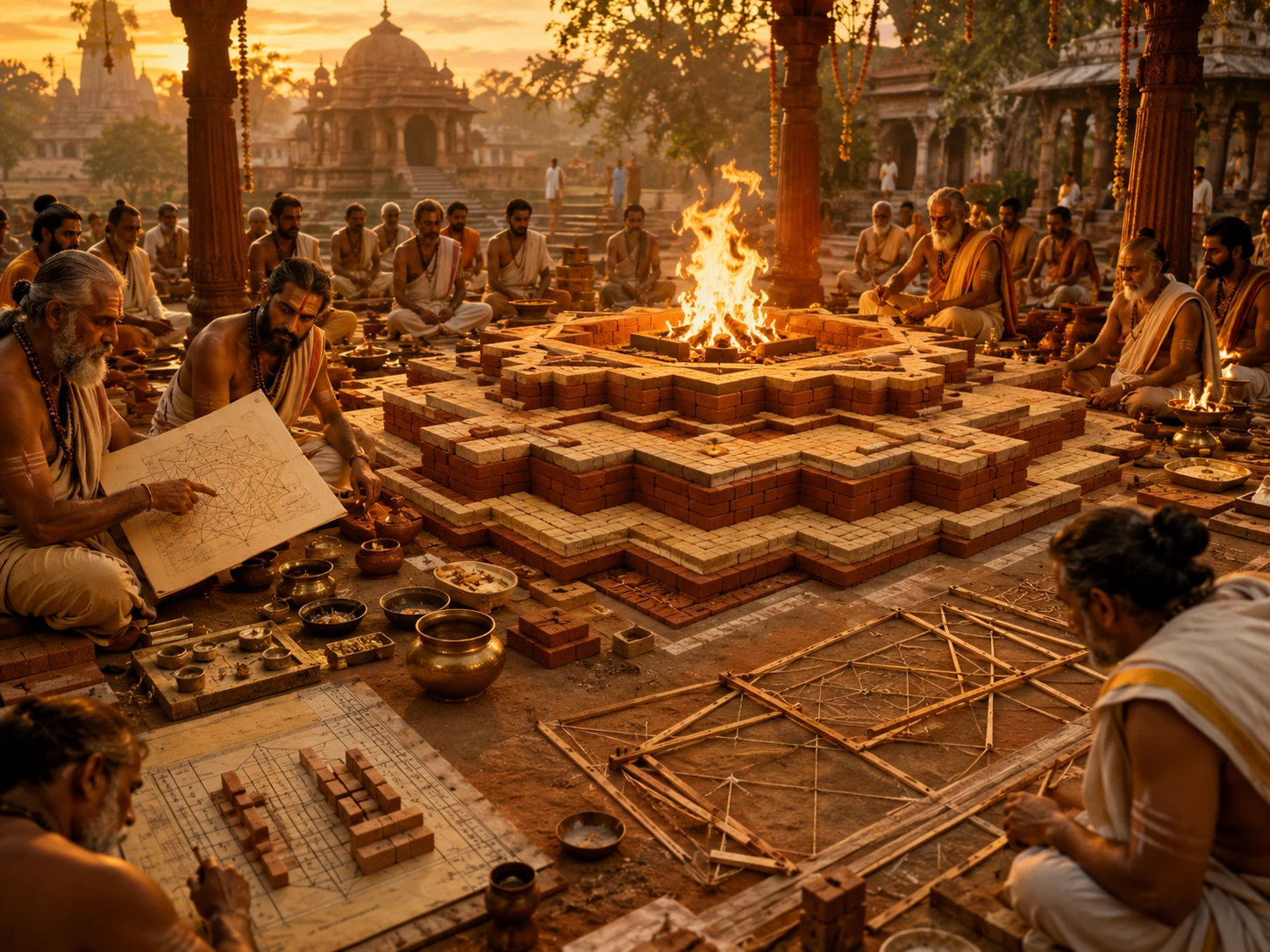
Agnichayana -- The Falcon-Shaped Fire Altar That Survived 3,000 Years
12 min read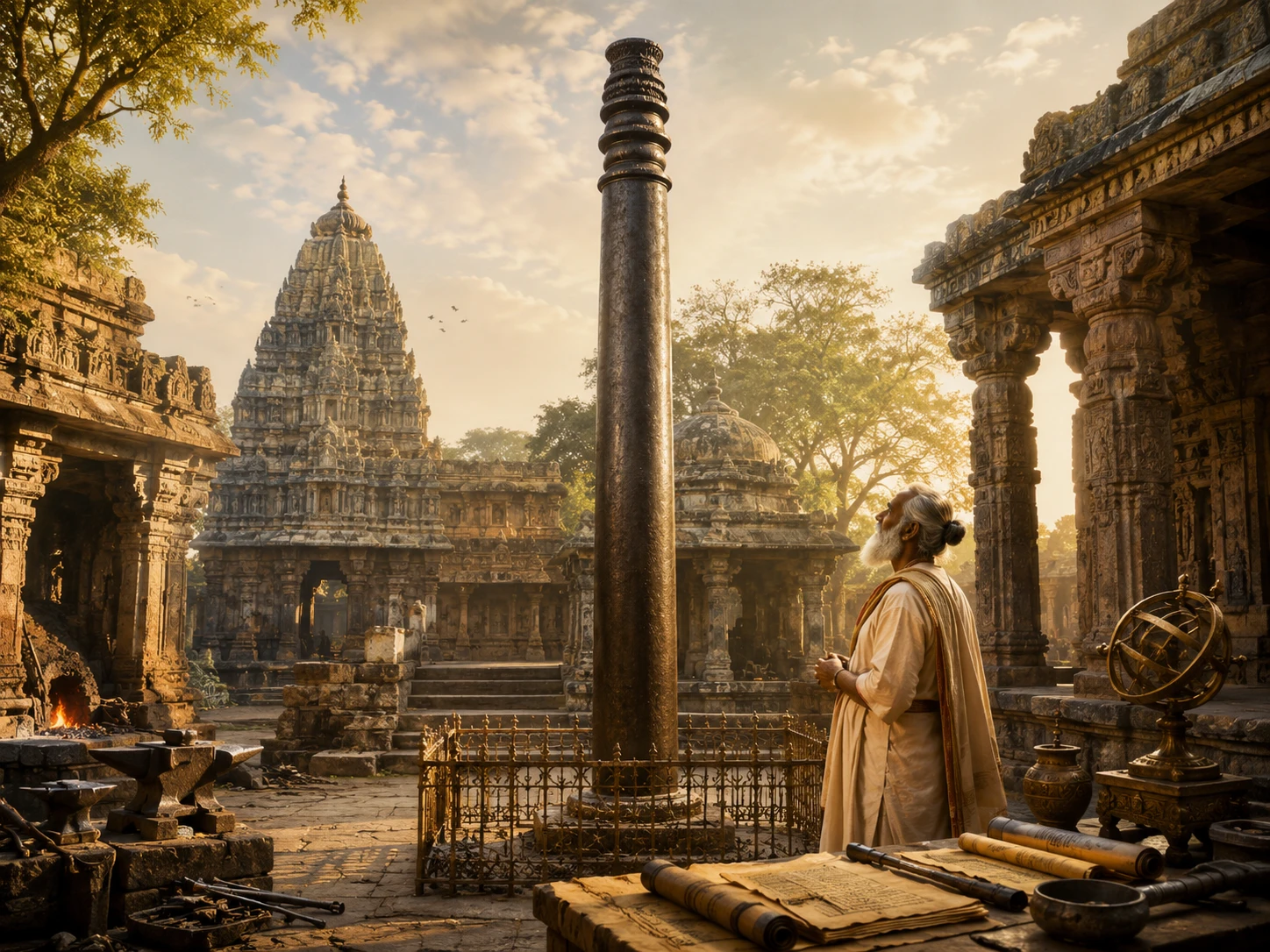
Ancient Indian Metallurgy -- The Iron Pillar That Refuses to Rust
13 min readAryabhata -- The Astronomer Who Said the Earth Turns
3 min readThe same translation error that turned '33 Koti' into '33 crore' in Hinduism also happened in Buddhism. The Chinese translation of Buddhist texts rendered 'Sapta Koti Buddha' (7 Supreme Buddhas) as '7 Crore Buddhas.' The…
Deities AvatarsCommunity Reflections
🕉️
Be the first to share your reflection.