Samay Chakra -- Why Each Raag Has Its Hour
समय चक्र -- हर राग का अपना प्रहर क्यों
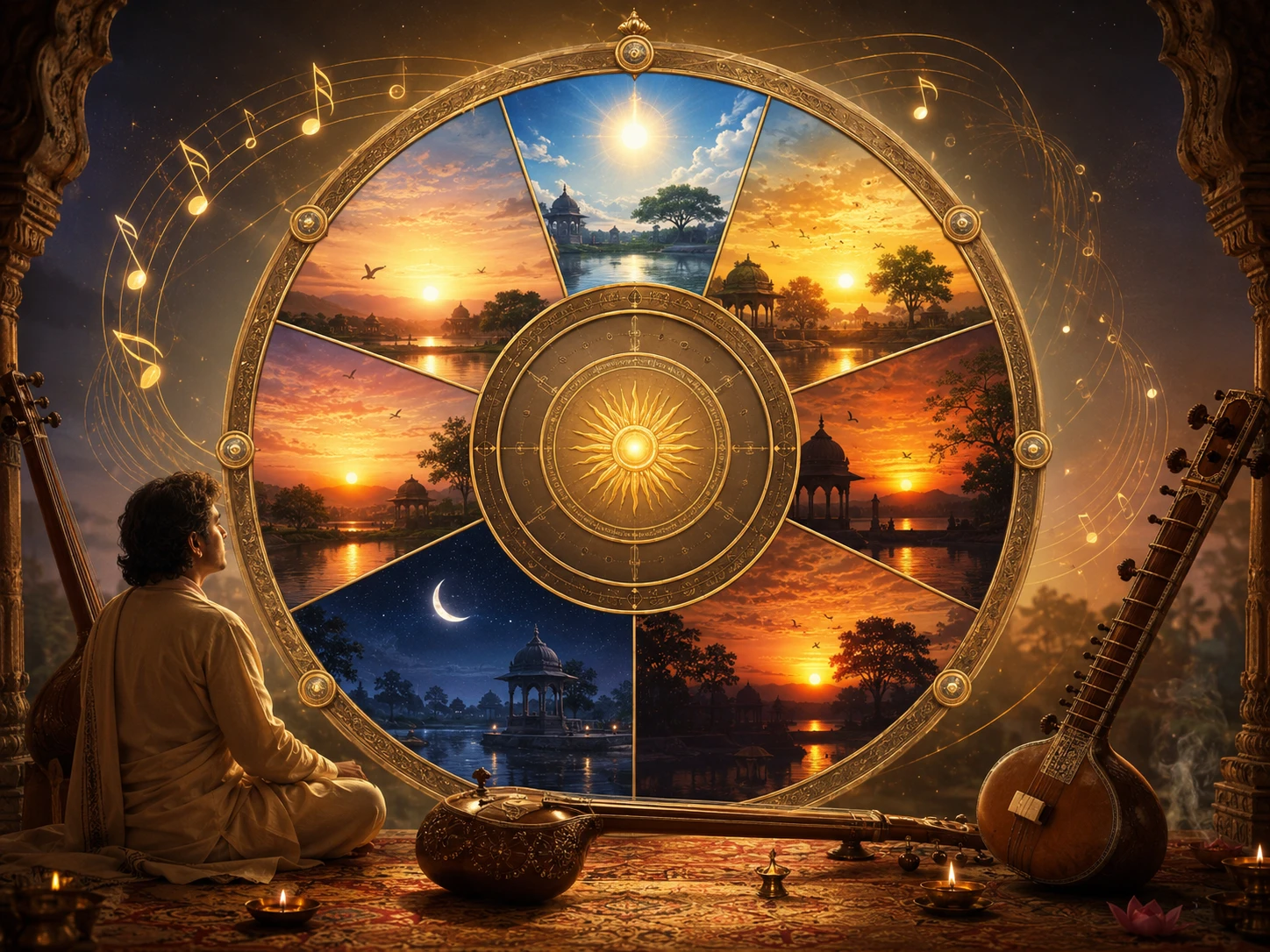
Imagine a Hindustani classical concert that runs from dusk to dawn -- the kind that still happens every January at the Saptak Festival in Ahmedabad or at the Dover Lane Music Conference in Kolkata. The first artist takes the stage at 7 in the evening and sings Yaman. Around 10 pm, the next vocalist offers a Bageshri or a Kedar. By 1 am, the raag turns to Darbari Kanada or Malkauns -- deep, weighty, slow. As the sky begins to lighten around 4 am, someone takes up Lalit or Bhatiyar, raags that catch the in-between hour when night has not quite ended and day has not quite begun. The closing raag, just after sunrise, is almost always Bhairav or Bilawal. By 7 am the festival is over.
This sequence is not a programmer's preference. It is a rule. Hindustani classical music assigns each raag to a specific Prahar of the 24-hour day, and to a specific Ritu of the year. Pick the wrong raag for the wrong hour and a trained listener will notice within thirty seconds. Pick it in the right hour and the music does something that is hard to describe but easy to feel -- the raag arrives as though it were already waiting in the room.
The previous article in this cluster, Nada Brahma, established the textual foundation of Indian classical music. This article opens the system that organizes that music in time. The premise is that every hour of the day has its own emotional and physiological character, and the raag system is engineered to align with those characters. A morning raag is not just a raag performed in the morning. A morning raag is a raag whose internal architecture matches what morning feels like in the body and the mind. That alignment is what samay theory codifies, what Bhatkhande systematized in the early 20th century, and what every working Hindustani musician still operates by today.
बृहत्साम तथा साम्नां गायत्री छन्दसामहम्। मासानां मार्गशीर्षोऽहमृतूनां कुसुमाकरः॥
brihat-sama tatha samnam gayatri chandasam aham masanam marga-shirsho 'ham ritunam kusumakarah
Among the hymns of the Sama Veda I am the Brihat Sama. Among meters I am the Gayatri. Among months I am Margashirsha. Among seasons I am the flower-bearing spring.
— Bhagavad Gita 10.35
Krishna's choice in this verse is worth slowing down for. He names his vibhuti among hymns (Brihat Sama), among meters (Gayatri), among months (Margashirsha), and among seasons (Vasanta). Sound, time, and season are placed in a single chain. The same divine principle manifests as a hymn, a meter, a month, and a flowering season. The samay theory of raag is the musical realization of exactly this insight. A raag is sound. A Prahar is time. A Ritu is season. When all three align, the music ceases to be performance and becomes participation in the larger rhythm.
The foundation of the time system is the Prahar. The companion article on Kaal Ganana already lays out the eight Prahars that divide one Ahoratra (a 24-hour day-and-night cycle) into roughly three-hour segments -- four Prahars of day, four Prahars of night. Hindustani classical inherits this division wholesale. Each Prahar gets its own set of raags, and each raag belongs to one Prahar primarily, with a secondary window allowed for performance.
Two Prahars carry special weight. They are called the sandhi prakash Prahars -- the joining-light Prahars, the twilight zones. The first sandhi is dawn (the transition between the last night Prahar and the first day Prahar, roughly 5 am to 7 am at equinox). The second sandhi is dusk (the transition between the last day Prahar and the first night Prahar, roughly 5 pm to 7 pm). These two windows are when day and night literally meet. The raags assigned to them -- Bhairav and its family at dawn, Yaman, Marwa, Shree, and Puriya at dusk -- are considered the most structurally important raags in the Hindustani repertoire. Every musician learns these first because the sandhi raags carry the architectural rules that other raags then variations on.
What makes the sandhi raags structurally special is their use of komal Re and komal Dha (the lowered second and sixth notes) at dawn, paired with shuddha Re and shuddha Dha plus tivra Ma (the raised fourth) at dusk. Two opposite swara configurations, one for each twilight. Sit in any small temple in Varanasi at 5:30 am and you will hear Bhairav. Sit in the same temple at 5:30 pm during evening aarti and the bhajans will tilt toward Yaman or Marwa. The musical language of dawn and dusk is categorically different, and the system reflects that difference.
The 8 Prahars and Their Representative Raags
| Prahar / प्रहर | Approximate Time | Representative Raags | Distinctive Swara Feature |
|---|---|---|---|
| Day 1 -- Pratah / प्रातः | 6 am to 9 am (sandhi) | Bhairav, Bilawal, Ramkali, Todi | Komal Re, Komal Dha (Bhairav family) |
| Day 2 -- Madhyahn purva / पूर्व-मध्याह्न | 9 am to 12 noon | Asavari, Jaunpuri, Gaud Sarang, Devagiri Bilawal | Komal Ga, Komal Ni emerge |
| Day 3 -- Aparahn / अपराह्न | 12 noon to 3 pm | Bhimpalasi, Multani, Pilu, Madhyamavati | Komal Ga, Komal Ni dominant |
| Day 4 -- Sandhya purva / पूर्व-सान्ध्य | 3 pm to 6 pm | Patdeep, Madhumad Sarang, Shuddha Sarang | Mixed komal-shuddha, leaning shuddha |
| Night 1 -- Pradosh / प्रदोष | 6 pm to 9 pm (sandhi) | Yaman, Marwa, Shree, Puriya, Hamsadhwani | Tivra Ma, shuddha Re-Dha (sandhi) |
| Night 2 -- Nishi / निशि | 9 pm to 12 midnight | Bageshri, Kedar, Bahar, Jaijaiwanti | Mixed swaras, broad emotional palette |
| Night 3 -- Madhyaratri / मध्यरात्रि | 12 midnight to 3 am | Darbari Kanada, Adana, Malkauns, Chandrakauns | Komal Ga, Ni, Dha; deep, weighty |
| Night 4 -- Brahma muhurta / ब्रह्म मुहूर्त | 3 am to 6 am | Lalit, Bhatiyar, Paraj, Sohni | Both Ma swaras together; pre-dawn tension |
Prahar boundaries shift with sunrise and sunset times across the year. Times above are approximate equinox-day values for North India. Each Prahar carries dozens of raags; only the most foundational are listed.
Underneath the eight-Prahar table sits a deeper rule, the rule that actually predicts which Prahar a new raag will belong to. Pt. Vishnu Narayan Bhatkhande, working in the early 20th century, formalized it from older oral conventions. The rule has two parts.
Part one is the vadi-samvadi rule. Recall from the Nada Brahma article that every raag has a vadi (king note) and a samvadi (minister note), the two notes that carry the most emotional weight. Bhatkhande observed that if the vadi falls in the lower tetrachord (poorvanga, the Sa to Ma half of the octave), the raag belongs to the second half of the day -- noon to midnight. If the vadi falls in the upper tetrachord (uttaranga, the Pa to high Sa half), the raag belongs to the first half of the day -- midnight to noon. Yaman has Ga as vadi and Ni as samvadi, both in the lower half. So Yaman is an evening raag. Bhairav has Dha as vadi and Re as samvadi -- Dha sits in the upper half, so Bhairav belongs to the morning. Once you internalize this rule, the time of any raag becomes predictable from its swara structure alone.
Part two is the komal-shuddha rule. Komal swaras (the lowered notes -- komal Re, Ga, Dha, Ni) tend to feel introspective, soft, sometimes sorrowful. Shuddha and tivra swaras tend to feel open, brilliant, sometimes celebratory. Bhatkhande observed that the day's psychological arc follows a similar curve. The dawn sandhi uses komal Re and komal Dha because waking up has its own quiet weight. The full morning opens up to shuddha and komal mixed (Bilawal, Asavari) as consciousness arrives. The midday raags lean on komal Ga and komal Ni, which carry a yearning quality fitting for the sun's peak and its slow descent. The dusk sandhi uses shuddha Re-Dha with tivra Ma, the brightest configuration available, because dusk is when light makes its last full statement. Late night returns to deep komal swaras (Darbari Kanada, Malkauns) because the night reaches its own form of weight before pre-dawn turns the pattern again.
This is not mystical reasoning. This is empirical pattern-matching across centuries of practice. Bhatkhande did not invent the alignment. He observed that musicians had already converged on it across the ten Thaats, and gave it a clean rule that could be taught in a Mumbai conservatory. The rule has held up. A trained student can today look at any raag's vadi-samvadi pair and its komal-shuddha mix and predict its Prahar with about 90 percent accuracy. The 10 percent are edge cases like Lalit, where both Madhyam swaras coexist, or like raags that mix poorvanga and uttaranga vadis ambiguously.
ओमित्येतदक्षरमुद्गीथमुपासीत। ओमिति ह्युद्गायति तस्योपव्याख्यानम्॥
om ity etad aksharam udgitham upasita om iti hy udgayati tasyopavyakhyanam
Let one meditate upon the syllable Om as the Udgitha, the high chant. For one chants while pronouncing Om -- this is its explanation.
— Chandogya Upanishad 1.1.1
The Chandogya Upanishad places the act of singing Om at the very beginning of its first chapter for a reason. Chanting is not added to time. Chanting marks time. The Sama priests of the Vedic ritual chanted at specific moments of the yagna because the sound and the moment had to align. The samay theory of raag is the fully matured form of that early intuition.
Beyond the daily Prahar cycle, the system has a second axis -- the seasonal axis, called Ritu. Some raags are not bound to a Prahar at all. They are bound to a season. The most famous of these is the Malhar family. Miyan ki Malhar, Megh Malhar, Gaud Malhar, Ramdasi Malhar, Sur Malhar -- all of these belong to Varsha Ritu, the monsoon. They are sung between June and September across India, regardless of the hour of day. Walk into any classical concert in Mumbai or Pune in August and the chances are high that the headlining raag will be a Malhar variant. Walk into the same hall in February and a Malhar will not appear.
The same pattern holds for Vasanta Ritu (spring), where Basant, Bahar, Hindol, and Phalguni Bhairav take precedence -- often around Holi. Hemanta Ritu (early winter, October-December) is associated with raags like Maru Bihag and Bihag. Shishira Ritu (deep winter, January-February) tilts toward Lalit and Bhatiyar. The Sangeet Ratnakara already lays out this ritu-raag system in its 13th century treatment, and Bhatkhande retained it almost unchanged in his early 20th century reorganization.
It is tempting, especially in the wellness era of 2026, to claim that this entire system has been validated by modern circadian rhythm research or by neuroscience studies on music and mood. The honest position is more measured. Some studies do show that morning music tends to affect cortisol and mood differently from evening music. Some clinical work has explored the use of specific raags for anxiety, sleep, and concentration. The findings are interesting but limited, and the gap between general results and the specific claim that, say, Raag Todi uniquely benefits the late-morning brain is large. The samay system was built on something more concrete -- centuries of musicians and audiences observing what worked at what hour, and passing those observations forward through the gharana lineages. Modern research can echo the tradition. It cannot replace the tradition's own method of testing, which is performance before live audiences across generations.
For a reader who has just absorbed all this and wants to actually hear what the samay rule feels like in practice, a short listening guide is the most useful next step. The recordings below are widely available on Spotify, YouTube, and Saregama Carvaan, and each one demonstrates the alignment between raag and Prahar with the kind of clarity that only happens when a master performs in their right hour.
For the dawn Prahar, Pt. Bhimsen Joshi's recordings of Raag Bhairav and Raag Bilaskhani Todi are the canonical reference. His Bhairav alaap from the 1972 All India Radio archive recording, with its slow uncoiling of komal Re and Dha, is the closest a recording can come to making you feel a Varanasi morning even if you are listening on AirPods in a Mumbai metro car. Ustad Bismillah Khan's shehnai recordings from his decades of dawn performances at the Kashi Vishwanath temple gate are the other unmissable dawn library, available now on multiple Saregama compilations.
For the late-afternoon Prahar, look for Pt. Kumar Gandharva's Bhimpalasi or his Multani. The afternoon raags carry a peculiar yearning that Kumar Gandharva captured better than almost anyone. Begum Parveen Sultana's renditions of Bhimpalasi are also widely circulated and offer a different gharana reading of the same Prahar.
For the dusk sandhi, Pt. Hariprasad Chaurasia's flute recordings of Raag Yaman are the standard introduction. His longer concert recordings, especially the early 1990s sessions with Ustad Zakir Hussain on tabla, demonstrate why Yaman has been called the king of evening raags. Add to this Smt. Kishori Amonkar's vocal Yaman from the Jaipur-Atrauli gharana for a contrasting interpretation of the same Prahar.
For the deep night Prahar, Pt. Jasraj's Darbari Kanada and Ustad Rashid Khan's Malkauns are the standard references. Listening to Pt. Jasraj's Darbari at 1 am, in headphones, in a quiet room, is one of the most direct experiences a modern listener can have of why this raag belongs to this hour. The slow descending phrases on komal Ga and komal Dha unfold at a pace that matches exactly the pace at which the late-night mind moves. Try the same recording at 11 am and the same notes will feel ponderous, slightly off. The raag did not change. The hour did. This is the entire samay theory in one listening experiment.
For the Brahma muhurta Prahar -- the pre-dawn window between roughly 3 am and 6 am -- the recordings to start with are Pt. Mallikarjun Mansur's Raag Lalit and any well-recorded Bhatiyar by Pt. Rajan and Sajan Mishra. The Brahma muhurta raags are some of the trickiest in the Hindustani repertoire because they sit on the cusp where komal Re and Dha (the dawn signals) meet both forms of Madhyam (the night-to-day shift). Lalit uses both shuddha Ma and tivra Ma in close succession, creating an in-between tension that exactly matches the unsettled feeling of pre-dawn. Listening to a competent Lalit at 4:30 am while the sky shifts from black to grey to the first thin orange is one of the rare experiences in Indian music where listener and raag and Prahar collapse into a single moment. This is what the system was engineered to produce.
When All India Radio launched its classical music programming in 1936, the broadcasters made an early decision to follow the samay rule strictly. A morning broadcast played morning raags. An evening broadcast played evening raags. Late-night programs after midnight played Darbari, Malkauns, and similar deep-night raags. This 90-year-old programming convention still operates on AIR's Akashvani channels today. If you happen to tune in at 4:30 am on any given day, you are statistically very likely to hear Lalit, Bhatiyar, or another Brahma-muhurta raag -- the same Prahar where Bhishma chose to depart his body in the Mahabharata.
The samay rule sounds antiquarian until you watch it operate in 2026. Spotify's algorithm-driven Hindustani classical playlists for users in India routinely rotate raags by hour of day -- Bhairav playlists peaking at 6 am, Yaman playlists peaking at 7 pm, Darbari playlists peaking after midnight. The platform did not impose this. It learned the pattern from listener behaviour. Indian listeners reach for the right raag at the right hour without being told to.
All India Radio's Akashvani still organizes its classical programming by samay. The Sangeet Natak Akademi awards classical music conferences that respect the rule. The annual Saptak Festival in Ahmedabad (every January 1-13), the Sawai Gandharva Bhimsen Mahotsav in Pune (every December), and the Dover Lane Music Conference in Kolkata (every January) all build their evening-to-dawn programmes around samay sequencing. The festival organizers do not advertise it. The audience expects it.
The film and OTT industry has absorbed the rule almost unconsciously. When Sanjay Leela Bhansali scores a dawn temple scene in Padmaavat or in Devdas, the underlying raag will be a Bhairav variant. When the score sets a love-confession scene at dusk, the raag will tilt toward Yaman or Marwa. Coke Studio Bharat's monsoon releases predictably feature Malhar-flavoured compositions. Indian Idol's classical-themed episodes since 2021 have repeatedly featured the samay rule in their judging commentary. Pt. Ajoy Chakrabarty, Shankar Mahadevan, and Vishal Bhardwaj have all explained on national television why a contestant's choice of raag at a given hour either landed correctly or felt off.
For a JEE aspirant in Kota studying alone at 2 am, a Darbari Kanada in her earbuds is not decoration. It is the raag that matches the Prahar her body is awake during. For a tech worker in Bengaluru who plays Bhairav on her morning walk through Cubbon Park at 6:30 am, the alignment is the entire point. For an NRI family in California holding a Diwali aarti at sunset, the bhajans played in Yaman or Hamsadhwani feel correct because they are correct -- the system engineered them to feel that way. The samay rule is not a museum piece. It is a living grammar that explains what most Indians recognize intuitively when they hear classical music done right.
A worthwhile footnote -- the rule is broken deliberately and effectively in some film music, and the breaks are themselves an indirect tribute to the rule. When R.D. Burman set Mehbooba Mehbooba in a non-traditional time scheme, the dissonance was the point. When Vishal Bhardwaj scores a midnight scene in a Yaman-flavoured composition, he is exploiting the listener's trained expectation of dusk Yaman to create a feeling of displacement. A rule has to exist before its breaking can mean anything. The samay system is robust enough that even the breaks tell its story. For a curious listener in any Indian city in 2026, the simplest test is the easiest one to run -- pick the recording matched to the current Prahar, and listen for what shifts.
Listen by Prahar
Match your listening to the hour: Bhairav at dawn, Todi in the late morning, Bhimpalasi in the afternoon, Yaman at dusk, Darbari late at night, Bhairavi to close. Eternal Raga does not yet sort music by prahar; the raag articles in its Vedic Sciences section describe each raag and its hour.
Tags
Eternal Raga · शाश्वत राग
Institutional voice — scholarly articles on Sanatan Dharma
Deepen Your Understanding
अपनी समझ और गहरी करें
vedic sciences
Nada Brahma -- Sound as Creation in Hindu Sangeet Shastra
Long before raags had names, India held one foundational claim: sound is creation itself. Trace the lineage from the Sama Veda's chants to Bharata's Natya Shastra to Sharangadeva's Sangeet Ratnakara -- the spine of classical music as sadhana.
vedic sciences
Kaal Ganana -- The Hindu Measure of Time
From a single blink of the eye (Nimesha) to one Day of Brahma (4.32 billion years) -- explore the complete cosmic time hierarchy of Hindu cosmology, anchored in Vishnu Purana 1.3, with its remarkable parallels to modern science.
vedic sciences
Raag Bhairav -- The Dawn Raag of Shiva
Bhairav is the first raag of the Hindustani morning -- austere, slow, weighted, named after Shiva's most fearsome form. Read its swara structure, its tantric backdrop, its great recordings, and why every classical concert that runs through the night ends with Bhairav at sunrise.
vedic sciences
Raag Yaman -- The King of Evening Raagas
Yaman is the most performed raag in Hindustani classical music -- the dusk sandhi prakash piece every student learns first, every concert opens with, every gharana claims its own reading of. Read its swara structure, its Persian-Hindustani synthesis, its standard bandishes, and the long lineage of canonical recordings.
vedic sciences
Dasha Thaat -- Bhatkhande's Modern Map of Hindustani Raagas
How does a tradition with hundreds of raagas teach itself? Pt. Vishnu Narayan Bhatkhande's answer was the ten-Thaat system, published between 1909 and 1935. Trace the system, its limits, and why every Hindustani conservatory still teaches by it.
When All India Radio launched its classical music programming in 1936, the broadcasters made an early decision to follow the samay rule strictly. A morning broadcast played morning raags. An evening broadcast played even…
More in Vedic Sciences
Agnichayana -- The Falcon-Shaped Fire Altar That Survived 3,000 Years
12 min read
Ancient Indian Metallurgy -- The Iron Pillar That Refuses to Rust
13 min readAryabhata -- The Astronomer Who Said the Earth Turns
3 min readThe same translation error that turned '33 Koti' into '33 crore' in Hinduism also happened in Buddhism. The Chinese translation of Buddhist texts rendered 'Sapta Koti Buddha' (7 Supreme Buddhas) as '7 Crore Buddhas.' The…
Deities AvatarsCommunity Reflections
🕉️
Be the first to share your reflection.