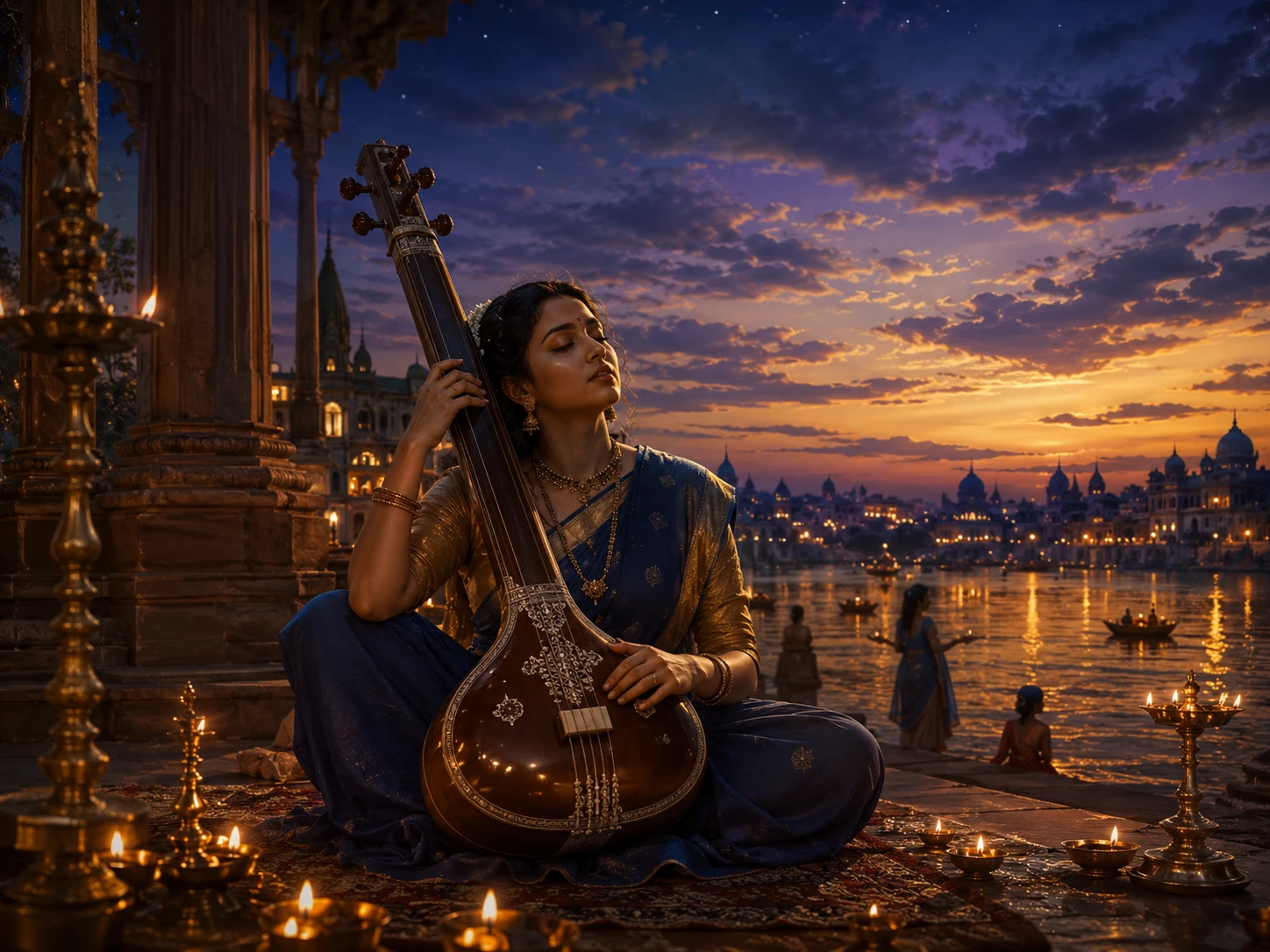
Raag Yaman -- The King of Evening Raagas
राग यमन -- सान्ध्य रागों का राजा
It is 6:45 in the evening at the Sawai Gandharva Mahotsav grounds in Pune, the first weekend of December. The audience of three thousand has settled. The artist for the opening slot of the festival's first night walks onstage, bows to the tanpura players already seated behind, and takes his place at the centre. The light overhead is the kind of warm gold that concert halls build to mimic the actual hour outside. He tunes for a moment. The audience leans forward. Then he opens with a single phrase -- Ni, Sa, upper Ga, tivra Ma, Pa -- and every listener in the hall who has been to a Hindustani classical concert before knows exactly which raag is coming. It is Yaman. It is always Yaman. There is no other raag in the Hindustani tradition that opens more concerts, more recordings, more music school exams, more public broadcasts. By long convention and by something deeper than convention, Yaman is the dusk raag every musician reaches for first.
Yaman is the king of evening raagas. The phrase is not casual. It is the working description that musicians and music critics have used for at least a century. The reasons are several. The raag uses only one altered note -- tivra Ma, the raised fourth -- with all six other swaras shuddha. This makes it the most accessible of all the major raagas. A complete beginner can sing Yaman recognizably within a week of starting vocal lessons. The raag also has a dignity, a regal quality, that the simpler structure does not predict. The single tivra Ma, sitting at the fourth degree of the scale, gives Yaman an upward brightness that no other Hindustani raag matches. Other raagas weep, brood, yearn, plead. Yaman declares. It does so without losing its dignity, and that combination is what gives the raag its hundred-year reputation as the king.
This article is the seventh in the Eternal Gyan music cluster, and the fourth of seven raag profiles. The previous profiles covered Bhairav at dawn, Todi in late morning, and Bhimpalasi in late afternoon. Yaman occupies the dusk Prahar, roughly 6 pm to 9 pm, the second of the two sandhi prakash twilight zones. Where Bhairav opens the morning, Yaman opens the night. The two raagas are structural mirrors -- Bhairav with its komal Re and komal Dha, Yaman with its tivra Ma and otherwise shuddha swaras. Together they bracket the Hindustani classical day. Most all-night concerts begin with Yaman at dusk and end with Bhairav at sunrise. Most beginning students learn Bhairav first thing in the morning and Yaman last thing at night. The architecture is intentional. The tradition was built this way.
यदा यदा हि धर्मस्य ग्लानिर्भवति भारत। अभ्युत्थानमधर्मस्य तदात्मानं सृजाम्यहम्॥
yada yada hi dharmasya glanir bhavati bharata abhyutthanam adharmasya tadatmanam srijamy aham
Whenever there is a decline of dharma and a rise of adharma, O Bharata, then I manifest myself.
— Bhagavad Gita 4.7
Krishna's declaration in this verse is the textual register that Yaman occupies. The mood of the raag is not the brooding austerity of Bhairav nor the yearning of Bhimpalasi. It is the mood of declaration -- a divine speaker stepping forward, a king entering his court, a host welcoming guests at the door of his haveli at dusk. Where the morning raagas open inward and the afternoon raagas wait, Yaman opens outward. The raag announces. The announcement carries weight without weight, dignity without austerity, brilliance without show. This is what the tradition calls rajasi-bhakti -- regal devotion, the bhakti of one who knows that grandeur and humility are not opposites.
The dusk hour of Indian life carries this mood naturally. The day's work is finishing. The lamps are being lit on the threshold. The temple bells from the neighbourhood mandir are starting their evening cycle, the conch is sounding, and somewhere in the house the Sandhya Vandana is beginning. This is the hour when the household gathers. The children are home from coaching. The working members are returning from offices. The grandparents are setting out the evening prayers. The dusk has its own social texture in Indian life, and Yaman is the auditory expression of that texture. A Yaman alaap at 6:30 pm, played softly on a Bluetooth speaker in the living room while the lamps are being lit, completes the hour the way a mantra completes a ritual.
There is also a longer textual lineage to acknowledge. The Brihadaranyaka Upanishad's famous Pavamana Mantra -- asato ma sad gamaya, tamaso ma jyotir gamaya, mrityor ma amritam gamaya -- is traditionally chanted at dusk because the moment of transition between day and night is when the soul most needs the prayer to be led from the unreal to the real, from darkness to light, from death to immortality. The mantra and the raag carry the same underlying intuition. Dusk is the threshold hour. It is when the day's accumulated experience meets the night's stillness, and the seeker can be most receptive to what lies beyond either. Yaman opens that receptivity musically. The raag does not push. It opens. The receptivity does the rest.
There is one more piece of context worth holding. The Yaman that modern Hindustani musicians perform is the result of a long synthesis. The raag's name itself comes from the Persian word Iman -- meaning faith or trust -- and the Persian-Mughal period of North India saw considerable cross-pollination between Persian musical modes and the older Indian raag structure. The Iman that Persian musicians sang was not identical to the Yaman that Hindustani musicians sing today, but the conceptual link is clear. The conceptual link is also why Yaman, more than any other Hindustani raag, comfortably carries Sufi qawwali compositions, ghazals in classical settings, and the bhakti pads of North Indian saints. The raag was already a synthesis when it took its modern shape, and the synthesis made it elastic in ways that more rigidly Hindu raagas like Todi or Bhairavi are not.
The Kalyan Family -- Major Raags Sharing the Tivra Ma Foundation
| Raag / राग | Distinguishing Feature | Time / Mood | Standard Recording |
|---|---|---|---|
| Yaman / यमन | Tivra Ma; aroh skips Sa, lands on Ni in lower octave | 6 pm to 9 pm, regal dignity | Pt. Bhimsen Joshi -- AIR archives, multiple decades |
| Yaman Kalyan / यमन कल्याण | Yaman with brief shuddha Ma in avaroh phrases | 6 pm to 9 pm, slightly softer than pure Yaman | Pt. Hariprasad Chaurasia -- flute concertos |
| Bhupali / भूपाली | Five-note pentatonic; drops Ma and Ni entirely | Early evening, devotional simplicity | Pt. Kumar Gandharva -- Gwalior gharana readings |
| Hamsadhwani / हंसध्वनि | Five-note pentatonic; uses shuddha Ma not tivra; Carnatic origin | Early evening, celebratory bright | Pt. Ravi Shankar -- sitar global tours |
| Shyam Kalyan / श्याम कल्याण | Yaman base + komal Ni occasionally; Krishna-leaning | Late evening, pastoral evening | Smt. Kishori Amonkar -- Jaipur-Atrauli readings |
| Shuddha Kalyan / शुद्ध कल्याण | Yaman with both Ma forms used cautiously | Late evening, brighter than Yaman | Ustad Vilayat Khan -- sitar long-form |
| Kedar / केदार | Yaman base + komal Ni in specific phrases; Shiva-leaning | Late evening to early night, devotional | Pt. Jasraj -- Mewati gharana renderings |
Hamsadhwani is the structural outlier in this family -- it is a Carnatic raga adopted into Hindustani performance through Pt. Aman Ali Khan and the Bhendi Bazaar gharana in the early 20th century, and uses shuddha Ma rather than the tivra Ma that defines the Kalyan Thaat. It is included because Hindustani concerts treat it as an evening Kalyan-family piece in practice.
Yaman uses seven swaras with one alteration -- Sa, Re, Ga, tivra Ma, Pa, Dha, Ni. The tivra Ma is the raised fourth, sitting a semitone above the shuddha Ma. All other swaras are shuddha. This single tivra Ma is the structural signature of the entire Kalyan Thaat. Remove it and you have the Bilawal Thaat parent scale. Add a komal Re alongside and you have Marwa. Add a komal Dha alongside and you have Poorvi. The tivra Ma alone is what makes this set of swaras Yaman. The simplicity is deceptive. The tivra Ma is one of the most expressive single notes in any raag system, because it sits between Ga and Pa as a kind of suspended question, neither resolved up nor down until the singer chooses. Every Yaman performance is, in some real sense, a meditation on what to do with the tivra Ma.
The aroh of Yaman has a distinguishing feature that confuses beginners. The traditional ascent does not begin from Sa. It begins from the Ni below the lower Sa. The full aroh runs lower Ni, Re, Ga, tivra Ma, Pa, Dha, Ni, upper Sa. The lower Ni-Re leap is the raag's opening signature. A Yaman that begins straight from Sa to Re sounds like Yaman but feels off, and a trained listener notices the absence of the Ni-Re leap within the first few seconds. The avaroh is more conventional -- upper Sa, Ni, Dha, Pa, tivra Ma, Ga, Re, Sa -- with the tivra Ma falling weight-bearingly between Pa and Ga.
The vadi-samvadi pair places Ga as vadi and Ni as samvadi. Both fall in the lower tetrachord, which by Bhatkhande's rule places the raag in the second half of the day. The specific placement of Ga as the king note is what gives Yaman its declarative quality. The singer rests on Ga repeatedly. The Ga is approached from below through the Re or from above through the tivra Ma, and each approach produces a slightly different emotional weight. From below the Ga feels arrival. From above through tivra Ma the Ga feels descent into something more grounded. A Yaman alaap that uses both approaches across its development is doing what the raag is structurally built to do.
The pakad of Yaman is widely accepted as -- Ni Re Ga, Re Ga, Re Sa, Ni (lower) Re Ga, tivra Ma Pa Ga Re Sa. The opening Ni-Re-Ga and the closing tivra Ma-Pa-Ga-Re-Sa together establish the raag's identity within the first phrase. Recognition is so quick that Yaman has become the standard test in music theory exams -- a student who cannot identify Yaman within ten seconds of an alaap is not yet ready for any other raag. The specific moment when the listener crosses the recognition threshold is when the singer lands on tivra Ma and holds it briefly before descending through Pa to Ga. That single phrase is Yaman, and a Yaman performance that delays this phrase too long is testing the audience's patience rather than offering them the raag's identity.
The relationship between Yaman and Yaman Kalyan deserves a note. Yaman Kalyan is Yaman with the addition of brief shuddha Ma touches in the avaroh, particularly in the phrase tivra Ma Pa shuddha Ma Ga. This brief shuddha Ma is the only difference between the two. The result is a slightly softer, more pliable feel in Yaman Kalyan, where pure Yaman has more declarative edge. Many gharanas treat the two as variations of the same raag rather than distinct entities. Some musicologists insist on the separation. The student-level rule is that any concert programme that says simply 'Yaman' will lean toward the pure form, and the explicit 'Yaman Kalyan' will introduce the shuddha Ma touches as part of the rendition.
असतो मा सद्गमय। तमसो मा ज्योतिर्गमय। मृत्योर्मामृतं गमय। ॐ शान्तिः शान्तिः शान्तिः॥
asato ma sad gamaya. tamaso ma jyotir gamaya. mrityor ma amritam gamaya. om shantih shantih shantih
Lead me from the unreal to the real. Lead me from darkness to light. Lead me from death to immortality. Om peace, peace, peace.
— Brihadaranyaka Upanishad 1.3.28 (Pavamana Mantra)
The Pavamana Mantra of the Brihadaranyaka Upanishad is the textual ancestor of every Yaman bandish that has been composed in the centuries since. The structure of the prayer -- a movement from one state to another, three times repeated, ending in peace -- is the structural shape of a Yaman alaap. The singer moves from Sa to Ga, from Ga to tivra Ma, from tivra Ma to Pa, each transition opening a slightly larger window of receptivity, ending in upper Sa as the closing peace. The mantra and the raag are not literally linked by composition history, but the parallel is real and trained listeners feel it.
Three bandishes deserve specific mention, though Yaman has dozens of widely performed compositions. The first is Eri Ali Piya Bin -- O dear friend, without my beloved -- a slow vilambit composition addressed to a sakhi (girlfriend) describing the gopi's longing during Krishna's absence. The composition has been recorded by every major Hindustani vocalist of the twentieth century, and Pt. Bhimsen Joshi's rendering, particularly in the 1968 All India Radio archive recording, is the canonical reference. The second is Mhare Dere Aao Pritam Pyare -- come to my house, my beloved -- a Mira-tradition bhajan often set in Yaman, where the speaker invites Krishna directly into the domestic space. The third is Aaj Raini Bhayee Suhani -- tonight has become beautiful -- an evening bandish celebrating the dusk hour itself, often performed at the opening of evening concerts and used as a teaching piece for new students learning Yaman's structural movements.
The roster of canonical Yaman performers is long because Yaman is the raag every major vocalist and instrumentalist eventually records. Pt. Bhimsen Joshi (1922-2011) of the Kirana gharana sang Yaman more often than any other raag in his concert career, and his Yaman recordings span six decades. The 1968 AIR vilambit, the 1985 Pune live concert, the 2003 Bharat Ratna ceremony invocation -- each demonstrates a different facet of the same raag in the same singer's voice. Ustad Vilayat Khan (1928-2004) recorded Yaman repeatedly on sitar, and his long-form vilambit performances from the 1970s set the standard for instrumental Yaman. Pt. Hariprasad Chaurasia's flute Yaman -- the bansuri being Krishna's own instrument -- carries an additional bhakti context that other instruments cannot quite produce. His joint album with Pt. Shivkumar Sharma (santoor) in Yaman from the 1980s is widely considered one of the great instrumental recordings of the era.
Among female vocalists, Smt. Kishori Amonkar's Yaman from the Jaipur-Atrauli gharana is the canonical reference. Her vilambit Yaman recordings, particularly from the 1980s and 1990s, demonstrate the range of expression possible within the raag's structure. Begum Parveen Sultana's Yaman recordings show a different stylistic emphasis, with longer taans and more dramatic climaxes. M.S. Subbulakshmi, though primarily a Carnatic singer, recorded Yaman bhajans in her later career that brought the raag to a different audience and demonstrated how the raag works in cross-stylistic contexts.
Pt. Ravi Shankar's Yaman recordings on sitar were the introduction to Hindustani classical music for an entire generation of Western listeners in the 1960s. His 1962 album Three Ragas included a Yaman that was likely the first time most Western listeners had heard Indian classical music in concert form. The cultural reach of that album, combined with Ravi Shankar's later collaborations with Yehudi Menuhin and the Beatles era exposure, made Yaman the most globally recognized Hindustani raag by some distance. The recognition factor remains. A casual listener in Tokyo or Berlin in 2026 who has heard any Hindustani classical music has almost certainly heard Yaman.
There is a working logic to why Yaman opens almost every Hindustani concert that begins at dusk, and the logic is worth unpacking because it explains both the raag's centrality and the genre's structure.
The first reason is the samay rule. The dusk Prahar runs from roughly 6 to 9 pm, and the sandhi prakash window within it is roughly 6 to 7:30 pm. A concert that begins at 6:30 or 7 pm is starting in the sandhi window. The samay rule prescribes a sandhi raag for that moment. The major sandhi raagas of dusk are Yaman, Marwa, Shree, and Puriya, with Yaman being the most accessible and the others requiring more advanced listening. A concert that wants to bring its audience along will open with Yaman before introducing the more demanding sandhi raagas later in the evening.
The second reason is pedagogical. Yaman is the first major raag every Hindustani vocal student learns. By opening a concert with Yaman, the performer signals to the audience -- we are starting at the foundation, with the raag we all know, before moving to the more specialized territory. Audiences appreciate this. The signal is welcoming rather than condescending, because Yaman is also the raag in which the most virtuosic performances happen. A master can make Yaman do things a beginner cannot, and the audience watches the same notes they themselves learned in their first vocal class produce something they could not have imagined.
The third reason is structural. Yaman's tivra Ma -- that single altered note -- is the easiest place for a performer to demonstrate command. Hold the tivra Ma a fraction too long and the raag drifts. Land on it cleanly and the raag opens. Approach it from above and from below in the same alaap and the audience can hear the singer's range. Yaman is the test piece that displays competence without requiring the audience to follow complex swara configurations. The display of competence early in the concert builds the credibility the performer needs for the more demanding raagas later.
The fourth reason is emotional. Yaman is the raag that opens the heart without overwhelming it. Bhimpalasi yearns. Todi pleads. Bhairavi mourns. Marwa wounds. Yaman invites. Audiences settling into their seats at 7 pm have come from offices, traffic, the day's accumulated tensions. Yaman releases that tension without demanding emotional engagement. By the time the singer moves to the second piece, the audience is open. The opening Yaman does the psychological work that the rest of the evening builds on. Other openings would do less of this work.
Together these four reasons -- samay, pedagogy, structure, emotion -- make Yaman not just a popular opener but the structurally optimal one. The convention has held for at least a century, across gharanas, across cities, across audience demographics. It will likely hold for another century unless something fundamental about the genre changes.
The widely repeated story that Mughal court musician Mian Tansen composed Raag Yaman is tradition rather than documented history. The raag's name itself comes from the Persian word Iman (faith), and the modern Yaman emerged from a long process of synthesis between Persian musical modes and older Indian raag structures during the Mughal period -- spanning generations of court musicians, not the work of any single composer. Tansen almost certainly performed in Yaman, since the raag was already part of the active repertoire by his time, but specific compositions attributed to him have to be treated with the same caution that applies to any claim of single authorship in a tradition that transmitted orally for centuries before being notated in the early 20th century.
Yaman has translated into modern Indian life so completely that most listeners encounter it daily without recognizing the raag. The translation runs through several channels.
Hindi film music has used Yaman more than any other classical raag. Naushad's score for Mughal-e-Azam (1960) reached for Yaman in several palace evening sequences. S.D. Burman set parts of Guide (1965) and Pyaasa (1957) in Yaman-leaning melodies. Madan Mohan, perhaps the most classical-trained of major film composers, used Yaman as the underlying structure for several of the Lata Mangeshkar ghazals he composed in the 1960s. The iconic Lag Ja Gale from Woh Kaun Thi (1964) is widely identified as built on a Yaman framework. R.D. Burman, who studied classical music while developing his more modernist film style, used Yaman-shaped phrasings in introspective evening songs. In recent decades, A.R. Rahman has reached for Yaman repeatedly. The famous Khwaja Mere Khwaja from Jodhaa Akbar (2008), built on a Sufi qawwali base but with melodic motion in Yaman, is one of the most widely heard Yaman-derived film compositions of the 21st century. Vishal Bhardwaj's compositions for Maqbool, Omkara, and Haider use Yaman in dusk-set scenes consistently.
On the listening side, Spotify's Indian classical analytics show Yaman-tagged content peaking between 6:30 pm and 9:30 pm every weekday, with secondary peaks during festival seasons (particularly Navratri evening sessions and Diwali week). The listenership cuts across age groups in a way that other classical raagas do not. The yoga and meditation app market uses Yaman heavily for evening wind-down sessions, often without naming the raag. Most users do not need the name. They recognize the mood. The mood is dusk dignity, the bhakti opening of an Indian evening, and the regal welcome that the day's end calls for.
Indian Idol's classical-themed weeks since 2021 have featured Yaman regularly. Pt. Ajoy Chakrabarty has explained on national television why a contestant's chosen Yaman-based composition either landed or felt off, citing specifically the tivra Ma execution and the Ni-Re aroh leap. The Indian wedding industry has embraced Yaman for the post-baraat reception hour, where instrumental Yaman recordings or live shehnai performances of Yaman-leaning compositions establish the celebratory but dignified mood that Indian weddings target. Bismillah Khan's shehnai recordings from his decades-long career include dozens of Yaman pieces that are still heard at weddings across India in 2026, two decades after his death.
For the practical listener in 2026 looking to actually experience Yaman rather than read about it, the entry points are multiple. Pt. Bhimsen Joshi's 1968 AIR vilambit is the canonical reference, available on multiple streaming platforms. Pt. Hariprasad Chaurasia's Yaman flute recordings from the 1980s are equally canonical for instrumental Yaman. Smt. Kishori Amonkar's vocal Yaman from the 1990s offers the female vocal range in classical depth. Any of these, played at 7 pm on a weekday with the lights low and no other input, demonstrates more about the raag than three thousand words of prose can. The system was engineered to produce that experience. The system still works. Yaman in the dusk hour does what Yaman has done for at least four hundred years -- it opens the evening, declares its presence with quiet dignity, and waits for the listener to step into the rest of the night.
Listen to Raag Yaman at Dusk
Listen to Yaman at dusk, as the lamps are lit: the bandish 'Eri Ali Piya Bin', or an evening bhajan set in it. Notice the tivra ma, the one sharpened note that gives Yaman its glow. Eternal Raga does not yet have raag-wise collections; its Listen page has a devotional album and a daily Gita podcast.
Tags
Eternal Raga · शाश्वत राग
Institutional voice — scholarly articles on Sanatan Dharma
Deepen Your Understanding
अपनी समझ और गहरी करें
vedic sciences
Raag Bhairav -- The Dawn Raag of Shiva
Bhairav is the first raag of the Hindustani morning -- austere, slow, weighted, named after Shiva's most fearsome form. Read its swara structure, its tantric backdrop, its great recordings, and why every classical concert that runs through the night ends with Bhairav at sunrise.
vedic sciences
Raag Todi -- The Late-Morning Raag of Surrender
Todi is the raag of intense yearning -- four altered notes packed into a single octave, traditionally attributed to Tansen, sung between 9 am and noon. Read its swara structure, its Tansen lineage, the tragic story behind Bilaskhani Todi, and the canonical Amir Khan recordings.
vedic sciences
Raag Bhimpalasi -- The Afternoon Raag of Yearning
Bhimpalasi is the raag of late afternoon -- five swaras going up, seven coming down, a quiet ache that fits the hour between lunch and dusk. Read its swara structure, its place in the Krishna gopi-viraha tradition, and why Pt. Kumar Gandharva's readings reshaped the raag for the modern listener.
vedic sciences
Samay Chakra -- Why Each Raag Has Its Hour
Hindustani classical assigns each raag to a specific Prahar of the day or season. Bhairav at dawn, Yaman at dusk, Malhar in monsoon. Decode the architecture of samay -- the time-of-day theory that turns 24 hours into a musical map.
vedic sciences
Dasha Thaat -- Bhatkhande's Modern Map of Hindustani Raagas
How does a tradition with hundreds of raagas teach itself? Pt. Vishnu Narayan Bhatkhande's answer was the ten-Thaat system, published between 1909 and 1935. Trace the system, its limits, and why every Hindustani conservatory still teaches by it.
The widely repeated story that Mughal court musician Mian Tansen composed Raag Yaman is tradition rather than documented history. The raag's name itself comes from the Persian word Iman (faith), and the modern Yaman emer…
More in Vedic Sciences
Agnichayana -- The Falcon-Shaped Fire Altar That Survived 3,000 Years
12 min read
Ancient Indian Metallurgy -- The Iron Pillar That Refuses to Rust
13 min readAryabhata -- The Astronomer Who Said the Earth Turns
3 min readThe same translation error that turned '33 Koti' into '33 crore' in Hinduism also happened in Buddhism. The Chinese translation of Buddhist texts rendered 'Sapta Koti Buddha' (7 Supreme Buddhas) as '7 Crore Buddhas.' The…
Deities AvatarsCommunity Reflections
🕉️
Be the first to share your reflection.