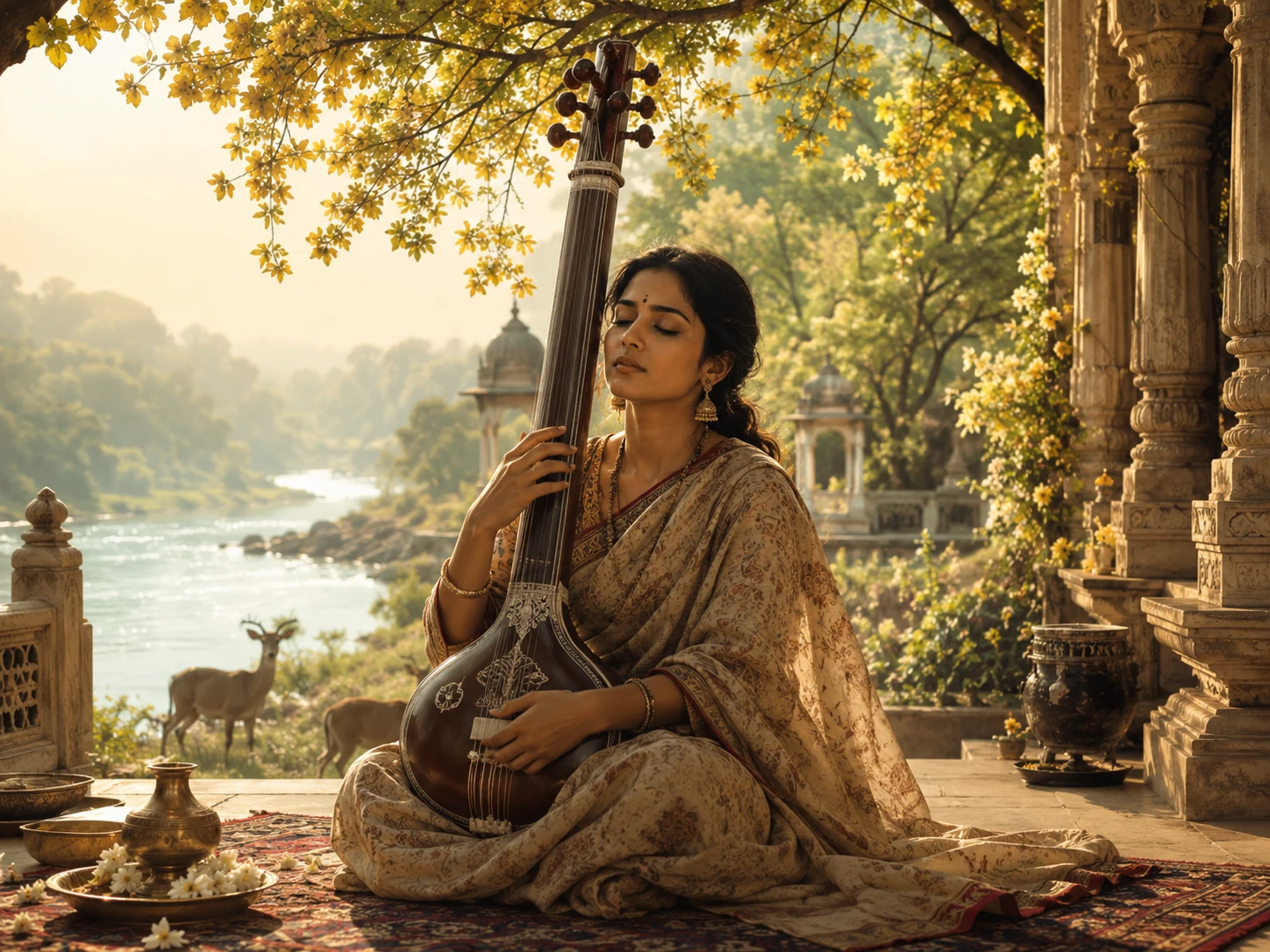
Raag Todi -- The Late-Morning Raag of Surrender
राग तोड़ी -- समर्पण का देर-प्रातः राग
It is 10:30 in the morning at a haveli in Lucknow. The first cup of tea has gone cold. The family pandit has finished the morning aarti at the house mandir. The ghats on the Gomti are slowly emptying. The harsh edge of dawn light has softened into the steady illumination of late morning, and the city has settled into the kind of working stillness that only the 10-to-noon window holds. A vocalist sits before the tanpura. He has tuned to the rising sun, tested the upper Ni, settled on Sa. He waits. Then he opens the alaap with one komal swara, then another, then another, packing four altered notes into a single octave -- komal Re, komal Ga, komal Dha, with tivra Ma sitting between them like a slow blade. The raag is Todi. There is no other raag like it. There is no other hour in which it makes the same sense.
Todi is the most demanding raag of the morning Prahar. It is also one of the most beloved. Every serious Hindustani vocalist eventually attempts Todi. Most spend a decade trying to do it justice. The technical difficulty is real -- four altered notes, a vadi that the singer must hold against gravity, a Pa that must be approached with restraint and sometimes skipped altogether, swaras that demand pitch precision well beyond what most other raags ask. The emotional difficulty is bigger. Todi carries an undertone the tradition calls karuna-bhakti -- compassion mixed with surrender, the music a soul makes when it has nothing left to defend.
This article is the fifth in the Eternal Gyan music cluster, and the second of seven raag profiles. The earlier profile covered Bhairav, the dawn raag of Shiva. Todi sits a few hours later in the day, and a few centuries earlier in its presumed authorship. Where Bhairav is ancient and untraceable, Todi is medieval and named -- the canonical form is called Miyan ki Todi, attributed by long tradition to Miyan Tansen at the court of Akbar in the late 16th century. The attribution is traditional rather than historically documented in the modern scholarly sense, and Todi clearly has older roots that pre-date Tansen. What is documented is that the raag has been at the centre of Hindustani classical practice for at least four centuries, and that every major gharana has its own reading of it.
मन्मना भव मद्भक्तो मद्याजी मां नमस्कुरु। मामेवैष्यसि युक्त्वैवमात्मानं मत्परायणः॥
manmana bhava madbhakto madyaji mam namaskuru mam evaishyasi yuktvaivam atmanam matparayanah
Always think of me, be devoted to me, worship me, offer obeisance to me. Having fixed your mind on me as your supreme goal, you will surely come to me.
— Bhagavad Gita 9.34
Krishna's instruction to Arjuna in the Gita -- think of me, be devoted to me, surrender to me -- is the textual root of the bhakti tradition that Todi sits inside. The raag's emotional centre is not romantic love, not heroic virtue, not philosophical inquiry. It is the moment when a devotee turns toward what they cannot reach by their own effort. The medieval poet-saints who shaped North Indian devotion -- Surdas, Mirabai, Tulsidas, Kabir -- wrote their verses in this register, and the raagas that came to carry their compositions developed in parallel. Todi is one of those raagas.
The traditional attribution of Miyan ki Todi to Tansen needs careful framing. Mian Tansen (c. 1500-1589) served as one of the Navratnas, the nine jewels, at the court of Akbar in Delhi and Fatehpur Sikri. He is the most celebrated court musician in Indian history. Tradition credits him with composing Miyan ki Todi, Miyan ki Malhar, Darbari Kanada, Miyan ki Sarang, and several other major raagas. The historical record from the 16th century is thin, however. The compositions attributed to Tansen survive in later transmissions through his descendants and through the Senia gharana that traces lineage back to him. Whether the raagas as performed today are the same as the raagas Tansen actually sang at Akbar's court is genuinely uncertain. What is certain is that the Tansen lineage shaped the raag for at least 400 years, and that the lineage's claim to authorship has been accepted by every major gharana since the 17th century.
The Sufi-Islamic and Hindu-Bhakti currents in 16th and 17th century North India met inside this raag. Tansen was a Hindu by birth (Misra family of Gwalior), trained under both Hindu and Sufi masters, and served a Muslim emperor. The compositions in Todi from his school include both Hindu bhakti texts and Persian-influenced lyrics. The raag carries that composite history in its mood. A Todi alaap can sound equally like an outpouring before a Krishna shrine and like a Sufi qawwali approaching its devotional climax. Both readings are correct. The raag accommodates them because the underlying register -- surrender to something larger than the self -- is shared across both traditions.
The name Todi itself is older than Tansen. The 13th century Sangeet Ratnakara mentions a raga called Todi, though its swara structure was different from the modern form. The transition from medieval Todi to the modern Miyan ki Todi happened sometime between the 14th and 16th centuries, with Tansen's reformulation being the form that survived. This is a common pattern in Hindustani raag history -- old names persist while their internal structures transform. Todi is the prime example.
The Todi Family -- Major Raags from Todi Thaat
| Raag / राग | Distinguishing Feature | Time / Mood | Standard Recording |
|---|---|---|---|
| Miyan ki Todi / मियाँ की तोड़ी | Canonical Todi -- komal Re, Ga, Dha + tivra Ma; Pa restrained | 9 am to 12 noon, deep yearning | Ustad Amir Khan -- Indore gharana 1960s |
| Multani / मुल्तानी | Same swaras as Todi; vadi Pa instead of Dha | 3 pm to 6 pm, late afternoon weight | Pt. Bhimsen Joshi -- AIR archive recordings |
| Gujari Todi / गुजरी तोड़ी | Drops Pa entirely; six-note skeletal scale | Mid-morning, ascetic detachment | Pt. Kumar Gandharva -- live recitals |
| Bilaskhani Todi / बिलासख़ानी तोड़ी | Komal Re, Ga, Dha, Ni with shuddha Ma -- structurally closer to Bhairavi family | Late morning, mournful surrender | Pt. Jasraj -- Mewati gharana renderings |
| Madhuvanti / मधुवन्ती | Shuddha Re, komal Ga, tivra Ma -- borderline raag | Late afternoon, romantic-yearning | Pt. Nikhil Banerjee -- sitar recordings |
| Bahaduri Todi / बहादुरी तोड़ी | Adds shuddha Dha alongside komal Dha | Late morning, more open than Miyan ki | Smt. Veena Sahasrabuddhe -- Gwalior recordings |
| Hussaini Todi / हुसैनी तोड़ी | Mixed Bhairavi-Todi swara treatment | Late morning, qawwali-influenced | Ustad Bade Ghulam Ali Khan -- Patiala gharana |
Bilaskhani Todi is named in the Todi family by tradition, but its actual swara configuration places it structurally closer to Bhairavi Thaat than to Todi Thaat -- a name that survived even after the underlying scale shifted. Multani and Gujari Todi share Todi's swaras but live in different Prahars and carry different moods.
Todi uses seven swaras -- Sa, komal Re, komal Ga, tivra Ma, Pa, komal Dha, Ni. Four altered notes in a single octave. This is more altered notes than any other major Hindustani raag uses. Bhairav has two komal swaras. Yaman has one tivra. Bhairavi has four komal but no tivra. Todi has three komal and one tivra together. The combination produces a tonal density that no other raag matches.
The aroh is Sa, komal Re, komal Ga, tivra Ma, Pa, komal Dha, Ni, upper Sa. The avaroh runs the same pattern in reverse. In actual performance, the Pa is treated with restraint -- a trained Todi singer often descends from Dha to Ma directly, skipping Pa, before returning through it later in the phrase. This Pa restraint is one of the distinguishing markers of the raag. A vocalist who hits Pa too prominently or too often is read as singing Multani rather than Todi, since Multani uses the same swaras with Pa as the vadi note.
The vadi-samvadi pair is contested across gharanas. Bhatkhande's textbook gives Dha as vadi and Ga as samvadi. Some readings give Ga as vadi and Dha as samvadi. The Indore gharana tradition associated with Ustad Amir Khan tends to emphasize Dha as the resting note. The Gwalior gharana tends to emphasize Ga. Both approaches produce recognizable Todi. Neither is wrong. The raag accommodates the variation.
The pakad of Todi is harder to reduce to a single phrase than is the case for simpler raags. A widely accepted form runs -- komal Dha komal Ga, tivra Ma komal Ga komal Re Sa, with andolan applied to komal Ga and komal Dha. Andolan in Todi is more pronounced than in Bhairav. The slow oscillation between komal Ga and the shuddha Ga it deliberately is not, and between komal Dha and the shuddha Dha it deliberately is not, creates the weeping quality that the raag is famous for. A Todi alaap that lacks andolan sounds clinical, almost academic. With andolan, the same notes carry the karuna-bhakti the tradition prescribes. The skill is in the slow swing, the willingness to hold each komal swara just long enough that the listener feels the pull toward its shuddha counterpart and then the gentle refusal to go there. That refusal is what Todi sounds like.
भज गोविन्दं भज गोविन्दं गोविन्दं भज मूढमते। सम्प्राप्ते सन्निहिते काले नहि नहि रक्षति डुकृञ्करणे॥
bhaja govindam bhaja govindam govindam bhaja mudhamate samprapte sannihite kale nahi nahi rakshati dukrnkarane
Worship Govinda, worship Govinda, worship Govinda, O foolish mind. When the appointed hour draws near, the rules of grammar will not save you, will not save you.
— Bhaja Govindam, verse 1 (Adi Shankaracharya)
Adi Shankaracharya's Bhaja Govindam, composed in Varanasi in the 8th century CE, sits naturally inside Todi's emotional register. The hymn's central message -- that worldly knowledge will not save you when the appointed hour arrives, only surrender to the divine will -- is the bhakti core that Todi compositions explore from a different direction.
Three bandishes deserve specific mention. The first is Langar Kankariya Mat Maro, a slow vilambit composition where the singer pleads with Krishna to stop throwing pebbles at her while she draws water from the well. The lyric is on its surface a Radha-Krishna teasing scene, but the slow vilambit treatment in Todi turns the pebble-throwing into something far deeper -- the divine playing with the soul, the soul pleading for relief that is also courtship. The second is Hari Ke Charan Kamal, a direct surrender bandish addressed to the feet of Hari (Krishna or Vishnu), often paired with the BG 9.34 register. The third is Garva Na Kar Re Banda, a Sadarang-tradition bandish warning the singer against pride. The Sadarang and Adarang brothers, court musicians of Muhammad Shah Rangile (1719-1748), are the second great pillar of the Hindustani bandish corpus after the Tansen tradition, and their Todi compositions number in the dozens.
Among 20th and 21st century performers, Ustad Amir Khan (1912-1974) of the Indore gharana is widely considered the canonical reference for Todi. His vilambit alaaps -- often stretching forty-five minutes before any rhythmic composition begins -- redefined what the raag could do in the long format. His 1960s recordings for HMV and his All India Radio archives are the starting point for any serious listener. Pt. Bhimsen Joshi's Todi from the Kirana gharana takes a different approach -- faster development, more emphasis on the bandish than on the alaap, but the same emotional weight. Ustad Bade Ghulam Ali Khan's famous Aaye Na Balam, in Bilaskhani Todi rather than pure Todi, became one of the most widely circulated classical recordings in independent India, played repeatedly on All India Radio through the 1950s and 1960s.
Pt. Kumar Gandharva approached Todi from yet another angle -- the Gwalior-Dewas tradition with strong folk-bhakti influences. His Gujari Todi recordings, particularly the post-tuberculosis recovery sessions of the late 1940s and early 1950s, carry a haunted quality that fits the raag's mood almost too well. Smt. Kishori Amonkar of the Jaipur-Atrauli gharana brought Todi back to its bandish-centric format in the 1980s and 1990s, with compositions like Chalo Sakhi Sajan Ke Pas demonstrating how the raag could carry a different gharana's reading without losing its core identity.
There is a quiet rule in Hindustani classical conservatories that no vocal student is given Todi to perform in public for at least the first five years of formal training. The rule is not written down. It is enforced by the gurus through the simple mechanism of refusing to teach the bandishes until the student is ready. The reason for this delay is the technical demand of the raag.
Three challenges face every Todi student. The first is pitch precision. Three komal swaras and one tivra Ma packed into a single octave means the singer must hit each altered note at exactly the right frequency, neither sliding into the shuddha version nor overshooting into a different komal. A komal Re sung half a microtone too high collapses the raag's atmosphere. A tivra Ma sung half a microtone too low pulls the raag toward Multani. The margin for error is tiny. Most students need years of riyaz before their pitch sense is stable enough to attempt Todi without supervision.
The second challenge is Pa restraint. Other raagas teach the student to use Pa as a resting note, a place to gather breath and reset before the next phrase. Todi denies this. Pa is available but cannot be leaned on. Singers who have spent years learning to rest on Pa must unlearn that habit when they reach Todi. The unlearning is harder than the original learning, and it shows in performance. A Todi where the singer reaches for Pa too often is a Todi where the singer is not yet ready for the raag.
The third challenge is the andolan on komal Ga and komal Dha. Andolan in any raag is a matter of training the breath and voice to oscillate slowly between two pitches without ever fully landing on either. In Todi, the andolan must convey weeping without becoming sentimental, must convey surrender without becoming weak. The line between competent andolan and overdone melodrama is thin, and the line between competent andolan and clinical stiffness is also thin. A trained ear can hear in the first thirty seconds of any Todi performance whether the singer has crossed both lines successfully. Most singers need a decade of guru-shishya parampara before they consistently land in the right zone.
Yet for all this difficulty, Todi is one of the most beloved raagas of the Hindustani tradition. Listeners who do not perform classical music recognize Todi within seconds, and feel the karuna-bhakti even without knowing why. The raag rewards the patient student and the patient listener equally. The investment in either direction takes years. The return, in both directions, is something that few other raagas in the Hindustani repertoire can match.
The most famous origin story in Hindustani raag history attaches to Bilaskhani Todi. When Mian Tansen died in 1589, his son Bilas Khan is said to have sat by his father's body at Gwalior and sung an extempore raag of grief. The composition combined elements of Todi and Bhairavi in a way no one had heard before. The tradition holds that Tansen's body briefly responded -- one finger raised in approval -- before stilling permanently. Bilas Khan named the raag after his father had blessed it through that final gesture, and the name Bilaskhani Todi has carried since. The story is treated as tradition rather than documented history -- the historical record from late 16th century Gwalior is too thin to verify any of it -- but the raag itself remains one of the most performed compositions of the Hindustani repertoire, and the story is recited in conservatory classrooms today the same way it was recited in Senia gharana lineages four hundred years ago.
Todi is the raag of the Indian working morning -- the hour after the dawn aarti, before the noon meal, when the household has settled into its first rhythm of the day and the office is in its second hour. The raag has slipped into modern life accordingly, in places that the casual listener does not always recognize.
The Hindi film tradition has used Todi-family raagas more carefully than it has used Bhairav. Naushad set parts of Mughal-e-Azam (1960) in Todi-leaning compositions for the Akbar court scenes, on the reasoning that the historical Tansen would have been singing in this register in those very rooms. Madan Mohan reached for Todi-adjacent phrasings in the Lata Mangeshkar ghazals he composed during the 1960s. In recent decades, A.R. Rahman's work in films like Dil Se (1998) and Jodhaa Akbar (2008) has incorporated Todi-leaning passages, especially in scenes that combine the Mughal court setting with bhakti-leaning lyrics. Vishal Bhardwaj's score for Maqbool (2003) used Todi inflections in some of the introspective sequences.
On the listening side, Spotify's Indian classical analytics show Todi-tagged content peaking between 9 and 11 am on weekdays. The listenership skews toward urban professionals in their thirties and forties -- the demographic that has the time and the trained ear for a 45-minute Amir Khan vilambit alaap, and that often listens during commutes or while working at home. The yoga-meditation app market has been more cautious with Todi than with Bhairav. The mood is too specific -- karuna-bhakti rather than the cleaner alertness Bhairav offers -- and most generic morning routines do not need that emotional weight. Apps that focus specifically on bhakti meditation, like Black Lotus and Sattva, do feature Todi prominently in their 10 am-noon slots.
For the practical listener, the entry point is a single Amir Khan vilambit Todi recording from his 1960s sessions, played in stillness between 10 am and 11 am, ideally on a weekday with no immediate work pressure. Forty minutes of Amir Khan's komal Re andolan, listened to once a week through a year, will teach more about the structure of Hindustani yearning than any textbook can. Beginners who find the full vilambit too demanding can start with a five-minute Todi tarana from the same era, which compresses the raag's identity into a faster format. From there the path leads back to the longer pieces, and from there to the neighbouring raagas of the family -- Multani in the late afternoon, Gujari Todi in the mid-morning, Bilaskhani Todi for the listener who has read the Bilas Khan story and wants to hear what the music sounds like. The raag was engineered to reward this kind of patient exploration. The reward is real.
Listen to Raag Todi in the Late Morning
Listen to Miyan ki Todi in the late morning, its traditional hour -- a vilambit khayal gives it room to unfold. Notice the komal re, ga and dha set against the tivra ma, which give Todi its searching quality. Eternal Raga does not yet have raag-wise collections; its Listen page has a devotional album and a daily Gita podcast.
Tags
Eternal Raga · शाश्वत राग
Institutional voice — scholarly articles on Sanatan Dharma
Deepen Your Understanding
अपनी समझ और गहरी करें
vedic sciences
Raag Bhairav -- The Dawn Raag of Shiva
Bhairav is the first raag of the Hindustani morning -- austere, slow, weighted, named after Shiva's most fearsome form. Read its swara structure, its tantric backdrop, its great recordings, and why every classical concert that runs through the night ends with Bhairav at sunrise.
vedic sciences
Samay Chakra -- Why Each Raag Has Its Hour
Hindustani classical assigns each raag to a specific Prahar of the day or season. Bhairav at dawn, Yaman at dusk, Malhar in monsoon. Decode the architecture of samay -- the time-of-day theory that turns 24 hours into a musical map.
vedic sciences
Dasha Thaat -- Bhatkhande's Modern Map of Hindustani Raagas
How does a tradition with hundreds of raagas teach itself? Pt. Vishnu Narayan Bhatkhande's answer was the ten-Thaat system, published between 1909 and 1935. Trace the system, its limits, and why every Hindustani conservatory still teaches by it.
vedic sciences
Nada Brahma -- Sound as Creation in Hindu Sangeet Shastra
Long before raags had names, India held one foundational claim: sound is creation itself. Trace the lineage from the Sama Veda's chants to Bharata's Natya Shastra to Sharangadeva's Sangeet Ratnakara -- the spine of classical music as sadhana.
vedic sciences
Raag Yaman -- The King of Evening Raagas
Yaman is the most performed raag in Hindustani classical music -- the dusk sandhi prakash piece every student learns first, every concert opens with, every gharana claims its own reading of. Read its swara structure, its Persian-Hindustani synthesis, its standard bandishes, and the long lineage of canonical recordings.
The most famous origin story in Hindustani raag history attaches to Bilaskhani Todi. When Mian Tansen died in 1589, his son Bilas Khan is said to have sat by his father's body at Gwalior and sung an extempore raag of gri…
More in Vedic Sciences
Agnichayana -- The Falcon-Shaped Fire Altar That Survived 3,000 Years
12 min read
Ancient Indian Metallurgy -- The Iron Pillar That Refuses to Rust
13 min readAryabhata -- The Astronomer Who Said the Earth Turns
3 min readThe same translation error that turned '33 Koti' into '33 crore' in Hinduism also happened in Buddhism. The Chinese translation of Buddhist texts rendered 'Sapta Koti Buddha' (7 Supreme Buddhas) as '7 Crore Buddhas.' The…
Deities AvatarsCommunity Reflections
🕉️
Be the first to share your reflection.