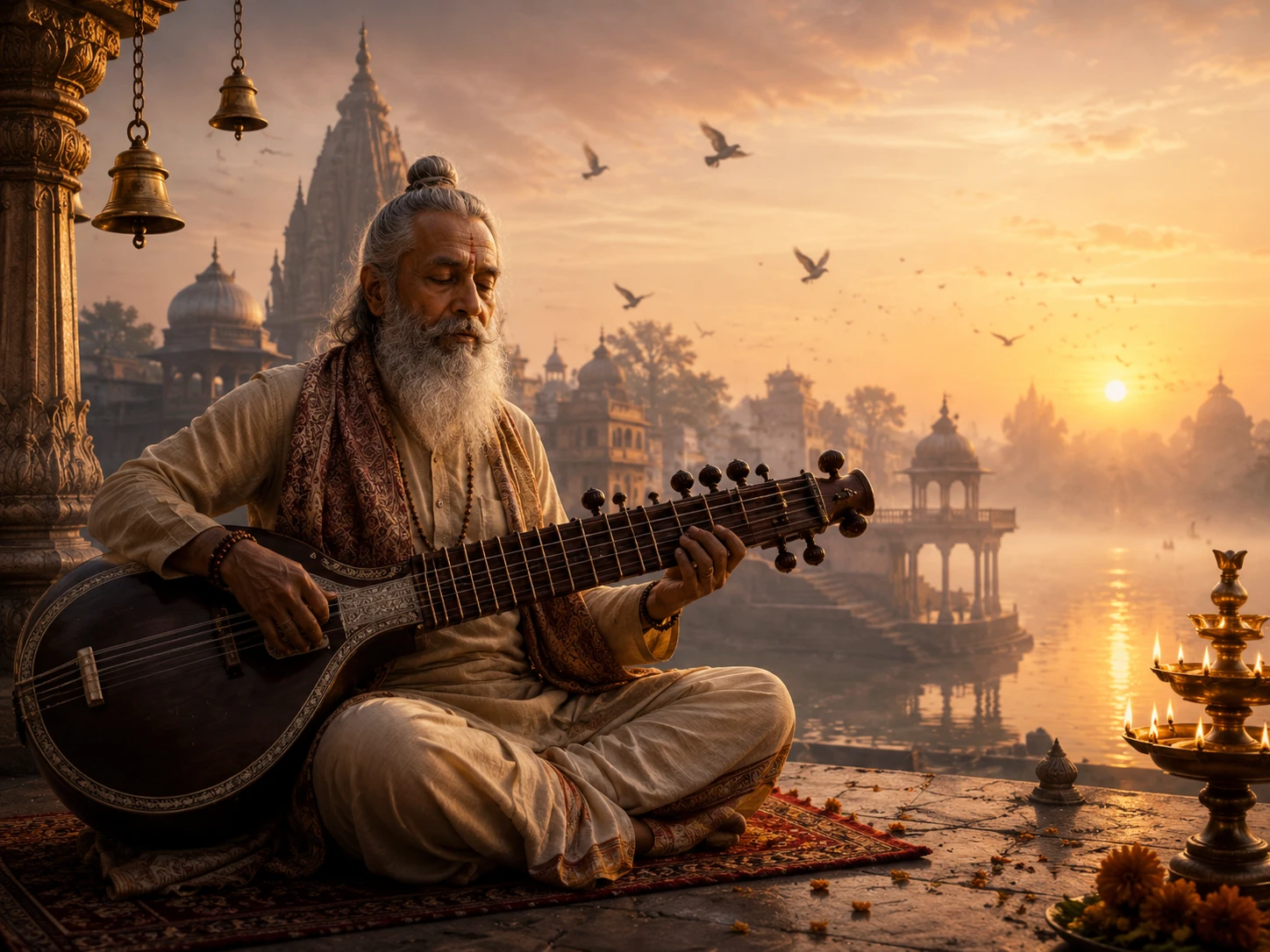
Raag Bhairav -- The Dawn Raag of Shiva
राग भैरव -- शिव का भोर राग
It is 5:30 in the morning at Manikarnika Ghat in Varanasi. The cremation fires from last night are still smouldering at one corner. The sky over the Ganga has begun to turn from black to the colour of slate, and the first thin orange line is showing on the eastern bank. Somewhere behind the Vishwanath temple, an old vocalist is sitting cross-legged on a chatai, tanpura tuned, voice clearing. He opens with a single long swara on Sa. Then he descends, slowly, on komal Re. Then a careful andolan, an oscillation between komal Re and Sa. Then a meend up to Ga. The raag he is singing is Bhairav. He is not performing. He is offering. And the city around him -- the priests starting their abhishek, the boatmen pulling oars on the ghat, the first cycle-rickshaw passing on the lane behind -- knows what raag this is the moment it hears the second komal Re.
Bhairav is the foundational morning raag of Hindustani classical music. It is the raag every vocal student learns first, the raag every all-night concert ends with at sunrise, the raag Akashvani has played every morning since 1936. It is named after Bhairava, the fierce dawn-roaming form of Shiva. The raag and the deity share a single mood, one that is hard to translate cleanly into English. Awe, austerity, weight, the kind of seriousness that arrives only at the threshold between night and day. The Sanskrit word that catches it best is gambhirya, gravitas. Bhairav is the gambhir raag of the Hindustani morning.
This article is the fourth in the Eternal Gyan music cluster. The earlier articles laid out the textual foundation of Indian classical music, the time-of-day theory that organizes raags by Prahar, and the ten-Thaat system that Bhatkhande compiled in the early 20th century. Bhairav is both a Thaat in that system and a raag within that Thaat. It is also, by long tradition, the first raag a serious student of Hindustani classical music is taught -- the alphabet of morning music, the raag from which the rest of the morning Prahar grammar grows. Understand Bhairav, and you have an entry into half of the Hindustani repertoire. Miss Bhairav, and the morning raags will always sound interchangeable to you, even after years of listening.
देवराजसेव्यमानपावनांघ्रिपङ्कजं व्यालयज्ञसूत्रमिन्दुशेखरं कृपाकरम्। नारदादियोगिवृन्दवन्दितं दिगंबरं काशिकापुराधिनाथकालभैरवं भजे॥
deva-raja-sevyamana-pavananghri-pankajam vyala-yajna-sutram indu-shekharam kripakaram naradadi-yogi-vrinda-vanditam digambaram kashika-puradhinatha-kalabhairavam bhaje
I worship Kala Bhairava, the Lord of Kashi, whose pure lotus feet are served by the King of the Devas, who wears a serpent for his sacred thread and the moon on his forehead, the merciful one, praised by Narada and the assembly of yogis, clothed in the directions themselves.
— Kala Bhairava Ashtakam, verse 1 (Adi Shankaracharya)
Adi Shankaracharya composed the Kala Bhairava Ashtakam at Kashi sometime in the 8th century CE, and the eight verses became one of the central Shaiva morning recitations of the Indian tradition. To understand the raag named after this deity, one has to first understand the deity himself.
Bhairava is a fierce manifestation of Shiva. The Linga Purana, Skanda Purana, and Shiva Purana each give different accounts of his origin, but the broad outline is shared. Brahma, in a moment of pride, claimed equality with Shiva. From Shiva's anger emerged a fearsome form with a body the colour of dark monsoon clouds, three eyes, four arms holding trident, sword, noose, and damaru, riding a black dog (shvana) as his vahana, garlanded with skulls, clothed in the directions themselves -- digambara. This form became Bhairava, the time-conqueror, kala-bhairava. He severed Brahma's fifth head with his thumbnail. The skull stuck to his palm, and Bhairava wandered the earth as a kapalika -- a skull-carrier -- until the sin of Brahmahatya was finally absolved at Kashi. Since then, Bhairava has been the Kotwal of Kashi, the divine guardian who never leaves the city.
The Tantric traditions count eight Bhairavas -- Ashta Bhairavas -- as guardians of the eight directions: Asitanga, Ruru, Chanda, Krodha, Unmatta, Kapali, Bhishana, and Samhara. Each carries his own iconography, his own mantra, his own temple. Kala Bhairava, the form Adi Shankara invokes, sits above this group as the master of time itself -- the one before whom even kala, the cyclical force that consumes all beings, must bow.
Two features of this deity matter for the raag named after him. First, the time of his wandering. In tantric tradition, Bhairava is most active at the sandhi prakash hours, the twilight zones where day meets night. The pre-dawn hour when temples open their doors for the first aarti, when the cremation grounds are still smoking, when most of the city is between sleep and waking -- this is the hour Bhairava walks. Second, the mood. Bhairava is not Shiva-the-yogi, not Shiva-the-cosmic-dancer Nataraja, not Shiva-the-householder with Parvati. Bhairava is Shiva at his most concentrated, most weighty, most awe-inducing. The raag carries exactly this mood. A Bhairav alaap is not romantic. It is not playful. It is not sweet. It is gambhir, weighty, the auditory equivalent of standing alone before a Shiva linga at 5 am with no one else in the temple.
The Bhairav Family -- Major Raags from Bhairav Thaat
| Raag / राग | Distinguishing Feature | Time / Mood | Standard Recording |
|---|---|---|---|
| Bhairav / भैरव | Komal Re, Komal Dha (with andolan) | Pratah sandhi, austere weight | Pt. Bhimsen Joshi -- AIR archive 1972 |
| Ramkali / रामकली | Adds tivra Ma in avaroh, lighter than Bhairav | Late dawn, devotional Sikh tradition | Pt. Jasraj -- live concert recordings |
| Bairagi / बैरागी | Drops Ga and Dha, four-note skeletal scale | Early morning, ascetic detachment | Pt. Ravi Shankar -- composed and popularized 20th c. |
| Gunkali / गुणकली | Drops Ga and Ni, five-note pentatonic | Dawn, simpler than Bhairav | Ustad Amir Khan -- Indore gharana |
| Jogiya / जोगिया | Komal Re, shuddha Dha (mixed), folk-leaning | Late dawn, ascetic-folk Rajasthani | Begum Akhtar -- thumri renditions |
| Ahir Bhairav / अहीर भैरव | Komal Re from Bhairav, Komal Ni from Kafi | Mid-morning, sweeter, more accessible | Pt. Hariprasad Chaurasia flute, A.R. Rahman film use |
| Nat Bhairav / नट भैरव | Shuddha Re and Shuddha Dha (less austere) | Mid-morning, lyrical adaptation | Pt. Kumar Gandharva -- Gwalior-Dewas readings |
Bhairav itself is the parent. The other raags either share the parent scale with modifications (Ramkali, Bairagi, Gunkali, Jogiya) or borrow swaras from neighbouring Thaats (Ahir Bhairav, Nat Bhairav). The mixed-Thaat Bhairavs are sometimes called Mishra (compound) raags.
Now to the technical bones. Bhairav uses seven swaras -- Sa, komal Re, Ga, shuddha Ma, Pa, komal Dha, Ni. The two flat notes, komal Re and komal Dha, are what define the raag's soundprint. They sit at the second and sixth scale degrees, both lowered by a semitone. The remaining five swaras are shuddha. There is no tivra Ma in Bhairav. Comparison with Bhairavi, the dusk raag often confused with Bhairav, is useful here -- Bhairavi takes komal Re, komal Ga, komal Dha, and komal Ni. Four flats. Bhairav takes only two flats. The shuddha Ga and shuddha Ni in Bhairav are what give it its weight without sliding into the pathos of Bhairavi.
The aroh is Sa, komal Re, Ga, Ma, Pa, komal Dha, Ni, upper Sa. The avaroh is upper Sa, Ni, komal Dha, Pa, Ma, Ga, komal Re, Sa. Bhatkhande's standard assignment puts Dha as vadi (the king note) and Re as samvadi (the minister). Some gharanas reverse this -- Re as vadi, Dha as samvadi. The reversal does not change the raag, only its centre of gravity. A Dha-vadi Bhairav rests in the upper tetrachord and feels expansive. A Re-vadi Bhairav rests in the lower tetrachord and feels brooding. Both are correct.
The signature element of Bhairav is andolan -- the slow, deliberate oscillation applied specifically to komal Re and komal Dha. This is not vibrato. Vibrato is a fast wobble around a fixed pitch. Andolan is a slow swing between two pitches, almost a dialogue between komal Re and the shuddha Re it is not. The notes do not just sit there. They breathe. A trained ear hears the andolan in the first phrase of any competent Bhairav, and the absence of andolan -- a singer or instrumentalist hitting the komal Re straight without the swing -- is instantly identified as either inexperience or a deliberate stylistic choice from a non-traditional school. The andolan is what gives Bhairav its meditative weight.
The pakad, the signature phrase, varies slightly by gharana but a widely accepted form is Ga Ma Dha (with andolan), Ma Pa, Ga Ma Re Re Sa. Recognition through the pakad is what allows even a half-trained listener to identify the raag within the first thirty seconds of an alaap. The time of performance is post-dawn, roughly 5 am to 8 am. Performance before sunrise is technically possible but is reserved for Bhairav-leaning Brahma muhurta raags like Lalit, which use both forms of Ma. Paired with andolan, Bhairav also uses meend, the slow glide between two notes that lets one swara melt into the next without striking it. The meend from komal Re up to Ga, executed cleanly, is one of the small tests by which a Bhairav singer's training is judged.
प्रातः स्मरामि भवभीतिहरं सुरेशं गङ्गाधरं वृषभवाहनमम्बिकेशम्। खट्वाङ्गशूलवरदाभयहस्तमीशं संसाररोगहरमौषधमद्वितीयम्॥
pratah smarami bhava-bhiti-haram suresham ganga-dharam vrishabha-vahanam ambikesham khatvanga-shula-varada-abhaya-hastam isham samsara-roga-haram aushadham advitiyam
In the morning I remember Shiva, the Lord of the Devas, the destroyer of the fear of worldly existence, who carries the Ganga, who rides the bull, the consort of Ambika, whose hands hold the khatvanga, the trident, and the gestures of boon and protection -- the unmatched medicine for the disease of samsara.
— Shiva Pratah Smaran Stotram, verse 1 (Adi Shankaracharya)
The Hindustani repertoire holds dozens of bandishes -- traditional fixed compositions -- in Raag Bhairav. Three deserve special mention. The first is Jago Mohan Pyare, a slow vilambit composition addressed to Krishna asking him to wake up, often sung as the opening item of a khayal recital. The lyrics ask the beloved to rise because morning has arrived, the cows are calling, the Yamuna waits. The bandish has been recorded by almost every major Hindustani vocalist of the 20th century. The second is Albela Sajan, more commonly heard today in its Ahir Bhairav variant, but with a Bhairav original that predates the Ahir Bhairav adaptation. The third is Mero Allah Meherban, a sufi-leaning Bhairav bandish that demonstrates how the raag crosses sectarian lines -- the same swaras carry both the call to Shiva and the call to Allah, and the morning hour holds both calls equally.
Pt. Bhimsen Joshi's Bhairav recordings, especially the All India Radio archive sessions of the 1970s, are widely considered canonical references for the raag. His vilambit alaap, developing the komal Re andolan over fifteen minutes before any rhythmic composition begins, demonstrates the patience the raag asks of its performer. Ustad Bismillah Khan's shehnai Bhairav recordings come from a different lineage but achieve the same mood. For decades he performed Bhairav at the gates of Kashi Vishwanath Mandir during the Mangala Aarti at 2:30 am, and many of those performances were recorded by Saregama and All India Radio. His shehnai's nasal, slightly weeping quality matched the raag perfectly. When Bhimsen Joshi and Bismillah Khan recorded a joint Bhairav for the 1956 Republic Day broadcast, the performance is said to have lasted nearly two hours.
Pt. Ravi Shankar took Bhairav to the global stage in the 1960s. His sitar recordings, particularly the Three Ragas LP released by World Pacific Records in 1956 and the Music of India compilations that followed, were the introduction to Hindustani classical for an entire generation of Western listeners. George Harrison's later study of the sitar with Ravi Shankar, and the resulting incorporation of Indian classical elements into Beatles tracks like Within You Without You, was downstream of this exposure. The connection is direct enough that the Bhairav-influenced phrasings in 1960s and 1970s Western popular music can be traced back to Ravi Shankar's specific recordings.
Among contemporary performers, Pt. Jasraj's Bhairav recordings carry a Mewati gharana devotional weight that suits the raag's Shiva associations. Ustad Rashid Khan's Bhairav -- from the Rampur-Sahaswan gharana -- is more measured, more khayal-centric. Smt. Kishori Amonkar's Bhairav, from the Jaipur-Atrauli gharana, leans heavier on bandish complexity than on raag exposition. Each gharana has its Bhairav, and a serious listener can today, in 2026, compare them on Spotify in a single afternoon.
There is a tradition in Hindustani classical music that an all-night concert ends with Bhairav at sunrise. The convention has roots in two separate logics. The first is the Prahar system itself -- if the concert starts at dusk with Yaman or Marwa, moves through the deep night with Darbari and Malkauns, and crosses into the pre-dawn with Lalit or Bhatiyar, then Bhairav is what comes next, and Bhairav is what closes. The samay rule does not allow anything else at that hour. The second logic is symbolic. Bhairav at dawn is also Bhairava the deity at his most active hour. Closing with Bhairav is closing with Shiva opening his eyes for the day. The musical and theological registers collapse into a single moment, which is the kind of alignment Indian classical music quietly engineers and rarely advertises.
This is why the great festivals -- Saptak in Ahmedabad, Sawai Gandharva Bhimsen Mahotsav in Pune, the Dover Lane Music Conference in Kolkata -- still program their final morning slot for a Bhairav specialist. The 2025 Sawai Gandharva closing was Pt. Sanjeev Abhyankar's Bhairav at 5:45 am, and the concert hall, which had been holding three thousand people through the night, sat absolutely still through it. The same pattern repeats at the smaller neighbourhood music conferences across Maharashtra, Bengal, and Karnataka every winter.
Beyond the concert hall, the convention shapes daily life in unexpected places. Akashvani Vividh Bharati's morning broadcast slot from 5 to 6 am is dominated by Bhairav and Bhairav-family raags. Spotify's curated Hindustani Classical Morning playlist for Indian users opens with Bhairav variants for the same algorithmic reason a thousand listeners started their day with the raag. Yoga retreats in Rishikesh and Kerala that begin their day with surya namaskar at 5 am play Bhairav alaaps in the background more often than any other raag. The IIT Madras research wing studying music and circadian alignment has published preliminary data suggesting Bhairav listening before 7 am correlates with measurable shifts in cortisol and alertness, though the sample sizes remain small and the findings should be treated as suggestive rather than conclusive. The tradition's claim is more modest and more robust -- people who have woken up at dawn in India for several thousand years have consistently reported that Bhairav fits the hour. The aggregate of that experience is the raag's most reliable evidence.
Ustad Bismillah Khan, the shehnai maestro who lived in Banaras for nearly a century (1916-2006), is said to have started almost every morning of his adult life with a Bhairav alaap at the gates of Kashi Vishwanath Mandir, beginning around 4:30 am. He turned down a Padma Vibhushan request to relocate to Mumbai or Delhi for better infrastructure, saying he could not leave the temple where his daily Bhairav lived. India eventually awarded him the Bharat Ratna in 2001 -- only the third musician to receive the country's highest civilian honour. He died in Banaras in 2006 and was buried near the temple, the way he had lived.
Bhairav has crossed comfortably into modern Indian life, though it has done so quietly and without much fanfare.
Hindi film music has used Bhairav and its cousin Ahir Bhairav for almost every dawn-set or temple-set song since the 1950s. Naushad's score for Baiju Bawra (1952) used Bhairav for Mohe Bhool Gaye Sanwariya, sung by Lata Mangeshkar. The same composer used Ahir Bhairav for the iconic dawn temple song Man Tarpat Hari Darshan Ko Aaj from Baiju Bawra, sung by Mohammed Rafi. S.D. Burman used Bhairav variants for several morning songs in his career. In recent decades A.R. Rahman has reached for Ahir Bhairav repeatedly -- the haunting Albela Sajan from Hum Dil De Chuke Sanam (1999) is in Ahir Bhairav, and traces of Bhairav phrasing appear in his work for Roja, Bombay, and Vande Mataram. Vishal Bhardwaj used Bhairav-leaning compositions for the dawn temple sequences in Omkara and Maqbool. The grammar is so deeply embedded in Indian film music that most viewers absorb the dawn-Shiva-temple feeling without ever knowing the raag they are hearing.
On the listening side, Spotify's data for Indian users shows that Bhairav-tagged content peaks consistently at 5:30 to 6:30 am every weekday, with secondary peaks during festivals like Mahashivratri and Shravan Maas. Apple Music's Indian classical playlists follow a similar shape. The yoga and meditation app market -- Black Lotus, Sattva, Wakefit's sleep app, Headspace's India-specific morning routines -- now uses Bhairav and Ahir Bhairav as default background for early morning sessions, often without naming the raag explicitly. Most users do not need the name. They recognize the mood.
For the practical listener in 2026 looking to actually experience Bhairav, the simplest starting point is one of the canonical recordings -- Pt. Bhimsen Joshi, Ustad Bismillah Khan, or Pt. Hariprasad Chaurasia -- played at the right hour. The right hour is some time between 5 am and 7 am, ideally with the first light of morning visible through whatever window the listener has access to. The recording does not have to be long. Even ten minutes of a competent Bhairav alaap, listened to in stillness at 5:45 am, demonstrates more about the raag than three thousand words of prose ever can. The system was engineered to produce that experience. The system still works. For a college student in Hyderabad, a tech worker in Bengaluru, an NRI in Toronto, or a JEE aspirant in Kota who has set the alarm for 5 am to study, the same raag awaits in the same hour. Bhairav does not change. The world around it does.
Listen to Raag Bhairav at Dawn
Listen to Raag Bhairav at its own hour, in the first light after dawn: a khayal, a morning bhajan, or a film song set in it such as 'Jago Mohan Pyare'. Listen once with full attention and eyes closed, and notice the komal re and komal dha. Eternal Raga does not yet have raag-wise collections; its Listen page has a devotional album and a daily Gita podcast.
Tags
Eternal Raga · शाश्वत राग
Institutional voice — scholarly articles on Sanatan Dharma
Deepen Your Understanding
अपनी समझ और गहरी करें
vedic sciences
Samay Chakra -- Why Each Raag Has Its Hour
Hindustani classical assigns each raag to a specific Prahar of the day or season. Bhairav at dawn, Yaman at dusk, Malhar in monsoon. Decode the architecture of samay -- the time-of-day theory that turns 24 hours into a musical map.
vedic sciences
Dasha Thaat -- Bhatkhande's Modern Map of Hindustani Raagas
How does a tradition with hundreds of raagas teach itself? Pt. Vishnu Narayan Bhatkhande's answer was the ten-Thaat system, published between 1909 and 1935. Trace the system, its limits, and why every Hindustani conservatory still teaches by it.
vedic sciences
Nada Brahma -- Sound as Creation in Hindu Sangeet Shastra
Long before raags had names, India held one foundational claim: sound is creation itself. Trace the lineage from the Sama Veda's chants to Bharata's Natya Shastra to Sharangadeva's Sangeet Ratnakara -- the spine of classical music as sadhana.
vedic sciences
Raag Yaman -- The King of Evening Raagas
Yaman is the most performed raag in Hindustani classical music -- the dusk sandhi prakash piece every student learns first, every concert opens with, every gharana claims its own reading of. Read its swara structure, its Persian-Hindustani synthesis, its standard bandishes, and the long lineage of canonical recordings.
vedic sciences
Raag Malhar -- The Raag That Calls the Rain
Malhar is the seasonal raag of the Indian monsoon -- attached to Varsha Ritu rather than to a Prahar, performed across all hours from June to September. Read the legend of Tansen, the structural family of Malhar variants, and the standard recordings that define how Indians listen when the rain arrives.
Ustad Bismillah Khan, the shehnai maestro who lived in Banaras for nearly a century (1916-2006), is said to have started almost every morning of his adult life with a Bhairav alaap at the gates of Kashi Vishwanath Mandir…
More in Vedic Sciences
Agnichayana -- The Falcon-Shaped Fire Altar That Survived 3,000 Years
12 min read
Ancient Indian Metallurgy -- The Iron Pillar That Refuses to Rust
13 min readAryabhata -- The Astronomer Who Said the Earth Turns
3 min readThe same translation error that turned '33 Koti' into '33 crore' in Hinduism also happened in Buddhism. The Chinese translation of Buddhist texts rendered 'Sapta Koti Buddha' (7 Supreme Buddhas) as '7 Crore Buddhas.' The…
Deities AvatarsCommunity Reflections
🕉️
Be the first to share your reflection.