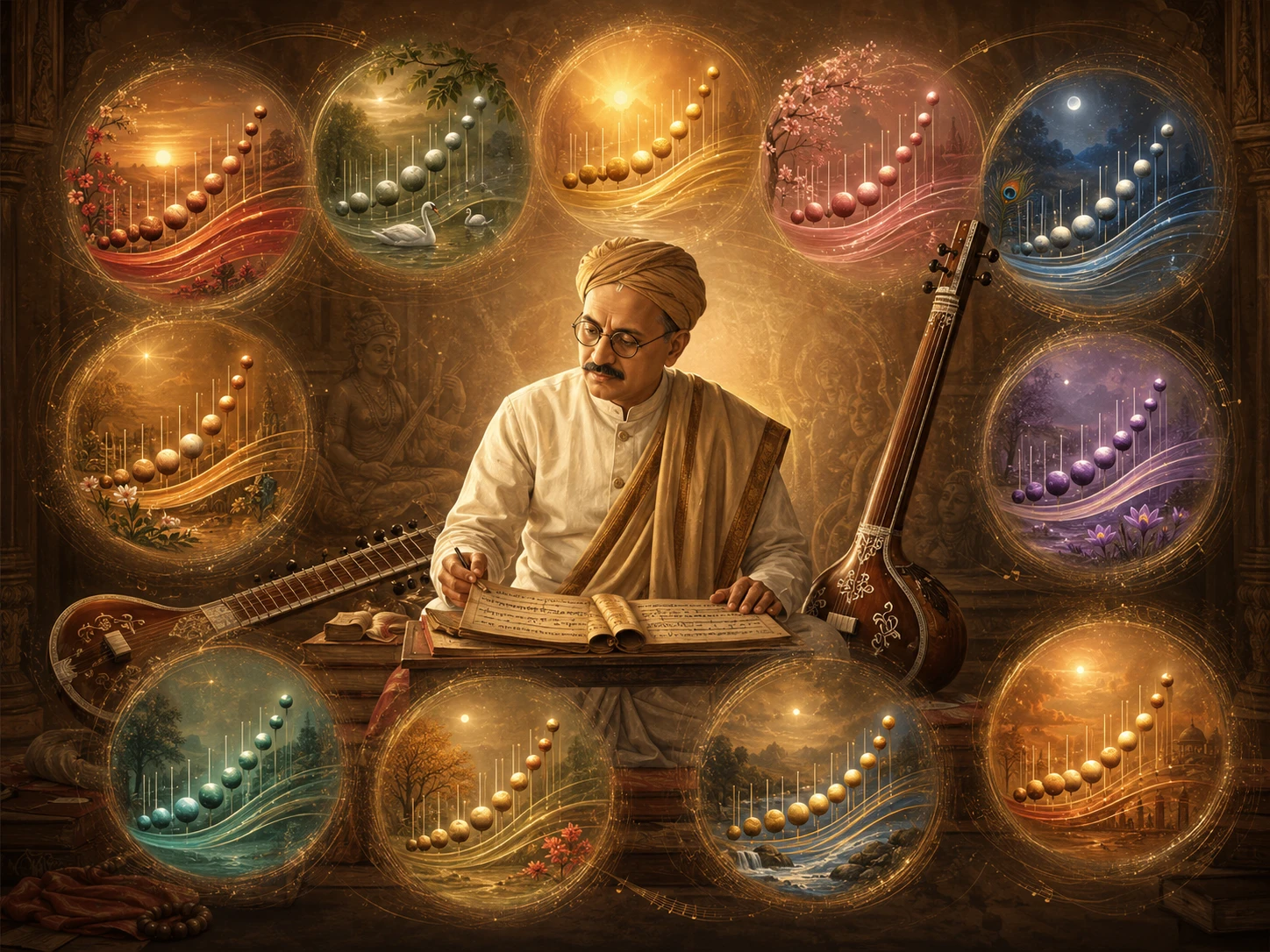
Dasha Thaat -- Bhatkhande's Modern Map of Hindustani Raagas
दस थाट -- भट्खण्डे का हिन्दुस्तानी राग का आधुनिक मानचित्र
Picture the state of Hindustani classical music in 1900. A young Marathi-speaking lawyer named Vishnu Narayan Bhatkhande, who has been listening to khayal since boyhood and has decided to spend his savings travelling across India to interview the surviving ustads, sits down with one of them in Lucknow. He asks a simple question. Which raag are you teaching this student. The ustad names a raag. Bhatkhande writes it down. The next day, he meets a different ustad in Banaras who is teaching what he calls the same raag. The notes are slightly different. The characteristic phrase is different. The time-of-day rule is different. By the time Bhatkhande has crossed five cities and twenty teachers, he has collected forty different versions of what is supposedly one raag.
This was not anyone's fault. Hindustani classical had been an oral tradition for centuries. Each gharana preserved its own reading. Each ustad taught what he had received. Notation barely existed. The 13th century Sangeet Ratnakara had documented 264 raags, but the centuries between Sharangadeva and 1900 had seen so much variation, divergence, and Persian-influenced reshaping that the link to the older text was now thin. A young student in Mumbai in 1900 who wanted to learn Hindustani classical music had to find a guru, sit in his house for fifteen years, and absorb what was passed down. There was no textbook. There was no syllabus. There was no shared vocabulary that allowed two musicians from two cities to compare notes about the same raag.
Bhatkhande spent thirty years of his life solving this problem. By the time he died in 1936, he had built a complete textbook system that organized roughly 150 active Hindustani raags into ten parent groups called Thaats. Every conservatory in India today, from the Sangeet Mahavidyalaya in Lucknow that bears his name, to ITC Sangeet Research Academy in Kolkata, to Pune's Bharat Gayan Samaj, teaches Hindustani classical music using his organization. Every Sangeet Visharad student in 2026 begins her exam preparation by memorizing the ten Thaats. This article maps that system -- what it is, why he made it, where it succeeds, and where it openly fails.
ॐ शीक्षां व्याख्यास्यामः। वर्णः स्वरः। मात्रा बलम्। साम सन्तानः। इत्युक्तः शीक्षाध्यायः॥
om shikshaam vyakhyasyamah varnah svarah. matra balam. sama santanah ity uktah shikshadhyayah
Om. Now we shall explain the science of Shiksha -- the elements are letter, accent, measure, articulation, evenness, and continuity. Thus the chapter on Shiksha is taught.
— Taittiriya Upanishad 1.2 (Shiksha Valli)
The Taittiriya Upanishad lists six elements of Shiksha -- letter, accent, measure, articulation, evenness, and continuity -- because the Vedic seers understood that any sound system has to be classified before it can be taught. Bhatkhande was inheriting an old impulse, not inventing a new one. Indian musicology had been making classification attempts since at least the Natya Shastra. What changed in his hands was scale, completeness, and the decision to publish for the common student rather than the court musician.
Before Bhatkhande, three classification frameworks held the field. The first was the Raga-Ragini system, popular in north India from roughly the 14th to the 17th century. It treated raags as members of a divine family -- six male Raags (Bhairav, Malkauns, Hindol, Deepak, Megh, Shree), each married to five Raginis (female forms), each producing eight Putras (sons) and Bharyas (wives). The system gave us much of the visual culture of Hindustani classical music -- the miniature paintings of Pahari and Rajasthani traditions where each raag is depicted as a deity or scene -- but it was emotionally compelling rather than technically rigorous. The same notes could appear in multiple raagas across different families, and the family relationships did not track musical similarity reliably.
The second was the Mela system of Carnatic music, given mature form by Venkatamakhin in his Chaturdandi Prakashika (1660). Venkatamakhin organized 72 parent scales (melakartas) using a rigorous combinatorial scheme -- every possible combination of swaras consistent with the basic rules. Carnatic music adopted this system early and has used it ever since. South Indian musicians today still identify a raga first by its melakarta number. North Indian musicians, on the other hand, did not adopt Venkatamakhin's system, partly because the Persian and Mughal influences in the north had created a different musical culture, partly because the courts that would have backed such a project were fragmenting under colonial pressure.
The third was the Locana mela framework from his Raga Tarangini, written in the 14th or 15th century. Locana proposed twelve melas. By the 19th century, this had been refined and reduced in various unpublished manuscripts. Bhatkhande read these documents, travelled to consult ustads in Mumbai, Lucknow, Banaras, Gwalior, Lahore, Kolkata, and -- importantly -- South India, where he met Carnatic stalwarts like Subbarama Dikshitar in Ettayapuram. He absorbed the Carnatic mela method without copying it. His own ten-Thaat reduction was a synthesis -- combinatorial in spirit, but tuned to the specific raags actually performed in Hindustani concerts of his time.
The Ten Thaats and Their Major Child Raags
| Thaat / थाट | Swara Configuration | Character | Major Child Raags |
|---|---|---|---|
| Bilawal / बिलावल | All shuddha (Sa Re Ga Ma Pa Dha Ni) | Bright, balanced, daytime poise | Bilawal, Alhaiya Bilawal, Deshkar, Bihag-adjacent |
| Khamaj / खमाज | Komal Ni only | Romantic, light, devotional-folk | Khamaj, Tilak Kamod, Des, Tilang, Jhinjhoti |
| Kafi / काफी | Komal Ga, Komal Ni | Pastoral, warm, full-bodied | Kafi, Bageshri, Bhimpalasi, Pilu, Dhanashri |
| Asavari / आसावरी | Komal Ga, Komal Dha, Komal Ni | Sober, contemplative, late morning | Asavari, Jaunpuri, Darbari Kanada, Adana, Komal Rishabh Asavari |
| Bhairavi / भैरवी | Komal Re, Ga, Dha, Ni (all komal except Ma) | Pathos, surrender, traditional concert close | Bhairavi, Bilaskhani Todi, Malkauns-adjacent, Sindh Bhairavi |
| Bhairav / भैरव | Komal Re, Komal Dha (rest shuddha) | Devotional, austere, dawn weight | Bhairav, Ramkali, Bairagi, Gunkali, Jogiya |
| Marwa / मारवा | Komal Re, Tivra Ma (rest shuddha) | Sunset melancholy, suspended longing | Marwa, Puriya, Sohni, Bhatiyar, Lalit-adjacent |
| Kalyan / कल्याण | Tivra Ma only | Auspicious, regal, dusk brilliance | Yaman, Bhupali, Hamsadhwani, Shyam Kalyan, Yaman Kalyan |
| Poorvi / पूर्वी | Komal Re, Tivra Ma, Komal Dha | Late afternoon weight, ceremonial gravity | Poorvi, Shree, Puriya Dhanashri, Basant, Paraj |
| Todi / तोड़ी | Komal Re, Komal Ga, Komal Dha + Tivra Ma | Intense yearning, late-morning tension | Miyan ki Todi, Multani, Gujari Todi, Madhuvanti-adjacent |
Lowercase letters indicate komal (lowered) swaras in the standard Bhatkhande notation. Some raags genuinely sit between Thaats (e.g., Bihag is sometimes Bilawal, sometimes Khamaj) and the parent assignment is a working convention rather than a final word.
Bhatkhande was born on 10 August 1860 in Bombay (today's Mumbai) into a Marathi-speaking family. He trained as a lawyer and practised at the Bombay High Court, but his weekends and evenings went into music. By his thirties, he had decided that the law was a side activity and music scholarship was the actual project. His first major publication came in 1909 -- a Sanskrit work titled Shri Mallakshaya Sangeetam, written under the pseudonym Chatur-pandit, where he laid out the theoretical skeleton of his ten-Thaat system. A pseudonym was prudent. Open challenge to established hereditary musicians from a self-taught lawyer would not have worked.
Between 1910 and 1935 came the four volumes of Hindustani Sangeet Paddhati, written this time in Marathi and under his own name, as a long commentary on the earlier Sanskrit work. By the time he completed the fourth volume, in the last year of his life, he was relying heavily on his disciple S.N. Ratanjankar to finish the manuscript. Alongside this theoretical project, he produced the six-volume Kramik Pustak Malika, which contained roughly 1,200 actual compositions in his notation system, organized by raag. This was the practical textbook -- the book a student could hold, open to a page, and learn from. Until Bhatkhande, no such object existed in Hindustani music.
His method was empirical. He did not impose a system. He went raag by raag, asking ustads to sing or play the raag, writing down the swaras they actually used, comparing across multiple performers, and converging on a description that captured the consensus while flagging the variations. His method ran across thirty-plus years and seven major Music Conferences he organized between 1916 and 1925 in Baroda, Delhi, Banaras, and Lucknow -- conferences where he deliberately put masters from different gharanas in the same room to discuss the same raags and see where they agreed and disagreed. The Thaat assignments emerged from this slow consensus-building. They were not Bhatkhande's preferences. They were the working median of what he had documented across India.
The choice of ten Thaats was a deliberate compromise. Carnatic Venkatamakhin had used 72. Locana had used twelve. Bhatkhande converged on ten because that was the minimum number needed to cover the major raags performed in active Hindustani concerts of his time without redundancy. He could have used twelve or fourteen and lost less information. He could have used six and made the system simpler. Ten was the working compromise between completeness and pedagogy. Every textbook published in Hindi, Marathi, English, Bengali, and Gujarati on Hindustani music since 1935 has used his ten Thaats. This level of long-term adoption is the most reliable evidence we have that he got the compromise right.
मत्तः परतरं नान्यत्किञ्चिदस्ति धनञ्जय। मयि सर्वमिदं प्रोतं सूत्रे मणिगणा इव॥
mattah parataram nanyat kinchid asti dhananjaya mayi sarvam idam protam sutre mani-gana iva
There is nothing higher than me, O Dhananjaya. All this is strung on me, like beads strung on a thread.
— Bhagavad Gita 7.7
Krishna's image of beads on a thread is the right metaphor for what a Thaat does. A Thaat is the thread. The raags within that Thaat are the beads. Each bead is a distinct ornament with its own colour and weight. The thread does not determine the bead. The thread holds the beads in a sequence that lets the listener see how they relate.
Concretely, a Thaat is a heptatonic parent scale -- seven swaras chosen from the twelve available notes in the octave, set in a fixed configuration. The Thaat itself is rarely performed as a raag in concert. What is performed is one of the child raags that draws its swaras from that Thaat. The relationship between Thaat and child raag is one-to-many. Kalyan Thaat with its single tivra Ma generates Yaman (a five-note ascent skipping Sa, returning with all seven), Bhupali (a five-note pentatonic skipping Ma and Ni entirely), Hamsadhwani (a five-note shape borrowed from Carnatic music), and Shyam Kalyan (a six-note shape that mixes Yaman with hints of Khamaj). All four use the Kalyan parent scale, but each shapes that scale differently in its aroh, avaroh, vadi-samvadi, and pakad. The Thaat is the alphabet. The raag is the word.
Bhatkhande's choice of which raag to assign to which Thaat was sometimes contested, and remains so. Bhairavi as a parent Thaat carries all four komal swaras, which makes it look almost like a duplicate of Asavari at first glance. The difference is in komal Re, present in Bhairavi but absent in Asavari. The decision to give Bhairavi its own Thaat rather than collapse it into Asavari was based on the practical observation that the family of raagas built from Bhairavi (Malkauns, Bilaskhani Todi) behaves differently in performance from the family built from Asavari (Darbari Kanada, Adana). Whether that justifies a separate Thaat is a question that musicologists still debate.
The Carnatic comparison is worth holding in view. Carnatic uses 72 melakarta scales, Hindustani uses 10 Thaats. Both systems are working with the same 12 swaras and the same underlying physics. The difference is intent. Carnatic's 72 is exhaustive -- every mathematically possible heptatonic scale that satisfies the basic rules gets a melakarta number, even if no real raag uses it. The system is a complete map of the territory, including the empty regions. Bhatkhande's 10 is selective -- only the parent scales that actually have child raagas in living performance get a Thaat. Empty regions are left empty. Carnatic asks what is mathematically possible. Hindustani asks what is musically active. Both methods are defensible. They serve different purposes.
The ten-Thaat system has known limits. Bhatkhande himself acknowledged some of them. His students and successors have catalogued more. Any account that claims the system is perfect is selling something it should not.
The first limit is the borderline raag problem. Several raags genuinely sit between two Thaats and cannot be cleanly assigned. Raag Bihag uses both shuddha Ni and komal Ni in different phrases, which makes it Bilawal-leaning by some readings and Khamaj-leaning by others. Raag Lalit uses both shuddha Ma and tivra Ma in close succession, which technically violates the single-Madhyam rule of any standard Thaat. Most textbooks place Lalit in Marwa Thaat with a footnote acknowledging the discrepancy. Some musicologists have argued that Lalit deserves its own eleventh Thaat. The argument has not won, but it has not gone away either.
The second limit is the lost-raag problem. Bhatkhande documented roughly 150 active raags in his time. Older texts list hundreds more, and many of these survive only in isolated gharana lineages. Some of these old raags do not fit any of the ten Thaats cleanly because they were built on scales that fell out of use. The system is calibrated for current practice. It does not retroactively organize all of historical Hindustani music.
The third limit is the time-and-place specificity. Bhatkhande's reductions reflect the raags performed in early 20th century North India, with particular weight given to the Lucknow, Banaras, and Mumbai concert circuits he could access. Regional traditions of folk-classical fusion -- Rajasthani Mand, Punjabi Tappa, Kashmiri Sufiana -- sit awkwardly within his system because they were not the centre of his attention. Modern scholars working on regional musics often need to extend or modify his framework.
The fourth limit is the Thaat-as-real-raag illusion. New students sometimes believe that Bhairav the Thaat and Bhairav the raag are the same thing. They are not. The Thaat is a parent scale named after one of its child raags for convenience. Performing the Thaat note-by-note as a scale is not performing a raag. A raag is what emerges when the parent scale is shaped by aroh, avaroh, vadi-samvadi, pakad, and time-of-day rules. The Thaat is one of those layers, the swara layer. The raag is the full structure. Conflating them is the most common student mistake, and it can persist for years if a teacher does not call it out.
Bhatkhande was clear-eyed about all this. His goal was a working pedagogy, not a final theory. Ninety years of conservatory experience suggests his working pedagogy holds up. The remaining edges are problems that any classification system in any tradition would face. Music does not submit to clean categories. Music submits to good-enough categories that allow students to begin learning.
Bhatkhande never received formal music training from any gharana. He was a self-taught lawyer who built a textbook system that hereditary musicians had failed to build in three centuries. His approach -- comparative documentation, public conferences, mass-print pedagogy -- was borrowed more from European philological scholarship of his time than from Indian musical tradition. Some ustads resented this. They saw a non-musician systematizing what they had spent lifetimes mastering. Bhatkhande responded not by claiming musical authority but by publishing the ustads' own compositions in his Kramik Pustak Malika, with full credit. The tactic worked. Within a generation, his books were on the shelves of the same gharanas that had once dismissed him.
The ten Thaats are not a museum object. They are how India still teaches its classical music in 2026.
Every Sangeet Visharad and Sangeet Praveen syllabus across Indian universities -- Banaras Hindu University, Indira Kala Sangit Vishwavidyalaya, Bhatkhande Music Institute University in Lucknow that bears his name -- begins the theory paper with the ten Thaats. Memorize them, name a child raag for each, identify which komal-shuddha-tivra swaras differentiate them. This is the grammar that lets a vocal student in Bhopal and a sitar student in Kolkata talk to each other about a third musician they both heard in Pune.
The mass-market apps have absorbed the system. Saregama Carvaan organizes its Hindustani classical content by Thaat in many of its packaged playlists. Music education startups like Riyaz, Pandit Ji, and Saregama Music Academy structure their beginner Hindustani courses Thaat-by-Thaat. YouTube tutorials by Pt. Rajan Sajan Mishra, Smt. Manjusha Patil, and dozens of younger teachers introduce students to raag identification through the Thaat lens before anything else. A college student in Hyderabad picking up sitar through online lessons in 2026 will encounter Bhatkhande's framework within the first three classes, even if his name is never mentioned.
Indian Idol's classical-themed weeks since 2021 have repeatedly featured Thaat questions in their judging rounds. Pt. Ajoy Chakrabarty has explained on national television why a contestant's chosen Bilawal-Thaat raag did or did not match the chosen tempo. Composer A.R. Rahman, in interviews, has acknowledged that his harmonic choices in songs like Vande Mataram and Khwaja Mere Khwaja are anchored in specific Thaat-based raagas before they are anchored in anything else. When a Bollywood music director sits down to score a temple scene, a love scene, or a battle scene, the choice he is making is first and foremost a Thaat choice -- Bhairav for the temple, Kalyan for the love, Bhairavi or Asavari for the lament. The grammar Bhatkhande compiled has become the unspoken default of the entire Indian film music industry, and through that industry, of the global Indian listener.
For the JEE aspirant in Kota using a music app to wind down at midnight, the algorithm pushing Darbari Kanada is operating on a Thaat tag from Asavari. For the wedding planner in Jaipur designing a destination wedding's afternoon mehendi soundscape, the playlist tilting toward Khamaj and Kafi raagas is doing samay-aware Thaat work. For the IT professional in Bengaluru starting Hindustani classical lessons through ITC Sangeet Research Academy's online programmes, the first three months are pure Thaat work. Bhatkhande did not invent Indian music. He did give it a working alphabet that survived him by ninety years and counting.
Hear the Thaats Side by Side
Pick a parent thaat and listen for its family: Kalyan for Yaman, Bhairav for dawn devotional pieces, Kafi for warm pastoral kirtans. Play a recording from each back to back and notice which notes change. Eternal Raga does not yet sort music by thaat; its Listen page has a devotional album and a daily Gita podcast.
Tags
Eternal Raga · शाश्वत राग
Institutional voice — scholarly articles on Sanatan Dharma
Deepen Your Understanding
अपनी समझ और गहरी करें
vedic sciences
Nada Brahma -- Sound as Creation in Hindu Sangeet Shastra
Long before raags had names, India held one foundational claim: sound is creation itself. Trace the lineage from the Sama Veda's chants to Bharata's Natya Shastra to Sharangadeva's Sangeet Ratnakara -- the spine of classical music as sadhana.
vedic sciences
Samay Chakra -- Why Each Raag Has Its Hour
Hindustani classical assigns each raag to a specific Prahar of the day or season. Bhairav at dawn, Yaman at dusk, Malhar in monsoon. Decode the architecture of samay -- the time-of-day theory that turns 24 hours into a musical map.
vedic sciences
Raag Bhairav -- The Dawn Raag of Shiva
Bhairav is the first raag of the Hindustani morning -- austere, slow, weighted, named after Shiva's most fearsome form. Read its swara structure, its tantric backdrop, its great recordings, and why every classical concert that runs through the night ends with Bhairav at sunrise.
vedic sciences
Raag Yaman -- The King of Evening Raagas
Yaman is the most performed raag in Hindustani classical music -- the dusk sandhi prakash piece every student learns first, every concert opens with, every gharana claims its own reading of. Read its swara structure, its Persian-Hindustani synthesis, its standard bandishes, and the long lineage of canonical recordings.
vedic sciences
Raag Malhar -- The Raag That Calls the Rain
Malhar is the seasonal raag of the Indian monsoon -- attached to Varsha Ritu rather than to a Prahar, performed across all hours from June to September. Read the legend of Tansen, the structural family of Malhar variants, and the standard recordings that define how Indians listen when the rain arrives.
Bhatkhande never received formal music training from any gharana. He was a self-taught lawyer who built a textbook system that hereditary musicians had failed to build in three centuries. His approach -- comparative docu…
More in Vedic Sciences
Agnichayana -- The Falcon-Shaped Fire Altar That Survived 3,000 Years
12 min read
Ancient Indian Metallurgy -- The Iron Pillar That Refuses to Rust
13 min readAryabhata -- The Astronomer Who Said the Earth Turns
3 min readThe same translation error that turned '33 Koti' into '33 crore' in Hinduism also happened in Buddhism. The Chinese translation of Buddhist texts rendered 'Sapta Koti Buddha' (7 Supreme Buddhas) as '7 Crore Buddhas.' The…
Deities AvatarsCommunity Reflections
🕉️
Be the first to share your reflection.