Raag Malhar -- The Raag That Calls the Rain
राग मल्हार -- वर्षा को बुलाने वाला राग
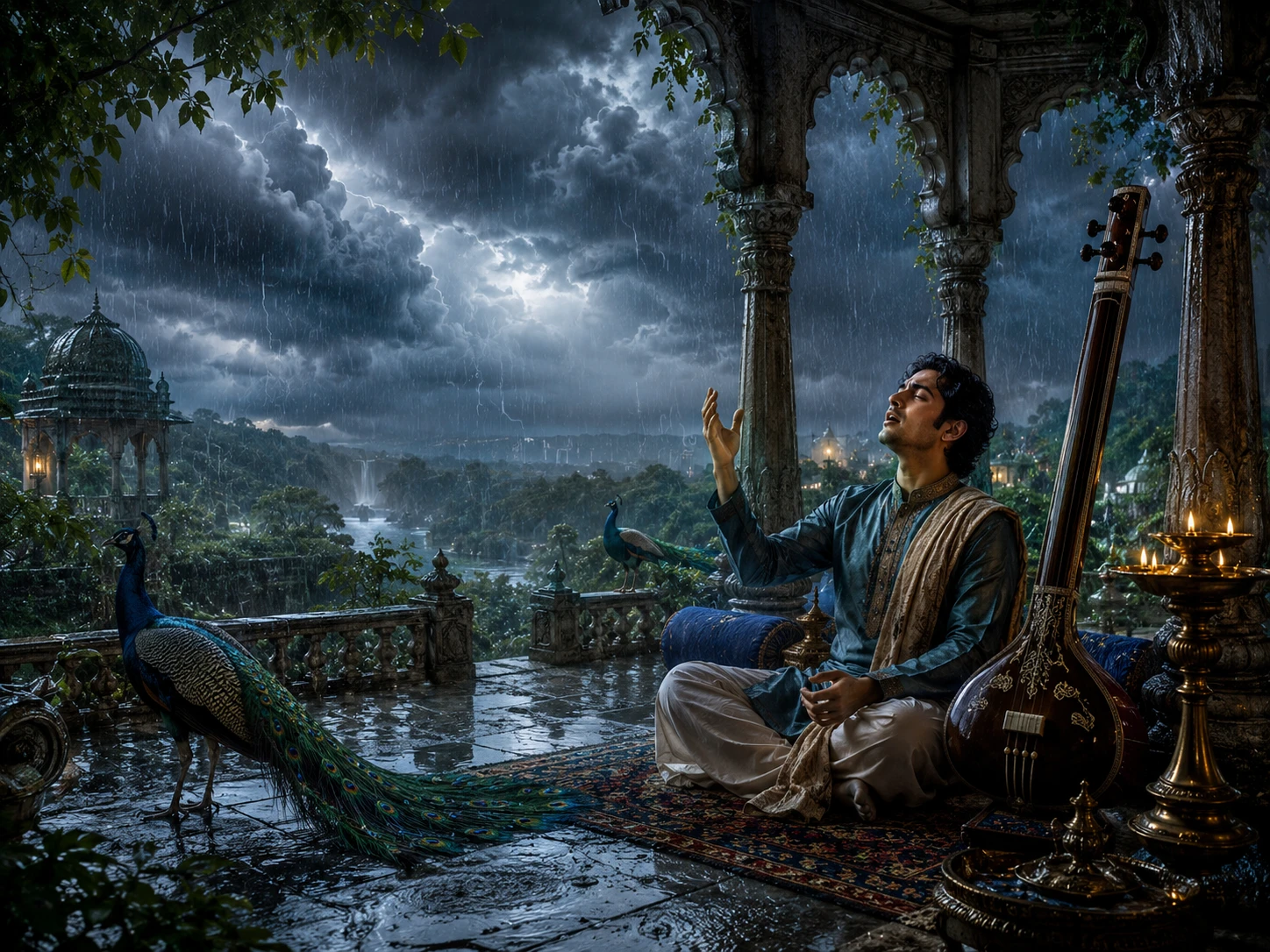
It is the third week of July in Mumbai. The Western Disturbance has finally cleared and the monsoon has settled in for its serious arrival. The clouds hang grey and low over the Arabian Sea. The bougainvillea in apartment balconies is dripping. The traffic on the Western Express Highway has slowed to its monsoon crawl. In a recording studio in Bandra, a vocalist puts on his Saregama Carvaan and chooses Pt. Bhimsen Joshi's 1979 Mumbai concert recording of Miyan ki Malhar. The first phrase emerges -- Sa, Re, komal Ga, shuddha Ma, Pa -- and within six seconds of listening, the studio's atmosphere has changed. The recording does not announce the rain. The rain announces the recording. The two are not separable. They have not been separable for at least four hundred years.
Malhar is the seasonal raag of the Indian monsoon. Where Bhairav belongs to dawn and Yaman belongs to dusk, Malhar belongs to Varsha Ritu, the monsoon season that runs from late June through mid-September across most of India. The raag is not bound to a Prahar. It is bound to a season. A Malhar performance can happen at 11 am, at 7 pm, at midnight -- as long as the rain is falling somewhere, the raag is correct. A Malhar performance in February, by the same logic, would feel structurally wrong. The samay rule for daily raagas is replaced here by the ritu rule for seasonal ones. A small number of raagas in the Hindustani repertoire operate this way, and Malhar is by far the most central among them.
This article is the eighth in the Eternal Gyan music cluster, and the fifth of seven raag profiles. The previous profiles -- Bhairav, Todi, Bhimpalasi, Yaman -- all worked within the Prahar system, anchored to specific hours of the day. Malhar steps outside that system. It is the Hindustani tradition's gift to the monsoon, the musical form that carries an entire civilization's relationship with the rain. The article walks through what the raag is, where it came from, the structural family that has grown around it, the canonical recordings that define how it is heard today, and the famous Tansen rain legend, handled with the honest framing it deserves rather than the breathless repetition it usually receives.
तपाम्यहमहं वर्षं निगृह्णाम्युत्सृजामि च। अमृतं चैव मृत्युश्च सदसच्चाहमर्जुन॥
tapamy aham aham varsham nigrihnamy utsrijami cha amritam chaiva mrityush cha sad asach chaham arjuna
I give heat as the sun, I withhold and send forth the rain. I am immortality and also death, the real and the unreal, O Arjuna.
— Bhagavad Gita 9.19
Krishna's claim in this verse is unusual within the Gita -- among the dozens of self-identifications he offers across the eighteen chapters, this is one of the few that anchors itself in a specific natural phenomenon. The monsoon. The sending forth and the withholding of rain. The phrase varsham nigrihnamy utsrijami sits at the centre of the verse. Krishna controls the rain. The Hindu civilization that read this text and wrote its raagas was a civilization built on agricultural rhythms that depended absolutely on the monsoon's punctual arrival. A delayed monsoon meant famine. A failed monsoon meant collective catastrophe. The monsoon was, and remains, the single largest annual variable in Indian life. To say that Krishna controls it is to say that the divine is most intimately involved in the most consequential annual event a farmer faces.
From this conviction the entire monsoon literature of Sanskrit and the regional languages took its shape. Kalidasa's Meghaduta, composed in the 4th or 5th century CE, opens with an exiled yaksha sending a message to his distant beloved through a passing cloud. The poem is the canonical Sanskrit treatment of viraha during the monsoon -- the season when absent lovers most acutely miss each other, when the rain that should be a celebration becomes a reminder of what is missing. The Bhagavata Purana describes Krishna lifting Mount Govardhana to shelter the gopis from Indra's destructive rain. The Ramayana opens its Kishkindha Kanda with Rama's lament during the monsoon as he separates from Lakshmana's company and waits to be reunited with Sita. The Tamil Tirukkural has its monsoon couplets. The Bengali Vaishnava poets wrote thousands of pads describing Radha-Krishna meetings during the rains. There is no major North Indian or South Indian literary tradition that does not have monsoon at the centre of its emotional vocabulary.
Malhar carries the musical version of this entire literary tradition. The raag's core mood is the simultaneous presence of joy and longing -- the joy of rain finally arriving after the brutal heat of May and June, mixed with the longing for a beloved who is far away while the rain is falling here. The Hindi film convention of the monsoon song -- from Pyaasa's Aaj Sajan Mohe Ang to Lagaan's Ghanan Ghanan to Lunchbox's quieter rain scenes -- all derive their emotional architecture from this Malhar register. The convention is so deeply embedded that audiences feel monsoon-yearning in a film without knowing they are responding to a centuries-old raag tradition. The civilization built the music. The music built the convention. The convention is what most modern Indian listeners now actually inhabit.
The Malhar Family -- Major Variants of the Monsoon Raag
| Raag / राग | Distinguishing Feature | Tradition / Mood | Standard Recording |
|---|---|---|---|
| Miyan ki Malhar / मियाँ की मल्हार | Both Ni forms; characteristic Ma-Re-Pa-Ma phrase | Tansen tradition, regal monsoon weight | Pt. Bhimsen Joshi -- 1979 Mumbai concert, AIR archives |
| Megh / मेघ Megh Malhar / मेघ मल्हार | Skips Ga and Dha; pentatonic-like with komal Ni | Ancient form, possibly oldest Malhar variant | Pt. Kumar Gandharva -- Gwalior gharana readings |
| Gaud Malhar / गौड़ मल्हार | Mixes Bilawal touches with Malhar core | Brighter, less weighty, late monsoon mood | Smt. Kishori Amonkar -- Jaipur-Atrauli gharana |
| Ramdasi Malhar / रामदासी मल्हार | Attributed to saint-poet Ramdas Swami; bhakti-leaning | Devotional, often paired with Mirabai pads | Pt. Jasraj -- Mewati gharana renderings |
| Sur Malhar / सूर मल्हार | Attributed to Surdas; gentler, lyric-leaning | Krishna-bhakti, Vrindavan pastoral mood | Begum Parveen Sultana -- Patiala gharana |
| Mira ki Malhar / मीरा की मल्हार | Attributed to Mirabai tradition; folk-Rajasthani inflections | Late monsoon, feminine longing register | Various Mewati gharana practitioners |
| Nat Malhar / नट मल्हार | Mixes Nat with Malhar; martial-monsoon hybrid | Heroic monsoon, less common in modern concerts | Pt. Hariprasad Chaurasia -- flute renditions |
The attributions to Tansen, Surdas, Ramdas Swami, and Mirabai are tradition rather than documented history. Each named composer almost certainly performed in or composed for the named variant, but the surviving forms of these raagas are the result of centuries of transmission and modification across gharanas. The Malhar family is unusually rich because the monsoon held such a central place in pre-modern Indian life that musicians were continuously inventing new variants for new emotional shades.
Miyan ki Malhar, the canonical Malhar form, uses seven swaras with both forms of Ni -- the shuddha Ni used in ascent and certain phrases, the komal Ni used in descent and the characteristic pakad. The other swaras are Sa, Re, komal Ga, shuddha Ma, Pa, Dha. The use of both Ni forms is the structural signature that makes Miyan ki Malhar distinct from other Kafi Thaat raagas like Bhimpalasi or Kafi itself. This dual-Ni treatment produces a peculiar effect that the tradition reads as the rumble of distant thunder -- the listener's ear oscillates between the two Ni positions and never quite settles, in the same way the monsoon sky does not quite settle into a single rainfall.
The aroh of Miyan ki Malhar is asymmetric. A typical ascent runs Sa, Re, komal Ga, Ma, Re, Pa, with Re returning between Ma and Pa rather than appearing only at the start. The Ma-Re-Pa figure is the signature movement. A trained listener who hears Ma-Re-Pa within the first ten seconds of an alaap knows the raag is Malhar. The avaroh runs upper Sa, shuddha Ni, Dha, Pa, Ma, Pa, komal Ga, Ma, Re, Sa -- with the Pa returning briefly between Ma and komal Ga in a kind of doubling-back that mirrors the way rain returns in showers rather than falling continuously.
The vadi-samvadi pair in Miyan ki Malhar is Ma as vadi and Sa as samvadi. The Ma is the weight-bearing note. A Malhar performance that does not return to Ma repeatedly does not feel like Malhar regardless of the other swaras. The Ma in this raag is approached specifically through the Re-Pa-Ma figure, where the Pa is touched on the way up and the Ma is the resting place on the way back. This is what produces the characteristic feeling of monsoon weight without monsoon despair. The raag carries weight, but the weight is domestic, civilizational, expected. The monsoon arrives every year. The Malhar Ma comes back every phrase. The two patterns are not separate.
Megh Malhar -- often shortened to just Megh -- is the structural opposite of Miyan ki Malhar in some ways. Megh skips Ga and Dha entirely, leaving a five-note skeletal scale that uses only Sa, Re, Ma, Pa, komal Ni. The result is a leaner, more austere form. Some musicologists argue that Megh is the older Malhar variant, predating the Miyan ki Malhar that Tansen tradition added later, and that the modern five-note Megh structure is closer to whatever the original monsoon raag of medieval India sounded like. Other variants like Gaud Malhar add Bilawal-touch phrases that brighten the mood, suitable for the late monsoon hours when the rain has already arrived and the celebration replaces the longing. The variants are not interchangeable. Each carries a slightly different shade of the monsoon emotional spectrum, and serious vocalists choose between them based on the mood they want to convey rather than randomly.
कश्चित्कान्ताविरहगुरुणा स्वाधिकारात्प्रमत्तः शापेनास्तंगमितमहिमा वर्षभोग्येण भर्तुः। यक्षश्चक्रे जनकतनयास्नानपुण्योदकेषु स्निग्धच्छायातरुषु वसतिं रामगिर्याश्रमेषु॥
kashchit kanta-viraha-guruna svadhikarat pramattah shapena astangamita-mahima varsha-bhogyena bhartuh yakshash chakre janaka-tanaya-snana-punyodakeshu snigdha-chchhaya-tarushu vasatim ramagiri-ashrameshu
A certain Yaksha, negligent of his duties, his power suspended by his master's curse to be borne for a year and made heavy by separation from his beloved, took up residence in the hermitages of Ramagiri, where the waters were sanctified by Janaka's daughter's bathing and the trees gave dense shade.
— Meghaduta, verse 1 (Kalidasa, c. 4th-5th century CE)
No discussion of Malhar can avoid the Tansen rain legend, but most discussions of the Tansen rain legend get it badly wrong. The story, as it is usually told, runs like this. Mian Tansen, the great court musician of Akbar (reigned 1556-1605), was once challenged by rivals to perform Raag Deepak, the raag of fire, which is so powerful that singing it literally heats the singer's body until it bursts into flames. Tansen sang Deepak. His body began to burn. To save him, his sister and his daughter, both trained singers, sang Megh Malhar -- the rain raag -- which brought down a downpour that doused the fire and saved Tansen's life. The story is recited in nearly every Hindustani classical introduction, in tourist-targeted books on Indian music, in films, in Wikipedia. It is also almost certainly not historical fact.
What is the historical position. Tansen (c. 1500-1589) was a real court musician at Akbar's court. He was almost certainly the most accomplished Hindustani musician of his era, and he is documented in multiple Mughal court records including the Ain-i-Akbari (1590) by Abu'l Fazl. His descendants and disciples founded the Senia gharana, which remains one of the central lineages of Hindustani classical music. His specific compositions cannot be reliably dated, but a substantial number of Malhar compositions from the Senia tradition carry his name as composer, suggesting that he had a deep engagement with the Malhar family. The general claim that Tansen contributed centrally to the development of Miyan ki Malhar is plausible and consistent with the surviving evidence.
What is not historical fact, by any defensible reading, is the specific Deepak-Megh story. The story does not appear in the Ain-i-Akbari or any Mughal-era documentary source. It first appears in tradition collected several centuries after Tansen's death. The framework of the story -- raagas as forces capable of producing literal physical effects, Deepak as fire-producing and Megh as rain-producing -- is the kind of legend that grows around great musicians in oral traditions across cultures. Treating it as historical fact requires accepting that singing notes can produce rain, which is a metaphysical claim that would need extraordinary evidence and has none. The honest reading is that the legend captures something real -- the cultural conviction that Malhar and the monsoon are not separable, and that great musicians can produce experiences in their listeners that feel like the elements responding -- without literally claiming that Tansen's performances controlled the weather.
The legend matters culturally even when it is not historically defensible. It captures the depth of the Indian conviction that music shapes reality, which the Sama Veda tradition holds as a foundational premise (sound is creation), and it captures the specific affection the Indian musical tradition has for Tansen as the figure who carried the most charged version of that conviction. The story is part of the music's cultural fabric. It just is not literally true. Both can be acknowledged at once.
Setting aside the Tansen legend, the documented Malhar lineage in the Hindustani tradition is rich. The Senia gharana, founded by Tansen's descendants, treated Miyan ki Malhar as the lineage's signature raag and passed it across centuries. The Agra gharana developed its own distinctive Malhar reading. The Gwalior gharana's Megh recordings, particularly Pt. Kumar Gandharva's, are widely considered canonical for the older five-note variant. Each gharana brought its own voice production style, its own pace, its own emphasis -- but the underlying conviction that Malhar belonged to the monsoon and that the monsoon required Malhar held across all of them.
Pt. Bhimsen Joshi (1922-2011) recorded Miyan ki Malhar repeatedly across his sixty-year concert career. The 1979 Mumbai monsoon concert, the 1985 Pune Sawai Gandharva session, the 1996 Kolkata Dover Lane festival recording -- each demonstrates the same singer approaching the same raag in different decades and producing recognizably the same Malhar while subtly evolving. The 1979 Mumbai recording is widely considered the canonical reference for Bhimsen Joshi's Malhar, and it has been re-released by Saregama, Underscore Records, and Music Today across multiple decades.
Pt. Hariprasad Chaurasia's flute Malhar recordings carry a particular quality that vocal renditions cannot quite produce. The bansuri, structurally close to Krishna's own instrument and physically requiring controlled breath that mirrors the monsoon's rhythm, is unusually well-suited to Malhar. His joint album with Pt. Shivkumar Sharma on Megh from the 1990s, and his solo Miyan ki Malhar concerts from the 2000s, are essential instrumental references. Ustad Vilayat Khan's sitar Malhar recordings from the 1970s set the standard for stringed instrumental Malhar, particularly his 1973 long-form Miyan ki Malhar that runs over an hour.
Among female vocalists, Smt. Kishori Amonkar's Gaud Malhar from the 1980s and Begum Parveen Sultana's Sur Malhar from the 1990s are the canonical references. Both demonstrate how the Malhar family accommodates female vocal range without losing the raag's monsoon character. M.S. Subbulakshmi, primarily a Carnatic singer, recorded Mira bhajans set in Malhar variants in her later career, particularly during the 1970s, demonstrating how the raag travels across the Hindustani-Carnatic boundary when paired with bhakti material.
The contemporary scene continues this lineage. Pt. Rashid Khan, Smt. Veena Sahasrabuddhe (before her death in 2016), Ustad Sajjad Ali, and Pt. Sanjeev Abhyankar have all recorded major Malhar performances in the 2000s and 2010s. Younger vocalists like Kaushiki Chakraborty, Aman Bhatt, and Devaki Pandit are continuing the tradition into the 2020s. The pattern of the Malhar performance -- always during monsoon, always anchored to the canonical compositions, always allowing for the gharana-specific interpretation -- has held for centuries and shows no signs of weakening.
When the Indian Meteorological Department announced the official onset of the southwest monsoon over Kerala on 1 June 2024, All India Radio's Akashvani classical channels switched their afternoon and evening programming to Malhar-family raagas within the same twenty-four hours. This is not a written rule. It is institutional convention that has held since AIR began classical broadcasting in 1936. Every monsoon onset triggers the switch. Every withdrawal of the monsoon (typically mid-September) triggers the return to regular Prahar programming. Listeners who tune in to Akashvani between June and September and find the standard time-of-day raag they expected replaced with a Malhar variant are experiencing a 90-year-old broadcasting decision that has never been formally codified in any AIR document but operates as binding tradition.
Hindi film music has used Malhar more than perhaps any other classical raag for the simple reason that monsoon songs are a fixed feature of Indian commercial cinema. Almost every major composer of the 20th century has at least one canonical Malhar-based monsoon song. Naushad's Aaj Sajan Mohe Ang Lagao from Pyaasa (1957) carries Malhar phrasing in its underlying melody. S.D. Burman's score for Guide (1965) used Malhar inflections in the Aaj Phir Jeene Ki sequence set during the rains. Madan Mohan composed the iconic Lata Mangeshkar piece Naina Barse Rim Jhim Rim Jhim from Woh Kaun Thi (1964) in a Malhar-leaning framework. Salil Chowdhury's monsoon songs across multiple Hindi and Bengali films draw consistently from the Malhar-Megh family.
In recent decades, A.R. Rahman set Ghanan Ghanan from Lagaan (2001) in a clear Malhar register, and the song became the centrepiece of one of the most iconic monsoon scenes in Indian cinema -- a village waiting for rain after years of drought, the music structurally calling the rain in exactly the way the Tansen legend describes. The film's Oscar-nominated reception introduced Malhar's emotional vocabulary to a global audience. Vishal Bhardwaj used Malhar inflections in Maqbool (2003) and Omkara (2006) for rain-set scenes. Pritam's compositions for Rockstar (2011), particularly the Sadda Haq sequence, draw on Malhar harmonic motion. Amit Trivedi's Dev D (2009) and Queen (2014) both reach for Malhar phrasings in their introspective monsoon sequences.
On the listening side, Spotify's Indian classical analytics show Malhar-tagged content remaining at peak levels throughout June, July, and August every year, with consumption dropping sharply by mid-September. The pattern is so reliable that Spotify's algorithm-curated Hindustani Classical Monsoon playlist is recreated every year by monsoon onset and dissolved by withdrawal. The yoga and meditation app market follows the same convention -- monsoon morning routines lean on Malhar variants where the rest of the year would use Bhairav or Bhairav-family raagas, and monsoon evening routines use Malhar-family pieces in place of Yaman.
Indian wedding planners working in monsoon-season weddings (a smaller but growing segment after Mumbai's expansion of indoor wedding venues) frequently commission live Malhar shehnai performances or instrumental Malhar arrangements. The bridal entrance set to Sur Malhar -- the gentle, lyric-leaning Surdas variant -- is a specific convention of the higher-end Mumbai-Pune wedding circuit that has emerged over the past decade. The pattern is downstream of the broader cultural conviction that monsoon and Malhar are not separable, and the conviction continues to translate into modern Indian social life in ways that most participants do not consciously trace back to the tradition.
For the practical listener in 2026 looking to actually experience Malhar rather than read about it, the simplest pathway is one of the canonical Bhimsen Joshi recordings played during monsoon. The 1979 Mumbai concert is widely available on Spotify, Apple Music, and YouTube Music. Played at any hour during a July or August evening when rain is falling outside, with no other input, the recording produces an alignment between the music and the weather that no amount of prose can substitute for. The system was engineered to produce that alignment. The system still works.
Listen to Raag Malhar in the Monsoon
Malhar belongs to the rains. On the next monsoon evening, listen to Miyan ki Malhar or Megh, or a film song set in Malhar such as 'Bole Re Papihara', and notice how the two nishads, komal and shuddha, meet. Eternal Raga does not yet have raag-wise collections; its Listen page has a devotional album and a daily Gita podcast.
Tags
Eternal Raga · शाश्वत राग
Institutional voice — scholarly articles on Sanatan Dharma
Deepen Your Understanding
अपनी समझ और गहरी करें
vedic sciences
Raag Bhairav -- The Dawn Raag of Shiva
Bhairav is the first raag of the Hindustani morning -- austere, slow, weighted, named after Shiva's most fearsome form. Read its swara structure, its tantric backdrop, its great recordings, and why every classical concert that runs through the night ends with Bhairav at sunrise.
vedic sciences
Raag Yaman -- The King of Evening Raagas
Yaman is the most performed raag in Hindustani classical music -- the dusk sandhi prakash piece every student learns first, every concert opens with, every gharana claims its own reading of. Read its swara structure, its Persian-Hindustani synthesis, its standard bandishes, and the long lineage of canonical recordings.
vedic sciences
Raag Bhimpalasi -- The Afternoon Raag of Yearning
Bhimpalasi is the raag of late afternoon -- five swaras going up, seven coming down, a quiet ache that fits the hour between lunch and dusk. Read its swara structure, its place in the Krishna gopi-viraha tradition, and why Pt. Kumar Gandharva's readings reshaped the raag for the modern listener.
vedic sciences
Samay Chakra -- Why Each Raag Has Its Hour
Hindustani classical assigns each raag to a specific Prahar of the day or season. Bhairav at dawn, Yaman at dusk, Malhar in monsoon. Decode the architecture of samay -- the time-of-day theory that turns 24 hours into a musical map.
vedic sciences
Dasha Thaat -- Bhatkhande's Modern Map of Hindustani Raagas
How does a tradition with hundreds of raagas teach itself? Pt. Vishnu Narayan Bhatkhande's answer was the ten-Thaat system, published between 1909 and 1935. Trace the system, its limits, and why every Hindustani conservatory still teaches by it.
When the Indian Meteorological Department announced the official onset of the southwest monsoon over Kerala on 1 June 2024, All India Radio's Akashvani classical channels switched their afternoon and evening programming …
More in Vedic Sciences
Agnichayana -- The Falcon-Shaped Fire Altar That Survived 3,000 Years
12 min read
Ancient Indian Metallurgy -- The Iron Pillar That Refuses to Rust
13 min readAryabhata -- The Astronomer Who Said the Earth Turns
3 min readThe same translation error that turned '33 Koti' into '33 crore' in Hinduism also happened in Buddhism. The Chinese translation of Buddhist texts rendered 'Sapta Koti Buddha' (7 Supreme Buddhas) as '7 Crore Buddhas.' The…
Deities AvatarsCommunity Reflections
🕉️
Be the first to share your reflection.