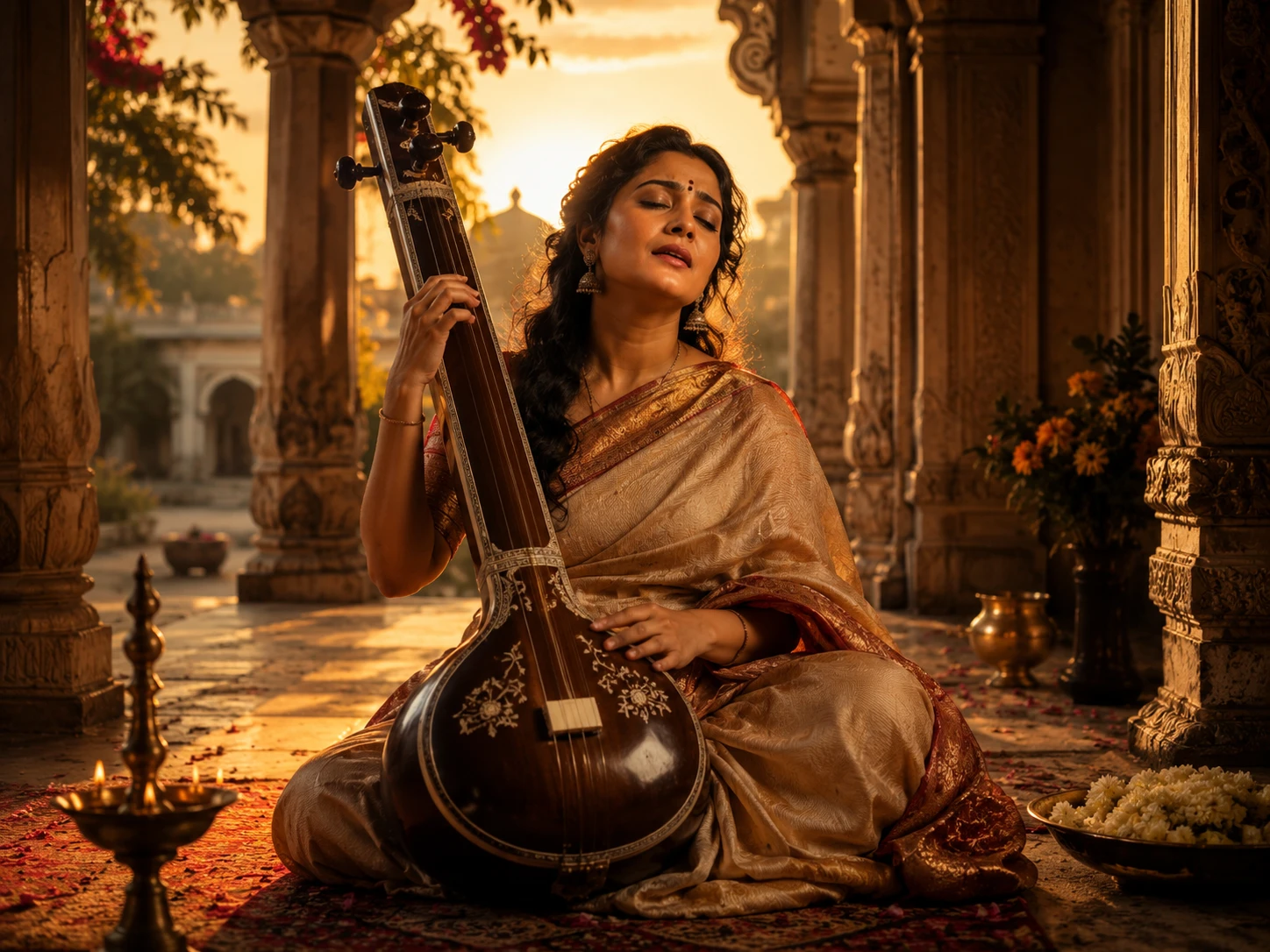
Raag Bhimpalasi -- The Afternoon Raag of Yearning
राग भीमपलासी -- तड़प का अपराह्न राग
It is half past three on a weekday afternoon in Mumbai. The lunch dabbas have been collected. The first cycle of office meetings is over. The light coming through the office window has softened from the harsh white of noon to a gentler gold, and the city outside has settled into the strange middle hour that belongs neither to morning energy nor to evening release. An older colleague, perhaps a senior who still believes in the old afternoon habit, slips a single earbud in and starts a recording. The first phrase that emerges is unmistakable. A slow ascent on Sa, a step up to komal Ga, a meend up to shuddha Ma, then a careful Pa, then a leap to komal Ni, and the upper Sa lands like a question rather than an answer. The raag is Bhimpalasi. There is no other raag like it. There is no other hour in which it makes the same sense.
Bhimpalasi sits in the third Prahar of the day, roughly 3 pm to 6 pm. It belongs to the Kafi Thaat, that warm pastoral parent scale that gathers the afternoon raagas and the early evening pieces alike. The mood it carries is harder to name than morning austerity or evening brilliance. The closest English word is yearning, but the Sanskrit register is more specific. The tradition calls it viraha-bhava, the mood of separation from a beloved one cannot reach. The Surdas pads, the Mira bhajans, the gopi songs of the Bhagavata Purana tenth book -- the entire devotional literature of Krishna-yearning sits inside this raag's emotional territory. A Bhimpalasi alaap is the auditory equivalent of standing in Vrindavan in mid-afternoon, when the cows have come back from grazing, when Krishna has gone somewhere only he knows, and the gopi who waits for him watches the empty path and feels the hour stretch.
This article is the sixth in the Eternal Gyan music cluster, and the third of seven raag profiles. Bhairav at dawn was about gambhir weight. Todi at late morning was about karuna-bhakti and intense surrender. Bhimpalasi is softer than either, more domestic, more human. It is the raag of the working afternoon and the bhakti undertow that runs beneath the working afternoon for anyone who has been raised in the Hindu devotional tradition. Bhimpalasi does not shout. Bhimpalasi waits.
यो मां पश्यति सर्वत्र सर्वं च मयि पश्यति। तस्याहं न प्रणश्यामि स च मे न प्रणश्यति॥
yo mam pashyati sarvatra sarvam cha mayi pashyati tasyaham na pranashyami sa cha me na pranashyati
One who sees me everywhere and sees everything in me, for that one I am never lost, and that one is never lost to me.
— Bhagavad Gita 6.30
Krishna's promise in this verse is the textual root of the bhakti seeing -- the trained vision that finds the divine in every face on the street, every leaf on the peepal tree, every cup of tea passed across a desk at three in the afternoon. Bhimpalasi sits inside exactly this register. The raag does not address Krishna directly. It addresses the world in which a devotee knows Krishna is present but cannot quite see him. The afternoon is the hour for that knowledge. The morning is too busy with rituals. The dusk is too caught up in the day's closing. The afternoon, especially the third Prahar between roughly 3 and 6 pm, is when the Hindu household has settled and the seeking can begin.
The bhakti literature that runs alongside this raag is enormous. Surdas (c. 1478-1583), the blind poet of the Pushtimarg tradition, composed his Sur Sagar entirely in the gopi-viraha register that Bhimpalasi later came to carry. His pads describing the gopis' separation from Krishna after Krishna leaves Vrindavan for Mathura -- the Bhramara-Geet section in particular -- are the textual canon for this mood. Mirabai (c. 1498-1547), the Rajput princess turned Krishna devotee, wrote in the same register but from a different angle, casting herself as the eternal beloved waiting for Krishna in every breath. Both poets predate the modern crystallization of Bhimpalasi as a raag, but their compositions have been set to Bhimpalasi by every generation of Hindustani musicians since.
The Bhagavata Purana, particularly its tenth book, gives this devotional register its Sanskrit foundation. The Rasa Lila chapters describe Krishna dancing with the gopis on the banks of the Yamuna, multiplying himself so that each gopi has a Krishna of her own. Then Krishna disappears. The gopis search for him through the forest. They ask the trees, the rivers, the cows -- have you seen our Krishna. The verses move through every register of loss before Krishna returns. The gopi-bhava that emerges from this tradition is not just longing for an absent lover. It is the specific kind of longing that knows the beloved is everywhere and still cannot be reached. That double consciousness -- knowing and missing -- is what Bhimpalasi makes audible. The vadi note Ma, in the middle of the octave, is the place where this double consciousness rests. The singer leans on Ma the way the gopi leans on the certainty that Krishna will come back, with the equal certainty that the wait is real and the hour is long.
The Kafi Family -- Major Raags Sharing Bhimpalasi's Parent Scale
| Raag / राग | Distinguishing Feature | Time / Mood | Standard Recording |
|---|---|---|---|
| Bhimpalasi / भीमपलासी | Skips Re and Dha in aroh -- 5 up, 7 down | 3 pm to 6 pm, gentle yearning | Pt. Kumar Gandharva -- mid-1950s recordings |
| Kafi / काफी | All seven swaras with komal Ga, komal Ni | Any time, but tilts late evening; pastoral mood | Ustad Vilayat Khan -- sitar |
| Bageshri / बागेश्री | Skips Pa in aroh, drops Re; closer to Kafi base | Late night (after 12), deeper longing | Pt. Bhimsen Joshi -- live concert recordings |
| Pilu / पीलू | Mixed komal-shuddha treatment, folk-leaning | Late afternoon, light thumri territory | Begum Akhtar -- ghazal-thumri renditions |
| Dhanashri / धनाश्री | Vakra (winding) treatment of komal Ga | Late afternoon, devotional weight | Pt. Jasraj -- Mewati gharana recordings |
| Patdeep / पटदीप | Same swaras as Bhimpalasi but uses shuddha Ni | Late afternoon, brighter than Bhimpalasi | Pt. Hariprasad Chaurasia -- flute |
| Madhuvanti / मधुवन्ती | Komal Ga + tivra Ma; borderline Todi-Kafi | Late afternoon, romantic-yearning | Pt. Nikhil Banerjee -- sitar |
All these raagas live in the late-afternoon Prahar but produce distinctly different moods. The differentiation comes not from the swaras alone but from the aroh-avaroh shape, the vadi-samvadi pair, and the characteristic phrases that gharanas pass down through generations.
Bhimpalasi uses seven swaras but distributes them asymmetrically between ascent and descent. The aroh -- the rising line -- is Sa, komal Ga, Ma, Pa, komal Ni, upper Sa. Five notes. Re and Dha are deliberately skipped going up. The avaroh -- the descending line -- is upper Sa, komal Ni, Dha, Pa, Ma, komal Ga, Re, Sa. All seven swaras come back on the way down. This asymmetry is the structural signature of Bhimpalasi. A raag that uses different swaras ascending and descending is called audava-sampurna -- five-note ascent, seven-note descent. The shape gives Bhimpalasi a specific feeling. The ascent feels light, almost evasive, like the gopi catching a glimpse of Krishna and watching him slip away. The descent feels complete, almost mournful, like the same gopi walking back home alone with all seven swaras weighing on her.
The vadi note is shuddha Ma, sitting at the centre of the octave. The samvadi is Sa. This vadi-samvadi pair, falling in the lower tetrachord, is what places Bhimpalasi in the second half of the day. By Bhatkhande's rule, a Ma-vadi raag belongs to the post-noon hours. The placement is reinforced by the warm pastoral character of the Kafi Thaat parent scale. Komal Ga and komal Ni are the two altered notes. Both are gentle alterations -- not the deep andolan-laden komal Re of Bhairav, not the jagged komal Re of Todi. The komal Ga in Bhimpalasi is closer to a sigh than to a wound. The komal Ni is the same kind of soft lowering -- a breath letting itself out at the end of a long thought.
The pakad of Bhimpalasi is widely accepted as -- Ni Sa Ma, Ma Pa Ga Ma Ga, Ma Pa Ni Sa (upper). The signature movement is the leap from Ma to upper Sa, often via komal Ni, skipping the intermediate notes. This leap is what allows the gopi-bhava to emerge -- the voice or instrument reaching upward toward something it cannot quite touch, then settling back. A Bhimpalasi performance that does not execute this leap cleanly does not produce the raag's characteristic mood. The leap is also what differentiates Bhimpalasi from Patdeep, the closely related raag from the same family. Patdeep uses shuddha Ni instead of komal Ni and feels brighter, more daytime, less burdened. The same five swaras going up, with one Ni-difference, produce two raagas that experienced listeners can distinguish within thirty seconds.
Bageshri, another close cousin, complicates the picture differently. Bageshri skips Pa in its aroh, drops Re entirely, and is performed in the late night Prahar (after midnight) rather than the afternoon. The same komal Ga and komal Ni that produce Bhimpalasi's gentle afternoon yearning produce Bageshri's deeper night-longing when paired with the Pa-skip. The Kafi Thaat is roomy enough to hold both, and the trained listener moves between them by hour rather than by note count alone.
सा त्वस्मिन् परमप्रेमरूपा।
sa tv asmin parama-prema-rupa
That bhakti is of the form of the highest love, directed toward Him.
— Narada Bhakti Sutra, sutra 2
Sage Narada's definition of bhakti as parama-prema, supreme love, is the textual node that explains why Bhimpalasi has carried so many bhakti compositions across centuries. The raag and the definition share a single insight -- love at its highest pitch is not a loud or dramatic thing. It is steady, quiet, oriented toward a single beloved, present even when the beloved is absent. The Hindustani tradition has set hundreds of bhakti compositions in Bhimpalasi to carry exactly that orientation.
Three bandishes deserve specific mention. The first and most famous is Ja Ja Re Apne Mandirwa, a slow vilambit composition where the singer addresses an unwelcome visitor and tells him to return to his own house, his own temple. On the surface the lyric is a rebuke. Read in the bhakti register, the unwelcome visitor is the wandering mind, and the instruction to return to one's own mandir is the instruction to return to the inner space where Krishna actually waits. The bandish has been recorded by every major Hindustani vocalist of the twentieth century. Pt. Kumar Gandharva's mid-1950s recording, in particular, is the canonical reference. The second is Saghan Ban Chatkani Bijuriya -- thunder rolls through the dense forest -- a viraha bandish where the gopi describes the monsoon storm outside and connects it to the storm of separation inside her chest. The third is Kahe Sundari Karat Solahar, a vilambit composition addressing the gopi as she completes her sixteen ornaments before going to meet Krishna who may or may not arrive.
Pt. Kumar Gandharva (1924-1992) is widely considered the canonical Bhimpalasi performer of the twentieth century. His tubercular illness in his late twenties forced him to stop singing for nearly seven years. When he returned to performance in the early 1950s, his voice and his musical thinking had both transformed. The Bhimpalasi he sang from then onward carried a quality that no one else had quite produced -- a Bhimpalasi where every phrase felt earned, where the raag's yearning sounded like the yearning of a singer who had nearly lost the ability to sing it. His Gwalior-Dewas gharana lineage, his willingness to incorporate Malwa folk inflections, and his slow re-emergence into performance all combined to produce a Bhimpalasi that became a separate tradition in itself. Recordings from his 1953 to 1965 period are the starting point for any serious listener.
Pt. Bhimsen Joshi recorded Bhimpalasi from a different angle -- the Kirana gharana approach with longer alaaps and stronger emphasis on the slow vilambit before any rhythmic composition. Begum Parveen Sultana's Bhimpalasi recordings from the 1980s demonstrate the female vocal range possibilities of the raag, with her characteristic leaps into the upper octave bringing out the gopi-bhava with unusual clarity. Ustad Vilayat Khan's sitar Bhimpalasi recordings, particularly the long-form performances from the 1970s, set a benchmark for how the raag works on a stringed instrument. Pt. Hariprasad Chaurasia's flute Bhimpalasi -- the bansuri being structurally close to Krishna's own flute -- carries an additional layer of bhakti context that vocal renditions cannot quite produce.
Bhimpalasi has translated into modern Indian life more comfortably than most classical raagas. The reason is structural. The afternoon is the hour when most Indians have a few uncluttered minutes -- the lull between the post-lunch slowdown and the evening's demands. Office workers in their 4 pm tea break, college students between afternoon lectures, homemakers after the children have left for tuitions and before they return for dinner, retirees in their reading hour. Bhimpalasi fits all of these because the raag's internal pace matches the body's natural pace at this hour.
There is a second reason. The Krishna gopi-viraha tradition that gave Bhimpalasi its emotional centre is one of the few classical Hindu literary registers that has translated smoothly into modern emotional vocabulary. The mood of waiting for someone you cannot quite reach -- a partner working late in another city, a child studying at IIT Madras while the parents are in Pune, an NRI sister whose calls come on Sunday evenings, a spouse passed on whose presence is still in the room -- all of these find a sympathetic register in Bhimpalasi. The raag does not require the listener to be a Krishna devotee to carry the weight. The raag's structural shape -- the rising leap, the descent that brings back what was skipped, the gentle komal Ga that sighs without weeping -- maps onto any kind of patient absence. The bhakti tradition gave the raag its specific emotional language, but the language has stayed accessible to listeners who do not share the specific tradition.
Hindi film music has used Bhimpalasi extensively, though the use is often softer and harder to pin down than the use of Bhairav or Yaman. S.D. Burman's score for several Dev Anand films of the 1950s and 1960s drew on Bhimpalasi-leaning phrasings for afternoon-set songs. Madan Mohan reached for Bhimpalasi inflections in many of the Lata Mangeshkar ghazals he composed. R.D. Burman, who studied classical music seriously even while developing his more modernist film style, used Bhimpalasi-shaped melodies in scenes that called for a quiet emotional centre rather than a dramatic one. In recent decades, A.R. Rahman has reached for Bhimpalasi-adjacent registers in songs like the softer pieces of Roja, Bombay, and Dil Se. Vishal Bhardwaj's compositions for Maqbool and Omkara use Kafi-Bhimpalasi inflections in the more reflective scenes, particularly the late-afternoon palace sequences.
On the listening side, Spotify's data for Indian users shows Bhimpalasi-tagged content peaking between 3 pm and 5:30 pm on weekdays. The listenership cuts across age groups in a way that other classical raagas do not -- college students playing Bhimpalasi while studying, mid-career professionals during their afternoon work block, retirees in their reading hour. The yoga and meditation app market uses Bhimpalasi heavily for afternoon mindfulness sessions, often without naming the raag. Most users do not need the name. They recognize the mood. The mood is afternoon yearning, the bhakti undertow of an ordinary working day, and the quiet conviction that the divine is somewhere on the other side of the office wall waiting to be noticed.
The name Bhimpalasi has two competing etymologies. The traditional explanation derives it from a combination of Bhima (one of the Pandavas) and Palas (the flame-of-the-forest tree, Butea monosperma), suggesting an old narrative connection that has not survived in any documented text. A second explanation, more linguistic, derives it from Bhima (loud or deep) and palasa (taking, holding) -- a name describing the raag's structural feature of skipping notes in ascent and holding onto them only in descent. Most musicologists today lean toward the second explanation, since the first lacks textual support. Whatever the etymology, the raag's name has been stable since at least the time of Sharangadeva's 13th century Sangeet Ratnakara, where Bhimpalasi appears in a recognizable older form before evolving into the modern shape over the next four centuries.
For a reader in 2026 looking to actually experience Bhimpalasi rather than read about it, the simplest pathway is one of the canonical Kumar Gandharva recordings -- preferably from his 1953 to 1965 period -- played at the right hour. The right hour is between 3 pm and 5:30 pm, ideally on a weekday when the listener has a 30-minute window with no immediate work pressure. The recording does not have to be long. Even fifteen minutes of Kumar Gandharva's Bhimpalasi alaap, listened to in stillness with no other input, demonstrates more about the raag than three thousand words of prose can.
A second pathway works for listeners who find the long-form vilambit too demanding. Spotify, Apple Music, and YouTube Music all carry Bhimpalasi content in shorter formats -- ten-minute drut compositions, eight-minute sitar pieces by Vilayat Khan, six-minute flute alaaps by Hariprasad Chaurasia. The shorter formats compress the raag's identity and skip the slow exposition, but they convey the mood quickly. From there the listener can graduate to longer pieces.
A third pathway, perhaps the most useful for the modern listener, is the bhakti bhajan tradition. Pt. Jasraj's Hari Ke Charan Kamal in Bhimpalasi, M.S. Subbulakshmi's Bhimpalasi-tinged Krishna bhajans, and the various Surdas-pad recordings circulated by Ravi Shankar's Music Circle compilations all offer Bhimpalasi at a lower technical bar. These recordings carry the raag's emotional weight without requiring the listener to follow a forty-five-minute alaap. They are the gateway. From the gateway, the path leads back into the longer classical recordings, and eventually into the family raagas -- Bageshri after midnight, Patdeep in the same afternoon Prahar but with a brighter register, Pilu for the listener who wants the same yearning in a folk-leaning treatment.
For an IIT Hyderabad student studying through the afternoon, a software engineer in Bengaluru working from home, an NRI mother in California who wants to expose her teenage daughter to classical music without overwhelming her, or a retired UPSC officer in Lucknow returning to music after decades away -- Bhimpalasi works the same way it has worked for centuries. Pick the recording. Pick the hour. Listen. The afternoon raag does what afternoon raagas have always done. It accompanies the working day's quietest hour, and it returns the listener to the bhakti undertow that runs beneath ordinary life whether the listener notices it or not.
Listen to Raag Bhimpalasi in the Afternoon
Listen to Bhimpalasi in the afternoon, its traditional hour: the bandish 'Ja Ja Re Apne Mandirwa', or a Surdas or Mirabai pad set in it. Notice the komal ga and komal ni, and how re and dha are left out on the way up. Eternal Raga does not yet have raag-wise collections; its Listen page has a devotional album and a daily Gita podcast.
Tags
Eternal Raga · शाश्वत राग
Institutional voice — scholarly articles on Sanatan Dharma
Deepen Your Understanding
अपनी समझ और गहरी करें
vedic sciences
Raag Bhairav -- The Dawn Raag of Shiva
Bhairav is the first raag of the Hindustani morning -- austere, slow, weighted, named after Shiva's most fearsome form. Read its swara structure, its tantric backdrop, its great recordings, and why every classical concert that runs through the night ends with Bhairav at sunrise.
vedic sciences
Raag Todi -- The Late-Morning Raag of Surrender
Todi is the raag of intense yearning -- four altered notes packed into a single octave, traditionally attributed to Tansen, sung between 9 am and noon. Read its swara structure, its Tansen lineage, the tragic story behind Bilaskhani Todi, and the canonical Amir Khan recordings.
vedic sciences
Samay Chakra -- Why Each Raag Has Its Hour
Hindustani classical assigns each raag to a specific Prahar of the day or season. Bhairav at dawn, Yaman at dusk, Malhar in monsoon. Decode the architecture of samay -- the time-of-day theory that turns 24 hours into a musical map.
vedic sciences
Dasha Thaat -- Bhatkhande's Modern Map of Hindustani Raagas
How does a tradition with hundreds of raagas teach itself? Pt. Vishnu Narayan Bhatkhande's answer was the ten-Thaat system, published between 1909 and 1935. Trace the system, its limits, and why every Hindustani conservatory still teaches by it.
vedic sciences
Nada Brahma -- Sound as Creation in Hindu Sangeet Shastra
Long before raags had names, India held one foundational claim: sound is creation itself. Trace the lineage from the Sama Veda's chants to Bharata's Natya Shastra to Sharangadeva's Sangeet Ratnakara -- the spine of classical music as sadhana.
The name Bhimpalasi has two competing etymologies. The traditional explanation derives it from a combination of Bhima (one of the Pandavas) and Palas (the flame-of-the-forest tree, Butea monosperma), suggesting an old na…
More in Vedic Sciences
Agnichayana -- The Falcon-Shaped Fire Altar That Survived 3,000 Years
12 min read
Ancient Indian Metallurgy -- The Iron Pillar That Refuses to Rust
13 min readAryabhata -- The Astronomer Who Said the Earth Turns
3 min readThe same translation error that turned '33 Koti' into '33 crore' in Hinduism also happened in Buddhism. The Chinese translation of Buddhist texts rendered 'Sapta Koti Buddha' (7 Supreme Buddhas) as '7 Crore Buddhas.' The…
Deities AvatarsCommunity Reflections
🕉️
Be the first to share your reflection.