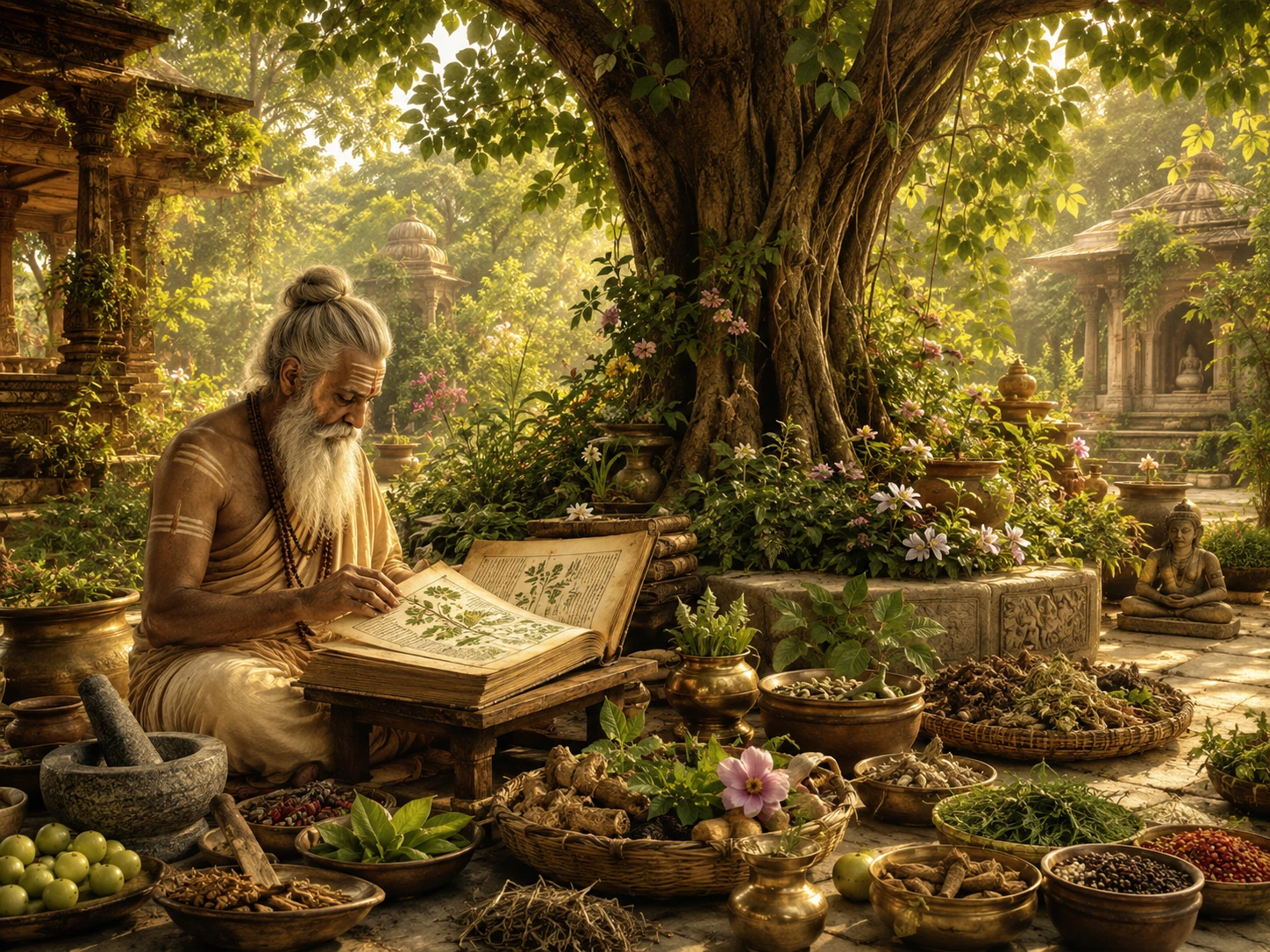
Vrikshayurveda -- The Ancient Indian Science of Trees
वृक्षायुर्वेद -- वनस्पति का प्राचीन भारतीय विज्ञान
In 2006, two small tea growers in Golaghat district of Assam, Arijit Bhuyan and Babul Lahkar, tried something unusual on their family gardens. Their tea bushes had become resistant to most chemical pesticides. Red spider mite and helopeltis kept coming back, season after season, no matter what they sprayed. Soil tests showed pesticide residues had built up to the point where earthworms had disappeared.
They began applying a fermented liquid called kunapa-jala. The recipe, written down in Sanskrit a thousand years ago, called for boiled animal waste mixed with sesame oil cake, soaked black gram, honey, and ghee, fermented underground in a clay pot. They followed it as written. Within a few months, the red spider mite was gone. Within a year, the earthworms had returned. The Assam Agricultural University researchers who tested the soil afterwards found that pesticide residues had begun to break down.
The Sanskrit text was Vrikshayurveda -- literally, the Ayurveda of trees -- composed in Bundelkhand around 1000 CE by a court physician named Surapala under the patronage of King Bhimapala. The manuscript itself was sitting unread in the Bodleian Library at Oxford until 1996, when Dr Y.L. Nene of the Asian Agri-History Foundation tracked it down and Dr Nalini Sadhale translated the 325 verses into English. The Hindi translation followed in 2003.
Most of the science is still being rediscovered. Some of it works. Some of it does not. All of it is older than any European botanical text.
Vrikshayurveda is one of those Sanskrit words that is exact when you slow it down. Vriksha means tree. Ayur-veda is the science of life. Together, the science of the life of trees -- the same framework that produced Charaka and Sushruta for human medicine, applied to plants. The earliest references to a science of plants come from the Rig Veda and the Atharva Veda, which name a worm called kapana that destroys leaves, list rodents and borers as crop enemies, and prescribe certain plants as protective. By the time of Varahamihira's Brihat Samhita in the 6th century CE, an entire chapter (chapter 55) is dedicated to vrikshayurveda -- planting, soil, propagation by cuttings, treatment of trees that fail to flower.
Surapala's text is the most complete one to have survived. Its 325 verses run across 13 chapters: salutation to Ganesha, glorification of trees, raising orchards, agri-horticulture, planting near houses, procuring and treating seeds, preparing pits, soil selection, irrigation, finding groundwater, nourishment and fertilisers, plant diseases, plant medicines, garden layout, examination of land for digging wells, and cultivation of grains. Roughly 170 plant species are described.
What makes the text usable today is that it is not philosophy. It reads like a working manual. Surapala tells you how deep to dig the pit (verse-specific to species), what to put at the bottom (cow bones, cow dung, burnt earth), how to treat the seed before sowing (smear with honey and ghee for bulbous roots; smear with cow dung for stone-like seeds), and what to feed the seedling once it sprouts (fresh acrid fish along with milk of the snuhi plant). It is granular like an Excel sheet. The chemistry behind it is, in many cases, defensible.
दशकूपसमा वापी दशवापीसमो ह्रदः। दशह्रदसमः पुत्रो दशपुत्रसमो द्रुमः॥
daśa-kūpa-samā vāpī daśa-vāpī-samo hradaḥ | daśa-hrada-samaḥ putro daśa-putra-samo drumaḥ ||
Ten wells equal one stepwell. Ten stepwells equal one lake. Ten lakes equal one son. Ten sons equal one tree.
— Surapala's Vrikshayurveda 1.6 (also Matsya Purana 154.512)
The verse looks like an arithmetic of devotion, but it is doing something stranger. By placing one tree above ten sons, Surapala is making a deliberate moral inversion -- a culture that genuinely valued sons (with the patrilineal weight that carried in 11th-century Bundelkhand) is being told that planting a tree exceeds that. The same arithmetic appears in Matsya Purana chapter 154, in Devi Parvati's voice, where it forms part of an explicit explanation of why dedicating a tree as one's spiritual son is meritorious. The logic is not sentimental. A son lives perhaps eighty years and serves one lineage. A tree lives several centuries and serves every species that crosses its shade. Surapala uses this verse to open his text because the entire science that follows -- soil, water, manure, disease, healing -- is written for an audience that already accepts the premise.
The practical consequence is visible in the medieval landscape. Across most of inhabited India, villages had a fixed roster of grama-vrikshas -- the village's own trees, planted and protected by named families across generations. Banyan, peepal, mahua, neem, tamarind, jamun. Some still stand. The 600-year-old peepal at Sarnath, the great banyan at Pillalamarri (Telangana, around 700 years old), the Mahua tree groves of Chhattisgarh -- these are not accidents. They are the surviving fragments of a system that took dasha-putra-samo-drumah seriously enough to plant for a great-grandchild who was not yet born.
Six Sanskrit Texts on Plant Science -- A Lineage
| Text | ग्रन्थ | Author and date | Focus |
|---|---|---|---|
| Rig Veda mentions | ऋग्वेद | Anonymous; before 1200 BCE | Earliest references -- worms, pests, healing herbs |
| Atharva Veda agriculture hymns | अथर्ववेद | Anonymous; c. 1000 BCE | Bhumi Sukta; pest-protection mantras; herbal medicine |
| Vrikshayurveda by Salihotra | सालिहोत्र वृक्षायुर्वेद | Salihotra; c. 4th century BCE (date contested) | 12 chapters; soil classification (anupa, jangala, sadharana) |
| Brihat Samhita Ch. 55 | बृहत्संहिता अध्याय 55 | Varahamihira; c. 6th century CE | Vrikshayurveda chapter -- planting distance, propagation, treatment |
| Krishi Sukti by Kashyapa | कश्यप कृषि सूक्ति | Kashyapa; c. 8th-9th century CE | Paddy cultivation, eatable and uneatable substances |
| Vrikshayurveda by Surapala | सुरपाल वृक्षायुर्वेद | Surapala; c. 1000 CE (Bhimapala's court) | 325 verses; 170 species; most complete surviving treatise |
The Atharva Veda's Bhumi Sukta (12.1) treats the earth as a living mother whose body the farmer must not wound. This ethical framing -- the earth is not raw material but a body -- runs through every later text in the lineage.
The chapter on plant disease in Surapala (verses 165-217) is where the science gets unexpectedly precise. Diseases are classified by the three doshas of Ayurveda transferred onto plants: vata-roga (drying, wilting, brittleness), pitta-roga (yellowing, scorching, oozing), kapha-roga (rotting, fungal growth, sliminess). The framework is humoural in name and has none of the modern microbial vocabulary, but the symptoms are recognisable to any agricultural extension officer today. Surapala's treatments use specific plant decoctions -- vidanga (false black pepper), yashtimadhu (liquorice), turmeric, garlic, and a few others -- many of which have since been confirmed in modern lab studies as having actual antifungal or antibacterial activity.
The most thoroughly studied of his prescriptions is kunapa-jala, the fermented liquid manure. Verse 101 lists the ingredients in the order of preparation: animal excreta, bone marrow, brain, flesh, and blood, mixed with water and stored underground. Verse 102 expands the source list -- if not boar, then ram, goat, or other horned animals; verse 103 adds husk to the mixture before sealing. Later verses prescribe variations for specific trees: dates, jackfruit, bilva, plantain, citrus, and the pleasure-flowers of the royal garden each get a slightly different recipe. The active mechanism is fermentation. Anaerobic decomposition of organic nitrogen produces ammonium-rich liquid with a microbial population that, when applied to soil, both fertilises and out-competes pathogens. Modern labs have measured nitrogen, phosphorus, and potassium content in kunapa-jala prepared by Surapala's method, and the readings come in close to commercial NPK fertiliser ranges, with the difference that the kunapa-jala also delivers a working microbial inoculum.
Verses 147-151 of Surapala's text describe ashoka, kurabaka, kadamba, and a few other trees that are said to blossom at the loving glance or gentle kick of a young woman. This is poetic convention, lifted from classical Sanskrit kavya tradition. But verses 320-324 list specific seed-treatment soaks (cow milk, sour gruel, fermented herbal liquids) that have measurably increased germination rates in modern controlled trials at the Indian Council of Agricultural Research. The same author, the same chapter -- two registers, separated by what we now call evidence-based practice. The trick is knowing which is which.
Kunapa-jala -- Surapala's Ingredient Stack
| Ingredient | सामग्री | Function | Modern interpretation |
|---|---|---|---|
| Animal flesh, marrow, blood | जंतु माँस, मज्जा, रक्त | Nitrogen and phosphorus source | Organic NPK release on decomposition |
| Bones (boar, fish, ram) | अस्थि (सूअर, मछली, भेड़) | Calcium and phosphorus | Slow-release calcium phosphate |
| Sesame oil cake | तिल खली | Carbon and nitrogen | Microbial substrate; insect deterrent |
| Soaked black gram | भीगा काला चना | Protein and starch | Fermentation accelerator |
| Honey | शहद | Sugar source for microbes | Carbon energy for bacterial growth |
| Ghee (small quantity) | घी (अल्प मात्रा) | Lipid layer; surface seal | Anaerobic seal; protein-rich |
| Husk (paddy) | धान भूसी | Bulking agent | Pore structure; aeration control |
The recipe has no fixed quantities. The vaidya was expected to know how much, based on the season, the quality of source materials, and the intended target tree. This makes the procedure resistant to mass production but well-suited to community-scale practice -- which is exactly what is happening today in Assam, Karnataka, and parts of Tamil Nadu.
Surapala's tenth chapter, vichitra-adhyaya or chapter of botanical wonders, is where modern readers should read with the most care. He prescribes methods to make plants flower out of season, change their colour, produce fruit at unusual times, or shrink to half their normal size. Some of these are recipes for what would today be called horticultural manipulation -- light blocking, hormonal trigger by specific plant decoctions, root pruning, controlled stress. Others read like fairy tale. The challenge is that without controlled experiment, the two are hard to tell apart.
Dr Y.L. Nene's group at the Asian Agri-History Foundation has been running comparative trials since 1999. Some of Surapala's seed treatments produce statistically significant improvements over untreated controls. Some do not. The point of the work is not to vindicate ancient claims wholesale or dismiss them wholesale -- both reactions are emotional, and both are wrong. The point is to do what Surapala himself would presumably have wanted -- read carefully, test honestly, keep what holds up, and put aside what does not.
This is the same standard you would apply to any other thousand-year-old technical manual. It happens to be written in Sanskrit. Its dating is contested -- some scholars place Surapala in the 7th century, others in the 10th, and at least one tradition associates the name with several authors across centuries. None of that affects whether kunapa-jala helps an Assam tea garden recover. The Golaghat farmers did not need to settle the historiography first.
Today, three streams of work meet at this old text. The first is academic -- universities, the Asian Agri-History Foundation, ICAR, and a few state agricultural research stations doing controlled studies on specific Vrikshayurveda treatments. The second is craft-revival -- small organic tea growers in Assam and Darjeeling, coffee estates in Karnataka, paddy farmers in the Cauvery delta, who simply use the text as a working manual. The third is policy. India's Paramparagat Krishi Vikas Yojana, launched in 2015, formally recognises traditional agricultural inputs including jeevamrit, bijamrit, and panchagavya. Most of these are direct descendants or simplifications of formulations described in Surapala. Sikkim, the world's first fully organic state since 2016, draws extensively on this same lineage.
Not every modern claim about Vrikshayurveda holds up. The text does not predict modern genetics, does not anticipate Mendel, and does not contain a Sanskrit version of Watson and Crick. What it does contain is a thousand-year-old framework for how to read a plant -- by leaf colour, root pattern, soil type, season, and disease symptom -- and how to act on what you read. Some of those readings have been tested and survive. Some have not. Some never will. None of that changes the fact that someone in 11th-century Bundelkhand was already asking the right questions.
The Bodleian Library at Oxford holds two copies of Surapala's Vrikshayurveda manuscript. The version Dr Nene used was bound in the 19th century from palm leaf originals collected somewhere in northern India. Two key verses (numbers 184 and 202) are physically missing from the manuscript -- the leaves were broken or lost before binding. A complete recension may still exist in some private collection in India that has never been catalogued. The 325 verses we have are themselves quite probably an abridged version of a longer original.
Read the Bhumi Sukta
The Atharva Veda's hymn to the Earth as a living mother -- the philosophical foundation of every Indian text on agriculture and trees that followed.
Tags
Eternal Raga · शाश्वत राग
Institutional voice — scholarly articles on Sanatan Dharma
Deepen Your Understanding
अपनी समझ और गहरी करें
vedic sciences
Krishi Parashara -- The Sage Who Wrote a Monsoon Almanac in Sanskrit
243 verses, 1500 years old, written for the working farmer. Krishi Parashara classifies clouds, predicts the monsoon by the alignment of moon and sun, prescribes wind-direction observation, and dedicates a full section to cattle care. India's rainfed cropland still covers 60 percent of farms. The questions Parashara asked are the questions IMD and ICAR are still answering.
vedic sciences
Ayurveda -- The 3,000-Year-Old Science That Knows Your Body Type Before You Do
Long before personalised medicine became a Silicon Valley buzzword, the Charaka Samhita classified every human being into one of seven constitutional types based on three biological forces -- Vata, Pitta, and Kapha. Modern genomic studies at CSIR-IGIB have found that these ancient types correlate with distinct gene expression profiles. Ayurveda did not guess. It observed.
vedic sciences
Charaka vs Sushruta -- The Two Founders of Ayurveda and Why India Had Both Internal Medicine and Surgery 2,000 Years Ago
Charaka wrote the textbook on diagnosing disease. Sushruta wrote the textbook on cutting it out. Together, the Charaka Samhita and Sushruta Samhita represent one of the most complete medical systems of the ancient world -- covering everything from pulse diagnosis and herbal pharmacology to rhinoplasty, cataract surgery, and caesarean section. One text founded internal medicine. The other founded surgery. And both were written in India over 2,000 years ago, centuries before comparable texts appeared in Greece or Rome. This article puts the two traditions side by side and asks: what did ancient India actually know about healing the human body?
vedic sciences
Upavedas -- The Four Applied Sciences of Hindu Tradition
The Vedas gave India its philosophy and rituals. The Upavedas gave India its professions. Four applied knowledge systems -- Ayurveda (medicine), Dhanurveda (warfare), Gandharvaveda (music and performing arts), and Sthapatyaveda (architecture) -- were classified as subsidiary Vedas, each attached to one of the four main Vedas. They represent the Hindu tradition's insistence that sacred knowledge must produce practical results: a healed body, a defended nation, a beautiful performance, a well-built home. Together, the Upavedas form the intellectual infrastructure of pre-modern Indian civilisation -- from the surgeon's scalpel to the architect's blueprint to the musician's raga.
vedic sciences
Vedic Water Harvesting -- Stepwells, Tanks, and the Engineering Bharat Forgot
Bengaluru is running out of water. Chennai had a Day Zero. Yet a 5th-century Patan stepwell still holds water in summer. Sringaverapura's 2-million-litre Mauryan reservoir is intact. The water systems Bharat built between 1500 BCE and 1500 CE are starting to look like the future, not the past.
sacred symbols
Vanaspati -- The Sacred Trees of the Hindu Civilisational Imagination
Pipal, Banyan, Bel, Tulsi, Neem. Five names a Hindu child learns before she can read. Each one is a deity, a doctrine, and a doctor at the same time. Behind them stands the older idea of vrkshayajna -- the worship of trees as the first acts of religion -- and the network of sacred groves that quietly preserved India's biodiversity for two thousand years.
Verses 147-151 of Surapala's text describe ashoka, kurabaka, kadamba, and a few other trees that are said to blossom at the loving glance or gentle kick of a young woman. This is poetic convention, lifted from classical …
More in Vedic Sciences

Agnichayana -- The Falcon-Shaped Fire Altar That Survived 3,000 Years
12 min read
Ancient Indian Metallurgy -- The Iron Pillar That Refuses to Rust
13 min readAryabhata -- The Astronomer Who Said the Earth Turns
3 min readThe same translation error that turned '33 Koti' into '33 crore' in Hinduism also happened in Buddhism. The Chinese translation of Buddhist texts rendered 'Sapta Koti Buddha' (7 Supreme Buddhas) as '7 Crore Buddhas.' The…
Deities AvatarsCommunity Reflections
🕉️
Be the first to share your reflection.